

How to Hire Employee in India Without Entity: Options for US Companies
This guide explores how to Hire Employee in India Without Entity: Options for US Companies. Use it to clarify the work your team needs, the skills to assess, and the management arrangements that will support the hire.
Table of Contents
- Why US Companies Are Hiring Remote Employees in India in 2026
- The Challenge of Setting Up a Local Entity in India
- Your Main Options to Hire in India Without an Entity
- EOR vs. Dedicated Remote Staffing: Which Is Right for You?
- Roles You Can Hire From India Without an Entity
- Step-by-Step: How to Start Hiring Remote Employees in India
- Compliance and Legal Tips for India Remote Employee Hiring
- Frequently Asked Questions
Why US Companies Are Hiring Remote Employees in India
Beyond cost, Indian professionals are increasingly sophisticated in their use of global collaboration tools — Slack, Jira, GitHub, Figma, QuickBooks, HubSpot, and more — reducing the learning curve for integration into existing US workflows. The talent quality, when sourced correctly, rivals what you would find hiring domestically.
The Challenge of Setting Up a Local Entity in India
The most obvious path to employing someone in India would be to incorporate a subsidiary there — a Private Limited Company or a Liaison Office. In practice, however, entity setup is prohibitively complex and slow for most US small and mid-sized businesses.
- Timeline: Registering a Private Limited Company in India typically takes 4–8 weeks under ideal conditions and often longer due to regulatory back-and-forth.
- Ongoing compliance: You must file regular returns with the Ministry of Corporate Affairs, maintain statutory audits, comply with the Provident Fund (PF) and Employee State Insurance (ESI) schemes, and manage TDS (Tax Deducted at Source) obligations.
- Director requirements: Indian law requires at least one resident Indian director, which adds governance complexity for foreign companies.
- Risk: Missteps in compliance can result in penalties, frozen bank accounts, or reputational damage.
For a company hiring one to twenty employees, entity setup rarely makes financial or operational sense. The good news is that there are well-established, legally sound alternatives that let you hire employee in India without entity overhead.
Your Main Options to Hire in India Without an Entity
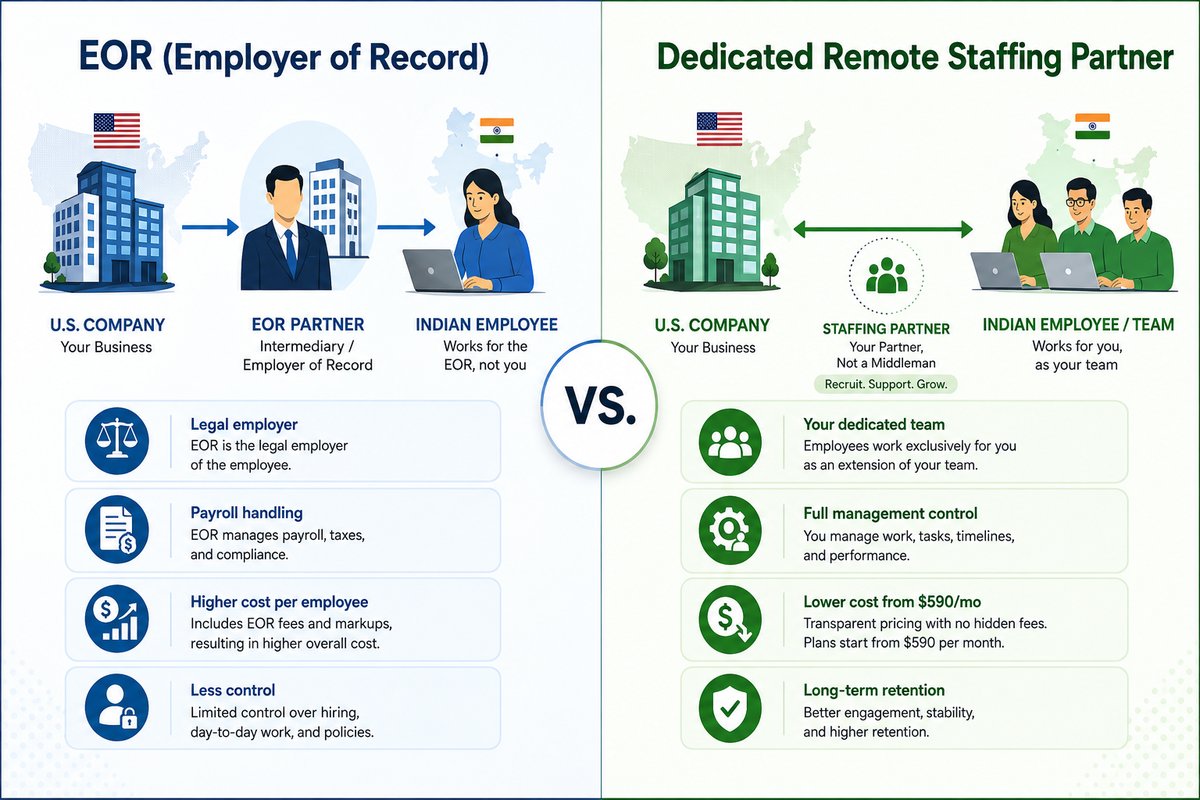
US companies have three primary pathways to bring on Indian talent without establishing a local legal presence. Each has distinct trade-offs in terms of cost, control, compliance coverage, and scalability.
3. Independent Contractor Engagement
Some US companies hire Indian professionals as independent contractors directly. This carries meaningful risk: India's tax authorities and labor courts scrutinize contractor relationships closely, and misclassification — where a contractor functions as a de facto full-time employee — can expose your business to back taxes, penalties, and claims under Indian labor law. Contractor engagement works best for genuinely project-based, time-limited engagements rather than ongoing full-time roles.
EOR vs. Dedicated Remote Staffing: Which Is Right for You?
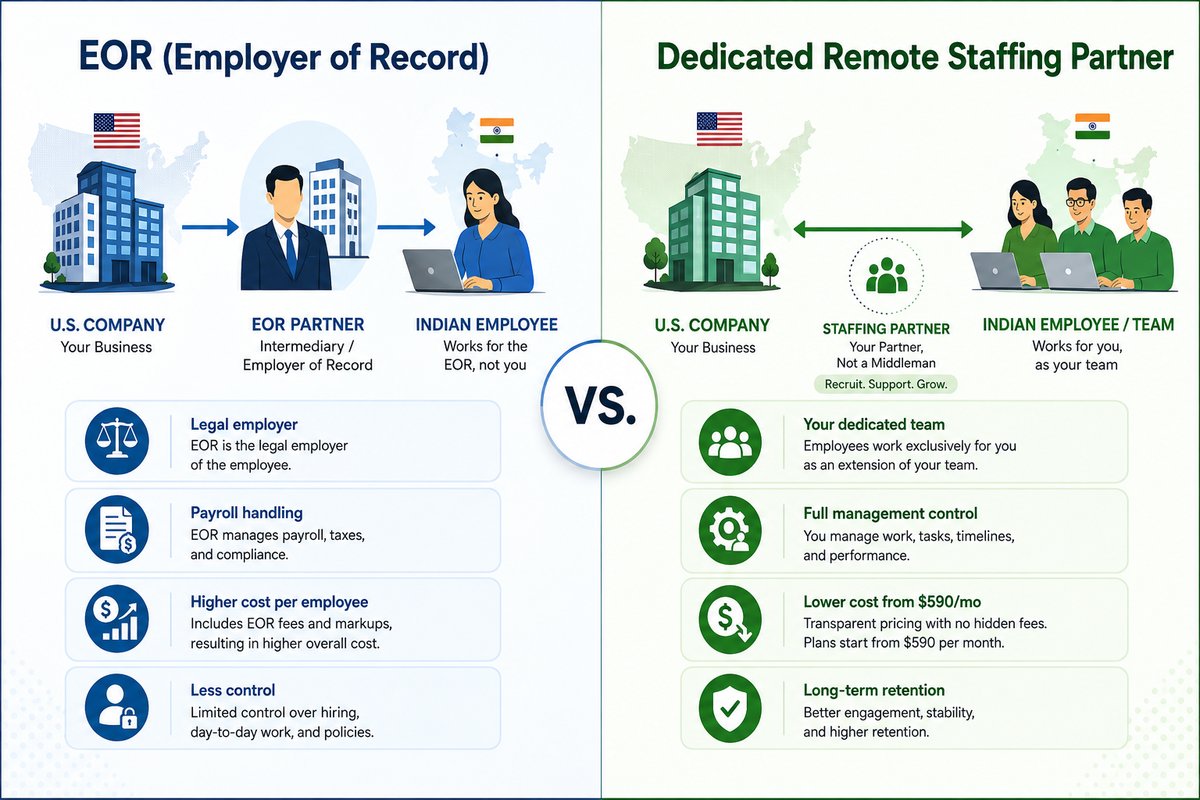
The two most popular entity-free hiring paths for US companies are EOR services and dedicated remote staffing. Here is a practical comparison to help you choose:
- Talent sourcing: EOR platforms are compliance engines — they do not typically source talent for you. Dedicated staffing providers handle end-to-end recruitment, saving you the effort of posting jobs, screening CVs, and conducting initial interviews.
- Control: Both models give you full operational control over the employee's tasks, tools, and schedule. The legal employer differs, but the working relationship is identical from your day-to-day perspective.
- Best fit: EOR is best for companies with strict legal or audit requirements. Dedicated staffing is best for companies prioritizing speed, talent quality, and cost predictability.
Roles You Can Hire From India Without an Entity
One of the most common misconceptions is that entity-free hiring is only viable for generic back-office work. In reality, Indian professionals fill highly technical, strategic, and client-facing roles for US companies every day. Here are the most in-demand categories:
Technology and Development
India's developer talent pool is among the deepest in the world. You can hire developers in India across virtually every stack and specialty:
- React developers for modern front-end applications
- Python developers for data pipelines, automation, and backend APIs
- Node.js developers for scalable server-side applications
- Java developers for enterprise-grade systems
- DevOps engineers for CI/CD, cloud infrastructure, and reliability engineering
- AI/ML engineers for machine learning models and data science initiatives
Design and Creative
If you need visual talent, you can hire designers in India including UI/UX specialists, graphic designers, and product designers who are fluent in Figma, Adobe Creative Suite, and design systems.
Digital Marketing
Indian digital marketing professionals are experienced with Google Ads, Meta Ads, SEO strategy, and content marketing for US audiences. You can hire digital marketing experts or specialists like SEO executives and content writers at a fraction of US agency rates.
Business Operations and Support
- Virtual assistants and executive assistants
- Bookkeepers and accountants familiar with US GAAP and QuickBooks
- Data entry operators for CRM management and database maintenance
- Customer support agents trained for US market communication standards
Step-by-Step: How to Start Hiring Remote Employees in India
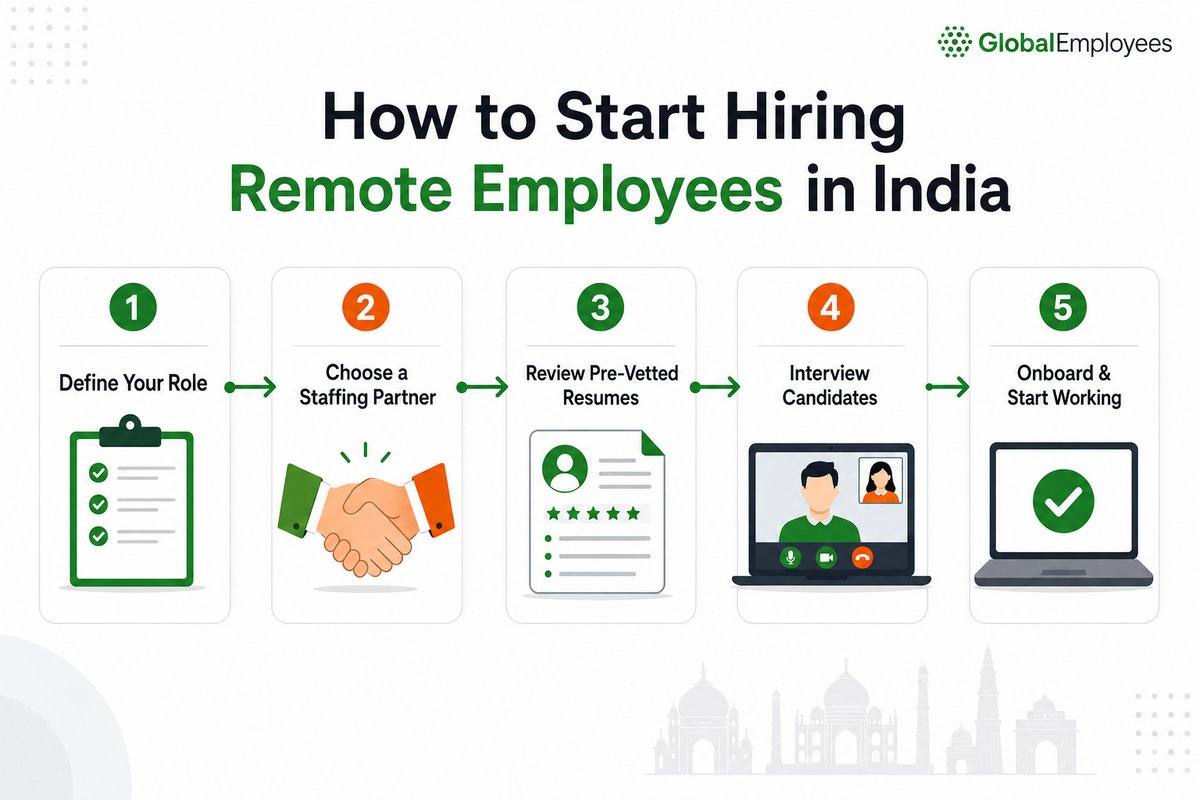
Whether you choose an EOR or a dedicated remote staffing provider, the practical hiring process follows a similar arc. Here is a straightforward roadmap:
- Define the role clearly. Write a detailed job description including required skills, tools, working hours (specify overlap with your time zone), and reporting structure. The more specific you are, the better your shortlist will be.
- Choose your hiring model. Decide between EOR and dedicated staffing based on your compliance needs, timeline, and budget. For most US companies hiring 1–20 people, dedicated remote staffing is faster and more cost-effective.
- Extend an offer and onboard. Your staffing partner handles the employment contract, payroll setup, and statutory compliance. You focus on onboarding the employee into your tools, workflows, and team culture.
- Set up communication rhythms. Establish daily stand-ups, weekly check-ins, and shared project management tools (Slack, Asana, Jira) from day one to maximize productivity and alignment.
- Review and scale. Most companies that hire one remote employee in India quickly scale to teams of five, ten, or more once they experience the quality and cost advantages firsthand.
Compliance and Legal Tips for India Remote Employee Hiring
Even when you are not the legal employer, there are compliance considerations you should be aware of as the directing company. Here are the most important:
Permanent Establishment Risk
If your Indian employees conduct sales, sign contracts, or perform activities that could be construed as core business operations for your company in India, you may inadvertently create a taxable Permanent Establishment (PE) under Indian tax law. Working through a recognized staffing provider significantly reduces this risk because the employment relationship sits with the provider, not with your US entity.
Intellectual Property Protection
Ensure that the employment or services contract includes clear IP assignment clauses specifying that all work product created by the employee is owned by your company. A reputable remote staffing provider will include these provisions as standard.
Data Privacy
India's Digital Personal Data Protection Act (DPDPA), which came into full effect in 2024, imposes obligations on organizations processing Indian citizens' personal data. Ensure your staffing agreements address data handling, storage, and cross-border transfer requirements consistent with both Indian law and any applicable US regulations (CCPA, HIPAA, etc.).
Currency and Payment Compliance
If you are exploring an offshore staffing model or considering staff augmentation to extend your existing team, both approaches can be structured to minimize compliance exposure when executed through an established provider.
Frequently Asked Questions
Can a US company legally hire an employee in India without setting up an entity?
Yes, US companies can legally employ Indian professionals without establishing a local entity by using an Employer of Record (EOR) service or a dedicated remote staffing provider. In both cases, a compliant Indian entity — the EOR or staffing firm — acts as the legal employer, handling payroll, taxes, and statutory benefits under Indian law. You retain full operational control over the employee's work while avoiding the cost and complexity of entity registration. This approach is used by thousands of US businesses ranging from early-stage startups to established mid-market companies.
What roles can I hire from India without setting up a company there?
Virtually any role that can be performed remotely is available through entity-free hiring models in India. Popular categories include software developers (React, Python, Java, Node.js, .NET, PHP), DevOps and cloud engineers, AI/ML engineers, UI/UX and graphic designers, digital marketers, SEO specialists, content writers, accountants, virtual assistants, data entry operators, and customer support agents. India's talent market is broad and deep enough to support both highly technical positions and operational support roles, often at the same provider with consistent quality standards.
Is it safe to share intellectual property and business data with remote employees in India?
Yes, provided you have appropriate contractual protections in place. A reputable remote staffing provider will include IP assignment clauses, confidentiality agreements (NDAs), and data security obligations as standard in the employment contract. You should also implement your own internal security practices — role-based access controls, company-managed devices, and VPN requirements where appropriate. India's IT industry has a long track record of handling sensitive IP for US and European clients, and many Indian professionals are already experienced working under strict confidentiality frameworks.
Do I need to worry about permanent establishment risk when hiring remote employees in India?
Permanent Establishment (PE) risk arises when your Indian employees perform activities that could be interpreted as your company conducting business operations in India — such as signing contracts, soliciting sales, or maintaining a fixed place of business. Working through a dedicated staffing provider substantially mitigates this risk because the legal employment relationship sits with the provider's Indian entity, not your US company. It is still advisable to consult a cross-border tax advisor if your Indian team is large or performs revenue-generating activities, but for most operational and support roles, PE exposure is minimal when using an established staffing model.
How this fits client-managed staffing
GlobalEmployees sources candidates for the requirements your team defines. You interview candidates, decide who to bring onboard, and manage their daily work. We handle payroll and HR administration. This arrangement is designed for companies with the managers and processes to direct their people. It does not transfer project delivery or day-to-day supervision to us.
Define the role around actual responsibilities, the tools the employee will use, and the decisions they can make. Include the reporting line, working arrangements, and how your team will review the work. Discuss the fee and any additional support requirements for your particular brief instead of assuming a fixed package applies to every hire.
If the employee is not the right fit, you can request a replacement during the first two weeks after joining. Raise concerns early with specific examples so that expectations and next steps can be discussed.
Include practical AI requirements
Describe where AI assistance would be useful in this workflow and which tools your organization approves. Ask candidates to demonstrate a relevant task, explain what they verified, and show how they handle an incorrect or incomplete output. Familiarity with a tool should be assessed alongside the underlying professional skills the job requires.
Decide what information may be used with those tools, which outputs require human review, and how work will be documented. GlobalEmployees can source for the AI experience in your brief; your team interviews candidates and evaluates whether their ability meets the requirement. Keep the assessment grounded in your actual work rather than a generic claim of AI expertise.
Questions to resolve before you start
- What outcome does the business need, and what recurring work will the person own?
- Which skills are essential now, and which can be learned after joining?
- Who will interview, select, supervise, and review the employee's work?
- What systems, documentation, and approved AI tools will be available?
- How will you assess quality and discuss concerns during the first two weeks?
Use these answers to align the people involved in hiring. A clear brief makes the search and interviews more focused, and it gives the employee a practical starting point after joining.
Tell us about your hiring requirements or explore dedicated IT and non-IT roles.
Need to hire dedicated remote talent?
Tell us the role, experience, and AI skills your team needs.
Hire Talent Now