

Staff Augmentation: What It Is and How It Works
Staff Augmentation: What It Is and How It Works
You need a developer, a designer, or an extra pair of hands on a project, but hiring full-time feels slow, expensive, or premature. This is exactly the gap staff augmentation fills. It's a staffing model where you bring in outside talent to work alongside your existing team, under your direction, without the overhead of a traditional hire.
So what is staff augmentation, exactly? It means adding skilled professionals from an outside provider to your team on a temporary or ongoing basis, while you keep full control over their day-to-day work. The provider handles recruitment, payroll, and compliance; you handle the actual management and output. It's different from a typical staff augmentation contract with a freelancer or a project-based agency, because these workers function like dedicated team members, not one-off contractors — a distinction we unpack in hiring a freelancer vs. a dedicated remote developer.
In this article, we'll break down the staff augmentation meaning in plain terms, walk through how the model actually works day to day, and cover the real benefits of staff augmentation for businesses trying to fill skill gaps or scale up fast without long-term commitments.
Why businesses turn to staff augmentation
Most companies don't turn to staff augmentation because it sounds appealing on paper. They turn to it because they're stuck: a project is stalling, a role has been open for months, or the workload has outgrown the team that's supposed to handle it. The staff augmentation service model exists to solve those problems quickly, without forcing a company into a full-time hire it isn't ready to make, and there's no shortage of staff augmentation companies in the USA built around exactly that.
Filling skill gaps without a long search
Hiring a specialized developer or designer locally can take eight to twelve weeks between sourcing, interviewing, and onboarding. That timeline doesn't work when a client deadline is three weeks out. With staff augmentation, you're picking from a pool of pre-vetted candidates who can start within days, not months. This matters most for niche skills, think a specific framework, a compliance-heavy design process, or a QA specialty, where your internal team simply doesn't have the bandwidth or expertise to cover the work.
Cutting the cost of hiring and infrastructure
A full-time hire in the US or Europe comes with salary, benefits, office space, equipment, and HR overhead before they've written a line of code, which is why the true cost of an in-house hire versus a remote dedicated team rarely matches the salary figure alone. Staff augmentation strips most of that away. The provider handles payroll, laptops, software licenses, and compliance, so you're paying for the work itself rather than the machinery around it. Businesses working with GlobalEmployees, for example, bring on dedicated professionals starting from $1,090 a month, with zero setup or infrastructure costs on their end.
Staff augmentation lets you pay for output, not overhead.
Scaling up or down without long-term risk
Business needs shift, and a six-person team you need this quarter might not be necessary next quarter. Traditional hiring locks you into severance costs, notice periods, and legal complications when headcount needs change. Augmented staff can be added or released with short notice, since there's no long-term contract binding you to headcount you no longer need. This flexibility is why the model appeals to both startups testing a new product line and established companies managing seasonal or project-based demand.
Understanding what staff augmentation is in practice, not just in theory, comes down to these three pressures: speed, cost, and flexibility. Every business that adopts the model is usually solving for at least one of them.
How the staff augmentation process works
Getting started with a staff augmentation service follows a fairly predictable sequence, whether you're hiring one developer or building a five-person team. The process is designed to move fast: our step-by-step hiring process gets most clients interviewing candidates within a week of the first call, and onboarding within days after that.
From request to onboarding
Here's what the typical path looks like:
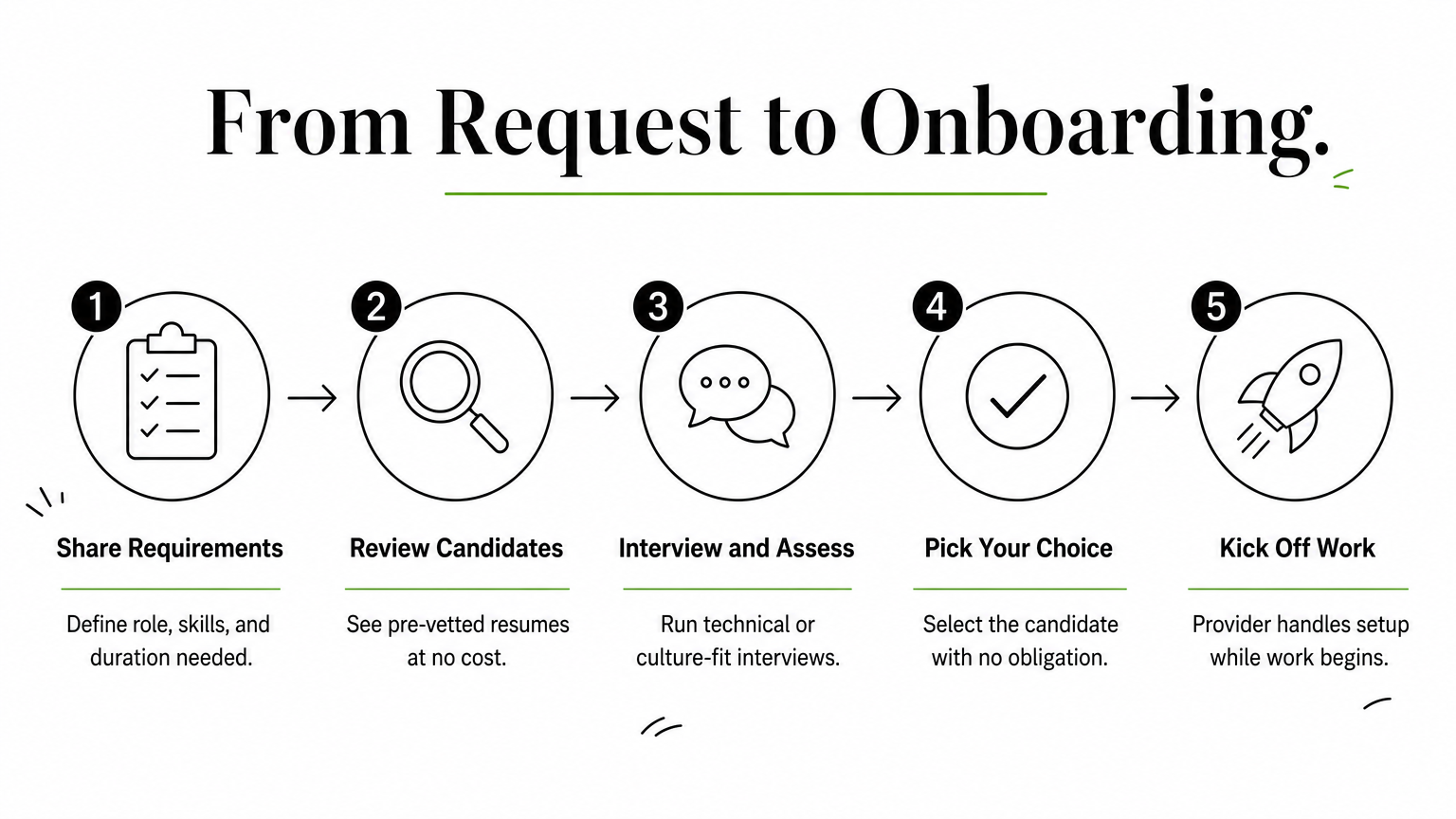
- Share your requirements: role, skills, seniority, and how long you expect to need the person
- Review pre-vetted candidates: often with sample resumes provided free before you commit to anything
- Interview and assess: you run technical or culture-fit interviews just like you would for an in-house hire
- Pick your choice: select the candidate who fits, with no obligation until this point
- Kick off work: the provider handles contracts, payroll, and equipment while you start assigning tasks
The whole process is built so you're only paying once you've found the right fit.
What happens after you sign
Once a candidate is placed, they typically join your existing tools, Slack, Jira, Zoom, whatever you already run, and report directly to your team leads. The staffing provider stays in the background handling HR, compliance, and infrastructure, but doesn't manage the day-to-day work itself. If the fit isn't right, most staff augmentation services, including GlobalEmployees, offer a quick replacement or money-back guarantee rather than locking you into a bad match for months.
Staff augmentation vs. outsourcing and other models
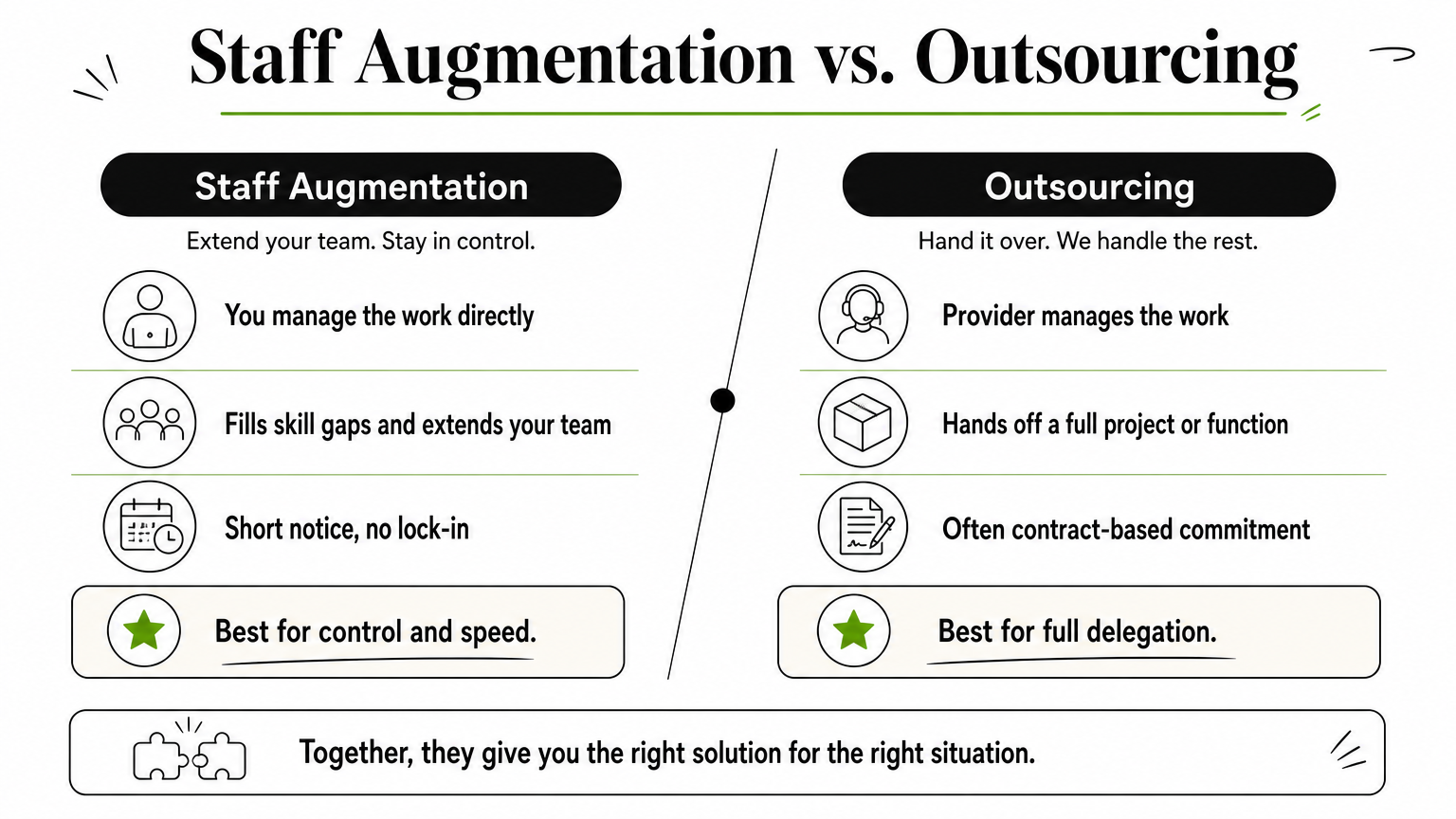
Confusion between staff augmentation and traditional outsourcing is common, and it costs businesses money when they pick the wrong model. Outsourcing hands an entire project or function to an outside company, which manages both the people and the process. Staff augmentation only supplies the people; you keep control of the work itself, and the key differences between staff augmentation and outsourcing are worth reading before you commit either way. That distinction matters if you need day-to-day oversight over quality, deadlines, or how tasks get prioritized.
Comparing the common models
Businesses often lump staff augmentation, outsourcing, freelancing, and managed teams together, but each business model fits a different project scope, budget, and management style.
| Model | Who manages the work | Best for | Commitment |
|---|---|---|---|
| Staff augmentation | You | Filling skill gaps, extending your team | Short notice, no lock-in |
| Outsourcing | Provider | Handing off a full project or function | Often contract-based |
| Freelancing | Freelancer | One-off tasks, small scope | Project by project |
| Managed dedicated team | Shared | Long-term product builds | Ongoing, flexible |
If you want to keep control over how the work gets done, staff augmentation fits better than handing the whole job to an outside vendor.
Why the distinction matters for your budget
Outsourcing bakes management overhead into its pricing, since the vendor is running the show. Augmentation staff cost less precisely because you're only paying for their time and skill, not a management layer on top. If your team already knows how to direct the work, augmentation gets you there faster and cheaper.
Types of staff augmentation and when to use each
Not every staffing gap looks the same, and staff augmentation covers a few distinct patterns depending on how long you need help and how specialized the work is. Most businesses fall into one of three buckets: short-term skill fills, long-term team extensions, or project-based sprints. Knowing which one you need before you start looking prevents you from paying for more commitment than the situation calls for.
Short-term and skill-specific augmentation
This is the classic case for staff augmentation IT work: a single developer with a niche skill, brought on for weeks or a few months to close a gap your internal team can't cover. Think a security audit, a one-time migration, or a burst of QA testing before launch. You're not building a career role here, you're solving an immediate bottleneck.
Long-term team extension
Some roles stay open indefinitely because the workload never really goes away. A dedicated marketing coordinator or backend developer who joins your team for a year or more, reporting to your managers daily, falls into this category. It functions almost like a full hire, minus the payroll and compliance burden.
The right type of augmentation staff depends on whether your gap is temporary or structural.
Project-based augmentation
Here, a small group joins for the life of a specific build, then rolls off once it ships, useful when you need several skill sets at once without permanent headcount.
What to expect in a staff augmentation contract
A solid staff augmentation contract spells out exactly what you're paying for and what happens if things go wrong. Unlike a full-time offer letter, it won't cover benefits or severance, since the provider is the legal employer. Instead, it focuses on scope, rates, duration, and the terms that let you walk away without penalty if the arrangement isn't working.
Key terms to look for
Before signing anything, check the contract covers these basics:
- Scope and role: exact skills, seniority, and responsibilities expected
- Duration and notice period: how long the engagement runs and how much notice either side needs to end it
- Rate and billing cycle: monthly or hourly cost, and when invoices go out
- Replacement or refund terms: what happens if the person isn't a fit
- Confidentiality and data security: NDAs, VPN use, and device management
- IP ownership: confirmation that any code, designs, or content belongs to your company
A good contract protects you from lock-in just as much as it protects the provider from risk.
Why flexibility matters most
Watch for contracts that quietly slip in long-term commitments or steep termination fees, since that defeats the purpose of the model. Providers like GlobalEmployees skip long-term contracts entirely, offering short-notice scaling along with a money-back guarantee or quick replacement if the placement doesn't work out. Reviewing these terms upfront, rather than after a bad hire, is what keeps the arrangement genuinely low-risk.
Deciding if staff augmentation is right for your team
Staff augmentation makes sense the moment you can name the gap: a role you can't fill fast enough, a skill your team doesn't have, or a workload that's outgrown your headcount. It doesn't make sense if you need someone to own an entire project end to end without your oversight, that's outsourcing territory. The definition of staff augmentation boils down to control plus speed: you direct the work, someone else handles the recruiting, payroll, and compliance, and you scale without long-term risk.
If that fits what you're dealing with right now, the next step is simple. Skip the eight-week hiring cycle and look at candidates who are ready to start this week. Look at pre-vetted, full-time professionals from $1,090 a month, get matched resumes in 48 hours, and see how quickly a real skill gap gets closed, with no cost until you actually pick someone.
Need to hire dedicated remote talent?
Tell us the role, experience, and AI skills your team needs.
Hire Talent Now