

Staff Augmentation vs Hiring Full-Time Remote Employees: Which Model Works Best?
This guide explores staff Augmentation vs Hiring Full-Time Remote Employees: Which Model Works Best. Use it to clarify the work your team needs, the skills to assess, and the management arrangements that will support the hire.
Table of Contents
- What Is Staff Augmentation?
- What Is Dedicated Remote Staffing?
- Key Differences: Staff Augmentation vs Full-Time Remote
- When to Use Staff Augmentation
- When to Hire Full-Time Remote Employees
- Cost Comparison: Which Is More Affordable?
- Frequently Asked Questions
What Is Staff Augmentation?
Staff augmentation is a flexible outsourcing model where you bring in external professionals to supplement your existing in-house team for a specific project or timeframe. These professionals work alongside your permanent staff, often remotely or on-site, and are managed by your organization. The service provider handles payroll, benefits, and administrative burdens, while you retain full control over the day-to-day tasks and deliverables.
For example, if your in-house development team lacks a specialized React developer for a six-month project, you can augment your team with a vetted React expert. The augmentation provider sources, screens, and provides the talent, but your project manager directs their work. This model is particularly popular in IT, where skill gaps are common and project timelines are tight.
Staff augmentation services typically operate on an hourly or monthly billing basis, with rates varying based on skill level and location. It’s a quick way to scale up without the long-term commitment of a permanent hire. However, because these professionals are not your employees, they may have limited loyalty and may leave once the contract ends, which can disrupt knowledge continuity.
Key characteristics of staff augmentation include:
- Short-term or project-based engagement
- You manage the augmented staff directly
- Provider handles HR and payroll
- Often billed hourly or monthly
- Ideal for filling specific skill gaps
In summary, staff augmentation is like renting a specialist for a specific job. It gives you immediate access to expertise without the overhead of a permanent hire, but it requires active management and may not be ideal for long-term, ongoing needs.
What Is Dedicated Remote Staffing?
With dedicated remote staffing, you get a vetted professional who works 40 hours per week (or your required hours) and is committed to your long-term goals. The provider handles recruitment, payroll, benefits, and HR compliance, while you manage the employee’s daily tasks and performance. This model is ideal for ongoing needs, such as building a permanent software development team or hiring a virtual assistant for continuous support.
Advantages of dedicated remote staffing include:
- Full-time commitment and exclusivity
- Deeper integration into your team and processes
- Provider manages payroll, taxes, and compliance
- Scalable as your business grows
In essence, dedicated remote staffing is like hiring a remote employee, but with the administrative heavy lifting handled by a partner. It offers the best of both worlds: the commitment of a full-time hire and the flexibility of outsourcing.
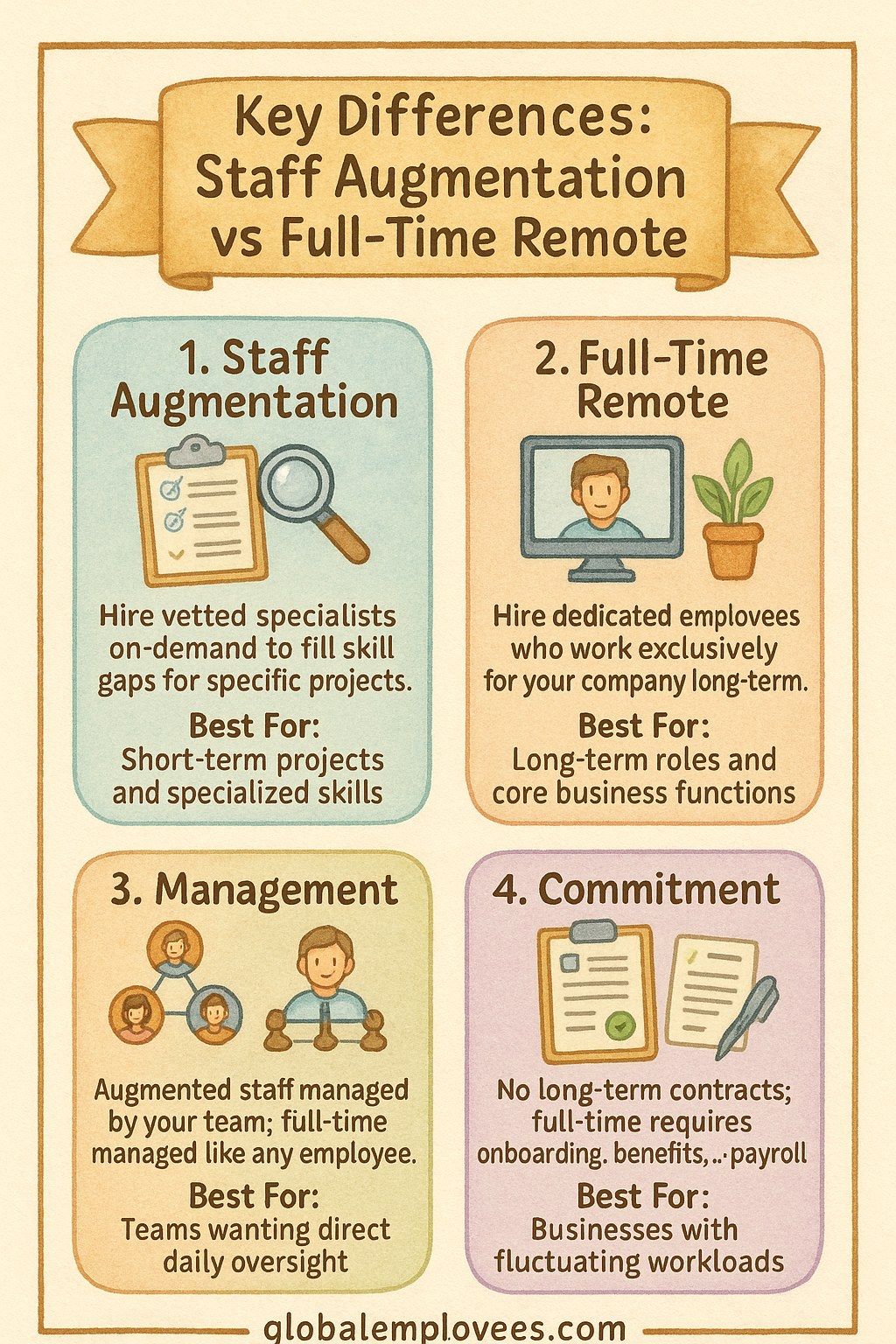
Key Differences: Staff Augmentation vs Full-Time Remote
To make an informed decision, it’s crucial to understand the fundamental differences between staff augmentation and dedicated remote staffing. These differences span engagement duration, level of control, cost structure, and team integration.
Engagement Duration: Staff augmentation is typically short-term, ranging from a few weeks to a few months, and is tied to a specific project. Dedicated remote staffing is a long-term arrangement, often ongoing, with the employee working full-time for your company indefinitely.
Control and Management: In staff augmentation, you manage the augmented staff directly, but they may also have their own reporting lines. With dedicated remote staffing, you have full managerial control over the employee’s tasks, priorities, and performance—just like a regular employee.
Team Integration: Augmented staff are often seen as external contractors, even if they work alongside your team. Dedicated remote employees are fully integrated, participating in meetings, using your tools, and building relationships with colleagues.
Here’s a quick comparison:
- Staff Augmentation: Short-term, hourly billing, external contractors, limited integration.
- Dedicated Remote Staffing: Long-term, monthly billing, full-time employees, deep integration.
Ultimately, the choice depends on your project’s duration, your need for control, and your budget. If you need a specialist for a finite project, staff augmentation is ideal. If you need ongoing support and want to build a dedicated team, full-time remote employees are the better investment.
When to Use Staff Augmentation
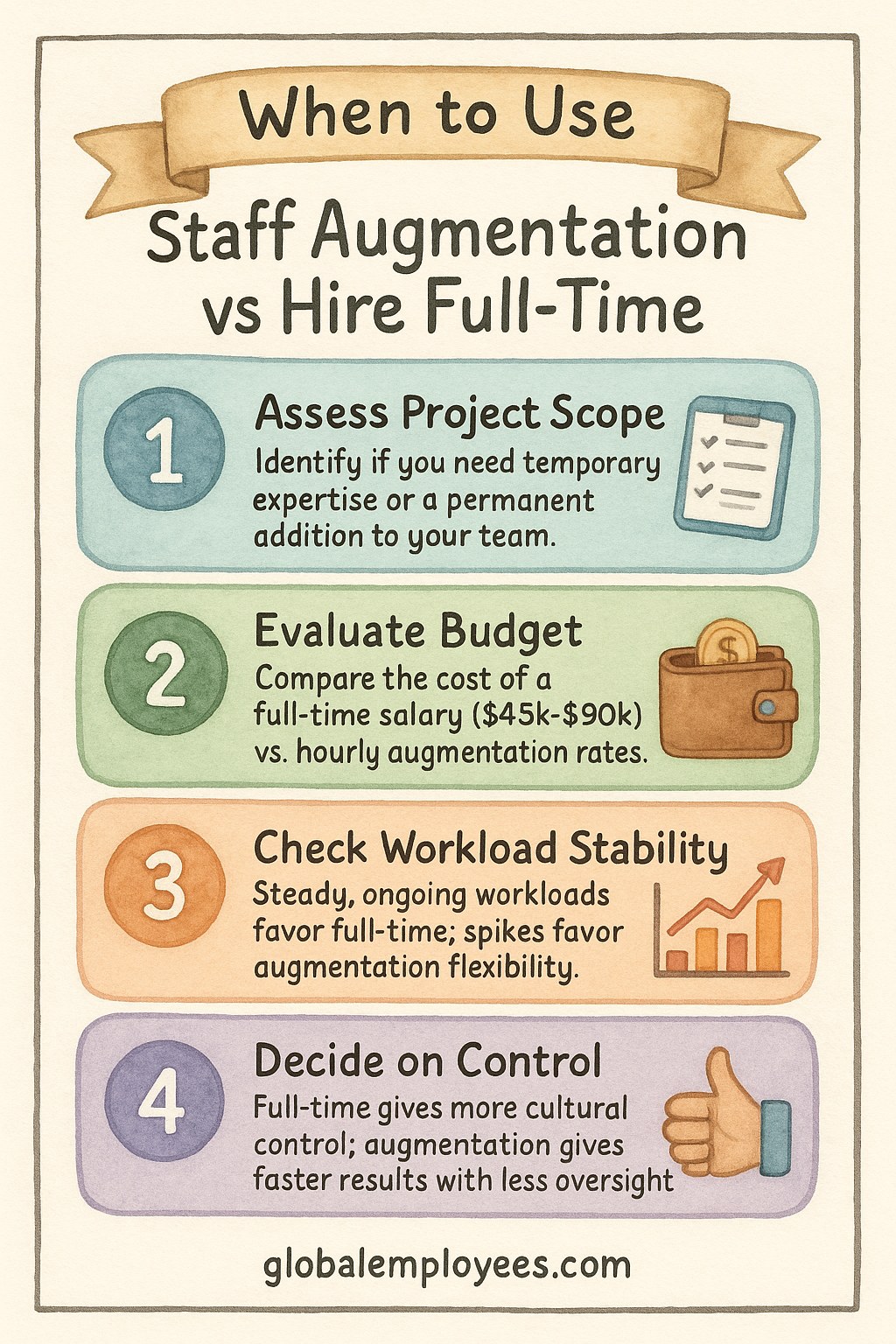
Staff augmentation is the perfect solution for specific scenarios where you need immediate expertise without long-term commitment. Here are common situations where IT staff augmentation makes sense:
1. Short-Term Projects with Clear Scope
If you have a project with a defined start and end date—like migrating to a new platform or launching a mobile app—staff augmentation allows you to bring in specialists for the duration. You don’t have to worry about long-term payroll or benefits, and you can let them go once the project is complete.
2. Filling a Temporary Skill Gap
Maybe your in-house team lacks a specific skill, such as Salesforce development or DevOps expertise. You can augment your team with a specialist who has that exact skill set, without having to train existing employees or hire a permanent employee who may not be needed later.
3. Meeting Tight Deadlines
When deadlines are looming, staff augmentation services can quickly provide additional hands. For instance, if you need to double your QA team for a release, you can augment with experienced QA testers within days, not weeks.
4. Trial Run Before Full-Time Hire
Staff augmentation can serve as a trial period. You can evaluate a professional’s performance and cultural fit before deciding to offer them a full-time dedicated role. This reduces hiring risk significantly.
However, staff augmentation has its downsides. Since these professionals are not committed long-term, they may not fully embrace your company culture. Additionally, hourly billing can lead to cost overruns if the project scope expands. If you find yourself repeatedly augmenting for the same skills, it may be more cost-effective to hire a dedicated remote employee.
When to Hire Full-Time Remote Employees
Dedicated remote staffing is the better choice when you have ongoing needs that require a committed, integrated team member. Here are scenarios where hiring full-time remote employees is the optimal strategy:
1. Long-Term, Recurring Work
If you need continuous support—like a customer support agent, a content writer, or a software developer for your core product—a full-time remote employee is more cost-effective and reliable than repeatedly hiring contractors. They become a valuable asset who understands your business deeply.
2. Building a Dedicated Team
When you want to build a dedicated offshore team to scale your operations, hiring full-time remote employees is the way to go. You can hire a team of developers, designers, and marketers who work exclusively for you, creating a cohesive unit that grows with your company.
3. Need for Deep Integration and Culture
If you value team cohesion and want employees who are invested in your company’s success, full-time remote employees are more likely to adopt your culture and align with your goals. They participate in team-building activities, attend virtual meetings, and feel a sense of belonging.
4. Predictable Budgeting
In addition, full-time remote employees often have higher productivity and lower turnover compared to contractors. They are more committed to your long-term success, which translates to better quality work and fewer disruptions.
If your needs are ongoing and you want a reliable, dedicated professional, hiring a full-time remote employee is the superior choice.
Cost Comparison: Which Is More Affordable?
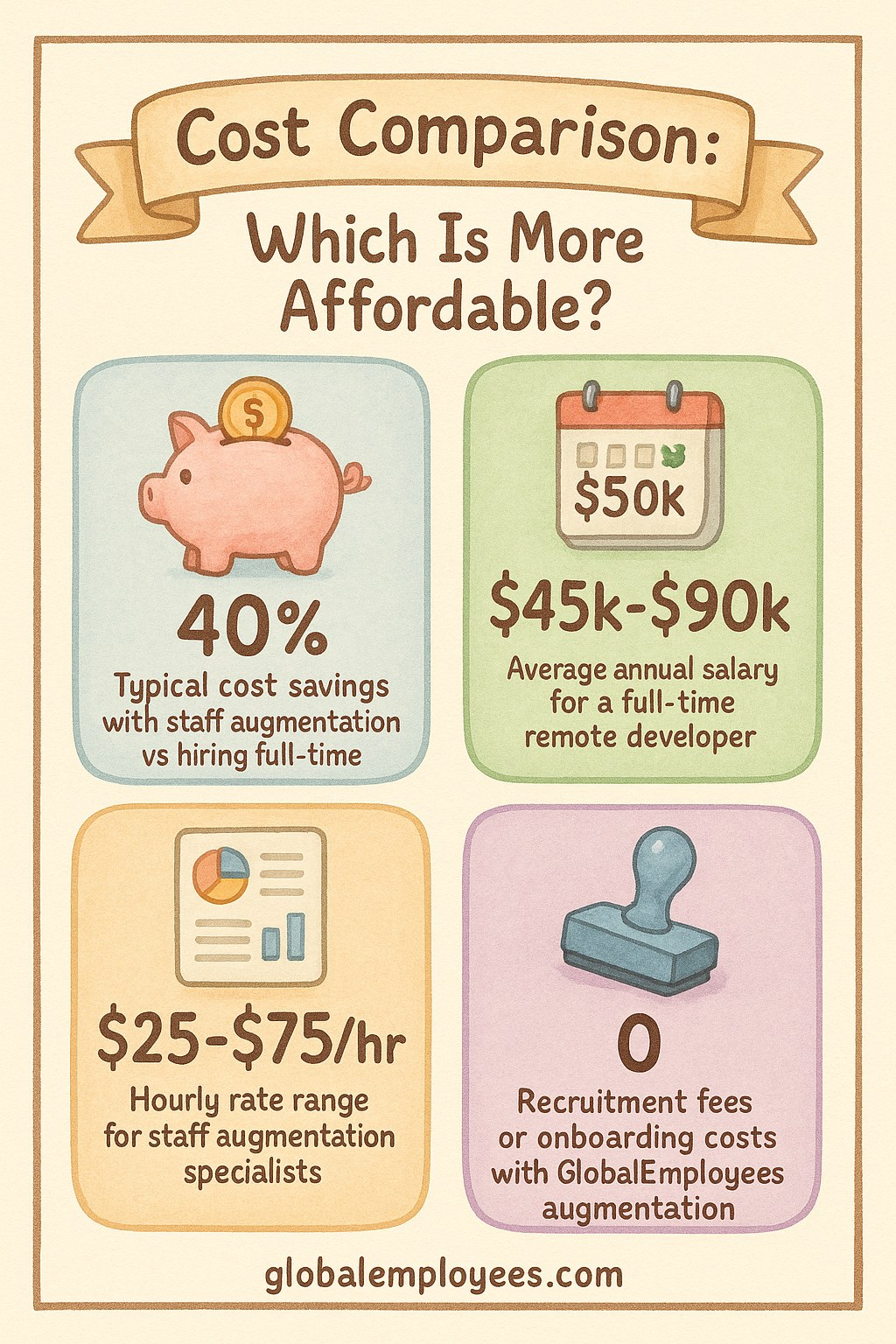
Cost is often the deciding factor when choosing between staff augmentation and hiring full-time remote employees. Let’s break down the financial implications of both models.
Long-Term Value
Moreover, dedicated remote employees are more productive because they are committed to your company. They don’t have the “contractor mentality” and are more likely to go the extra mile. This increased productivity further enhances the cost-effectiveness of the dedicated remote model.
In summary, if you need a professional for more than a few months, dedicated remote staffing is significantly more affordable and predictable. For short-term, specialized needs, staff augmentation might be cheaper, but for long-term value, dedicated remote wins.
Frequently Asked Questions
What is the difference between staff augmentation and dedicated remote staffing?
Staff augmentation is a short-term, project-based arrangement where you hire external professionals to fill skill gaps, often billed hourly. Dedicated remote staffing involves hiring a full-time remote employee through a provider, who works exclusively for you on a monthly fee basis, offering deeper integration and long-term commitment.
What roles are best suited for dedicated remote staffing?
Dedicated remote staffing works well for roles that require ongoing support, such as software developers, virtual assistants, digital marketers, customer support agents, and data entry operators. It’s ideal for building a dedicated team that works exclusively for your business.
How this fits client-managed staffing
GlobalEmployees sources candidates for the requirements your team defines. You interview candidates, decide who to bring onboard, and manage their daily work. We handle payroll and HR administration. This arrangement is designed for companies with the managers and processes to direct their people. It does not transfer project delivery or day-to-day supervision to us.
Define the role around actual responsibilities, the tools the employee will use, and the decisions they can make. Include the reporting line, working arrangements, and how your team will review the work. Discuss the fee and any additional support requirements for your particular brief instead of assuming a fixed package applies to every hire.
If the employee is not the right fit, you can request a replacement during the first two weeks after joining. Raise concerns early with specific examples so that expectations and next steps can be discussed.
Include practical AI requirements
Describe where AI assistance would be useful in this workflow and which tools your organization approves. Ask candidates to demonstrate a relevant task, explain what they verified, and show how they handle an incorrect or incomplete output. Familiarity with a tool should be assessed alongside the underlying professional skills the job requires.
Decide what information may be used with those tools, which outputs require human review, and how work will be documented. GlobalEmployees can source for the AI experience in your brief; your team interviews candidates and evaluates whether their ability meets the requirement. Keep the assessment grounded in your actual work rather than a generic claim of AI expertise.
Questions to resolve before you start
- What outcome does the business need, and what recurring work will the person own?
- Which skills are essential now, and which can be learned after joining?
- Who will interview, select, supervise, and review the employee's work?
- What systems, documentation, and approved AI tools will be available?
- How will you assess quality and discuss concerns during the first two weeks?
Use these answers to align the people involved in hiring. A clear brief makes the search and interviews more focused, and it gives the employee a practical starting point after joining.
Tell us about your hiring requirements or explore dedicated IT and non-IT roles.
Need to hire dedicated remote talent?
Tell us the role, experience, and AI skills your team needs.
Hire Talent Now