

Software Development Staff Augmentation: What It Is and How It Works
Software Development Staff Augmentation: What It Is and How It Works
Your product roadmap is full, but your engineering team isn't big enough to ship it. Hiring locally takes months and costs a small fortune once you add recruiting fees, benefits, and equipment. That gap is exactly why so many founders and CTOs start looking into software development staff augmentation.
At its core, software staff augmentation means adding dedicated developers to your existing team without putting them on your own payroll. A staffing partner recruits, vets, and employs the developer directly, while you manage their day-to-day work like any other team member. You get the skill set you need, whether that's a React developer or a DevOps engineer, without the overhead of a full-time hire or the unpredictability of hiring a freelancer instead of a dedicated developer on a marketplace.
This article breaks down exactly how developer staff augmentation works, from sourcing candidates to onboarding them into your workflow, and what separates a reliable provider from a risky one. We'll also cover pricing, contract structures, and the questions worth asking before you commit, so you can decide if this model fits how your team actually builds software.
Why software development staff augmentation matters
Software teams are stretched thinner than ever, and the traditional hiring pipeline just can't keep pace with how fast product requirements change. When you're competing for the same senior engineers as every other company in your city, local hiring stops being a strategy and starts being a bottleneck. That's the practical reason software development staff augmentation has moved from a niche workaround to a mainstream part of how growing companies build software.
The hidden cost of local hiring
Budgeting for a new hire rarely stops at salary. Once you add recruiting fees, background checks, benefits packages, payroll taxes, and the laptop and software licenses you hand over on day one, a single mid-level developer in the US can cost $130,000 or more per year before they've written a line of production code. Then there's the time cost: the average tech hire in the US takes somewhere between 6 and 8 weeks from job posting to signed offer, according to data cited by the U.S. Bureau of Labor Statistics on hiring timelines in skilled occupations, and that's before onboarding even starts. Staff augmentation sidesteps most of that math because the augmentation partner already employs, insures, and equips the developer.

| Factor | Traditional In-House Hire (US) | Staff Augmentation (India) |
|---|---|---|
| Time to productive work | 8-12 weeks | 1-3 weeks |
| Recruiting/HR overhead | Paid by you | Absorbed by provider |
| Equipment and software | Paid by you | Provided by provider |
| Annual cost (mid-level developer) | $110,000-$150,000+ | $13,000-$25,000 |
| Contract flexibility | Difficult to reverse | Scale up/down with notice |
Those numbers explain why founders who are watching runway closely gravitate toward this model. It's not that in-house talent isn't valuable, it's that the fully loaded cost of building a team from scratch locally often doesn't match the pace at which a startup or growing business needs to ship.
Staff augmentation exists because hiring locally is slow and expensive, and most product roadmaps can't wait for either.
The speed advantage when deadlines won't move
Getting a developer into a sprint fast matters more than most hiring plans admit. With developer staff augmentation, you're not writing a job description, screening a stack of resumes, and running four rounds of interviews before you even know if a candidate can do the job. A staffing partner like GlobalEmployees maintains a pool of pre-vetted candidates, so you can review sample resumes, interview a shortlist, and have someone working inside your codebase within a couple of weeks. Compare that to the average enterprise hiring cycle, and it's easy to see why teams facing a hard launch date or a client deadline choose augmentation over posting another job listing.
Flexibility to scale without long-term risk
Product demand rarely moves in a straight line. You might need three extra backend developers for a six-month migration project, then only one for ongoing maintenance afterward. Committing to full-time local hires for that kind of fluctuation means either overstaffing during slow periods or scrambling to hire again when demand spikes. Staff augmentation lets you add or release developers with short notice instead of locking yourself into severance packages and long notice periods. GlobalEmployees structures its staffing model specifically around this kind of flexibility, with no long-term contracts required, so you can size your team to match your actual workload rather than a headcount plan you made six months ago.
Reducing the risk of a bad hire
Every hiring manager has a story about a hire that looked great on paper and fell apart in the first ninety days. Replacing that person means restarting the entire recruiting cycle, plus the sunk cost of salary, onboarding time, and lost project momentum. Reputable staff augmentation providers absorb much of that risk for you. Because the developer stays on the provider's payroll, a poor fit usually means a fast, no-cost replacement rather than a formal termination process. GlobalEmployees backs this with a money-back guarantee, which shifts the financial risk of a mismatch away from your business.
Why this matters beyond cost
Beyond dollars and timelines, staff augmentation gives smaller teams access to specialized skills they couldn't justify hiring full-time. A three-person startup doesn't need a full-time DevOps engineer forever, but it might need one intensely for a month during infrastructure migration. Augmentation makes that kind of targeted expertise accessible without distorting your org chart or your budget. For founders and CTOs juggling a growing backlog and a lean team, that access to on-demand, vetted talent is often the difference between shipping on schedule and quietly slipping every deadline on the roadmap.
How software development staff augmentation works
Most people picture staff augmentation as something abstract, but the actual process is closer to a structured hiring pipeline that someone else runs for you. You describe the role, a provider sources and vets candidates against that role, you interview the remote shortlist, and the developer you pick joins your team while staying employed by the provider. Understanding each step helps you spot a provider who does this well versus one who's just reselling resumes.
The typical process, step by step
Every reputable software development staff augmentation provider follows some version of this step-by-step hiring sequence, though the details vary:
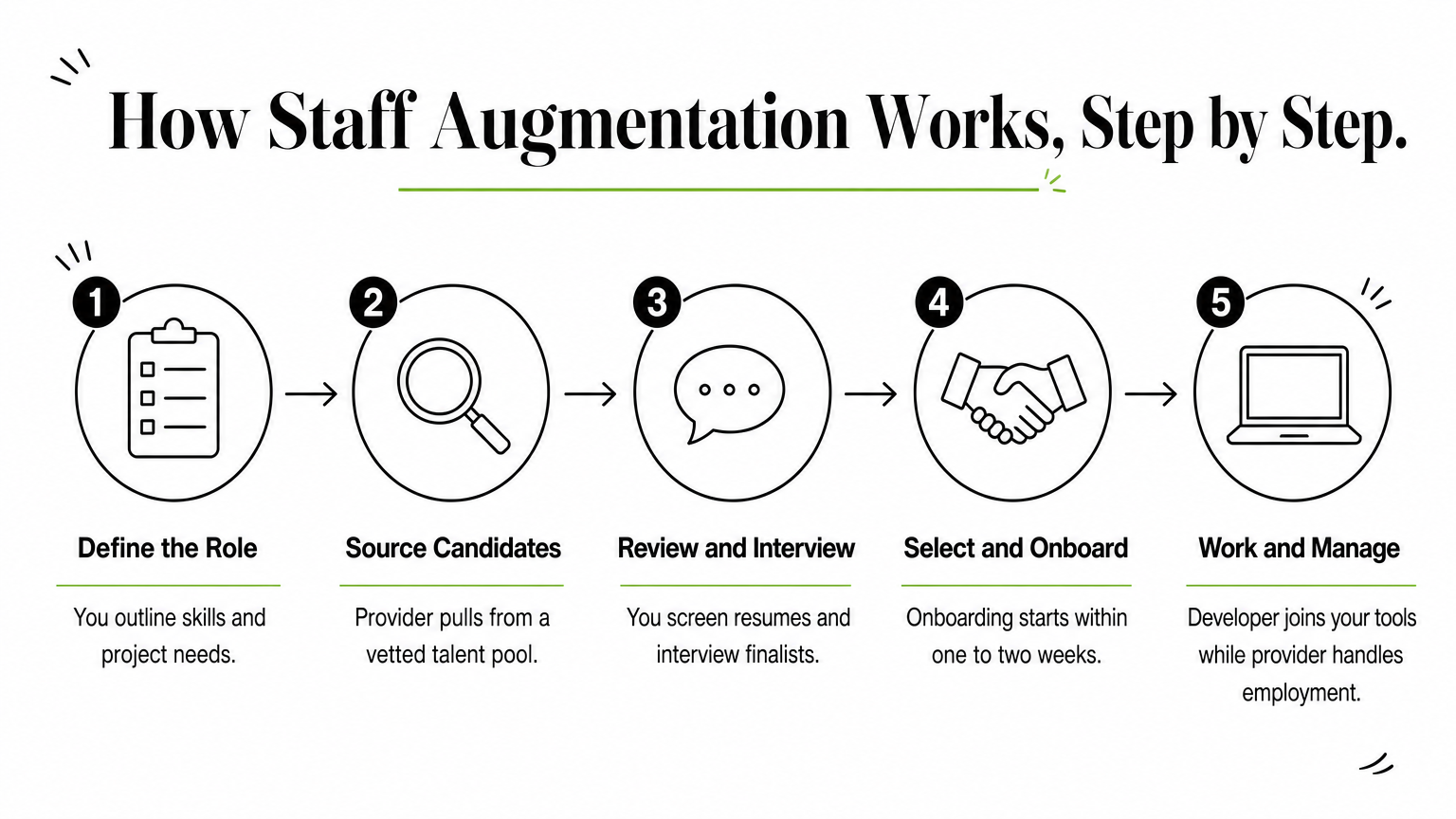
- Define the role. You outline the skills, seniority, and project context you need, whether that's a Django backend developer or a QA automation engineer.
- Provider sources candidates. The partner pulls from its existing vetted pool or actively recruits for the specific stack you named.
- You review resumes and interview. GlobalEmployees, for example, gives clients free access to sample and vetted resumes before any commitment, so you're not paying to see if candidates even exist.
- You select and kick off. Once you pick a candidate, onboarding starts, typically within one to two weeks.
- The developer works inside your systems. They join your Slack, your sprint board, and your codebase, reporting to your team lead like any other engineer.
- The provider handles employment logistics. Payroll, benefits, compliance, and equipment stay on their side, not yours.
The provider handles who's on payroll; you handle what gets built.
Who actually manages the work
Once a developer is placed, day-to-day management is yours, not the provider's. You assign tickets, run standups, do code review, and set deadlines exactly as you would with an in-house hire, which makes managing a remote employee through the first 90 days your responsibility, not theirs. This distinction matters because it's what separates developer staff augmentation from project-based outsourcing, where a vendor manages the work and hands you finished deliverables. With augmentation, the person is embedded in your process, using your tools, following your definition of done. The provider's role shrinks to employment administration and, when needed, quick replacement if a hire isn't a fit.
Where infrastructure and security fit in
Before a developer touches your codebase, a serious provider has already handled the groundwork most companies forget to ask about. Equipment gets shipped or provisioned, VPN access gets configured, and NDAs get signed on both the individual and company level. GlobalEmployees builds this into its onboarding, including secured laptops and limited-access setups, so you're not troubleshooting IT logistics for someone working eight time zones away. Compliance paperwork, tax withholding, and local labor law all sit with the provider too, which is one of the practical reasons companies choose this model over trying to set up a foreign legal entity when they can hire in India without an entity just to bring on one or two developers.
Contract structure and flexibility
Contracts in this model tend to look different from a typical staffing agency arrangement. Rather than locking you into a fixed multi-year term, most staff augmentation agreements run month-to-month or on short renewal cycles, letting you add developers when a project ramps up and release them when it winds down. GlobalEmployees specifically avoids long-term contracts, which means you're not stuck paying for a team sized for last quarter's roadmap. Payment usually runs as a flat monthly rate per developer rather than hourly billing, which makes budgeting predictable even as project scope shifts. That predictability, combined with the ability to scale a team up or down on short notice, is what makes staff augmentation feel less like outsourcing and more like an extension of your own hiring function, just without the paperwork.
Staff augmentation vs outsourcing vs in-house hiring
Founders often use "staff augmentation" and "outsourcing" interchangeably, and that mix-up causes real problems once contracts are signed and expectations don't match reality, so it helps to know the key differences between these staffing models first. All three models, staff augmentation, project outsourcing, and in-house hiring, get you developers, but they hand you very different levels of control, cost, and day-to-day involvement. Knowing which one you're actually buying matters before you commit budget to it.
Staff augmentation vs project-based outsourcing
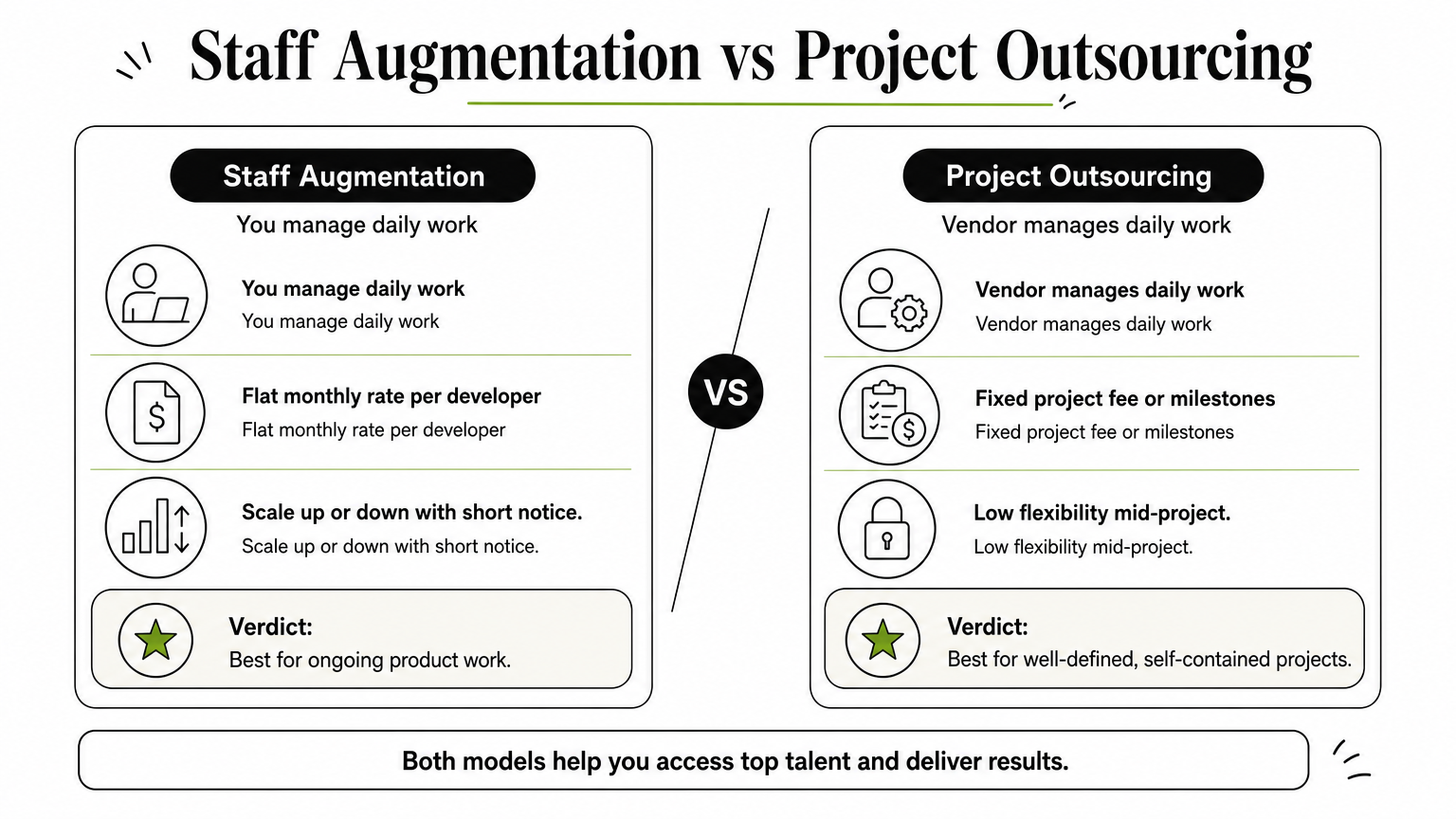
Project outsourcing means handing a defined scope of work to a vendor and waiting for a finished deliverable. The vendor's project manager assigns tasks, sets internal deadlines, and decides who works on what, while you mostly see status updates and final output. Software development staff augmentation flips that arrangement: the developer joins your team directly, sits in your standups, and takes direction from your lead, not the provider's. That difference shows up fastest when priorities shift mid-project. With outsourcing, a scope change usually means a change order and a renegotiated timeline. With augmentation, you just reassign the developer's next ticket, because you're managing the work, not the vendor.
Outsourcing hands you a finished product; staff augmentation hands you a teammate.
Staff augmentation vs in-house hiring
Building an in-house team gives you the tightest control over culture, institutional knowledge, and long-term continuity, but it comes with the slowest ramp and the highest fixed cost. Every local hire means running a full recruiting cycle, negotiating salary and benefits, and absorbing the cost of a bad fit if the role doesn't work out. Augmentation keeps you close to that same level of day-to-day control, since the developer works inside your systems and reports to your team, but it removes the employment overhead. You're not managing benefits enrollment or filing payroll taxes for someone in another country; the provider handles that side while you handle the actual engineering work.
Side-by-side comparison
Laying the three models next to each other makes the tradeoffs easier to weigh at a glance:
| Factor | Staff Augmentation | Project Outsourcing | In-House Hiring |
|---|---|---|---|
| Who manages daily work | You | Vendor's project manager | You |
| Deliverable | Embedded developer | Finished product/feature | Embedded employee |
| Speed to start | 1-3 weeks | Varies by scope, often longer | 6-8+ weeks |
| Cost structure | Flat monthly rate per developer | Fixed project fee or milestone billing | Salary + benefits + overhead |
| Flexibility to scale | High, short notice | Low mid-project | Low, requires layoffs/rehiring |
| Best for | Ongoing product work, sprint capacity | Well-defined, self-contained projects | Long-term core team, culture-critical roles |
Which model actually fits your situation
Neither model is universally better; each solves a different problem, much like dedicated staffing, freelancers, and agencies compared side by side. Project outsourcing works well when you have a tightly scoped deliverable, like a marketing microsite, where you don't need ongoing visibility into how it gets built. In-house hiring makes sense for roles tied to your core product vision, where continuity and deep company context matter more than speed. Developer staff augmentation sits in between: you get someone embedded in your daily workflow, working your backlog, without the multi-month hiring cycle or the fixed cost of a full-time local salary. If your team already has a process that works and you just need more hands inside it, augmentation is usually the fastest path that doesn't sacrifice control over how the work gets done.
Real-world examples of staff augmentation in practice
Theory only goes so far. Seeing how software development staff augmentation plays out in actual companies makes the model easier to picture, and easier to judge against your own situation. The scenarios below aren't hypothetical edge cases, they're the patterns that come up again and again when founders and CTOs explain why they went this route.
A startup racing to launch before funding runs out
Picture a five-person startup with eight months of runway and a product launch date that can't move because it's tied to an investor demo. The founder needs two backend developers and a QA engineer, but posting jobs, screening candidates, and running interviews for three local hires would eat six of those eight months before anyone writes code. Instead, the founder works with a staffing partner, reviews a shortlist of pre-vetted candidates within days, and has all three developers working inside the sprint board within three weeks. The runway math works because monthly cost per developer sits far below a US salary, and the timeline math works because there's no recruiting cycle standing between the decision and the first commit.
When runway and deadlines are both fixed, staff augmentation is often the only lever left to pull.
An agency filling a skills gap without full-time overhead
A digital agency lands a client project that requires deep DevOps expertise, specifically someone who's set up Kubernetes clusters at scale before. The agency's existing team is strong in front-end and product work, but nobody on staff has shipped infrastructure like this, and hiring a full-time Kubernetes and CI/CD engineer for one project doesn't pencil out. Bringing in an augmented developer for the length of the engagement solves the immediate problem without permanently changing the agency's headcount or its cost structure. Once the project wraps, the agency releases the role instead of finding busywork to justify keeping a specialist on payroll.
A mid-size company scaling QA before a major release
A 40-person SaaS company is six weeks from a major release and realizes its two QA engineers can't cover regression testing across the new feature set fast enough. Rather than pulling developers off feature work to test their own code, the company adds three QA automation engineers through developer staff augmentation, scoped specifically to the release window. The augmented team writes automated test suites, runs regression cycles, and reports bugs directly into the existing ticketing system, working alongside the two in-house QA leads rather than replacing them. After the release ships, the company keeps one of the three on and releases the other two, matching headcount to the calmer maintenance phase that follows a launch.
When a placement doesn't work out
Not every match is perfect on the first try, and that's where the model proves its worth in a different way. A client working with GlobalEmployees brings on a mid-level React and Next.js developer who looks strong on paper but struggles to keep pace with the team's sprint cadence after two weeks. Instead of running a formal termination process, negotiating severance, or absorbing months of lost productivity, the client flags the mismatch and gets a replacement candidate started within days, backed by the money-back guarantee. That fast reset is the part traditional hiring can't replicate, since a bad in-house hire usually means a multi-month setback, not a quick swap.
Across these examples, the common thread isn't the specific role or industry. It's that each company had a real constraint, whether that was time, budget, or a skill nobody on staff had, and augmentation let them solve it without permanently reshaping their team or their org chart.
How to choose the right staff augmentation partner
Not every staffing company delivers what it promises, and the gap between a good partner and a bad one shows up fast once a developer is actually on your team. Picking the right provider for software development staff augmentation means looking past a polished sales pitch and checking the parts of the operation that actually affect your day-to-day work: who they vet, how fast they replace a bad fit, and what happens to your code and data once someone outside your company has access to it.
Start with the vetting process, not the sales pitch
Any provider can promise "top talent," but few will show you their actual screening process before you commit. Ask how candidates are technically evaluated, whether that's live coding assessments, portfolio review, or reference checks, and ask how many candidates get rejected for every one that makes it into the vetted pool. GlobalEmployees, for instance, maintains a pool of over 2,800 vetted candidates and lets you review sample resumes before you commit to anything, which means you can judge the quality of the pipeline before spending a dollar. A provider that can't answer basic questions about its vetting standards is usually reselling resumes, not running a real hiring process.
A provider that hides its vetting process is telling you something about the quality behind it.
Ask about replacement policy before you need it
Every placement carries some risk of a bad fit, and the question that separates serious providers from risky ones is what happens next. Find out in writing how fast a replacement happens, whether it costs extra, and whether you get a refund for time already paid if the match clearly isn't working. GlobalEmployees backs its placements with a money-back guarantee and quick replacement, which shifts that risk off your business instead of leaving you to absorb a bad hire's salary while you wait for a fix. If a provider is vague about this, assume the worst case is on you.
Check the infrastructure and security setup
Before signing anything, confirm exactly how equipment, access, and data protection are handled for developers working outside your office. A developer staff augmentation partner worth using should have concrete answers here, not general assurances:
- NDAs signed at both the individual developer and company level
- VPN access and limited-permission setups instead of open access to your full codebase
- Company-owned, secured laptops rather than developers working from personal devices
- Clear data-handling policies covering what happens to access and credentials once an engagement ends
If a provider can't walk you through these details specifically, that's a sign the compliance side of the business is thinner than the marketing suggests.
Compare contract terms and true cost
Look closely at what you're actually agreeing to before you sign, because contract flexibility varies more than most people expect between providers.
| What to check | Good sign | Warning sign |
|---|---|---|
| Contract length | Month-to-month or short renewal | Multi-year lock-in |
| Replacement policy | Fast, no extra cost | Slow or fee-based |
| Pricing structure | Flat monthly rate, clear from the start | Hidden fees added after signing |
| Access to candidates | Free resume review before commitment | Payment required just to see candidates |
| Scaling terms | Add/remove developers with short notice | Fixed headcount for contract term |
Talk to existing clients if you can
References matter more here than in most vendor decisions, since you're trusting this partner with both your codebase and your team's productivity. Try asking for a client in a similar industry or with a similar tech stack, and ask them directly how replacements were handled and how long onboarding actually took versus what was promised. Track record matters more than years in business alone, so look for a provider with a documented history of successful placements, not just a long list of client logos on a homepage.
What software development staff augmentation costs
Pricing is usually the first question founders ask, and it's also the one most staffing pages answer vaguely. Software development staff augmentation typically runs as a flat monthly rate per developer rather than hourly billing, which makes budgeting predictable even when project scope shifts mid-quarter. GlobalEmployees, for example, starts placements at $1,090 a month, a figure that already includes recruiting, payroll, and equipment rather than stacking those as separate line items later.
What actually drives the monthly rate
Rates move based on a handful of concrete factors, not a vague sense of "experience." Seniority is the biggest lever: a junior developer costs less than a senior engineer who can architect a system on their own. Specialization matters too, since a DevOps engineer with Kubernetes production experience typically costs more than a generalist front-end developer. Location inside India also shifts pricing slightly, and so does whether you're hiring one developer or building a dedicated team of five, since larger commitments often unlock lower per-head rates.
Typical monthly costs by role
Here's a rough sense of what developer staff augmentation costs by role, based on typical pricing for full-time dedicated developers based in India:
| Role | Typical Monthly Range (USD) |
|---|---|
| Junior developer (0-2 years) | $1,090-$1,500 |
| Mid-level developer (3-5 years) | $1,500-$2,200 |
| Senior developer (6+ years) | $2,200-$3,500 |
| DevOps/infrastructure specialist | $2,000-$3,200 |
| QA automation engineer | $1,300-$2,000 |
Those numbers sit well below what the same seniority level costs as a US-based hire, even before you factor in benefits and overhead.
A senior developer through staff augmentation often costs less annually than three months of a comparable US salary.
What's included versus what gets billed separately
A reliable quote should tell you upfront what's bundled into that monthly rate. With software staff augmentation done right, the flat fee usually covers:
- Recruiting and vetting costs
- Payroll processing and local compliance
- Equipment, including a secured laptop
- Software licenses needed for the role
- Basic HR administration
What it typically doesn't cover is anything specific to your project, like paid third-party tools your team already uses, or a signing bonus if you're hiring for a role in high demand. Ask for a written breakdown before you sign, since a provider that bundles everything into one number is usually more trustworthy than one that adds surprise fees after the fact.
Comparing total cost, not just the sticker price
Comparing staff augmentation to in-house hiring only on salary misses most of the real difference. A US mid-level developer costs $110,000 to $150,000 a year once you add benefits, payroll taxes, recruiting fees, and equipment, while a comparable offshore developer through augmentation runs closer to $18,000 to $26,000 a year all-in, as this salary breakdown for developers in India versus the US shows. That gap holds even after you account for the time you'll spend onboarding and managing the augmented developer, since that management time exists with an in-house hire too. The savings come from eliminating duplicate overhead, not from paying less for equivalent skill.
Contract terms that affect what you actually pay
Cost isn't only about the monthly rate; it's also about how easily you can adjust that spend as your needs change. Short renewal cycles and no long-term lock-in mean you're not paying for a developer during a slow month just because a contract says you have to. GlobalEmployees structures its pricing around this flexibility, so scaling a team down after a launch or up before a migration doesn't require renegotiating a multi-year agreement. Watch for providers who require annual commitments or charge penalties for early termination, since those terms erase a lot of the cost advantage that makes staff augmentation worth considering in the first place.
Finding the right approach for your team
Software development staff augmentation solves a specific problem: you need skilled developers working inside your process now, without the months-long hiring cycle or the fixed cost of a full-time local salary. It's not a replacement for every hiring decision, but for extending sprint capacity, filling a skills gap, or scaling QA before a launch, it beats waiting on a recruiting pipeline that may not deliver in time. The examples throughout this article show the same pattern: real constraints around time, budget, or specialized skill, solved without permanently reshaping a team.
If you're weighing whether software staff augmentation fits your roadmap, the fastest way to find out isn't more research, it's seeing actual candidates. GlobalEmployees offers staff augmentation from $1,090 a month and lets you review vetted developer resumes for free before you commit to anything, so you can judge the fit for your team before spending a dollar.
Need to hire dedicated remote talent?
Tell us the role, experience, and AI skills your team needs.
Hire Talent Now