

How to Hire DevOps and Cloud Engineers in India: What US Companies Need to Know
This guide explores how to Hire DevOps and Cloud Engineers in India: What US Companies Need to Know. Use it to clarify the work your team needs, the skills to assess, and the management arrangements that will support the hire.
Table of Contents
- Why India Is the Top Destination for DevOps and Cloud Talent in 2026
- DevOps and Cloud Engineer Skill Benchmarks: What to Expect
- Cost Comparison: US vs. India DevOps Engineer Salaries
- Hiring Models: Freelance, Agency, or Dedicated Remote Staff?
- Step-by-Step: How to Hire DevOps Engineers in India
- Red Flags and Common Mistakes US Companies Make
- Managing Your Remote DevOps Team Across Time Zones
- Frequently Asked Questions
Why India Is the Top Destination for DevOps and Cloud Talent
Beyond raw numbers, India's DevOps ecosystem has matured substantially. Engineers in cities like Bangalore, Hyderabad, Pune, and Chennai are routinely working on enterprise-scale infrastructure projects for Fortune 500 clients, SaaS platforms, fintech companies, and healthcare organizations. The familiarity with US business culture, English proficiency, and Agile methodology adoption means the communication gap that existed a decade ago has largely closed.
- Time zone overlap: India Standard Time (IST) is 9.5–12.5 hours ahead of US time zones, enabling morning-to-morning handoffs and near-24-hour development cycles.
- Certification density: Indian engineers are among the highest per-capita holders of AWS Certified DevOps Engineer, CKA (Kubernetes), and HashiCorp Terraform certifications globally.
- Ecosystem depth: Strong talent pipelines across Docker, Ansible, Jenkins, GitLab CI, Prometheus, Grafana, and major cloud platforms (AWS, GCP, Azure).
Whether you need a single dedicated DevOps engineer or an entire platform engineering team, India offers the scale, quality, and cost structure to meet that need sustainably.
DevOps and Cloud Engineer Skill Benchmarks: What to Expect
One of the most common mistakes US hiring managers make is applying a single "DevOps" label to a role that actually requires a very specific blend of skills. Before you post a job brief or review resumes, it's worth distinguishing between the core profiles you might need.
Core DevOps Engineer Skills
- CI/CD pipeline design and maintenance (Jenkins, GitHub Actions, GitLab CI, CircleCI)
- Infrastructure as Code — Terraform, CloudFormation, Pulumi
- Containerization and orchestration — Docker, Kubernetes (K8s), Helm
- Configuration management — Ansible, Chef, Puppet
- Monitoring and observability — Prometheus, Grafana, Datadog, ELK Stack
- Scripting proficiency — Bash, Python, Go
- Version control and GitOps workflows
Cloud Engineer Skills (AWS / GCP / Azure)
- Cloud architecture design — VPCs, load balancers, auto-scaling groups, serverless
- Cost optimization and FinOps practices
- Security and compliance — IAM, security groups, SOC 2 alignment
- Managed services expertise — RDS, Lambda, EKS, Cloud Run, AKS
- Disaster recovery and high-availability design
- Multi-cloud and hybrid cloud strategy
Site Reliability Engineering (SRE) Skills
- SLO/SLA/SLI definition and tracking
- Incident management and postmortem processes
- Capacity planning and performance tuning
- On-call runbooks and alert management
Cost Comparison: US vs. India DevOps Engineer Salaries
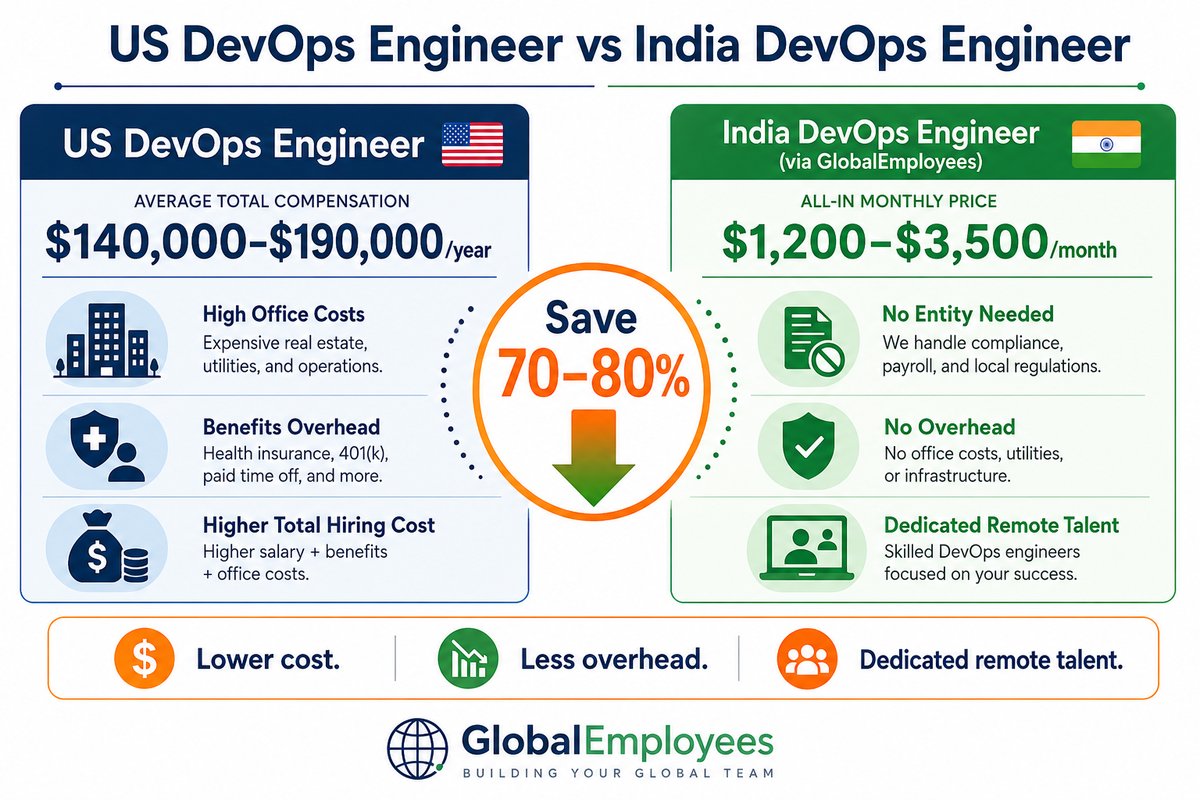
Cost is rarely the only reason to hire offshore, but it is consistently one of the most compelling. Here's a realistic comparison of what US companies typically budget for DevOps and cloud roles in both markets in 2026.
Hiring Models: Freelance, Agency, or Dedicated Remote Staff?
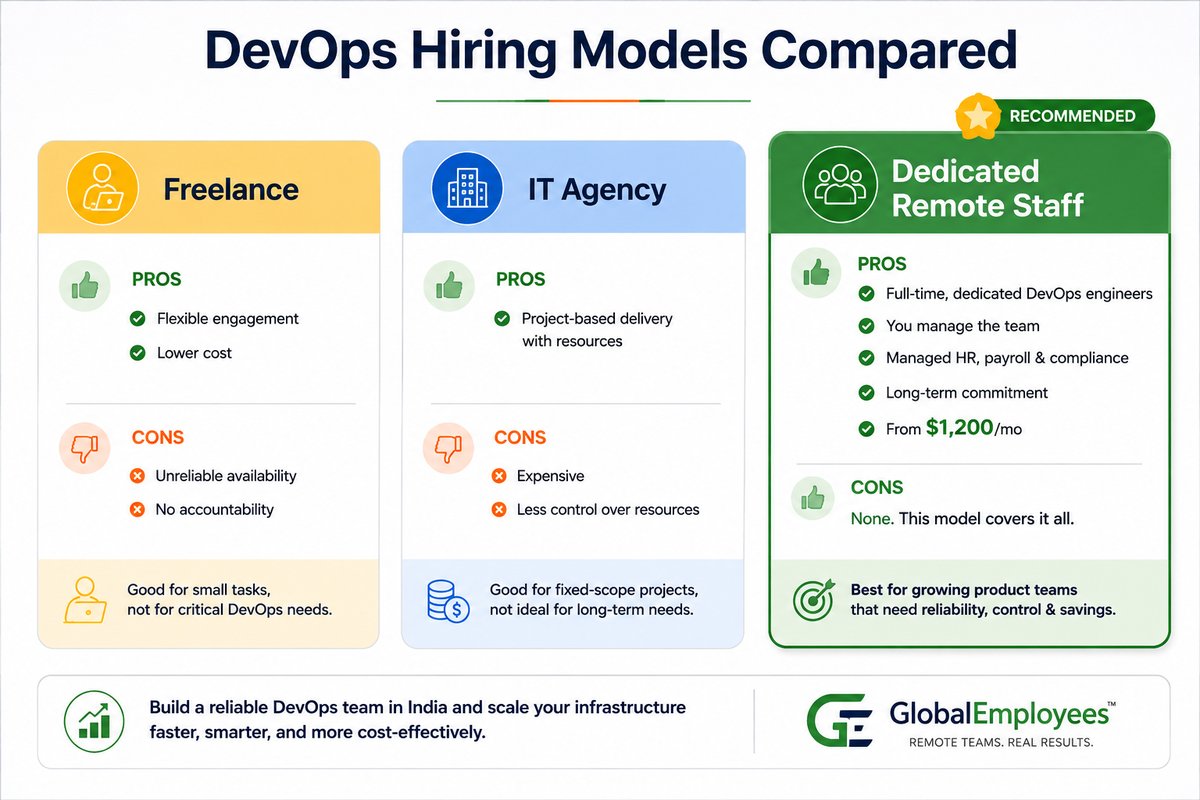
Not all offshore engagement models deliver the same results for DevOps functions. Here's a breakdown of the three primary options and when each one makes sense.
Freelance Platforms (e.g., Upwork, Toptal)
- Best for: Short-term tasks, one-off infrastructure audits, or proof-of-concept work
- DevOps fit: Poor for ongoing CI/CD ownership or on-call responsibilities
Project-Based IT Agencies
- Best for: Defined-scope migrations or one-time cloud architecture projects
- Drawbacks: Engineers are shared across accounts, you lose continuity when the project ends, and agencies mark up significantly
- DevOps fit: Moderate — acceptable for a migration but not for long-term platform ownership
Dedicated Remote Staffing (Recommended)
- Best for: Ongoing infrastructure management, team augmentation, embedded DevOps roles
- Benefits: Engineer works exclusively for your company, follows your processes, attends your standups, uses your tools
- DevOps fit: Excellent — mirrors the experience of a full-time hire without domestic overhead
For DevOps and cloud roles specifically, the dedicated model wins decisively. Infrastructure ownership, on-call rotations, security posture management, and CI/CD stewardship all require continuity, institutional knowledge, and deep context — none of which you get from a freelancer juggling five clients or an agency rotating engineers between accounts. Explore the dedicated offshore team model to understand how this structure works in practice.
Step-by-Step: How to Hire DevOps Engineers in India
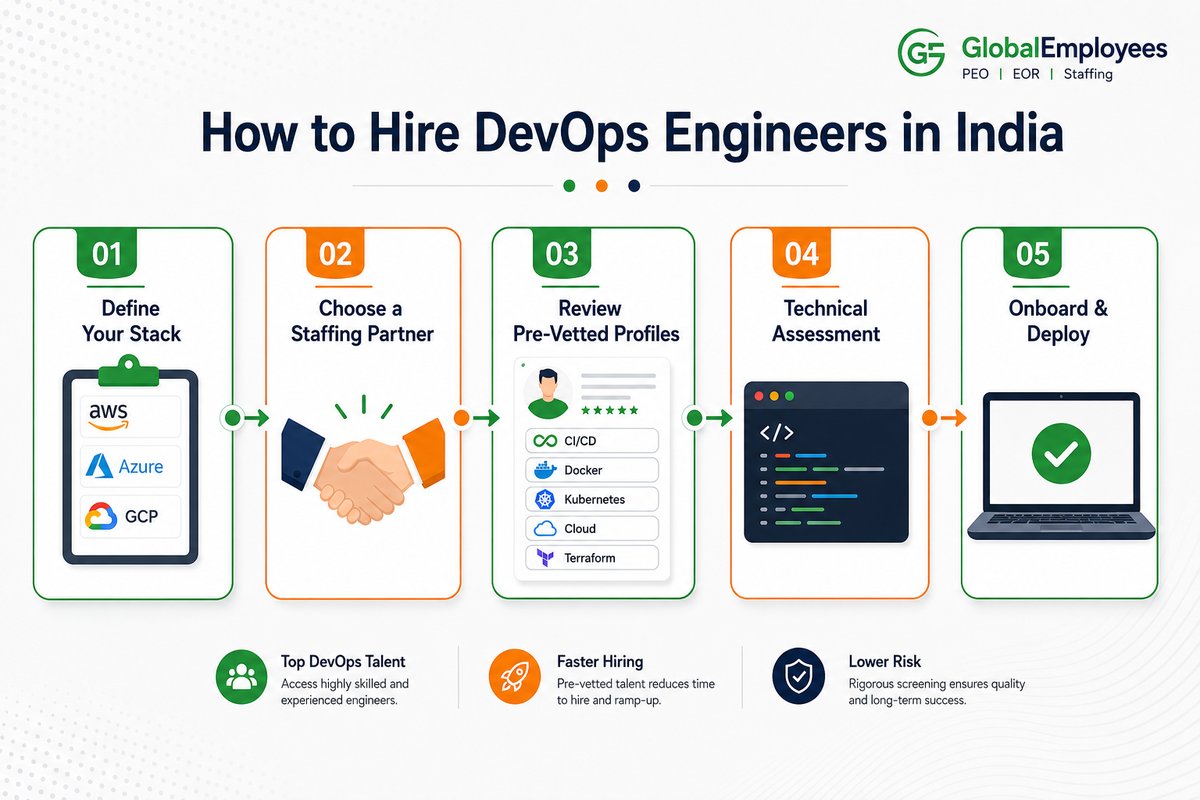
Here is a practical, proven process that US engineering leaders use to successfully onboard Indian DevOps talent through a staffing partner.
Step 1: Define the Role with Precision
Write a role brief that covers: primary cloud platform (AWS/GCP/Azure), must-have tools and certifications, experience level (years + complexity of environments managed), working hours overlap requirement, and any compliance frameworks (SOC 2, HIPAA, PCI-DSS).
Step 4: Structure the Onboarding
Treat your remote DevOps hire like any new team member. Prepare access provisioning (GitHub, AWS console, monitoring dashboards, Slack), assign a US-side buddy or manager, and run a structured first-week orientation. The first 30 days are critical for establishing communication rhythms and tool familiarity.
Step 5: Establish Communication and On-Call Protocols
Define your expected overlap hours, incident escalation paths, and documentation standards upfront. Many teams find that a 2–3 hour morning overlap (IST evening to US morning) is sufficient for standups, while async tooling (Linear, Jira, Confluence, Loom) handles the rest.
For a more detailed view of the end-to-end process, visit the How It Works page to understand how staffing engagements are structured from brief to hire.
Red Flags and Common Mistakes US Companies Make
Hiring DevOps engineers remotely from India is highly effective when done right — but there are predictable failure modes that experienced hiring managers learn to avoid.
Resume Keyword Inflation
Candidates who list every tool imaginable but can't explain their actual role in past projects are a red flag. Always ask: "What was your specific contribution to this Kubernetes migration?" rather than accepting a resume claim at face value.
Ignoring Time Zone Fit
If your team needs live collaboration during core US hours, confirm the candidate is comfortable working an IST evening shift (6 PM–2 AM IST for US Eastern alignment). Don't assume — ask explicitly and structure compensation accordingly.
Skipping the Technical Screen
Some hiring managers rely too heavily on certifications. Certifications are a useful signal, but a live scenario-based interview is non-negotiable for DevOps roles. Test actual problem-solving, not just theoretical knowledge.
No Clear Ownership or Documentation Expectation
Remote DevOps engineers need explicit documentation standards from day one. Runbooks, architecture diagrams, and change logs should be required deliverables — not afterthoughts. Establish this in the onboarding checklist before the engineer starts.
Managing Your Remote DevOps Team Across Time Zones
The best-hired DevOps engineer will underperform without the right management structure. Here are the practices that high-performing US companies use to get maximum value from their India-based staff augmentation relationships.
Async-First, Sync When It Matters
Invest in async documentation: video walkthroughs (Loom), detailed Jira tickets, architectural decision records (ADRs), and Confluence wikis. Reserve live video calls for sprint planning, incident reviews, and one-on-ones. This reduces meeting fatigue and respects time zone asymmetry.
Daily Standups with Written Summaries
Even if you can only overlap for 30 minutes, a written standup update ("Yesterday: deployed new autoscaling config. Today: monitoring CloudWatch alarms. Blockers: need AWS IAM policy approval") keeps everyone aligned without requiring live presence.
Quarterly Performance Reviews and Career Development
Treat your remote DevOps engineer with the same career development investment as a local hire. Engineers who feel invested in stay longer, build deeper institutional knowledge, and become genuine force multipliers for your team. High attrition in remote setups is almost always a management problem, not a talent problem.
Security and Access Management
Implement least-privilege IAM policies, VPN access controls, and audit logging from day one. This is standard good practice regardless of where your engineers are located — but it's particularly important to formalize when working with distributed teams. Ensure NDAs and IP assignment agreements are signed through your staffing provider before granting system access.
Companies looking to scale beyond a single DevOps hire can explore building a broader dedicated development team in India that includes backend engineers, QA automation specialists, and data engineers alongside their DevOps function — creating a fully integrated offshore engineering capability.
Frequently Asked Questions
What cloud certifications should I look for when hiring Indian DevOps engineers?
The most valuable certifications to look for include AWS Certified DevOps Engineer – Professional, Certified Kubernetes Administrator (CKA), HashiCorp Certified Terraform Associate, Google Professional DevOps Engineer, and Microsoft Certified: Azure DevOps Engineer Expert. While certifications are a useful baseline signal, they should always be paired with a live technical interview that tests real-world scenario handling. An engineer who holds a CKA and can walk you through a live cluster troubleshooting scenario is far more valuable than one who passed a cert exam without hands-on depth.
Can Indian DevOps engineers work US business hours?
Yes — many experienced DevOps engineers in India are accustomed to working shifted hours (typically IST evening, which overlaps with US Eastern or Pacific business hours) and are open to this arrangement, often with a modest shift allowance built into their compensation. For roles that require true on-call coverage or significant real-time collaboration, it's worth confirming shift availability during the interview process. Many US companies find that a 2–4 hour daily overlap window is sufficient for standups and urgent matters, with async tooling handling the rest of the workflow.
Yes, with the right security practices in place — which should be standard regardless of where your engineers are located. Implement least-privilege IAM policies, require VPN access, enable audit logging and CloudTrail (or equivalent), enforce MFA on all accounts, and ensure NDAs and IP assignment agreements are signed before granting system access. Reputable staffing providers include legally binding confidentiality agreements as part of their standard engagement terms. Many US companies in regulated industries (fintech, healthtech, SaaS) successfully run their entire cloud operations with India-based DevOps teams by following these standard security protocols.
What is the difference between hiring a DevOps engineer and a cloud engineer in India?
A DevOps engineer typically focuses on the software delivery pipeline — CI/CD automation, containerization, configuration management, and bridging the gap between development and operations teams. A cloud engineer focuses more on infrastructure architecture — designing, provisioning, and optimizing cloud environments on AWS, GCP, or Azure. In practice, many experienced professionals in India have deep skills in both areas, but if you have a specific need (e.g., Kubernetes platform engineering vs. AWS cost optimization), defining the role precisely will help your staffing partner match you with the right profile faster. Some roles, like Site Reliability Engineer (SRE), blend both disciplines with a strong emphasis on production reliability and observability.
Do I need to set up a legal entity in India to hire DevOps engineers there?
No — this is one of the primary advantages of working through a dedicated remote staffing provider. The staffing company acts as the employer of record in India, handling all local labor law compliance, payroll, tax filings, and statutory benefits on your behalf. You manage the engineer's day-to-day work and deliverables, while the provider handles all the administrative and legal complexity. This means you can have a fully integrated, dedicated remote DevOps engineer working exclusively for your company within weeks — without establishing an Indian subsidiary, navigating local employment law, or setting up local payroll infrastructure.
How this fits client-managed staffing
GlobalEmployees sources candidates for the requirements your team defines. You interview candidates, decide who to bring onboard, and manage their daily work. We handle payroll and HR administration. This arrangement is designed for companies with the managers and processes to direct their people. It does not transfer project delivery or day-to-day supervision to us.
Define the role around actual responsibilities, the tools the employee will use, and the decisions they can make. Include the reporting line, working arrangements, and how your team will review the work. Discuss the fee and any additional support requirements for your particular brief instead of assuming a fixed package applies to every hire.
If the employee is not the right fit, you can request a replacement during the first two weeks after joining. Raise concerns early with specific examples so that expectations and next steps can be discussed.
Include practical AI requirements
Describe where AI assistance would be useful in this workflow and which tools your organization approves. Ask candidates to demonstrate a relevant task, explain what they verified, and show how they handle an incorrect or incomplete output. Familiarity with a tool should be assessed alongside the underlying professional skills the job requires.
Decide what information may be used with those tools, which outputs require human review, and how work will be documented. GlobalEmployees can source for the AI experience in your brief; your team interviews candidates and evaluates whether their ability meets the requirement. Keep the assessment grounded in your actual work rather than a generic claim of AI expertise.
Questions to resolve before you start
- What outcome does the business need, and what recurring work will the person own?
- Which skills are essential now, and which can be learned after joining?
- Who will interview, select, supervise, and review the employee's work?
- What systems, documentation, and approved AI tools will be available?
- How will you assess quality and discuss concerns during the first two weeks?
Use these answers to align the people involved in hiring. A clear brief makes the search and interviews more focused, and it gives the employee a practical starting point after joining.
Tell us about your hiring requirements or explore dedicated IT and non-IT roles.
Need to hire dedicated remote talent?
Tell us the role, experience, and AI skills your team needs.
Hire Talent Now