

How Much Does It Cost to Hire a Developer in India vs. the US? A Budget Planning Guide
Compare hiring options by responsibilities, experience, management needs, and the services included in each proposal. Build a budget for your specific requirement rather than relying on a headline rate.
Build a budget around the actual scope
Start by defining the responsibilities, required experience, and working arrangement. A specialist maintaining a mature system may need different experience from someone handling a narrow, well-documented task. The budget should reflect those differences rather than a single headline rate attached to a job title.
Compare written proposals covering the same work and period. Identify the staffing fee or compensation, any separately charged services, equipment and software requirements, onboarding effort, and the management time your team will provide. Ask what is included, what is optional, and how a change in responsibilities would affect the arrangement.
For a project or hourly proposal, state the assumed volume of work and how changes are handled. For ongoing dedicated staffing, describe the recurring workload and the manager who will direct it. Avoid treating an hourly quotation, a base salary, and an inclusive staffing proposal as equivalent numbers without reconciling their scope.
GlobalEmployees will discuss pricing for your requirements. Previous indicative figures in this article have been removed because they should not be treated as a current quote. Request a proposal based on the role, seniority, and practical arrangements you actually need.
Table of Contents
- Why the India vs. US Developer Cost Comparison Still Matters in 2026
- US Developer Salaries in 2026: What Employers Are Actually Paying
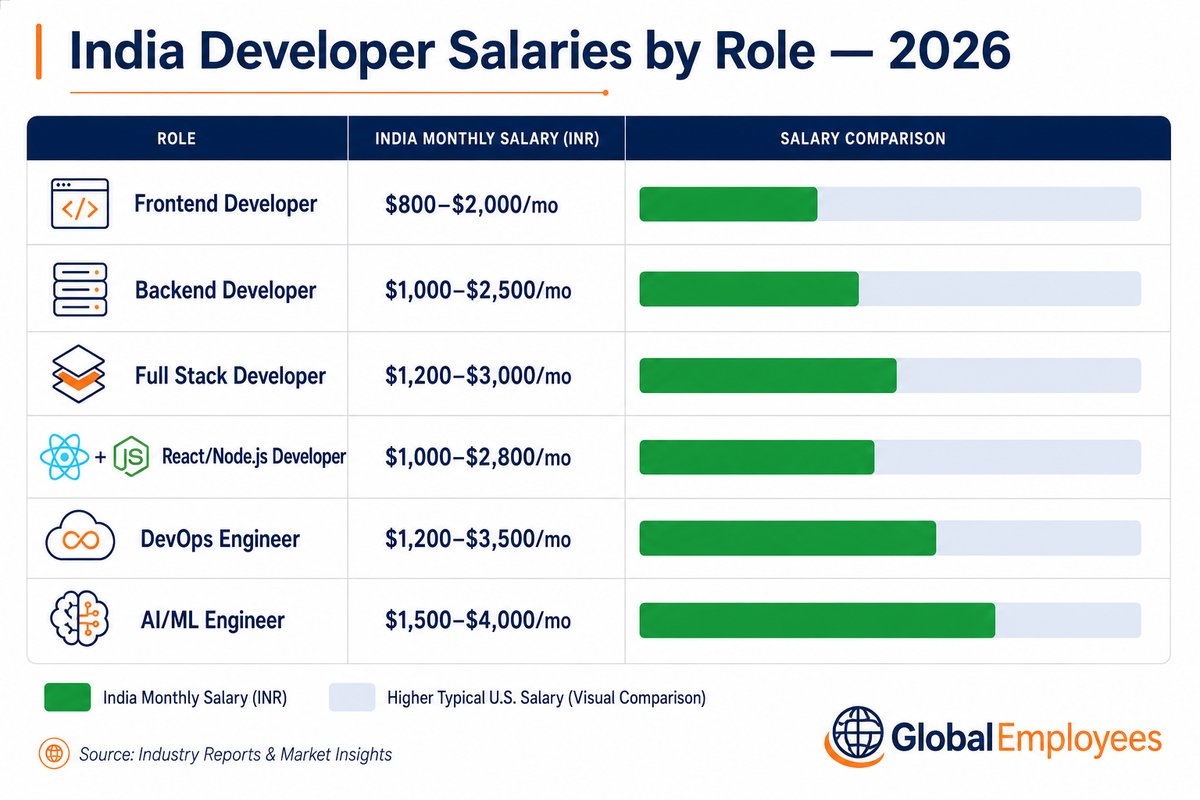
- India Developer Salaries in 2026: Role-by-Role Breakdown
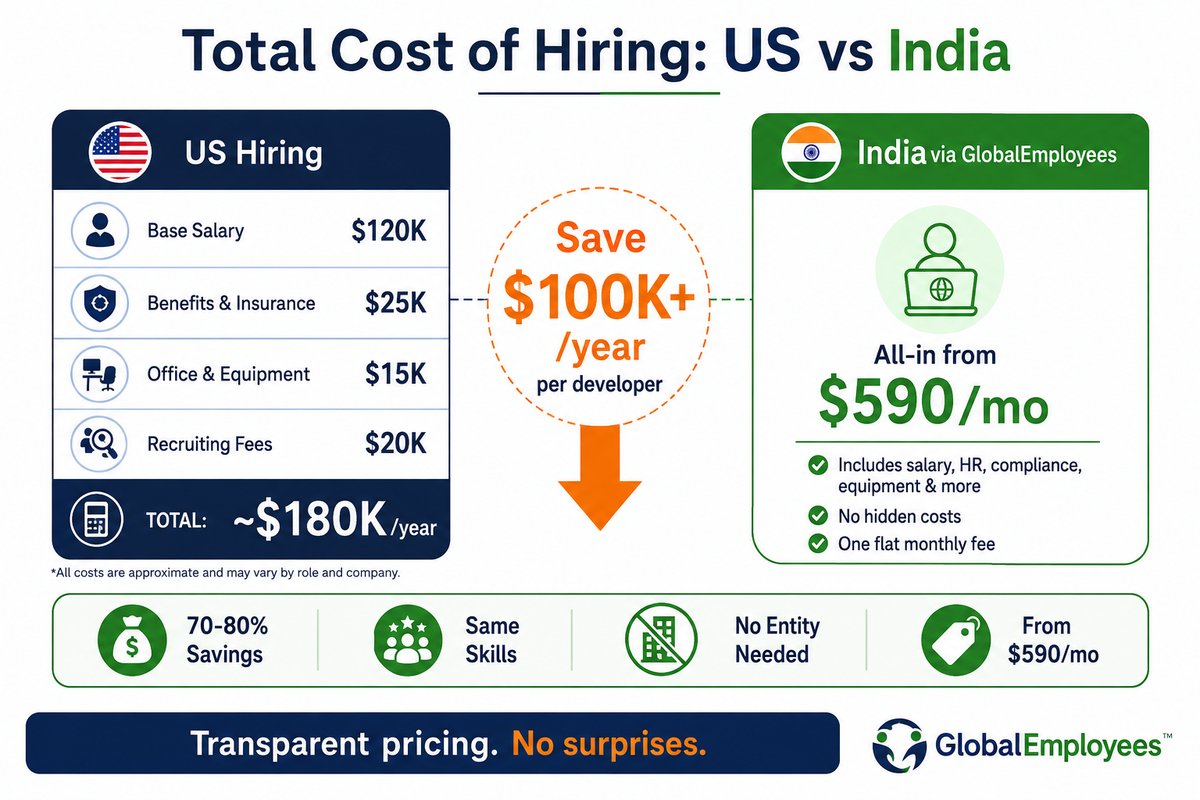
- Total Cost of Hiring: Beyond the Base Salary
- Does Lower Cost Mean Lower Quality? Addressing the Elephant in the Room
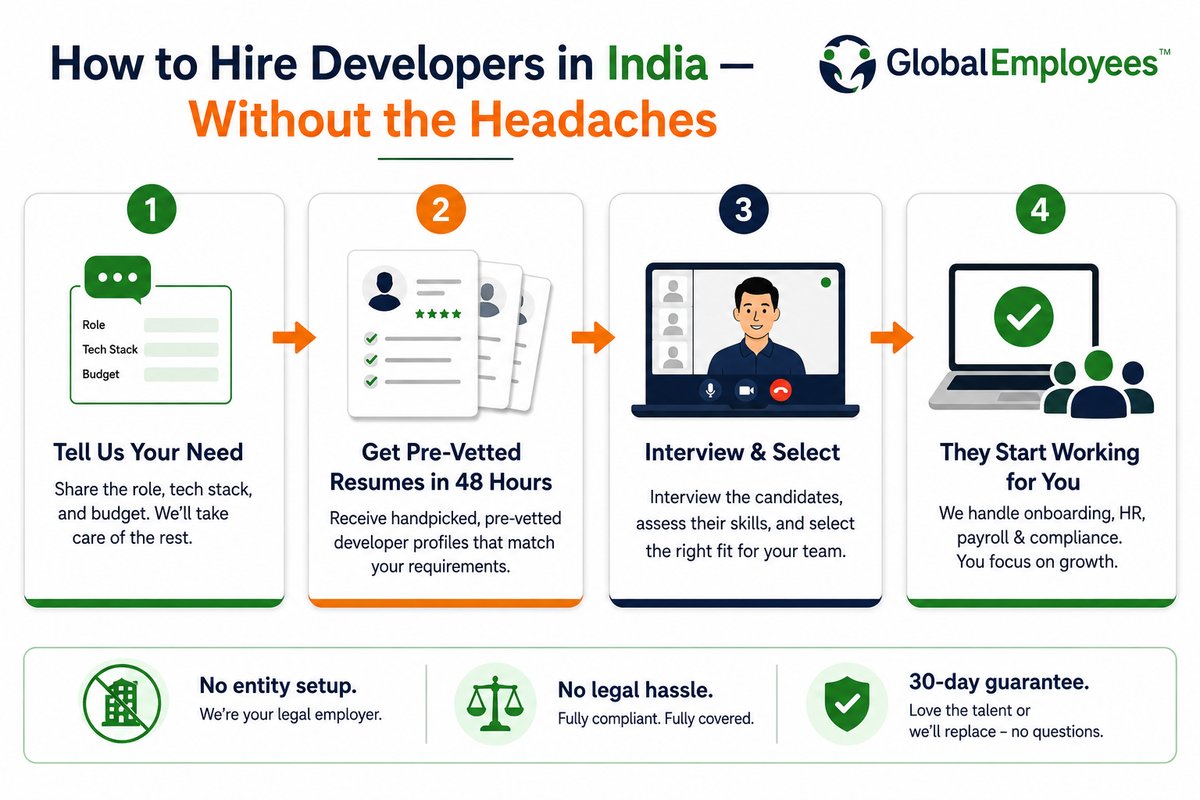
- How to Hire Developers in India Without the Usual Headaches
- Frequently Asked Questions
Why the India vs. US Developer Cost Comparison Still Matters
The result is a structural cost advantage that isn't going away. Whether you need a React developer, a Python engineer, or a full dedicated offshore team, understanding the real numbers — base salary, benefits, recruitment overhead, and ongoing management costs — is the only way to make a confident decision.
Let's get into the actual figures.
US Developer Salaries: What Employers Are Actually Paying
Hiring a software developer in the United States carries significant costs that go well beyond the base salary listed on a job posting. Here's a realistic look at what US employers are paying across common roles in 2026.
India Developer Salaries: Role-by-Role Breakdown
India's developer salary market has matured considerably. Salaries have risen in major tech hubs like Bangalore, Hyderabad, and Pune, but they remain dramatically lower than US equivalents. More importantly, the skill levels are genuinely comparable at the mid-to-senior tier — especially for developers with 4+ years of experience on international projects.
Total Cost of Hiring: Beyond the Base Salary
A direct salary comparison only tells part of the story. Let's look at the full picture side by side for a mid-level software developer over a 12-month period.
Does Lower Cost Mean Lower Quality? Addressing the Elephant in the Room
This is the question every pragmatic business owner asks — and it deserves a direct, honest answer. The short version: no, lower cost does not mean lower quality when you hire through a structured, vetting-focused process.
What India's Developer Talent Pool Actually Looks Like
- India is home to the world's second-largest pool of English-speaking tech professionals
- Top Indian developers are certified and experienced on AWS, Azure, Google Cloud, and all major frameworks
- Many have worked with US, UK, and Australian clients for 5–10+ years through IT services firms
- India consistently ranks among the top countries for developer skill assessments on platforms like HackerRank and Codility
Where Quality Risks Actually Come From
Quality issues in offshore hiring typically stem from process failures, not geography. Common pitfalls include hiring from unvetted freelance marketplaces, unclear project specifications, poor communication protocols, or hiring developers who don't have experience with international business culture. Working with a dedicated staffing provider that pre-screens candidates for technical skill, English proficiency, and remote work readiness eliminates most of these risks before the first interview.
Roles like AI/ML engineers and DevOps engineers from India are particularly strong — these are globally in-demand specializations that Indian universities and bootcamps have invested heavily in over the last decade.
How to Hire Developers in India Without the Usual Headaches
If you've tried hiring offshore talent before and had a poor experience, the process — not the talent — was likely the problem. Here's what a structured, low-risk approach to hiring developers in India looks like in 2026.
Step 1: Define Your Role Clearly
Before you speak to any staffing partner, document the role requirements: tech stack, years of experience, working hours overlap needed, communication expectations, and deliverables. The more specific your brief, the faster and more accurately a staffing partner can match candidates.
Step 2: Use a Dedicated Staffing Model (Not Freelancers)
Freelance platforms give you speed but not reliability. A dedicated staffing model gives you a full-time professional who works exclusively for your business, follows your processes, and integrates into your team. This is fundamentally different from project-based outsourcing and produces far better long-term outcomes. Explore the difference at the staff augmentation page to understand when each model applies.
Step 4: Onboard with Structure
Treat your India-based developer like any other full-time team member. Set up proper onboarding documentation, assign a point of contact, use project management tools like Jira or Asana, and establish a regular video check-in cadence. Remote team integration is a skill — the more deliberate you are, the faster productivity ramps.
Here's what makes the model work:
- Wide role coverage: From software developers and designers to digital marketing experts and beyond
The how it works page walks through the full process in detail — from your initial briefing through onboarding and beyond. For businesses that have been burned by opaque offshore arrangements in the past, the predictability and accountability of this model is a meaningful differentiator.
Frequently Asked Questions
What is the difference between offshore staffing and outsourcing?
Offshore staffing means hiring a dedicated full-time professional who works exclusively for your company, follows your processes, and is integrated into your team — they just happen to be based in another country. Outsourcing typically means handing a project or function to an external agency that manages the work independently. Offshore staffing gives you far more control, consistency, and cultural alignment than traditional outsourcing, and is generally preferred by companies building long-term remote teams.
How this fits client-managed staffing
GlobalEmployees sources candidates for the requirements your team defines. You interview candidates, decide who to bring onboard, and manage their daily work. We handle payroll and HR administration. This arrangement is designed for companies with the managers and processes to direct their people. It does not transfer project delivery or day-to-day supervision to us.
Define the role around actual responsibilities, the tools the employee will use, and the decisions they can make. Include the reporting line, working arrangements, and how your team will review the work. Discuss the fee and any additional support requirements for your particular brief instead of assuming a fixed package applies to every hire.
If the employee is not the right fit, you can request a replacement during the first two weeks after joining. Raise concerns early with specific examples so that expectations and next steps can be discussed.
Include practical AI requirements
Describe where AI assistance would be useful in this workflow and which tools your organization approves. Ask candidates to demonstrate a relevant task, explain what they verified, and show how they handle an incorrect or incomplete output. Familiarity with a tool should be assessed alongside the underlying professional skills the job requires.
Decide what information may be used with those tools, which outputs require human review, and how work will be documented. GlobalEmployees can source for the AI experience in your brief; your team interviews candidates and evaluates whether their ability meets the requirement. Keep the assessment grounded in your actual work rather than a generic claim of AI expertise.
Questions to resolve before you start
- What outcome does the business need, and what recurring work will the person own?
- Which skills are essential now, and which can be learned after joining?
- Who will interview, select, supervise, and review the employee's work?
- What systems, documentation, and approved AI tools will be available?
- How will you assess quality and discuss concerns during the first two weeks?
Use these answers to align the people involved in hiring. A clear brief makes the search and interviews more focused, and it gives the employee a practical starting point after joining.
Tell us about your hiring requirements or explore dedicated IT and non-IT roles.
Need to hire dedicated remote talent?
Tell us the role, experience, and AI skills your team needs.
Hire Talent Now