
Business Process Outsourcing Healthcare: What It Is and Why It Matters
Business Process Outsourcing Healthcare: What It Is and Why It Matters
Running a healthcare organization means drowning in paperwork that has nothing to do with patient care. Billing, claims processing, medical coding, scheduling, and patient support all eat up hours your clinical staff should spend on actual healthcare. That's where business process outsourcing healthcare comes in: handing off these non-clinical, administrative functions to specialized teams so your in-house staff can focus on what they were hired to do.
In plain terms, healthcare business process outsourcing means contracting outside teams to manage tasks like revenue cycle management, insurance verification, transcription, and back-office data entry, all while meeting HIPAA and other compliance requirements. Done right, it cuts overhead, speeds up turnaround times, and reduces the errors that come from overworked internal teams juggling too many roles.
This article breaks down exactly what falls under healthcare BPO, how it differs from clinical outsourcing, and what real cost and efficiency gains look like. We also cover the compliance safeguards you should demand from any partner, since patient data security isn't optional. If you're weighing whether outsourcing makes sense for your practice or hospital system, this gives you a clear, practical starting point.
Why healthcare organizations turn to BPO
Hospitals and clinics outsource for one blunt reason: staffing shortages keep getting worse while administrative work keeps piling up. The Bureau of Labor Statistics projects continued growth in healthcare support roles through the decade, yet most practices can't compete with hospital systems on salary or benefits for billing clerks and coders. Rather than leaving claims unprocessed for weeks, administrators turn to outside teams who already have the training and the software licenses in place.

Rising costs and staffing gaps
Salaries aren't the only expense. Every in-house hire adds payroll taxes, benefits, office space, and software subscriptions for billing platforms and EHR modules, which is why the true total cost of an in-house hire versus a remote team rarely matches the salary figure on paper. A medical coder in the US often costs a practice $55,000 to $70,000 a year once you factor in benefits, and that's before training time or turnover. Outsourcing shifts that fixed cost into a predictable monthly fee, which is why offshore staffing services offering dedicated staff starting around $1,090 a month have gained traction with smaller practices that can't absorb a full-time hire's overhead.
Outsourcing turns unpredictable staffing costs into a fixed, manageable line item.
Compliance and quality pressure
Beyond cost, regulatory complexity pushes organizations toward specialized partners. HIPAA rules, payer-specific billing codes, and constantly shifting insurance requirements demand dedicated attention that generalist office staff rarely have time to master. A BPO provider focused solely on healthcare billing and coding stays current on these changes as a matter of survival, since their entire business depends on getting claims accepted the first time.
Speed matters just as much as accuracy. Denied claims and delayed reimbursements hurt cash flow, and understaffed billing departments create backlogs that snowball. Common drivers behind the shift include:
- Reducing claim denial rates through specialized coding expertise
- Freeing clinical staff from scheduling and data entry
- Scaling support up or down during seasonal patient volume swings
- Avoiding the cost of recruiting, training, and retaining back-office staff
- Meeting compliance requirements without building an in-house legal or IT security team
Taken together, these pressures explain why healthcare BPO has moved from a niche cost-cutting tactic to a standard operating decision for practices of every size.
How healthcare business process outsourcing works
The process starts long before any claim gets processed or any call gets answered. A healthcare BPO provider first audits your current workflows, figures out where the bottlenecks live, and matches you with staff trained specifically for those gaps, whether that's medical coding, insurance verification, or patient scheduling. This upfront diligence, much like the hiring process for dedicated remote employees, separates a real outsourcing partnership from a generic call center that happens to answer healthcare calls.
Setting up secure systems
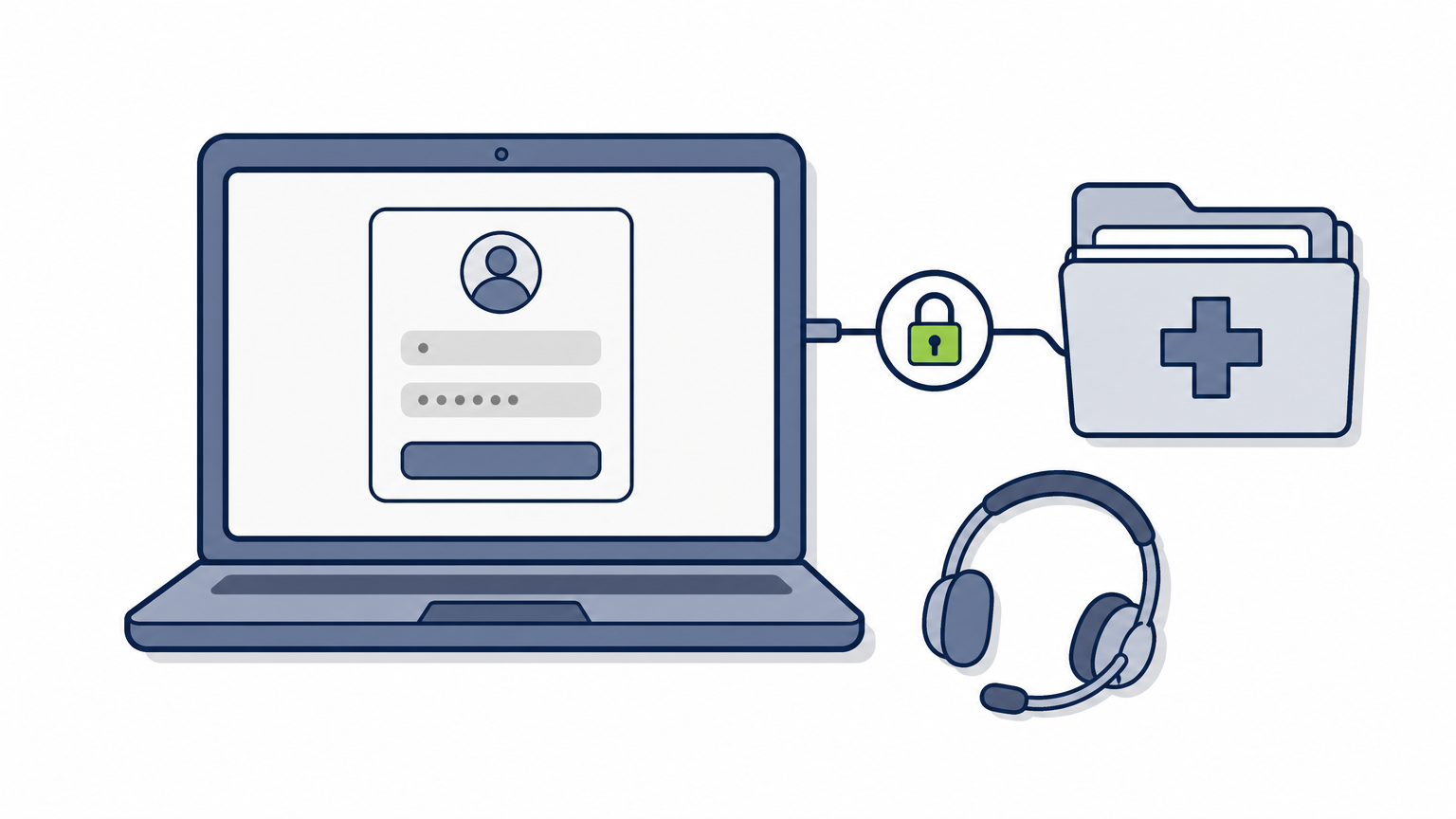
Once you agree on scope, the provider sets up access through HIPAA-compliant channels, usually a VPN connection into your EHR or practice management software rather than handing over raw data exports. Signed NDAs, role-based access limits, and encrypted devices should all be standard before a single file changes hands. Reputable providers also assign a dedicated account manager who tracks turnaround times and error rates, so you're not chasing updates through a generic support ticket queue.
A secure setup isn't a nice-to-have in healthcare BPO, it's the foundation the whole arrangement depends on.
Running the day-to-day workflow
After setup, work typically moves through a repeatable cycle:
- Requests or claims come in through your existing systems
- The outsourced team processes them under agreed service-level timelines
- Completed work gets logged and flagged for your review if anything looks off
- Regular reporting shows volume, accuracy, and turnaround metrics
This structure lets you extend your in-house team and scale the relationship without renegotiating from scratch. Need more coding support during flu season? Volume adjusts. Slower month? You're not paying for idle in-house staff. That flexibility, paired with the security safeguards above, is what makes business process outsourcing healthcare arrangements sustainable rather than a one-time cost-cutting experiment that falls apart the first time compliance gets questioned.
Core functions handled by healthcare BPO providers
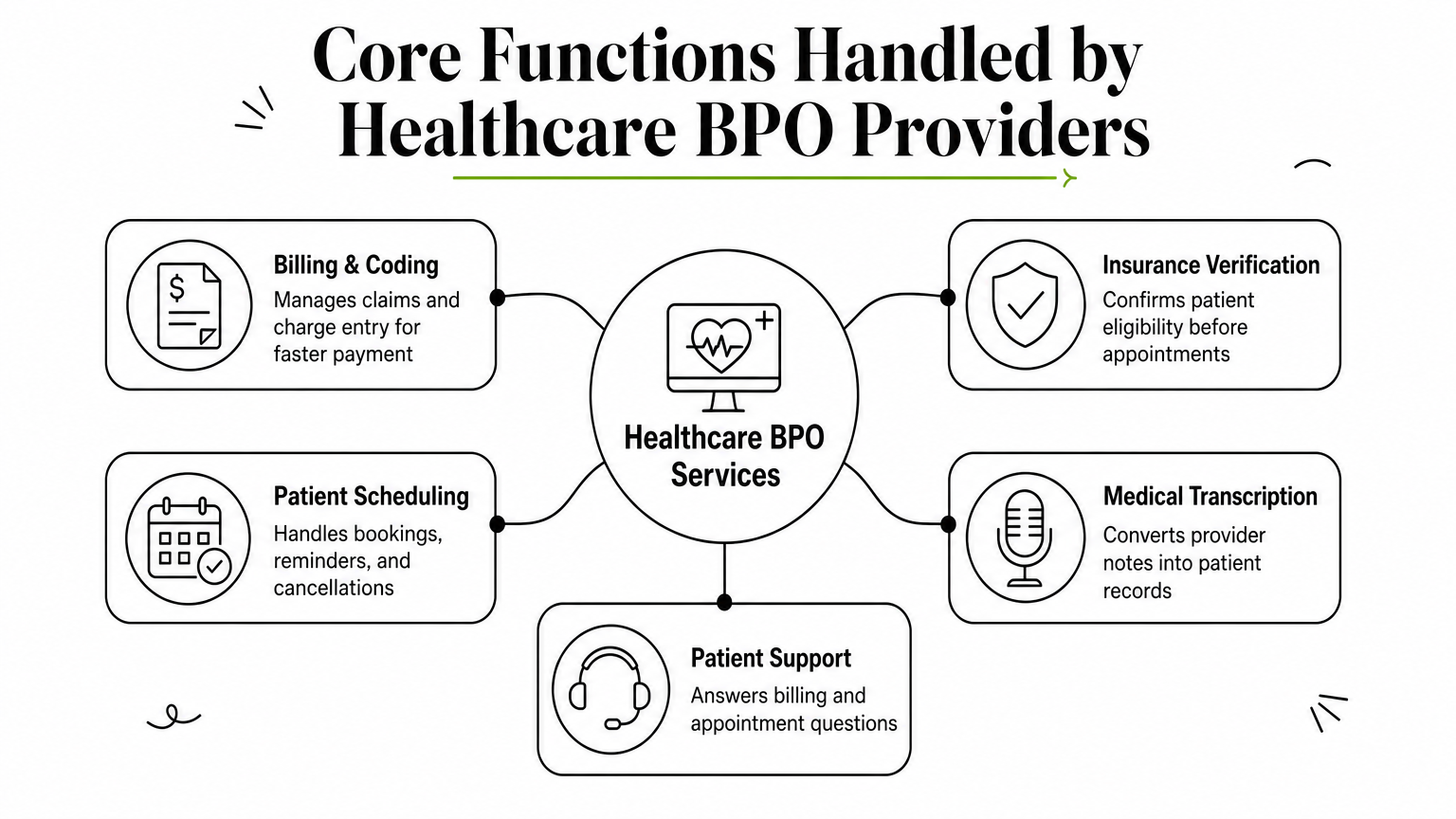
Most people think outsourcing means answering phones, but healthcare BPO providers now handle a much wider slice of the revenue cycle and back office. Billing and coding sit at the center of most contracts, since claim accuracy directly affects cash flow. Around that core, providers typically layer in scheduling, insurance verification, transcription, and patient support, all functions that touch administrative workflow without ever requiring a medical license.
Revenue cycle and coding work
Revenue cycle management covers everything from charge entry to denial follow-up, and it's usually the first function practices hand off because errors here cost real money. Medical coding accuracy determines whether a claim clears on the first submission or bounces back for weeks of rework, so specialized teams focus heavily on staying current with ICD-10 and CPT updates.
Get the coding and billing layer right, and everything downstream, cash flow, patient trust, staff morale, gets easier.
Support and administrative functions
Beyond billing, providers commonly cover:
| Function | What it involves |
|---|---|
| Insurance verification | Confirming eligibility before appointments |
| Medical transcription | Converting provider notes into records |
| Patient scheduling | Managing bookings, reminders, cancellations |
| Data entry | Updating EHR records and demographics |
| Patient support | Answering billing and appointment questions |
Each of these tasks demands consistency more than judgment calls, which makes them well-suited to dedicated data and admin professionals working under strict service-level agreements. Together, these functions form the backbone of practical business process outsourcing healthcare arrangements, letting your clinical staff stay focused on patients instead of paperwork.
How to choose a healthcare BPO partner
Picking a partner comes down to more than price. You want a provider who understands healthcare compliance requirements cold and can prove it with documentation, not just a sales pitch. Ask for references from practices similar in size to yours, and request sample work product before you sign anything long-term.
Vetting for security and compliance
Start by confirming the provider signs a business associate agreement under HIPAA, since this is non-negotiable for anyone touching patient data. Beyond the paperwork, look for concrete security measures: encrypted devices, VPN-only access, role-based permissions, and regular audits. A provider unwilling to walk you through their actual security stack, rather than a general statement about being "HIPAA compliant," should raise a flag.
If a vendor can't show you their security setup in detail, don't hand them patient data.
Evaluating fit and flexibility
Getting the right fit also means checking how the provider handles scale and specialization. Run through this checklist before committing:
- Do they specialize in healthcare, or is medical work a side offering?
- Can they scale staff up or down without penalty clauses?
- What's their average error rate and turnaround time?
- Do they offer a trial period or money-back guarantee?
- Will you get a dedicated team, or rotating generalist staff?
Hiring models that let you review vetted candidates before committing, with no long-term contract locking you in, reduce the risk considerably. GlobalEmployees, for instance, structures its dedicated staffing model around free resume access and a money-back guarantee, which lets healthcare administrators test fit before any real financial commitment. That kind of low-risk entry point matters more in healthcare BPO than in most other outsourcing categories, since a bad hire here can mean denied claims and frustrated patients, not just a missed deadline.
Putting healthcare BPO into perspective
Healthcare business process outsourcing isn't a shortcut around quality care, it's a way to protect the time your clinical staff needs to actually deliver it. Non-clinical functions like billing, coding, scheduling, and patient support drain hours that should go toward patients, and specialized outside teams handle that load with better accuracy and lower fixed costs than most in-house departments can match. Compliance safeguards, dedicated account managers, and flexible scaling turn what used to be a staffing headache into a predictable operating expense.
Judging a provider on price alone misses the point. The real question is whether they understand healthcare compliance, can prove their security setup, and let you test the relationship before committing long term. If you're ready to build that kind of low-risk offshore team, from billing support to broader operations roles, explore GlobalEmployees' dedicated staffing model and see which vetted candidates fit your practice before you sign anything.
Need to hire dedicated remote talent?
Tell us the role, experience, and AI skills your team needs.
Hire Talent Now