Staff Augmentation vs Consulting: What Is the Difference?
Staff Augmentation vs Consulting: What Is the Difference?
Staff augmentation vs consulting comes down to who directs the work and who answers for the result. With staff augmentation, you add outside people to your own team, you assign their daily tasks, and you own the outcome. With consulting, you hire outside experts to deliver advice or a defined result, they run the work their own way, and the firm answers for the deliverable. If you know what to build and need more hands, augment. If you still need to work out what to build, consult.
This guide explains why the distinction matters, how to choose between the models with a short set of questions, and how each one is billed. You will also see project examples, including the cases where the labels blur, and how to run an augmented team once you have one.
GlobalEmployees places dedicated, full-time offshore employees in India with US and European businesses, which puts us on the staff augmentation side of this decision. We will still tell you plainly when consulting is the better call, because a wrong fit costs you more than it costs us.
Why the choice between the two models matters
The staff augmentation vs consulting decision matters because each model puts control and accountability in a different place, and a mismatch shows up as missed deadlines, wasted budget, or a team you cannot steer.
Control and accountability sit in different places
With staff augmentation, you control the work. You assign tasks, set priorities, review output, and run the standups. The provider is accountable for sending qualified people and replacing them if they do not fit. You are accountable for what the team ships.

Consulting flips that arrangement. The firm controls how the work gets done, and it is accountable for the deliverable named in the contract, whether that is an architecture review, a migration plan, or a working system. You review results instead of managing tasks.
Buy augmentation when you hold the plan, and buy consulting when you need someone else to hold it.
What a wrong fit costs you
Buying consulting and then managing the consultants task by task is the most common mistake. You pay a premium for seniority and accountability, then override both. The consultants deliver what you directed, and nobody owns whether it was the right thing to build.
The reverse mistake is just as costly. Augmented developers do not hand you a strategy, because nobody is accountable for one. If your team has no technical lead with time to plan, review, and unblock, extra people add noise instead of output. Management time is the hidden price of augmentation, and teams that skip it see drift within weeks.
Timing is a third cost. Consulting engagements often open with discovery, so you may wait before anything ships. Augmented staff can contribute quickly, but only when the work is already defined.
How to choose between staff augmentation and consulting
Start with one test: do you already know what needs to be built and how? If you do, augment your team. If you do not, consult first, then augment to build.
Side-by-side comparison
The table sets the two models against the factors that decide most projects. Use it as a checklist against your own situation.
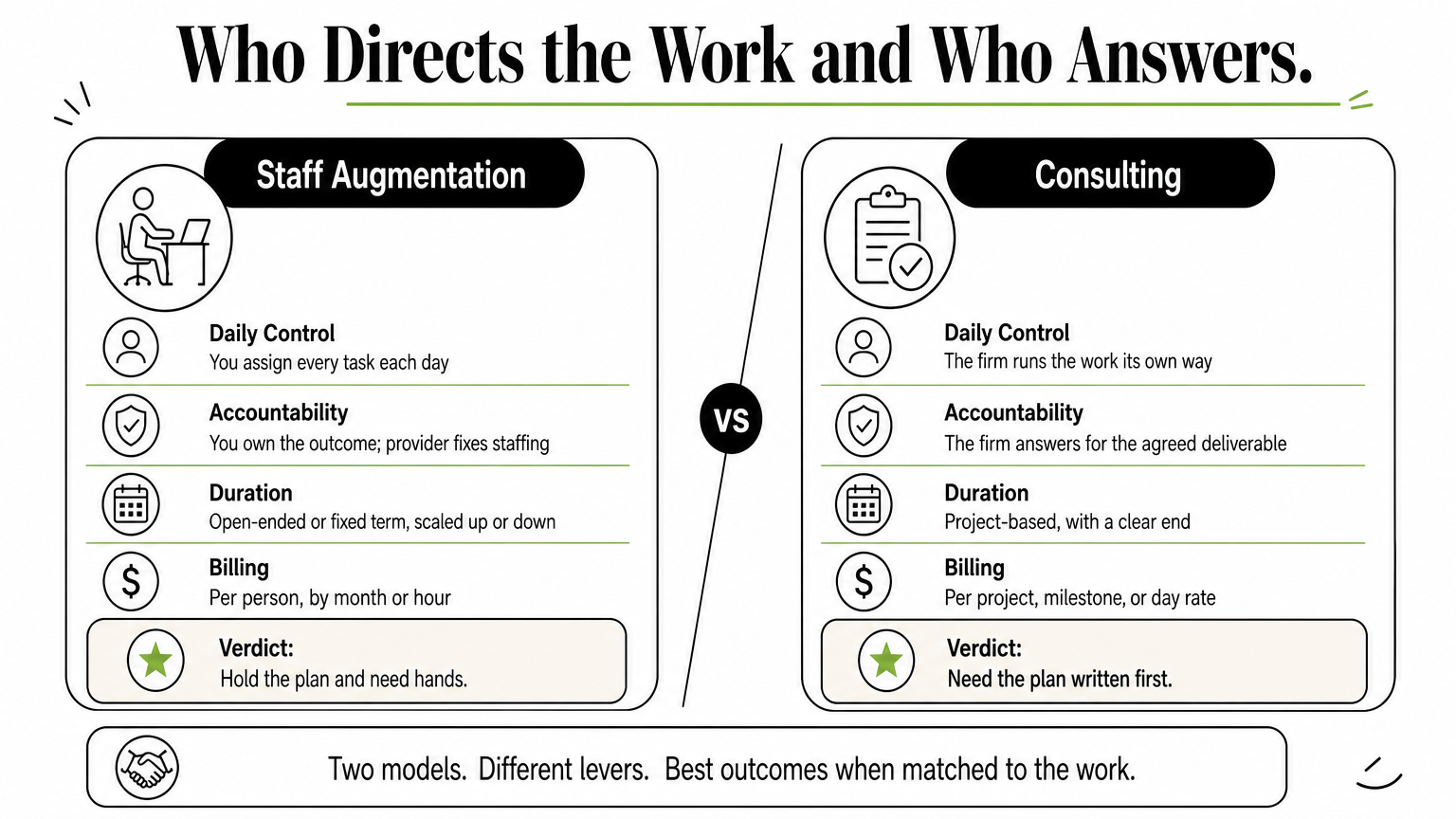
| Factor | Staff augmentation | Consulting |
|---|---|---|
| Who directs daily work | You | The consulting firm |
| Who is accountable for results | You. The provider covers staffing quality | The firm, per the agreed deliverable |
| Typical scope | Ongoing execution, defined tasks, skill gaps | Advice, diagnosis, strategy, or a scoped project |
| Duration | Open-ended or fixed term, scaled up or down | Project-based, with a clear end |
| Billing | Per person, by the month or hour | Per project, milestone, or day rate |
| Team integration | Embedded in your tools and processes | Mostly independent, often serving several clients |
| Knowledge after exit | Stays with your team if you document | Leaves with the firm unless handoff is contracted |
| Management load on you | High | Lower |
Read the accountability row twice. Buyers skip it, yet it decides who fixes the problem when work misses the mark, and it explains most disputes between clients and vendors.
Five questions to ask before you sign
These questions turn the table into a decision. Answer them honestly before you talk to any vendor.
- Do we have a written plan? If scope, priorities, and architecture exist, augment. If they do not, consult.
- Who will manage the work? Augmentation needs a named lead with real time to give.
- Are we buying hours or outcomes? Hours point to augmentation. A fixed result points to consulting.
- How long will the need last? A one-time deliverable suits consulting. Ongoing capacity suits augmentation.
- Who must understand the system afterward? If your own team must, favor augmentation or contract a documented handoff.
Answers that split evenly usually mean the project has two phases, and the examples later in this guide show how to sequence them.
If you cannot name the person who will manage the work, you are not ready to augment.
What each model costs and how it is billed
Staff augmentation is billed per person over time, and consulting is billed per deliverable or engagement, so the two never compare line by line. Compare the total cost of reaching your outcome instead.
How the billing differs
Augmentation providers charge a monthly or hourly rate per person, and you add or release people as demand changes, subject to notice terms. At GlobalEmployees, a full-time dedicated employee starts from $1,090 per month, which covers recruitment, HR, payroll, laptops, and software. No setup, HR, or infrastructure costs come on top.

Consulting firms usually quote a fixed fee for a scoped project, milestone payments, or day rates for senior people. Per hour, consulting typically runs higher, because the rate includes seniority, method, and accountability for the result. In return, your price attaches to a deliverable rather than to time.
Costs that never reach the invoice
Augmentation hides its costs in your own calendar. Your managers spend time on onboarding, reviews, and rework when requirements are vague. Consulting hides costs in change orders when scope moves, in the hours your staff spend supplying information, and in the expense of rebuilding knowledge when an engagement ends without documentation.
Before you compare quotes, ask each vendor to list what you must provide, then estimate those hours at your own internal rates. A cheap augmentation rate attached to a lead who has no time is not cheap.
The lowest rate is rarely the lowest cost, so add your own hours to every quote.
Examples of each model in real projects
Staff augmentation fits when the plan exists and capacity is short. Consulting fits when the plan, or the expertise to make one, is missing.
Where staff augmentation fits
Augmentation works best for execution inside a direction you already set. These cases show the pattern:
- An online store team on Magento or WooCommerce has a roadmap and one developer, so it adds Magento developers or WooCommerce developers to hit a launch date.
- A SaaS company needs a front-end specialist for the next release cycle and has a lead to review the work.
- A marketing team needs a steady SEO expert and content output, with goals already set.
Where consulting fits
Consulting works best when the question matters more than the labor:
- A company on a legacy monolith needs a migration strategy before it decides what to build.
- A founder choosing between a platform and a custom build wants an independent opinion.
- A team needs a security or architecture review from someone with no stake in the answer.
When the labels blur
Many vendors sell consulting staff augmentation, meaning consultants placed inside client teams and directed day to day. That is staff augmentation at a consulting price. Judge the model by who directs the work and who is accountable, not by the job title or the heading on the contract.
Staff augmentation consulting from one vendor can also be legitimate when it comes in sequence. A short consulting engagement defines the architecture and scope, then you augment with developers to build it under your own lead. That path gives you an independent plan and low-cost execution.
Judge the model by who directs the work, not by the word on the contract.
How to run an augmented team well
Run augmented staff like employees: one clear owner, written goals, shared tools, and secured access from day one. Teams that treat them as outsiders get outsider results.
Set up the first 30 days
A structured start prevents most early failures. Cover these steps in order:
- Grant access to tools, repositories, and documentation in the first days, with permissions limited to what each role needs.
- Name one person who assigns work and reviews it.
- Write goals for the first month, small enough to check weekly.
- Hold a short daily standup and a weekly review.
- Document decisions as you go, so knowledge stays with your company.
You also need a fast feedback loop. Review early output closely, correct course in week one, and relax oversight as quality proves out.
Protect your data and your exit
Security and exit terms should be settled before work starts. Insist on NDAs, VPN access, limited permissions, and secured laptops, and confirm who owns the code and files. GlobalEmployees applies these measures to every placement.
Check how easily you can change the team. Contracts with no long-term lock-in, plus a replacement or refund guarantee, let you scale down without penalty. You can also review vetted resumes before you commit, which is the cheapest way to test whether dedicated full-time developers fit your project.
Treat an augmented team as your team, and secure it that way from the first day.
Choosing the right model
Staff augmentation vs consulting is a question of control and accountability. If you hold the plan and have someone to manage the work, staff augmentation gives you capacity quickly and keeps knowledge inside your company. If you lack the plan or the expertise to build one, consulting buys independent judgment and a defined deliverable.
Many projects use both in sequence, with consulting to shape the work and augmentation to build it. Whichever you pick, name the person who directs the work, put accountability in writing, and count your own hours in the price.
If your plan is ready and you need people to execute it, you can build a dedicated team in India with full-time employees, no setup costs, and no long-term contracts.