

How to Hire a Magento Developer: Cost, Process, and Tips
How to Hire a Magento Developer: Cost, Process, and Tips
Your Magento store is losing money every day the wrong developer sits behind the keyboard, or worse, no developer at all. Between broken checkout flows, slow page speeds, and extensions that clash with core updates, Magento isn't a platform you hand to a generalist. Learning how to hire a Magento developer the right way saves you from expensive rebuilds and months of lost sales down the line.
If you're searching for this, you probably want a straight answer: what this hire should cost, how the process actually works, and where to find someone who won't disappear mid-project. That's exactly what this guide covers. We'll walk through realistic salary ranges across freelance, agency, and dedicated hiring models, plus the red flags that separate a skilled Magento developer from someone padding a resume with buzzwords.
We've spent over a decade helping US and European companies build offshore development teams in India, so we've seen what works and what wastes budget. This article breaks down the hiring process step by step, from writing a job description to running technical interviews, plus practical tips for vetting skills before you commit a single dollar.
What to know before you hire a Magento developer
Before you write a single line of a job posting, understand what you're actually shopping for. Magento developer is a catch-all title that covers everyone from a junior who can install extensions to a senior architect who can rebuild your checkout flow from scratch. Knowing this difference upfront keeps you from paying senior rates for junior work, or worse, junior rates for a job that needs real expertise.
Magento vs. Adobe Commerce: know your platform
Adobe bought Magento in 2018 and now sells the paid tier as Adobe Commerce, while the free version still runs as Magento Open Source. Your developer needs hands-on experience with the specific edition your store uses, because Adobe Commerce adds features like B2B tools, Page Builder, and advanced reporting that simply don't exist in the open source build. Confirm which version your site runs before you start interviewing, and ask every candidate directly how many stores they've built on that exact edition.
The types of Magento developers you'll encounter
Hiring gets easier once you know the different specialties inside the Magento world. Most candidates fall into one of these buckets:
- Front-end developers handle themes, UI/UX, and storefronts built on Luma or Hyva.
- Back-end developers work on modules, APIs, database structure, and third-party integrations.
- Full-stack engineers cover both, a good fit for smaller stores that can't justify separate specialists.
- Certified Magento developers hold Adobe's official certification, proof they've passed technical exams on architecture, security, and performance.
Match the developer type to your actual need. A storefront redesign calls for front-end strength; a broken payment integration calls for back-end depth.
What this hire typically costs
Rates swing widely depending on where you hire and which model you choose. Here's a realistic breakdown across common options:
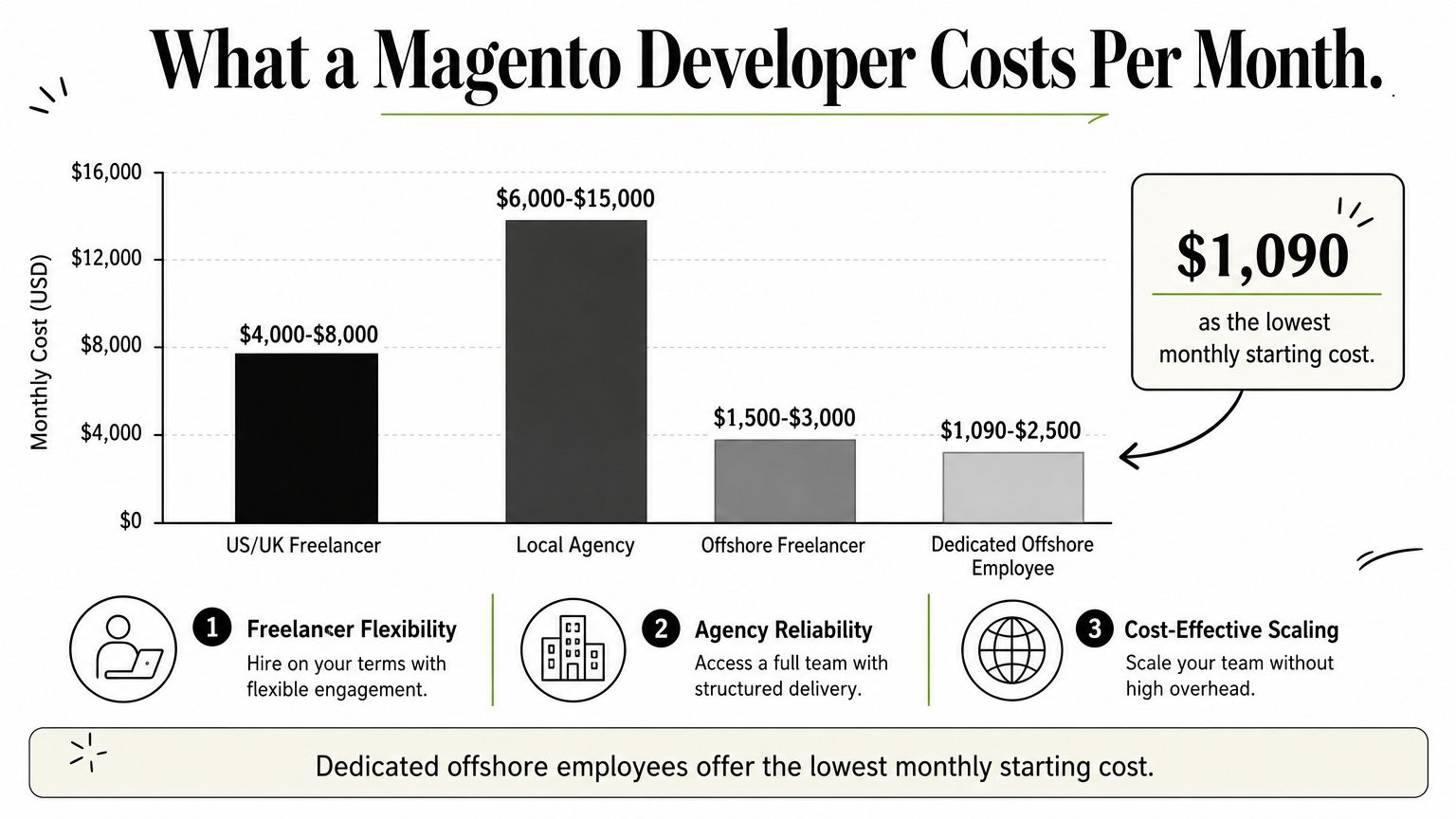
| Hiring Model | Typical Monthly Cost (USD) | Best For |
|---|---|---|
| US/UK Freelancer | $4,000-$8,000 | Short, urgent fixes |
| Local Agency | $6,000-$15,000 | Full builds with account management |
| Offshore Freelancer | $1,500-$3,000 | Budget-conscious, low-complexity work |
| Dedicated Offshore Employee | $1,090-$2,500 | Ongoing, full-time work at lower overhead |
The biggest cost mistake isn't overpaying for talent, it's underpaying for oversight and paying twice to fix the damage.
Getting these numbers wrong early is how projects blow past budget before the real work even starts, so it's worth reading a fuller breakdown of Magento developer pricing before you commit.
Red flags that should stop you from hiring
Several warning signs show up consistently across bad Magento hires, and catching them early saves real money:
- No live portfolio links, only screenshots or vague client names.
- Reluctance to discuss specific Magento versions they've actually worked with.
- Certification claims with no verifiable badge or certificate number.
- Promises to finish complex custom work in unrealistic timeframes.
Question anyone who can't explain caching, indexing, or Magento's module structure in plain terms. Those fundamentals separate developers who understand Magento from developers who've merely used it once. If you'd rather skip this vetting entirely, GlobalEmployees pre-screens Magento and other online store developers before you ever see a resume, cutting the guesswork out of this whole step.
Step 1. Define your project scope and budget
Skipping this step is the fastest way to end up with a mismatched hire and a blown budget. Before you post a job or contact an agency, write down exactly what needs to happen: a full site rebuild, a Hyva theme migration, ongoing maintenance, or a single broken integration that needs fixing this week. Defining your project scope in writing forces you to think through requirements you'd otherwise discover halfway through the work, when changing course costs three times as much.
List out deliverables, not vague goals
Turn your project into concrete deliverables instead of general statements like "improve the site." A scope document should answer:
- What pages, modules, or features need to change?
- Which Magento or Adobe Commerce version and extensions are involved?
- Is this a one-time project or ongoing work?
- What's your target launch date, and is it flexible?
- Do you need design work, or just development?
Hand this document to every candidate you interview. Their questions about it tell you more about their experience than their resume does.
Match your budget to the actual complexity
Complexity drives cost more than anything else in Magento work. A simple extension install runs a few hundred dollars with a freelancer. A full storefront rebuild with custom modules and third-party integrations can run tens of thousands with a US agency, or a fraction of that with a dedicated offshore hire once you account for the full overhead behind a local hire. Set your budget range before you start sourcing candidates, not after you fall for a pitch.
A project scope you can't explain in five sentences is a project you can't budget accurately.
Once you have a scope, decide whether you're hiring for a short-term project or long-term Magento support. These require different approaches entirely. A short fix suits a freelancer or agency retainer. Ongoing store management, feature rollouts, and performance tuning suit a dedicated full-time hire, since you're not paying premium hourly rates for someone to relearn your codebase every time an issue comes up.
Realistically, pad your budget by 15-20% for scope creep. Magento projects almost always uncover something unexpected once a developer gets into the codebase, whether that's outdated extensions, unpatched security holes, or database bloat from years of unmanaged data. Building that buffer in now means you won't be scrambling to renegotiate mid-project or cutting corners to stay within a number you set before anyone looked under the hood.
Step 2. Choose your hiring model
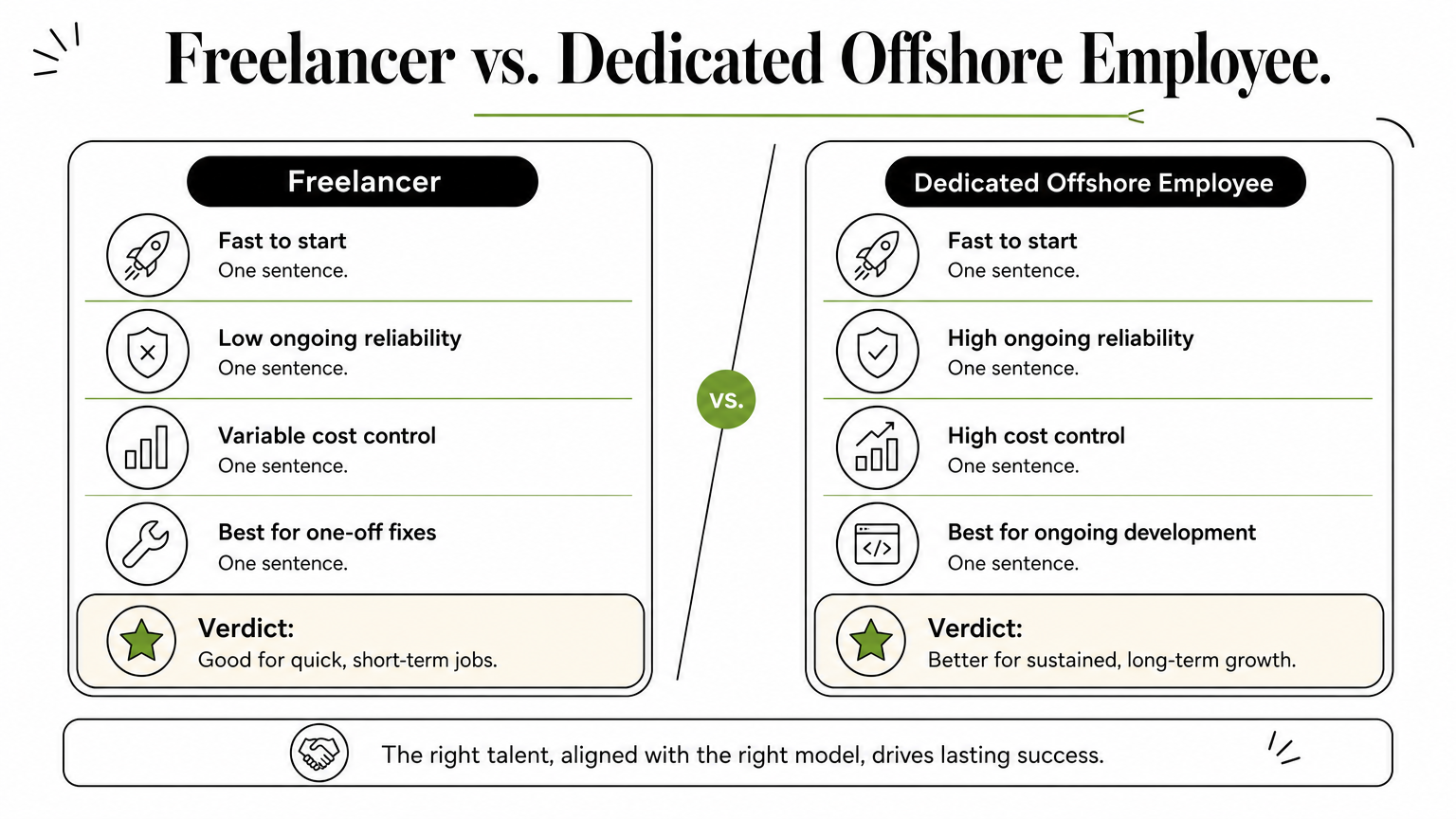
With your scope and budget locked in, the next decision is who actually does the work. Choosing your hiring model shapes everything downstream, from how much oversight you'll need to how fast you can scale if the project grows. Most businesses hiring a Magento developer land on one of three paths: a freelancer, an agency, or a dedicated offshore employee. Each fits a different kind of project, and picking the wrong one is how good budgets turn into bad outcomes.
Freelancers: fast but flaky for anything long-term
Freelancers work well for small, well-defined tasks: a broken checkout, a plugin conflict, a one-off theme tweak. You get speed and low commitment, but you also inherit the risk of someone juggling five other clients while yours sits in a queue. Freelancers rarely stick around for ongoing store management, and vetting them individually eats time you probably don't have, which is the core of the short-term contractor versus long-term remote hire decision.
Agencies: built for big builds, priced accordingly
Agencies make sense for large, complex projects that need multiple specialists working in parallel, like a full Adobe Commerce migration with custom B2B features. You get project management and a team structure, but you pay for that overhead, and you rarely get to choose exactly who's writing your code day to day.
Dedicated offshore employees: full-time focus without full-time cost
A dedicated offshore employee works only on your store, learns your codebase, and sticks around for the long haul, all without US or European salary and infrastructure costs. This model fits businesses that need ongoing development, not a single fix and a goodbye.
Hire for the project you have today, but pick a model that can absorb the project you'll have in six months.
| Model | Speed to Start | Ongoing Reliability | Cost Control | Best Fit |
|---|---|---|---|---|
| Freelancer | Fast | Low | Variable | One-off fixes |
| Agency | Moderate | High | Low | Large, complex builds |
| Dedicated Offshore Employee | Fast | High | High | Ongoing development and support |
Running a growing store with recurring feature requests? A dedicated hire through a service like GlobalEmployees removes the recruiting, payroll, and infrastructure burden while giving you someone who works exclusively on your Magento environment, at a fraction of what a US-based hire or agency retainer would run you monthly.
Step 3. Source and shortlist candidates
Once you know your scope and hiring model, the next job is finding actual humans to fill it. Where you look to find a Magento developer depends heavily on the model you picked in Step 2, but casting too wide a net wastes time on unqualified applicants, while too narrow a search leaves you stuck with whoever happens to answer first.
Where to look, based on your hiring model
Each hiring path has its own best sourcing channel. Match your search to the model instead of posting everywhere at once:
- Freelance platforms (Upwork, Toptal) for one-off fixes or short projects.
- Magento-specific job boards and forums for developers already immersed in the ecosystem.
- Agency directories like Adobe's Solution Partner list for large builds needing a full team.
- Staffing partners like GlobalEmployees for full-time, dedicated offshore hires without running your own recruiting funnel.
If you're leaning toward a dedicated hire, skipping the open market entirely and going through a staffing partner saves weeks. GlobalEmployees, for instance, gives you free access to vetted resumes before you commit to anyone, so you're shortlisting from candidates who've already cleared a technical screen, and you can see what hiring a pre-vetted remote employee involves end to end.
Build a shortlist that survives a real interview
Don't interview every applicant who replies. Filter first, then talk to people. A quick resume scan should eliminate anyone missing these basics:
- Named, live projects you can actually visit and click through.
- Specific Magento or Adobe Commerce version experience matching yours.
- Clear explanation of their role on past projects, not just "worked on Magento sites."
- No unexplained employment gaps or vague job titles like "web expert."
Aim for a shortlist of five to eight candidates for a freelance search, or two to three finalists if you're going through an agency or staffing partner that's already pre-vetted the pool.
A shortlist built on resumes alone is a guess. A shortlist built on live work is a decision.
When you're comparing candidates from multiple sources, keep notes in one place, rate limits, communication speed, portfolio depth, so you're not relying on memory a week into the process. This step is where sourcing Magento talent turns from a search into an actual decision, and it sets up everything that follows: the technical vetting in Step 4 only works if the people in front of you are worth vetting in the first place.
Step 4. Vet technical skills and certifications
A shortlist tells you who looks qualified; vetting tells you who actually is. This step is where you separate developers who've genuinely built on Magento from those who've read about it. Verifying technical skills now, before any code gets written, catches problems that a resume and a friendly interview never will.
Confirm certifications actually check out
Don't take a certification claim at face value. Adobe maintains a public certification directory where you can look up a candidate's badge by name or ID, so ask for that number directly and check it yourself before the interview even happens. A candidate who hesitates or can't produce it is telling you something important. Certified Magento developers should be able to walk you through what the exam actually covered, architecture, security, performance tuning, not just recite that they passed it.
Ask questions that only real experience can answer
Buzzword familiarity falls apart fast under specific questions. Skip generic interview scripts and build on a proper set of technical and communication questions for remote candidates, asking things that require hands-on scars:
- How do you clear and warm Magento's cache after a deployment, and why does order matter?
- Walk me through reindexing when a product change isn't showing on the storefront.
- What's your process for testing a third-party extension before installing it on a live store?
- How do you handle a Magento core update that conflicts with a custom module?
If a developer can't explain caching or indexing without notes, they've used Magento, not mastered it.
Listen for specifics, version numbers, actual error messages they've debugged, tools they reach for. Vague answers about "best practices" without detail are a warning sign, not a passing grade.
Review actual code, not just talk
Requesting a code sample or a walkthrough of a past project's repository tells you more than any conversation. Look for clean module structure, proper use of Magento's dependency injection, and comments that show someone else could pick up the work later. Technical vetting at this depth takes an extra hour or two, but it's far cheaper than discovering three weeks in that a developer's "five years of Magento experience" was mostly copying tutorials. If you're hiring through a staffing partner, this entire step should already be handled, GlobalEmployees runs candidates through exactly this kind of technical screening before they ever reach your shortlist.
Step 5. Run a skills test or paid trial
Interviews and certifications tell you what a candidate says they can do. A skills test or paid trial tells you what they actually do when the clock is running and nobody's coaching them through it. Skip this step and you're betting real budget on conversation alone, which is exactly how underqualified developers slip through a hiring process that looked thorough on paper.

Design a test that reflects real work
Generic coding puzzles don't tell you much about Magento specifically. Build a small, scoped task pulled straight from your own environment instead, something you can evaluate in under an hour but that still exposes real gaps. Good options include:
- Fixing a broken checkout calculation on a sandbox instance.
- Building a small custom module that adds a field to the product page.
- Debugging a cache issue you've deliberately introduced into a test store.
- Reviewing a chunk of existing code and flagging what they'd refactor.
Task: Add a custom attribute to the checkout summary block
Environment: Magento 2.4 sandbox (provided)
Deliverable: Working module + short write-up of your approach
Time limit: 4 hours, paid at your standard rate
Pay for this time. Asking for free work signals you don't respect a developer's time, and it filters out strong candidates who don't need to work for free to prove themselves.
A paid skills test costs a few hundred dollars. A bad hire costs a few thousand and a missed launch date.
Run a paid trial before you commit long-term
For a dedicated hire or anyone you're bringing on for ongoing work, extend the same logic into a short paid trial, one to two weeks of real tasks pulled from your actual backlog. This goes further than a single test because it shows you how someone handles a real workload, communicates about blockers, and manages their own time without daily supervision. Watch specifically for how they document their work and whether they ask clarifying questions before diving in, both are strong signals of how they'll behave once they're managing your store unsupervised.
Staffing partners often build this step into their process already. GlobalEmployees, for example, runs candidates through technical assessments before you ever interview them, so the trial period becomes confirmation rather than discovery. That difference alone can shave a week or two off your total time to hire.
Step 6. Check portfolio, references, and fit
A candidate can ace a skills test and still be wrong for your team. This step checks the parts a technical exercise can't measure: real client history, communication habits, and whether they'll actually mesh with how you work day to day. Skipping it is how businesses end up with a technically strong developer who misses deadlines, ghosts on Slack, or can't explain a decision without three follow-up emails.
Verify the portfolio is actually theirs
Don't just glance at screenshots. Ask for live URLs you can click through yourself, and if the store is still active, check page speed, checkout flow, and whether extensions look custom or off-the-shelf. Cross-reference their claimed role against what's visible; someone who says they "led the rebuild" should be able to walk you through specific decisions, not just describe the finished product. Checking portfolio authenticity matters more with Magento than with simpler platforms, because a store that looks polished on the surface can still be held together with unpatched extensions and technical debt underneath.
Call references, not just read them
A list of names on a resume proves nothing until you actually talk to those people. Reach out to at least two past clients or managers and ask specific questions:
- Did they meet deadlines consistently, or was there a pattern of slipping timelines?
- How did they communicate blockers or delays?
- Would you hire them again for a similar project?
- Did the finished work need significant rework after handoff?
A glowing resume means nothing if the person who actually worked with them hesitates when you ask "would you hire them again?"
Listen for hesitation as much as the actual words. A reference who pauses before answering "would you hire them again" is telling you something a resume never will.
Weigh cultural and communication fit
Technical skill gets a developer through the door, but fit for the role determines whether the relationship lasts past the first sprint. Consider time zone overlap, English fluency for daily standups, and whether their working style matches yours, some developers thrive with minimal oversight, others need clearer daily check-ins. This matters even more with offshore hires, where a staffing partner like GlobalEmployees can help by matching candidates not just on skill but on communication style and availability that actually overlaps with your working hours. Getting this right now saves you from a mid-project mismatch that no amount of technical talent can fix.
Step 7. Finalize the contract and onboard
You've picked your developer. Now the paperwork and setup determine whether this hire actually delivers or stalls out in week one. Finalizing the contract properly protects both sides, and a rushed onboarding wastes the momentum you built through six steps of vetting. Treat this step with the same care as the interview process, because a vague agreement or a messy first week sets the tone for everything that follows.
Nail down contract terms before anyone starts
Every Magento contract, whether it's a freelance gig, an agency retainer, or a dedicated hire, needs the same core protections spelled out in writing. Confirm these before signing:
- Scope of work matching the document from Step 1, with change-request terms for anything outside it.
- Payment schedule tied to milestones, not just hours logged.
- Code ownership and IP rights, explicitly transferred to you on delivery.
- Data security terms: NDAs, VPN requirements, and access limits on your store's backend.
- Termination or replacement terms if the fit isn't working after 30 days.
A contract without a replacement clause is a bet you can't hedge if the hire doesn't work out.
Dedicated hiring models built for flexibility, like the ones GlobalEmployees offers, skip long-term lock-in entirely. No long-term contracts means you can scale the engagement up or down without renegotiating a legal document every time your needs shift.
Set up access and infrastructure before day one
Getting your developer access to the right systems ahead of their start date avoids losing their first few days to logins and permissions. Prepare admin credentials, staging environment access, version control, and any project management tools before onboarding begins, the same way you'd plan a handover of work to a remote team. Onboarding a developer who's ready to work immediately, rather than waiting on IT tickets, makes the first week meaningfully more productive.
Structure the first two weeks with clear checkpoints
Don't leave the first stretch open-ended. Set a short list of concrete tasks pulled straight from your backlog, schedule a check-in at the end of week one, and a fuller review at day 30. This mirrors the paid trial from Step 5, just extended into the real engagement, and it catches communication or workflow issues early, while they're still cheap to fix.
Putting your hiring plan into action
Seven steps stand between you and a Magento hire that actually works out: scope, model, sourcing, vetting, testing, fit, and contract. Skip any one of them and you're gambling with a platform that punishes shortcuts, whether that's a botched checkout or a developer who vanishes mid-project. Knowing how to hire a Magento developer isn't about finding the cheapest option, it's about matching the right skill set to the right engagement model before you sign anything.
Go back through your notes from Step 1 and confirm your scope still matches what you're about to commit to. If the process above sounds like more vetting than you have time for, that's exactly the gap staffing partners exist to close. Get full-time Magento and Adobe Commerce developers from $1,090 a month and skip straight to a shortlist of pre-vetted candidates, no recruiting, no guesswork, and no long-term contract locking you in if your needs change.
Need to hire dedicated remote talent?
Tell us the role, experience, and AI skills your team needs.
Hire Talent Now