

Managed Services vs Staff Augmentation: Which Fits You?
Managed Services vs Staff Augmentation: Which Fits You?
You need more technical capacity, and now you're stuck comparing two sourcing models that sound similar but work completely differently. Get this choice wrong and you end up paying for a vendor who controls your roadmap, or worse, hiring contractors you have to babysit through every task. The managed service vs staff augmentation decision shapes your budget, your timelines, and how much control you keep over daily work.
Here's the short answer: staff augmentation puts skilled people under your direct management, working inside your existing processes and reporting to you. Managed services hand an entire function or outcome to an outside provider who owns the delivery, the team, and the results. One gives you control and flexibility; the other gives you a finished deliverable and less oversight.
In this article, we'll break down exactly how these two models differ in cost structure, management responsibility, and scalability, then walk through the scenarios where each one makes sense. If you're a founder or hiring manager trying to build a dedicated offshore team without guessing wrong on structure, you'll leave with a clear answer for your specific situation, whether that's hiring individual developers or building out a full department.
Why the right model changes your costs and control
Money is the first thing most founders notice when they compare these models, the same way they weigh what a local hire really costs against a remote team, but the real difference is where the risk sits. Staff augmentation charges you a flat monthly rate per person, so your costs scale directly with headcount. You know exactly what a developer or marketer costs each month, and you can add or remove people as your workload shifts. Managed services typically price around a scope of work or outcome, which means the provider absorbs the risk of scope creep, but you pay a premium for that protection. Get the scope wrong upfront and you're renegotiating contracts mid-project.

Control works the opposite way. With staff augmentation, you set the priorities, run the standups, and decide what gets built first. The people work inside your systems, using your project management tools, reporting to your team leads. With managed services, you hand that steering wheel to the vendor. They decide staffing, workflow, and often the technical approach, and you receive updates and deliverables rather than daily visibility into the work itself.
Staff augmentation buys you control over the work; managed services buys you freedom from managing it.
Scalability differs too. Augmented staff can be added or released with short notice, which matters if your roadmap changes every quarter. Managed service contracts usually lock you into a defined scope for a set period, so pivoting mid-contract costs you time and often money. Here's how the two stack up on the factors that actually affect your bottom line:
| Factor | Staff Augmentation | Managed Services |
|---|---|---|
| Cost model | Flat rate per person, per month | Fixed price or outcome-based |
| Who manages daily work | Your internal team | The provider |
| Speed to scale up/down | Fast, days to weeks | Slower, contract-bound |
| Risk of scope creep | Falls on you | Falls on provider |
| Best for | Ongoing internal capacity | Defined project outcomes |
This is exactly the tension we see when businesses come to us asking about staff augmentation versus dedicated remote staffing or a fully outsourced project. Companies with an established internal process usually want staff augmentation because they already know how to manage the work, they just need more hands. Companies without that internal bandwidth often lean toward managed services because they don't want to build a management layer just to get one project done. Neither choice is wrong, but picking the one that matches your internal capacity determines whether you spend the next six months building product or babysitting a vendor relationship. Recognizing that distinction early saves you from the two most common mistakes: over-managing contractors you were told would work independently, or under-managing a vendor who needed more oversight than you gave them.
How to decide which model fits your project
Before you pick a model, look inward first. Ask yourself how much bandwidth your internal team has to manage new hires, because that answer matters more than the price tag on either option. If you already have a project manager who can run standups, assign tickets, and review pull requests, staff augmentation lets you add capacity without adding overhead. If nobody on your team has time to manage another person's daily workload, you're better off handing the whole function to a managed services provider who brings their own management layer.
Match the model to your project scope
Next, look at how well-defined your project actually is. A clear, fixed-scope project with a known end date, like a website rebuild or a data migration, fits managed services because the vendor can price and staff it against a fixed outcome. An open-ended, evolving workload, like ongoing product development or long-term marketing execution, fits staff augmentation because your priorities will shift and you need people who adapt with you rather than a contract that locks in deliverables.
If your scope is fixed, buy an outcome. If your scope keeps changing, buy people.
Run through this checklist before you commit:
- Do you have someone in-house who can manage day-to-day work? If yes, lean toward staff augmentation.
- Is your scope locked and unlikely to change? If yes, managed services fits better.
- Do you need people embedded in your existing tools and culture? Staff augmentation wins here.
- Is speed to hire more important than deep process ownership? Staff augmentation typically moves faster.
The difference between staff augmentation and managed services usually comes down to this: one assumes you want to run the show, the other assumes you want someone else to run it for you. If you're leaning toward direct control, browse pre-vetted candidates across every role before committing to either path.
Staff augmentation vs managed services at a glance
Sometimes you just need the numbers side by side without wading through paragraphs of explanation. Below is a quick-reference comparison that pulls together everything from cost structure to contract flexibility, so you can hold both models up against your own situation in one glance rather than piecing it together from separate sections.
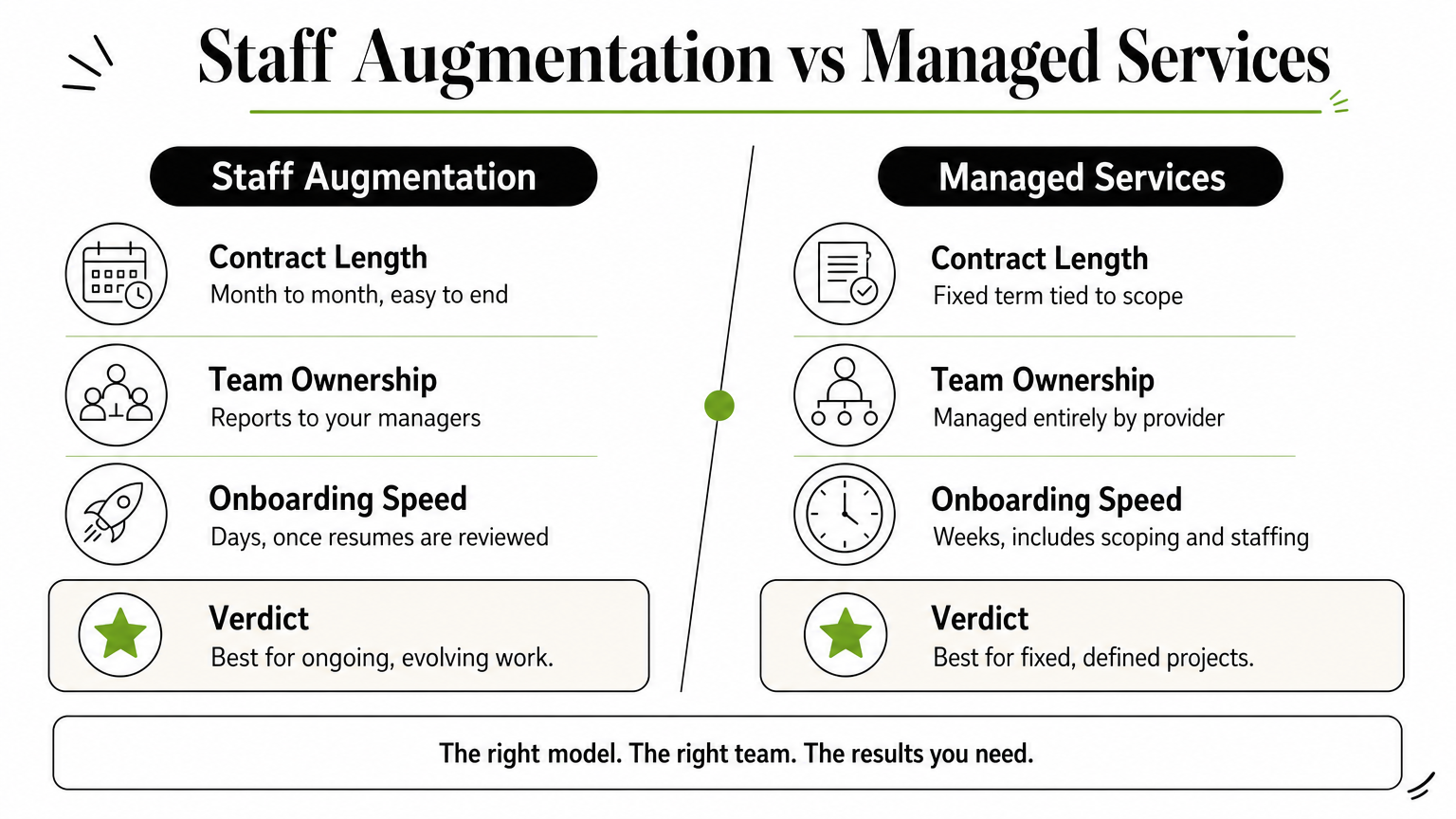
Side-by-side comparison
Use this table as a gut-check whenever a client, partner, or your own team asks about staff augmentation vs managed services and you need a fast, defensible answer.
| Factor | Staff Augmentation | Managed Services |
|---|---|---|
| Contract length | Month to month, easy to end | Fixed term tied to scope |
| Team ownership | Reports to your managers | Managed entirely by provider |
| Onboarding speed | Days, once resumes are reviewed | Weeks, includes scoping and staffing |
| IP and process control | Stays fully with your company | Shared, often provider-defined |
| Ideal use case | Ongoing dev, marketing, ops work | Defined projects with fixed deliverables |
When you compare managed services vs staff augmentation side by side, the real question isn't which is better, it's which matches how much control you want to keep.
Why the labels get confused
Part of the confusion around IT managed services vs staff augmentation comes from vendors blending the two terms in their marketing. A provider might call a team of augmented developers a "managed team" because they handle payroll and HR, even though your company still directs the daily work. That's not a managed service in the true sense, it's staffing with extra administrative support, which is worth checking against how staff augmentation actually works. Watch for this distinction when you're reading proposals, because the pricing model and the level of oversight you'll actually get depend on which one you're really buying, not on what the vendor chooses to call it.
Real-world scenarios for each model
Picture a SaaS startup that just closed a funding round and needs to bring on three more backend developers to keep shipping features every two weeks. They already have a product manager running sprints and a CTO reviewing code. This is a textbook case for staff augmentation: the founder adds a dedicated offshore team of engineers who plug into existing Slack channels, join the same standups, and take tickets from the same backlog. Nobody has to build a new management layer, and the company scales headcount up or down as funding milestones hit.

Now picture a mid-sized retailer migrating its entire e-commerce platform to a new backend before Black Friday. The internal team has no bandwidth to manage a six-month build, and the scope is fixed: migrate the catalog, rebuild checkout, launch by a hard deadline. This is where managed services make sense. The retailer hands the project to a provider who staffs it, sets the technical approach, and delivers a working platform on a fixed timeline. The retailer checks in on milestones instead of running daily standups.
The scenario that fits you isn't about company size, it's about who's already equipped to manage the work.
A third case sits in between: a marketing agency needs ongoing content production but also wants a one-time website redesign. They keep two remote content writers on staff augmentation for the recurring workload and bring in a managed services provider for the redesign, since that project has a clear start and end date. This blended approach shows up constantly among businesses that outsource through GlobalEmployees, because most companies aren't purely project-based or purely operational. They're both, depending on the week, and the sourcing model should match the actual work in front of them rather than a one-size label.
Combining both models for maximum flexibility
Most growing companies don't stay in one lane forever. A startup that hires staff augmentation developers for daily feature work often discovers a quarter later that it also needs a managed services provider to handle a one-off compliance audit or a platform migration nobody in-house has time for. Running both staff augmentation and managed services at once isn't a compromise, it's how mature engineering and marketing departments actually operate once they outgrow a single sourcing model.
The smartest teams don't pick one model and stick with it forever, they match the model to the work in front of them, every quarter.
How the hybrid model works in practice
Think of it as two separate budgets solving two separate problems. Your core, ongoing workload, the features, the campaigns, the support tickets that never stop, gets staffed with dedicated employees who report to your managers and grow with your product. Your time-boxed initiatives, the ones with a defined start and finish, get handed to a managed provider who owns the outcome and reports back on milestones instead of daily standups.
A hybrid setup typically looks like this:
- Two or three augmented developers embedded in your sprint cycle for continuous product work
- A managed services contract for a fixed project like a security audit, ERP rollout, or platform rebuild
- Shared reporting so leadership sees both budgets and both timelines without confusing the two
This split keeps your fixed costs predictable while still giving you a way to absorb one-time projects without pulling your core team off their roadmap. If you want to build the ongoing side of that mix first, start by reviewing available developer profiles in India before deciding where a managed contract might fill the gaps.
Choosing your path forward
Both models solve real problems, but only one matches the way your team actually works right now. Staff augmentation fits businesses with an internal manager ready to direct daily work and a workload that keeps shifting. Managed services fits a fixed-scope project where you'd rather hand over the steering wheel than build a management layer for something you'll only do once. Neither one is the "better" model in general, only the better fit for your specific bandwidth and scope.
Getting this decision right saves you months of either micromanaging contractors or waiting on a vendor who doesn't know your priorities. Now that you know which side of the managed service vs staff augmentation question you land on, the next step is finding people who fit that model. If ongoing capacity is what you need, build a dedicated offshore team that reports to you and start reviewing candidates this week.
Need to hire dedicated remote talent?
Tell us the role, experience, and AI skills your team needs.
Hire Talent Now