How to Hire a Full-Stack Developer: A Step-by-Step Guide
You need someone who can build the front end, wire up the back end, and keep the database from falling over, all without you hiring three separate specialists. That's why so many founders search hire a full-stack developer instead of piecing together a team they can't yet afford or manage.
The real question isn't whether full-stack talent exists. It's where to find developers who are actually vetted, what a fair rate looks like in 2026, and how to avoid the freelance marketplace lottery where half the profiles are exaggerated. This guide walks through the exact steps: defining your project scope, choosing between freelance platforms and dedicated offshore hires, screening for real technical skill, and negotiating pay that matches experience instead of guesswork.
We'll also cover where hiring a full-stack developer through a staffing partner beats freelancing sites, especially when you want payroll, compliance, and replacement guarantees handled for you. By the end, you'll have a repeatable process for building a reliable development team, whether you need one developer for a six-week project or a dedicated hire for the long haul.
What full-stack developers do and typical rates
A full-stack developer handles both sides of your application: the interface users click on and the server logic that makes it work. That means front-end frameworks like React, Vue, and modern JavaScript specialists work with, paired with back-end languages like Node.js, Python, PHP, or Ruby. They also touch databases (PostgreSQL, MySQL, MongoDB), basic DevOps (deploying to AWS or Vercel), and often API integrations. You're not hiring a specialist who only writes CSS or only tunes SQL queries. You're hiring someone who can carry a feature from wireframe to production.
The core skill set you should expect
Before you post a job or reach out to a staffing partner, know what "full stack" should actually include. A candidate who's genuinely qualified will show comfort across most of this list, not just one layer:
- Front-end markup and styling (HTML, CSS, a modern JS framework)
- Server-side language and framework (Node/Express, Django, Laravel, Ruby on Rails)
- Database design and queries (relational and/or NoSQL)
- REST or GraphQL API design
- Version control (Git) and basic CI/CD workflows
- Cloud deployment basics (AWS, Azure, or Google Cloud)
If a resume lists all of this but the portfolio only shows static landing pages, that's one of the red flags to watch for in full stack developer hiring, worth chasing down in the interview stage, which we'll cover shortly.
What rates actually look like
Rates vary more by hiring model than by raw skill level, which surprises a lot of first-time hirers. A full stack developer for hire through a US freelance marketplace can run $75 to $150 an hour. A dedicated offshore hire through a staffing company typically costs a flat monthly rate instead, which is easier to budget against a fixed runway.
| Hiring Model | Typical Cost | Best For |
|---|---|---|
| US-based freelancer | $75-$150/hour | Short, high-stakes projects needing local time zone overlap |
| European freelancer | $50-$100/hour | EU-based teams needing GDPR familiarity |
| Upwork/Toptal contractor | $40-$120/hour | One-off tasks, quick prototypes |
| Offshore dedicated hire (India) | $1,090-$2,500/month | Long-term, full-time roles needing consistent output |
| In-house US hire | $90,000-$140,000/year | Companies needing on-site presence or deep IP control |
A dedicated full-time hire almost always costs less per month than the same developer billed hourly on a freelance platform.
The math is straightforward once you see it laid out. A US freelancer at $100/hour working 160 hours a month costs $16,000, which is worth reading against what US developer salaries look like next to Indian rates in 2026. A dedicated developer based in India with the same stack experience, hired through a staffing partner, often costs under $2,000 a month, with payroll, HR, and equipment already handled. That's not a knock on freelancers, who are genuinely useful for short sprints. But if you need someone for six months or longer, the monthly-rate model changes your unit economics entirely.
Where you land on this table depends on project length, budget, and how much oversight you want to provide. Freelance platforms work when you need a specific task finished fast. A staffing model works better when you want a developer who shows up every day, learns your codebase, and sticks around long enough to actually own a feature end to end.
Step 1. Define your project scope and hiring model
Before you write a job post or call a staffing company, figure out what you're actually building. Project scope decides everything downstream: how many hours you need, what skills matter most, and whether a freelancer or a dedicated hire makes more sense. Skipping this step is the number one reason founders end up with a mismatched developer three weeks into a contract, realizing the person they hired specializes in Django when the project needed Rails.
Start by answering four questions in writing, not just in your head:
- What's the deliverable? A landing page, an MVP, or ongoing feature work on an existing app?
- What's your tech stack, or are you flexible on it?
- Is this a fixed-scope project with an end date, or ongoing work with no clear stopping point?
- Do you need one generalist, or will this grow into a small team within six months?
Match the scope to the right hiring model
Once you know the scope, the hiring model almost picks itself. A fixed-scope project, like a marketing site rebuild or a one-time integration, fits a freelancer or an agency contract. You pay for defined deliverables, and the relationship ends when the work does. Ongoing product development is a different animal entirely. If you're building a SaaS product that will need continuous updates, bug fixes, and new features for the next year or more, a dedicated full-time hire almost always beats a freelancer on cost and continuity.
Scope decides your hiring model before cost ever enters the conversation.
This is where a lot of first-time hirers get it backwards. They start by asking "how much does a developer cost?" instead of "how long will I need this person?" Duration matters more than headline rate. A three-month freelance contract at $90/hour might run you $43,000. The same work spread over a dedicated hire's first three months, through a staffing partner, could land under $6,000, since you're paying a flat monthly rate instead of billing every hour of ramp-up and Slack messages.
Write your scope down as a one-page brief: project goal, stack, timeline, and expected weekly hours. You'll use this same document in Step 2 to screen candidates and in Step 4 to build your interview questions, so it's worth getting right before you start reaching out to anyone.
Step 2. Choose where to find qualified candidates
With your scope written down, you've got three real options: freelance marketplaces, referral networks, or a staffing partner that pre-vets candidates before you ever see a resume. Each one trades speed for certainty in different ways, and knowing that tradeoff upfront saves you weeks of back-and-forth. If you want to hire full stack developer talent fast without gambling on an anonymous profile, you need to know which channel matches your risk tolerance.
Freelance marketplaces and their limits
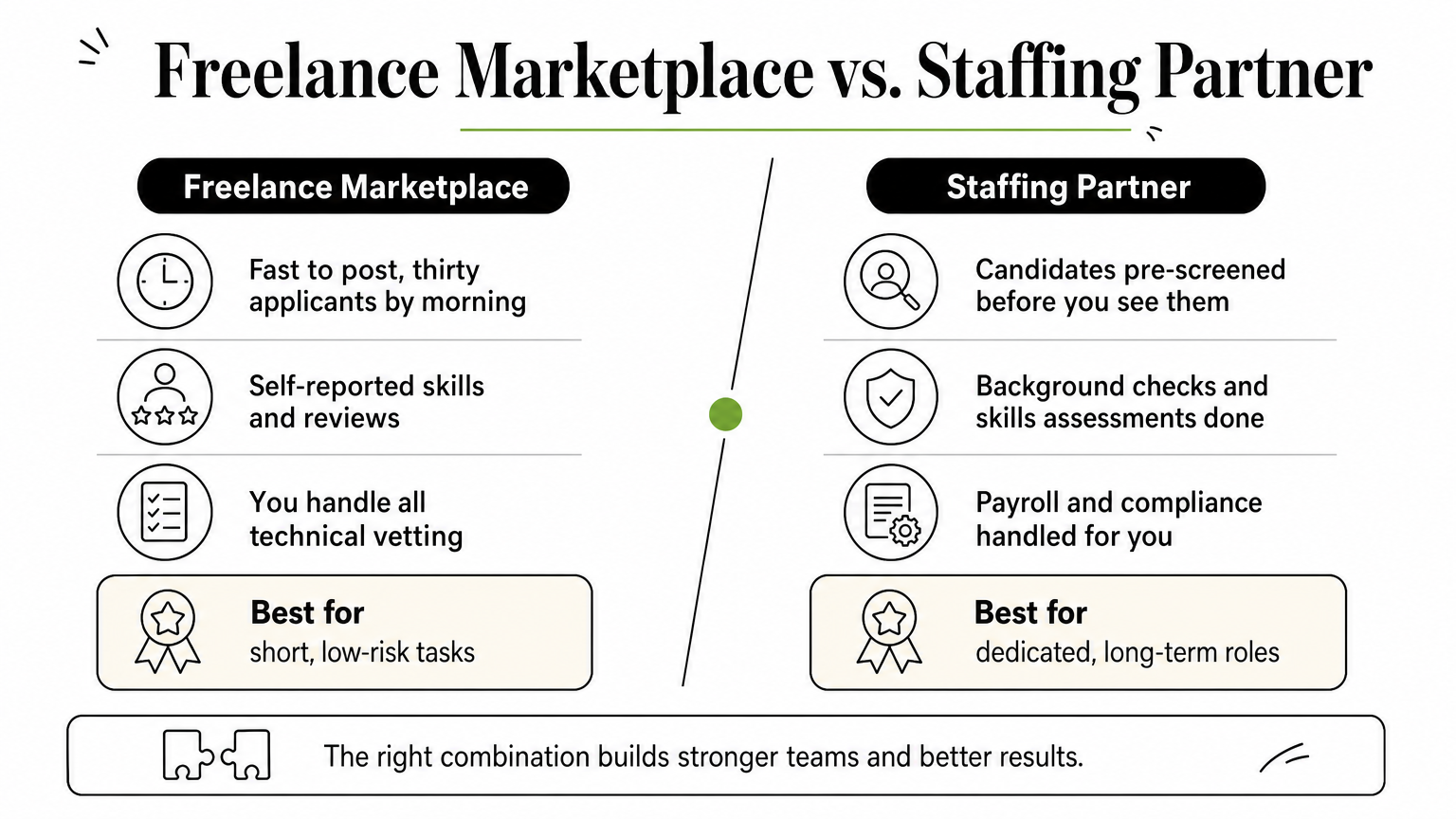
Upwork, Toptal, and the other platforms people use to hire full stack developers in India give you volume. You can post a job and get thirty applications by morning. The problem is verification. Portfolios get recycled, reviews get gamed, and "expert" badges don't always mean what they claim. Toptal screens harder than Upwork, but you still pay a premium for that filtering, and you're often left doing your own technical vetting regardless.
Referrals and your existing network
Asking other founders or developers for referrals still works, especially for senior hires. The catch is scale. A referral network gets you one or two candidates, not a pipeline, and it can take weeks to surface someone available right now. This works fine if you're patient and only need one person.
Staffing partners with pre-vetted talent
A staffing company that augments your in-house team flips the model. Instead of sorting through unverified applicants yourself, you get candidates who've already passed technical screening, background checks, and a skills assessment. GlobalEmployees, for example, gives you free access to sample resumes before you commit to anything, so you can gauge the talent pool before spending a dollar. That's a meaningfully different experience than posting a job and hoping the right person applies.
The fastest way to hire a qualified developer is to skip the sourcing step entirely and start from a pre-vetted shortlist.
| Channel | Speed | Vetting Level | Best Fit |
|---|---|---|---|
| Freelance marketplace | Fast | Self-reported, inconsistent | Short, low-risk tasks |
| Referral network | Slow | High, but limited pool | One senior hire, no urgency |
| Staffing partner | Fast | Pre-vetted, technically assessed | Dedicated, long-term roles |
If your project is a quick prototype, a marketplace is fine. If you're hiring someone who'll own your codebase for the next year, start with a partner who's already done the vetting for you.
Step 3. Vet skills, portfolios, and past work
Once you've narrowed a shortlist, resist the urge to skip straight to a phone call. Every developer's resume claims full-stack fluency, but portfolio depth separates the ones who actually shipped production code from the ones who copied a tutorial. Before you decide to hire full-stack developer candidates for an interview slot, spend thirty minutes on their public work. It's the cheapest filtering you'll do in the whole process.
Reviewing code samples and portfolios
Ask for a GitHub link or a live project, not just screenshots. Look at commit history, not just the finished product. Someone who committed steadily over months on a real repo tells you more than a polished Dribbble-style mockup ever will. Check whether the front end and back end in their sample project actually talk to each other, since plenty of "full-stack" portfolios are really just a styled front end sitting on top of dummy data.
Running a practical skills test
A short, paid technical assessment beats a resume every time. Keep it realistic and scoped to two or three hours, not a weekend-long ordeal that only unemployed candidates can afford to complete.
- Give them a small feature to build against a sample API
- Ask them to fix a deliberately broken function in an existing codebase
- Request a short write-up on how they'd scale the database as traffic grows
- Time-box the test and be explicit about what "done" looks like
A thirty-minute code review catches more red flags than a full hour of resume small talk.
Checking references and past client work
References matter more for offshore hires than most people expect, since you can't casually grab coffee with a former manager to sanity-check someone's story. Reach out to at least one past client or team lead and ask specific questions: did they meet deadlines, did their code need heavy rework after handoff, would you hire them again. Staffing partners that pre-vet candidates, like GlobalEmployees, already run this reference and background check step before a resume ever reaches you, which cuts your Step 3 workload down to a final sanity check rather than a full investigation from scratch.
Step 4. Interview candidates with targeted questions
Once a candidate clears the skills test, the interview should confirm what you already suspect, not introduce new guesswork. Targeted questions dig into how someone actually solved problems, not how well they can recite a definition of REST. If you're trying to hire a full stack developer who'll stick around past the first sprint, this step is where you separate strong communicators from strong engineers, since the two don't always overlap.

Technical questions that reveal real experience
Skip the whiteboard trivia and ask about their actual projects instead. Real-world scenarios expose gaps that generic algorithm questions miss entirely.
- "Walk me through a bug you spent more than a day chasing. What was it, and how did you find it?"
- "Describe a time you had to optimize a slow database query. What changed?"
- "How would you structure the API for a feature that needs to handle 10,000 concurrent users?"
- "What's a decision you'd make differently on a past project, knowing what you know now?"
Answers that stay vague or shift to textbook language usually mean the candidate hasn't actually done the work they're claiming.
Behavioral and communication questions
Behavioral fit matters more for remote and offshore hires than for someone sitting three desks away. Communication style under async conditions is the single biggest predictor of whether a remote hire works out long term. Ask how they've handled disagreements with a project manager, how they update stakeholders when a deadline slips, and how they document their own code for the next person who touches it.
A candidate who can explain a technical tradeoff in plain English is more valuable than one who can only explain it in jargon.
Give every candidate the same structured question set for remote engineering candidates, in the same order, so you're comparing answers fairly instead of judging each interview in isolation.
Structuring a 45-minute interview
Here's a format that keeps the conversation focused without running long:
0:00-0:10  Project walkthrough (their choice of past work)
0:10-0:25  Two technical scenario questions
0:25-0:35  One behavioral/communication question
0:35-0:45  Their questions for you, plus next-step expectations
If you're working with a staffing partner, this stage often gets shorter. GlobalEmployees pre-screens technical and behavioral fit before a candidate reaches your interview, so you're mostly confirming chemistry and project-specific expectations rather than starting the vetting process from zero.
Step 5. Finalize the contract and onboard your hire
Once you've picked your candidate, get the terms in writing before anyone touches a line of code. A clear contract structure protects both sides and prevents the scope-creep arguments that sink half of freelance relationships. Whether you're signing with a freelancer or activating a dedicated hire through a staffing partner, spell out payment terms, IP ownership, termination notice, and communication expectations before day one.
What your contract should cover
Don't rely on a generic template pulled from a random blog. Build the agreement around your actual project scope from Step 1, and confirm these points explicitly:
- Payment schedule (hourly invoicing vs. flat monthly rate)
- IP and code ownership, assigned to your company from the first commit
- Termination notice period, ideally 15-30 days for dedicated hires
- Confidentiality and data handling, including NDA terms for offshore work
- Working hours and expected overlap with your team's time zone
A contract that skips IP ownership terms isn't protecting your business, it's protecting your risk.
If you're hiring through a staffing company, most of this paperwork is handled for you. GlobalEmployees, for instance, builds NDAs, VPN access, and secured-device policies into every managed offshore placement, so you're not drafting compliance language from scratch or hoping a freelancer's personal laptop is actually secure.
Setting up access and tools on day one
Onboarding fails most often because access takes three days to sort out instead of thirty minutes. Before your developer's first shift, have their accounts ready: repository access, staging environment credentials, project management tool login, and a Slack or Teams channel. Send a short onboarding doc that covers your coding standards, branch naming conventions, and who to ping when something breaks.
The first two weeks matter most
Treat the first two weeks as a supervised ramp-up, not a hands-off start. Check in daily for the first week, then shift to a short standup three times a week once you're confident they've got their footing. Ask for a small, low-risk task first, like fixing a minor bug or writing a test, before handing over anything mission-critical. This gives you an early read on code quality and communication style without betting your roadmap on an unproven relationship.
A dedicated hire who ramps up cleanly in two weeks tends to stay productive for years. One who struggles silently in week one usually keeps struggling, which is exactly why a fast, structured onboarding process matters as much as the hiring decision itself.
Setting your new developer up for success
Getting this hire right isn't about finding the perfect resume. It's about matching project scope to the right hiring model, screening for real shipped work instead of self-reported skills, and building a contract that protects both sides before day one. Skip any of these five steps and you'll spend more time managing a mismatch than shipping features.
Speed matters just as much as rigor. Every week spent sorting through unverified freelance profiles is a week your roadmap slips. That's the gap a staffing partner closes: pre-vetted candidates, payroll and compliance handled, and a replacement guarantee if the fit isn't right.
If you're ready to skip the guesswork and start from a shortlist of screened candidates, see full-stack developer profiles and pricing here and get access to sample resumes before you commit to anything.