Full Stack Developer Hiring: What It Means and What It Costs
If you are trying to figure out full stack developer hiring costs before you post a job or call an agency, you are in the right place. Most guides throw around vague salary ranges or skip straight to job boards, leaving you guessing whether $60,000 or $120,000 is the real number for someone who can handle both frontend and backend work.
This article breaks down what hiring a full stack developer actually means today, from the skill set you should expect to the pricing models companies use, whether that's a US salary, a freelance rate, or an offshore monthly fee. You'll see how location and experience level change the math dramatically.
We'll also cover where most of the hidden costs show up, like recruiting fees, payroll taxes, and equipment, and how dedicated offshore hiring compares to building a local team. If you're weighing options like hiring in India through a staffing partner such as GlobalEmployees versus a traditional US hire, this guide gives you the real cost comparison you need to decide.
Why full stack developer hiring matters for your business
Businesses that get full stack developer hiring right build products faster and spend less money doing it. A single developer who writes React on the frontend and manages a Node or Python backend removes the coordination tax that comes with juggling two or three specialists on every feature. That matters most for startups and small teams, where each hire has to pull weight across the whole stack instead of just one narrow slice of it.
One hire covers two or three specialist roles
One developer who understands both ends of an application can move a feature from database schema to finished UI without waiting on a handoff. Full stack development hiring typically absorbs work that would otherwise require separate people:
- Building and styling the user interface
- Writing and securing backend APIs
- Designing database schemas and queries
- Basic deployment and server configuration
- Debugging issues that span both frontend and backend
A company that would normally need a dedicated front-end developer and a backend developer can often get by with one full stack hire for early-stage products, then add specialists later once the codebase and team grow.
Fewer handoffs mean faster shipping
Speed is where the value shows up fastest. When one person owns both sides of a feature, there's no waiting for a backend teammate to finish an endpoint before the frontend work can start, and no back-and-forth when a bug turns out to live at the boundary between the two. Teams that rely on full stack developer jobs filled internally report shorter release cycles simply because fewer people need to sign off before code ships.
Hiring one developer who can move across the whole stack removes the handoff delay that quietly eats weeks out of most product timelines.
Cost efficiency you can actually measure
Money is the other half of the equation, and it's where the case for combining roles gets concrete. Paying for one strong generalist costs less than paying two specialists, even when the generalist commands a premium salary. The table below shows how the math typically plays out in the US market, and how offshore hiring changes it further.
| Hiring Approach | Typical Annual Cost (US) | Notes |
|---|---|---|
| Separate frontend + backend developers | $170,000-$190,000 combined | Two salaries, two sets of benefits, more management overhead |
| One US-based full stack developer | $95,000-$120,000 | Covers both roles, still carries payroll tax and benefits costs |
| One offshore full stack developer (India) | roughly $13,000-$22,000 | Salary, HR, and infrastructure often bundled by a staffing partner |
Companies that route this through a staffing partner like GlobalEmployees skip the recruiting fees, payroll setup, and equipment costs baked into that first two rows, since those get handled as part of the placement.
Reduces hiring risk and turnover exposure
Generalists also lower the risk that comes from relying on narrow specialists. If a backend-only engineer leaves mid-project, you're stuck searching for someone with the exact same niche skill set while the project stalls. A full stack developer who already understands the whole codebase gives you more flexibility to shift priorities, cover for a departure, or reassign work without losing months of context. That flexibility is a big part of why hiring full stack developers has become the default starting point for lean teams, rather than an afterthought once budgets tighten.
How to hire a full stack developer step by step
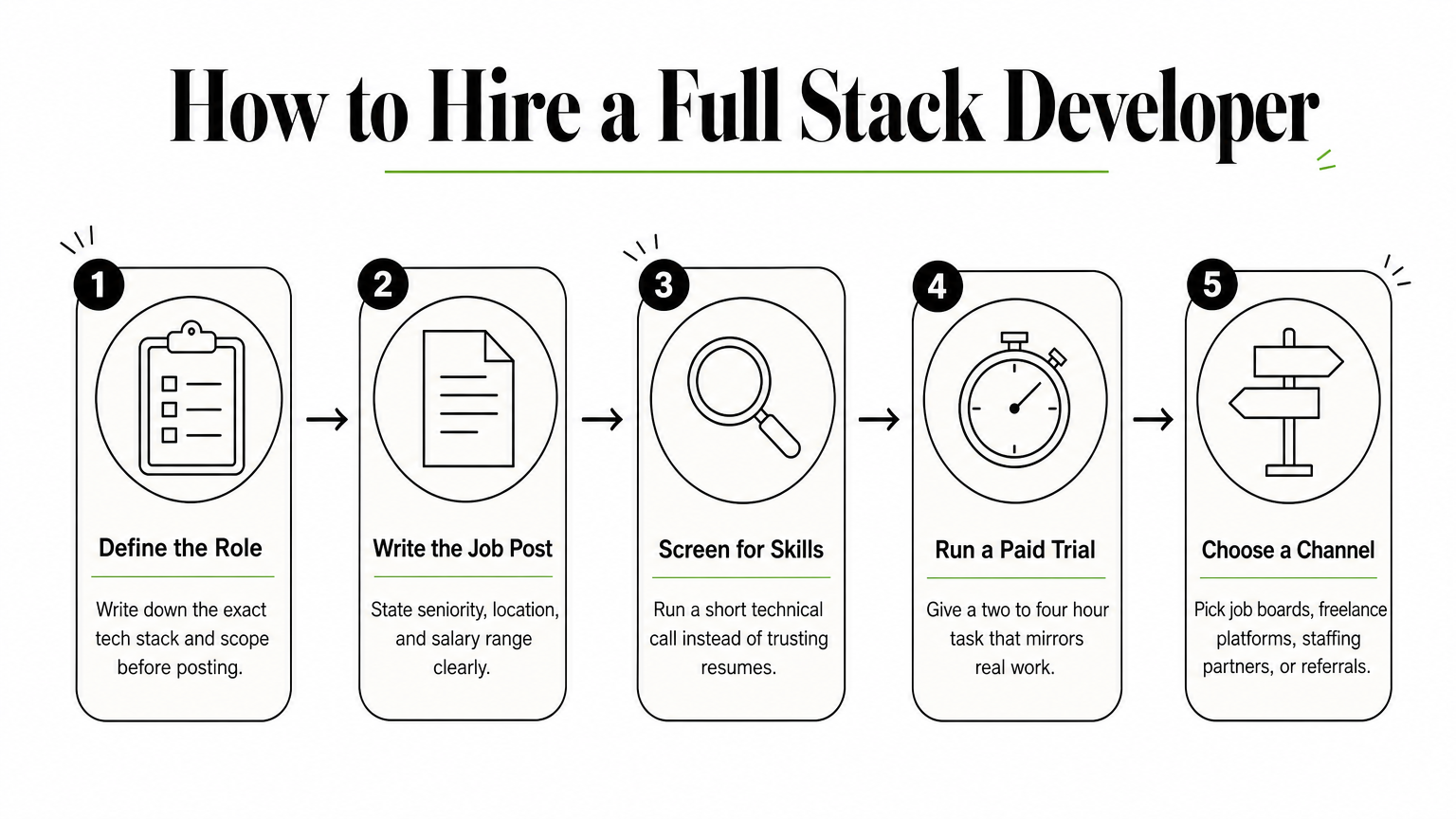
Hiring a full stack developer works best as a repeatable process, not a one-off scramble every time you need someone new, which is exactly what this step-by-step guide to hiring a full-stack developer lays out. Skipping steps is how companies end up with a developer who can build a login page but has never touched a production database, or someone who aces a whiteboard test but can't ship a real feature. The steps below apply whether you're posting on a job board, working with a recruiter, or hiring through a staffing partner that pre-vets candidates for you.
Define the role and scope before you write anything
Start by writing down exactly what the developer will touch: which frontend framework, which backend language, which database, and whether they'll also handle deployment or DevOps tasks. Vague postings that just say "full stack developer wanted" attract vague candidates. Being specific about your tech stack and the size of the codebase they'll inherit filters out people who aren't a real match before you waste time interviewing them.
Write a job description that filters correctly
A good posting does more than list technologies. It should state the seniority level, whether the role is remote or on-site, the salary or rate range, and what a typical week looks like. Candidates self-select out when the description is honest about scope, which saves you from wading through applicants who apply to everything regardless of fit.
Screen for real skills, not resume keywords
Resumes tell you almost nothing about whether someone can actually build software. A short technical screen, ideally a 30-minute call with a senior developer on your side, catches gaps that keyword matching misses entirely. Ask candidates to walk through a project they built end to end, including decisions they'd change if they did it again.
A resume tells you what someone claims to know. A working code sample tells you what they can actually build.
Run a paid trial task before you commit
A short, paid trial task, something that takes two to four hours and mirrors real work, remains the single best predictor of on-the-job performance. It reveals coding habits, communication style, and how someone handles ambiguity, none of which show up in an interview transcript. Companies that skip this step and hire off interviews alone report far higher early turnover.
Choose a hiring channel and finalize
Once you know what you're screening for, pick the channel that matches your budget and timeline:
- Direct job boards (LinkedIn, Indeed) for local hires, usually 4-8 weeks to fill
- Freelance platforms for short-term or project-based work
- Staffing partners like GlobalEmployees for pre-vetted, full-time offshore hires, often filled in 1-2 weeks
- Referrals through your existing network, fastest but limited in volume
Each channel trades speed, cost, and vetting depth differently, so match the choice to how urgent the hire is. If you go the offshore route, ask for sample resumes upfront so you can gauge quality before committing to interviews, which is how the offshore hiring process works with GlobalEmployees and worth insisting on with any staffing partner. Finalizing the hire should include a short trial period or money-back window, since even a well-vetted candidate can turn out to be a poor culture fit once real work starts.
What full stack developer hiring really costs
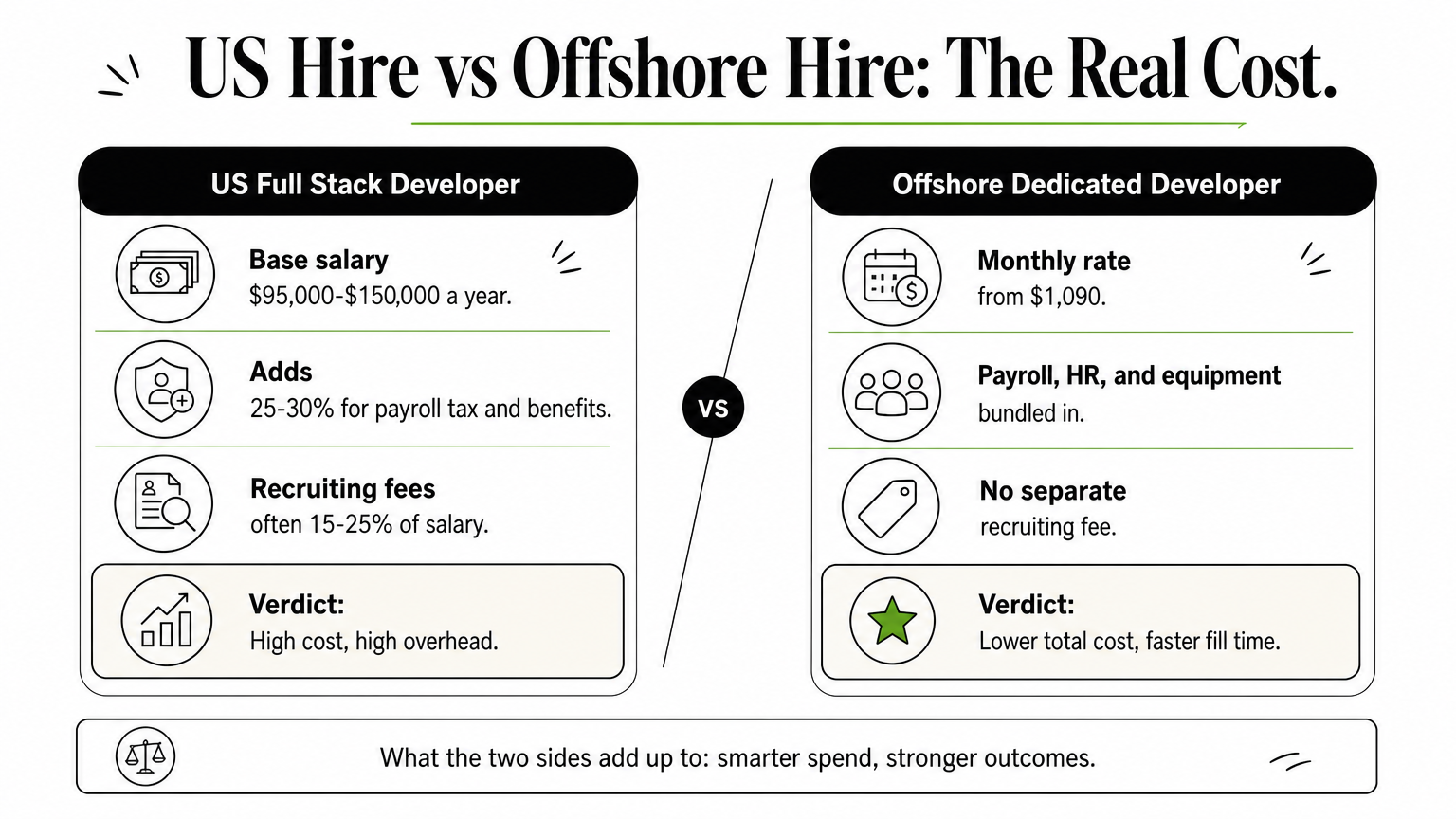
Most companies budget for a salary and stop there, but full stack developer hiring always carries costs beyond the number on the offer letter. Recruiting fees, payroll taxes, benefits, equipment, and management overhead all stack on top of base pay, and skipping that math is how a "$100,000 hire" quietly turns into $140,000 by year one.
What drives the base number
Experience level moves the price more than any other factor. A junior developer with one to two years of experience might command $65,000-$80,000 in the US, while a senior engineer with a decade of production experience can push past $150,000 in major tech hubs. Location matters almost as much: a developer in Austin or Denver typically costs 20-30% less than one in San Francisco or New York for the same skill set. Freelance rates follow a similar curve, ranging from $40 an hour for junior talent to $120 an hour or more for specialists in niche frameworks.
The hidden costs nobody budgets for
Beyond salary, a US-based full-time hire adds real overhead, and the full ownership cost of an in-house team adds up fast:
- Payroll taxes and benefits, typically 20-30% on top of base salary
- Recruiting fees, often 15-25% of first-year salary if you use an agency
- Equipment and software licenses, usually $2,000-$4,000 per developer
- Onboarding time, weeks of reduced productivity while a new hire ramps up
- Turnover risk, since replacing a mid-level developer can cost 50% of their annual salary in lost productivity and rehiring costs
The sticker price on a job posting is rarely the real cost. Payroll tax, benefits, and turnover risk usually add another 30-40% on top.
Comparing the real total cost by hiring model
Here's how total annual cost typically breaks down once you factor in the extras, not just base pay:
| Hiring Model | Base Pay Range | Added Overhead | Realistic Total Cost | |---|---|---| | US junior full stack developer | $65,000-$80,000 | 25-30% | $85,000-$105,000 | | US senior full stack developer | $120,000-$150,000 | 25-30% | $150,000-$195,000 | | Freelance full stack developer | $40-$120/hour | Minimal, but no continuity | Highly variable, project-dependent | | Offshore full stack developer (India) | $1,090-$2,000/month | Bundled by staffing partner | $13,000-$24,000/year |
Offshore hiring compresses that overhead into a single monthly rate. GlobalEmployees, for example, places dedicated full stack developers starting at $1,090 a month, with payroll, HR, and equipment already included, so the number you see is close to the number you actually pay.
Why the offshore math holds up long term
Savings from offshore hiring aren't a one-time discount, they compound every year the developer stays on your team, which is why so many US companies hire dedicated developers in India from $1,090 a month. A US company paying $150,000 for a senior developer spends roughly six to seven times what it would pay for an equally experienced developer through an offshore staffing arrangement, as this 2026 developer salary comparison for India and the US shows, and that gap widens once you add recruiting and turnover costs into the US column. Understanding full stack developer hiring costs this way, as a total package rather than a single salary line, is what lets you compare options honestly instead of chasing the lowest headline number.
Skills and qualifications to look for in candidates
Getting full stack developer hiring right depends less on a checklist of frameworks and more on how a candidate combines breadth with real depth. A developer who dabbles in ten technologies but masters none of them will slow your team down just as much as one who only knows a single stack. The goal is finding someone whose core competencies cover both ends of your application while still going deep enough on at least one layer to actually solve hard problems there.
Core technical skills to verify
Before anything else, confirm the candidate can work comfortably across your actual stack, not just stacks in general. Look for demonstrated experience with:
- Frontend frameworks (React, Vue, or Angular, matching whatever your product already runs on)
- Backend languages and frameworks (Node, Python/Django, Ruby on Rails, or similar)
- Database design, including both relational (PostgreSQL, MySQL) and NoSQL (MongoDB) systems
- API design and integration, especially REST and GraphQL
- Version control workflows, particularly Git branching and pull request practices
- Basic DevOps knowledge, like deploying to AWS, Docker, or a CI/CD pipeline
Questioning candidates on trade-offs, not just definitions, separates people who've shipped real software from people who've only read about it. Ask why they'd choose PostgreSQL over MongoDB for a specific use case, and listen for reasoning grounded in actual project experience.
Experience signals that matter more than years on a resume
Years of experience is a weak proxy for skill. A developer with three years at a fast-moving startup, shipping features weekly under real user load, often outperforms someone with seven years at a slow-moving enterprise team touching the same legacy module. Portfolio depth tells you more: ask for a GitHub link, a deployed project, or a walkthrough of a system they built end to end, including the parts that broke and how they fixed them.
A candidate who can explain what broke in production, and why, tells you more than one who only talks about what went right.
Gauge how someone talks about failure. Developers who can't discuss a bug they missed or a design decision they'd reverse are usually inexperienced or not being straight with you.
Soft skills that determine day-to-day success
Communication matters as much as code, especially on remote or offshore teams where you can't just walk over to someone's desk. Watch for candidates who ask clarifying questions during a technical screen instead of guessing at requirements, since that habit predicts how they'll handle ambiguous tickets later. Ownership is the other trait worth testing directly: ask how they've handled a production incident or a missed deadline, and listen for whether they take responsibility or deflect.
Red flags worth walking away from
Some warning signs show up early and rarely improve with time:
- Vague or evasive answers when asked to explain their own past projects in detail
- No willingness to complete a small paid trial task before a full commitment
- Inconsistent stories about their role on team projects versus what a portfolio actually shows
- Discomfort discussing basic security practices, like input validation or authentication flows
A staffing partner that pre-screens for these traits, and provides sample resumes upfront, saves you from discovering them after you've already made an offer.
In-house, freelance, or offshore: choosing a model
Choosing a hiring model matters more than any single interview question, because the model determines your cost structure, your speed, and how much control you keep over daily work. Full stack developer hiring decisions usually come down to three real options: an in-house employee, a freelancer, or a dedicated offshore hire through a staffing partner. Each one fits a different stage of business and a different risk tolerance, and picking the wrong one is expensive to unwind once someone is already on payroll.
When in-house hiring makes sense
Bringing a developer on as a direct, local employee still makes sense when the work touches sensitive infrastructure, requires daily in-person collaboration, or when you need someone deeply embedded in company strategy rather than just execution. In-house teams give you the tightest control over culture and communication, since there's no time zone gap and no third party managing the relationship. That control costs money, though: you're paying full US salary, benefits, payroll tax, and absorbing the recruiting timeline, which often runs six to eight weeks before someone starts.
When freelance hiring makes sense
Freelancers fit short, well-defined projects better than ongoing product work. If you need a marketing site rebuilt in six weeks or a one-time integration finished, a freelancer gets it done without the overhead of a full-time hire. Continuity is the trade-off, and it's the core of the freelancer versus full-time remote developer decision. A freelancer who finishes your project and moves to the next client won't be there when a bug surfaces three months later, and rates for strong freelance talent often rival or exceed what a full-time salary would cost per hour worked.
When offshore hiring makes sense
Offshore staffing for US businesses through a staffing partner fits companies that need sustained, full-time capacity but don't want US-level overhead attached to it. A dedicated offshore developer works your hours, joins your standups, and stays on the project long-term, unlike a freelancer who's juggling other clients. The main difference from a freelance marketplace hire is that a staffing partner like GlobalEmployees handles payroll, HR, equipment, and compliance, so you get the continuity of an in-house employee without the administrative load or the US salary line.
The real choice isn't in-house versus offshore. It's whether you want to manage HR and infrastructure yourself or hand that off while keeping full control of the work.
Comparing the three models side by side
| Model | Best For | Typical Cost | Control Level | Continuity |
|---|---|---|---|---|
| In-house employee | Sensitive, high-collaboration work | $95,000-$150,000/year | Highest | High |
| Freelancer | Short, defined projects | $40-$120/hour | Medium | Low |
| Offshore dedicated hire | Ongoing full-time work at lower cost | $1,090-$2,000/month | High | High |
Running through this comparison, along with a broader look at how staffing, freelance, and agency models stack up, saves you from defaulting to whatever model you used last time. Weighing budget against how long you'll need the role filled tells you which column actually fits your situation, and for most companies building an ongoing product, a dedicated offshore hire delivers in-house-level continuity at a fraction of the in-house price.
Where to find and hire full stack developers
Once you know what the role requires and what it should cost, the next question is where to actually source candidates. Full stack developer hiring channels fall into a handful of categories, and what full stack developer recruitment involves trades speed, cost, and vetting depth differently at each one. Picking the wrong channel for your timeline is one of the fastest ways to waste a month chasing candidates who were never a good fit to begin with.
General job boards and niche communities
LinkedIn and Indeed remain the default starting point for most companies, and they work well when you have time to filter through a large volume of applicants yourself. Niche communities like Stack Overflow Jobs or GitHub Talent, when active, tend to surface candidates who already show their work publicly, which cuts down on guesswork during screening. Postings on general boards typically take four to eight weeks to fill, and much of that time goes to sorting resumes rather than interviewing, since these platforms don't pre-screen for skill.
Freelance marketplaces
Upwork, Toptal, and similar platforms give you access to a global pool of developers fast, often within days. That speed comes with a trade-off: marketplace vetting varies wildly, and you're responsible for verifying skill level yourself, since a polished profile doesn't guarantee production-ready code. These platforms fit short projects better than the ongoing, full-time capacity most growing products actually need.
Staffing partners and offshore agencies
A staffing partner changes the equation by doing the sourcing and vetting before you ever see a candidate, and it's worth comparing the top staff augmentation companies serving US businesses before you commit. GlobalEmployees, for example, maintains a pool of over 2,800 vetted candidates and offers free access to sample resumes before you commit to interviewing anyone, which lets you gauge quality without spending a recruiting budget upfront. Placements typically fill in one to two weeks rather than the six to eight weeks a direct hire takes, and if you're weighing vendors, this rundown of the best places to source full stack developers in India compares them side by side.
The fastest path to a full stack developer isn't always the cheapest job board. It's the channel that already did the vetting for you.
Referrals and your existing network
Referrals from other developers or business contacts remain the highest-quality, lowest-cost channel when they're available, since someone you trust is vouching for the candidate's actual work. The catch is volume: most companies can't rely on referrals alone to fill an urgent role, and the pool dries up quickly once you've asked around your immediate network.
Matching the channel to your situation
| Channel | Typical Time to Fill | Vetting Depth | Best For | |---|---|---| | Job boards | 4-8 weeks | Low, self-managed | Local hires with time to spare | | Freelance marketplaces | Days | Variable | Short, defined projects | | Staffing partners | 1-2 weeks | High, pre-vetted | Ongoing full-time offshore hires | | Referrals | Varies | High, trust-based | Small volume, urgent trust needs |
Weighing this table against your actual timeline, rather than defaulting to whatever channel you used last time, is what separates a smooth hiring full stack developers process from one that drags on for months.
Common mistakes to avoid when hiring developers
Most hiring mistakes aren't exotic. They're the same handful of shortcuts repeated across thousands of job postings, and they show up whether you're doing full stack developer hiring for the first time or the tenth. Knowing what to avoid saves you more time than any tip on how to hire faster, because a bad hire costs months of rework and a second search on top of the first one.
Hiring off resume keywords alone
Skimming a resume for the right framework names feels efficient, but it tells you almost nothing about whether someone can actually build software. A candidate can list React, Node, and PostgreSQL without ever having shipped a real feature with any of them. Testing actual coding ability through a short technical screen or a live walkthrough of past work catches this gap before it costs you a bad quarter.
Skipping the paid trial task
Treating the interview as the finish line, rather than a step before a real trial, is one of the costliest shortcuts on this list. Interviews reveal how someone talks about work, not how they actually do it, so pair a trial with a structured remote developer interview checklist. A short paid task, mirroring the kind of ticket they'd handle in week one, exposes coding habits and communication style that no conversation surfaces.
Skipping the trial task to save two hours often costs two months of rework once the wrong hire is already on payroll.
Underestimating true cost
Quoting a base salary and calling it done leads to budget surprises later, since payroll tax, benefits, recruiting fees, and equipment routinely add 25 to 40 percent on top of the number in the offer letter. Companies that skip this math end up shocked when a "$100,000 hire" costs $135,000 by year one. Building the full cost into your budget from the start, rather than discovering it in the first payroll cycle, keeps the numbers honest.
Ignoring communication and time zone fit
Overlooking how a candidate communicates under ambiguity is a mistake that only shows up after the hire starts, especially on remote or offshore teams. A developer who's technically strong but never asks clarifying questions will guess at requirements and ship the wrong thing. Confirming overlap hours and communication habits during screening, not after the first missed deadline, prevents this from becoming a recurring problem.
No exit plan if the hire doesn't work out
Assuming every hire will work out is the mistake that turns a bad match into a long, expensive one. Even a well-vetted candidate can be a poor fit once real work starts, and companies without a trial period or replacement plan end up stuck paying for underperformance rather than fixing it. A money-back guarantee or fast replacement window, the kind built into a staffing partnership like GlobalEmployees, turns a hiring mistake into a quick correction instead of a sunk cost.
Here's a quick checklist worth running through before you extend an offer:
- Did the candidate complete a paid trial task, not just an interview?
- Have you calculated total cost, not just base salary or rate?
- Did you confirm communication style and time zone overlap directly?
- Is there a replacement or refund plan if the hire doesn't work out?
Running through this list before signing anything catches most of the mistakes that otherwise surface only after someone's already three months into the job.
Making the right hiring decision
Getting full stack developer hiring right comes down to three things: knowing what the role actually requires, understanding the true cost beyond the salary line, and picking a hiring model that matches your budget and timeline instead of whatever felt easiest last time. Skip the trial task or the cost math, and you'll pay for it later in rework and rehiring.
None of this has to be complicated. A clear job scope, a paid trial, and a channel that already vets candidates for you turns hiring from a gamble into a repeatable process. If you're weighing the offshore route against a local salary that eats your budget in one line item, the math in this guide should make the choice easier.
When you're ready to see what a vetted candidate actually looks like, hire a dedicated full stack developer from $1,290 a month and review sample resumes before you commit to anything.