
WordPress Developer for Hire: How to Find the Right Fit
WordPress Developer for Hire: How to Find the Right Fit
You need a WordPress site built or fixed, and a quick search for a wordpress developer for hire just dumped hundreds of freelancer profiles, agencies, and staffing sites in your lap. Some quote $15 an hour, others $150. Half the portfolios look identical. Picking wrong means a broken theme, missed deadlines, or a developer who vanishes mid-project.
Hiring a wordpress developer comes down to knowing where to look, what to pay, and how to test skills before you commit money. Whether you need someone for a one-off plugin fix or a hire dedicated wordpress developer arrangement for ongoing site management, the vetting steps stay largely the same, only the commitment level changes.
This guide walks through the practical side: where to find a qualified freelance wordpress developer, questions to ask during interviews, realistic pricing by experience level, and red flags that signal trouble before you sign a contract. We'll also cover when a solo freelancer makes sense versus when a staffed, full-time hire in India saves you money and headaches long term.
What to know before you hire a WordPress developer
Before you post a job listing or message a freelancer, understand that "WordPress developer" covers a wide range of skills. Some developers only know how to install themes and plugins through the dashboard. Others write custom PHP, build plugins from scratch, and optimize database queries. Confusing these two groups is the number one reason hiring a wordpress developer goes wrong. A theme customizer can't fix a broken WooCommerce checkout, and a backend specialist might overcharge you for a simple blog setup.
WordPress skills aren't one thing
Break the skill set down before you start searching, because the type of developer you need depends entirely on your project. A wordpress plugin developer writes PHP, the same core skill you'd screen for when you hire a dedicated PHP developer, and works with WordPress hooks and filters to build custom functionality, while a front-end specialist focuses on themes, CSS, and page builders like Elementor or Divi. Someone doing e-commerce work needs developers who specialize in WooCommerce, not general WordPress knowledge.
- Theme customization: CSS, basic PHP, page builder plugins (Elementor, Divi, Beaver Builder)
- Plugin development: PHP, WordPress hooks/filters/actions, REST API, database queries
- Full custom builds: Custom theme development, ACF (Advanced Custom Fields), headless WordPress with React or Vue
- E-commerce: WooCommerce configuration, payment gateway integration, inventory sync (see how WooCommerce, Shopify, and Magento compare before you commit to a platform specialist)
- Performance and security: Caching, CDN setup, malware removal, hardening
The single biggest hiring mistake is matching a general WordPress freelancer to a job that actually needs a specialist.
Custom development versus configuration
Many businesses think they need a developer when they actually need someone who knows how to configure existing plugins well. Setting up Yoast SEO, connecting Mailchimp, or installing a caching plugin doesn't require custom coding, and paying developer rates for that work wastes money. Genuine custom development, building a plugin that doesn't exist yet, integrating a third-party API, or fixing a PHP fatal error, does require someone who can read and write code fluently. Ask yourself whether your project involves writing new code or just assembling existing tools correctly. This single question changes your budget by hundreds or thousands of dollars.
The vetting problem freelance platforms don't solve
Platforms like Upwork and Fiverr show you star ratings and completed job counts, but those numbers don't tell you if a developer writes clean, secure code or just gets the visible parts working. Reviews get gamed, portfolios get padded with template sites, and a five-star rating often just means the client didn't know what to look for. You need your own vetting process, not borrowed trust from a platform's algorithm. This matters even more once you're comparing a wordpress developer freelancer working solo against a staffing option that pre-vets candidates for you before you ever see a resume.
Know your non-negotiables upfront
Decide before you start searching what you absolutely won't compromise on. Security practices matter more than most business owners realize, since a compromised WordPress site can mean lost customer data and blacklisting by Google. Communication style matters too. A brilliant coder who takes three days to answer a Slack message will slow your project down regardless of technical skill. Timezone overlap deserves consideration as well, particularly if you'll need quick fixes during your business hours rather than waiting overnight for a response from a developer on the other side of the world.
Write these requirements down before you contact anyone. It sounds basic, but most hiring mistakes trace back to skipping this step and getting swayed by a slick portfolio or a low hourly rate instead of matching skills to your actual project needs.
Step 1. Define your project scope and goals
Getting hired help without a clear scope is how projects balloon from a $500 fix to a $5,000 rebuild. Before you contact a single wordpress developer for hire, write down exactly what you need built, fixed, or maintained. Vague requests like "make my site better" invite vague quotes and mismatched expectations. Specific requests get specific, accurate pricing.
Write a project brief before you contact anyone
Drafting a one-page brief forces you to think through details you'd otherwise skip. Include your current site's URL, the WordPress theme and page builder you're using, any plugins that are central to your business (WooCommerce, membership plugins, booking systems), and a plain-language description of the problem or goal. Developers quote faster and more accurately when they don't have to guess, and you'll spot gaps in your own thinking before you ever send a message.
Project Brief Template
-----------------------
Site URL:
Current theme/builder:
Key plugins in use:
Goal (one sentence):
Must-have deliverables:
Deadline:
Budget range:
A one-page brief saves you more money than any amount of haggling over hourly rates.
Separate must-haves from nice-to-haves
Listing every feature you could ever want makes the project sound bigger and scarier than it is, which drives up quotes. Split your requirements into two columns instead: what the site absolutely needs to function, and what would be nice to add later. This distinction also helps you decide whether you need a one-time freelance wordpress developer for a defined project or someone on retainer for ongoing tweaks.
- Must-have: Fixes broken checkout, migrates to new host, builds three custom page templates
- Nice-to-have: Blog redesign, additional language support, advanced analytics dashboard
Moving items from must-have to nice-to-have often cuts a quote in half without cutting anything you actually need right now.
Set a realistic timeline
Open-ended timelines let a developer's other clients jump the queue ahead of you. Attach a real deadline to your brief, even if it's just "live in six weeks," and ask candidates directly whether that's achievable given their current workload. If someone hesitates or gives a vague answer about availability, treat that as information about how the rest of the working relationship will go, not just a scheduling detail.
Step 2. Set your budget and understand developer rates
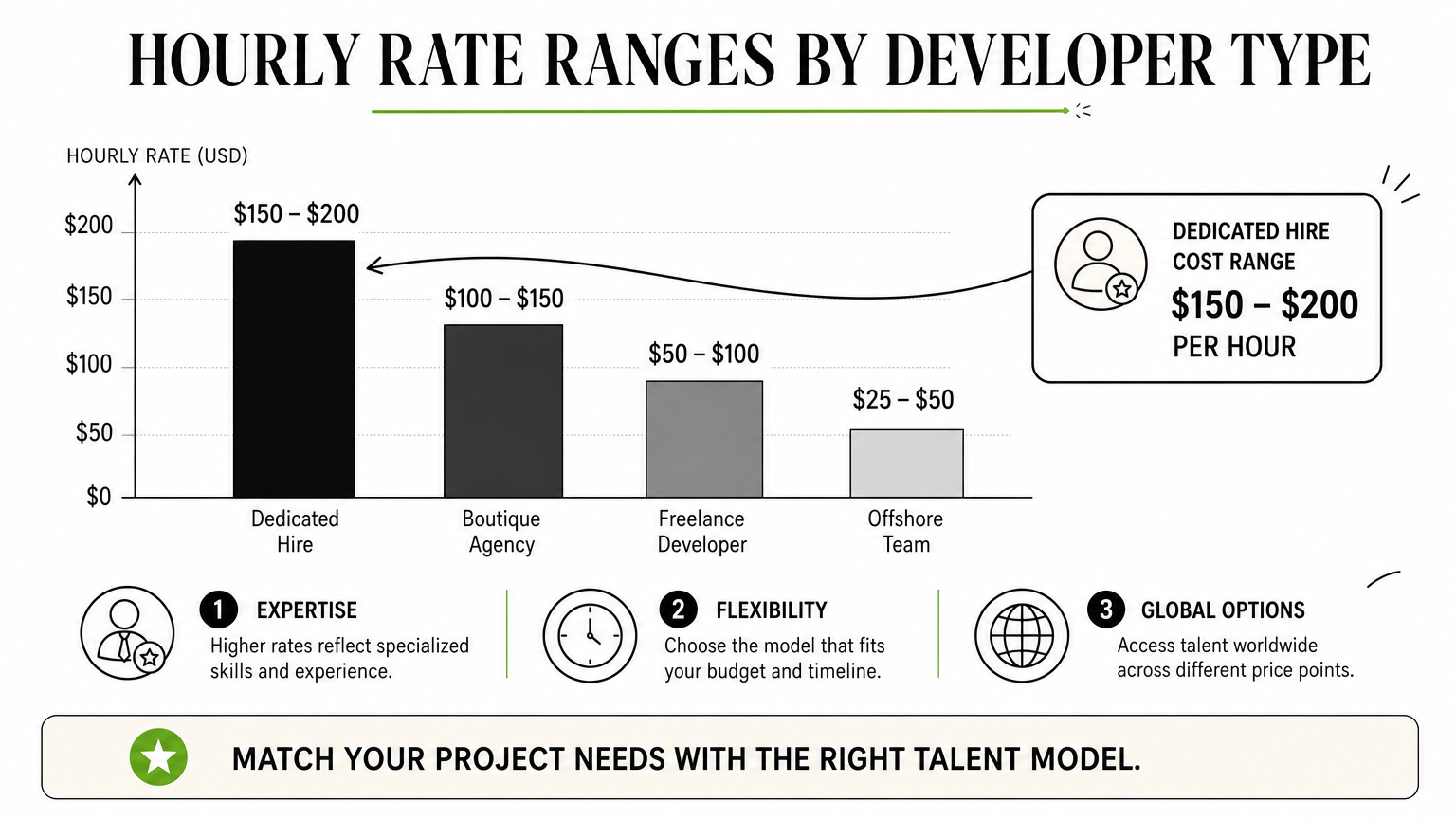
Rates for a wordpress developer for hire swing wildly depending on where the developer lives, how many years they've coded, and whether you're paying hourly or by project. Before you request quotes, know what a fair rate actually looks like so you can spot both overpriced freelancers and offers that are too cheap to be safe. A developer charging $8 an hour is either inexperienced, overseas with a much lower cost of living, or cutting corners somewhere you won't see until launch day.
Typical rates by experience and region
Geography and skill level drive price more than anything else, as this developer salary comparison between India and the US makes clear. Use this table as a baseline when a quote comes in and you're not sure if it's reasonable.
| Developer Type | Hourly Rate (USD) | Typical Monthly (Full-Time) |
|---|---|---|
| Junior freelancer, low-cost region | $10-$25 | $1,600-$4,000 |
| Mid-level freelancer, US/EU | $40-$80 | $6,400-$12,800 |
| Senior specialist, US/EU | $90-$150+ | $14,400-$24,000+ |
| Agency (project-based) | $75-$200 blended | Varies by scope |
| Dedicated offshore hire (staffed) | N/A | ~$1,090+ |
Comparing rates without comparing what's included in them is how businesses end up overpaying for underqualified help.
Why hourly rates hide the real cost
Quoting hourly sounds simple, but it rewards slow work and punishes efficiency. A skilled developer who fixes your checkout bug in two hours costs less than a slower one who bills five hours for the same fix, even at a lower rate. Ask for a project-based estimate whenever the scope is well-defined, since it forces the developer to commit to a number rather than billing indefinitely. Reserve hourly arrangements for ongoing maintenance or work where the scope genuinely can't be pinned down in advance.
The dedicated staffing alternative
Solo freelance rates also don't include the hidden costs of finding and replacing someone: job posting fees, interview time, and the risk of a mid-project disappearance. GlobalEmployees runs a different model entirely. Instead of hourly freelance billing, you get a dedicated wordpress developer working full-time for your business, hired and vetted through GlobalEmployees, starting around $1,090 a month with zero setup or HR costs added on top. That flat monthly figure often beats stitching together several freelance contracts, especially once you factor in the time you'd otherwise spend re-hiring every time a freelancer moves on.
Step 3. Choose between a freelancer, agency, or dedicated developer
Once you know your scope and budget, the next decision is structural: do you hire a solo freelancer, bring in an agency, or go with a dedicated wordpress developer who works full-time for your business? Each option fits a different kind of project, and picking the wrong structure costs you more than picking the wrong person within that structure. A one-off landing page and an ongoing multi-site operation need completely different arrangements, even if the actual coding skills required overlap.
Comparing the three models
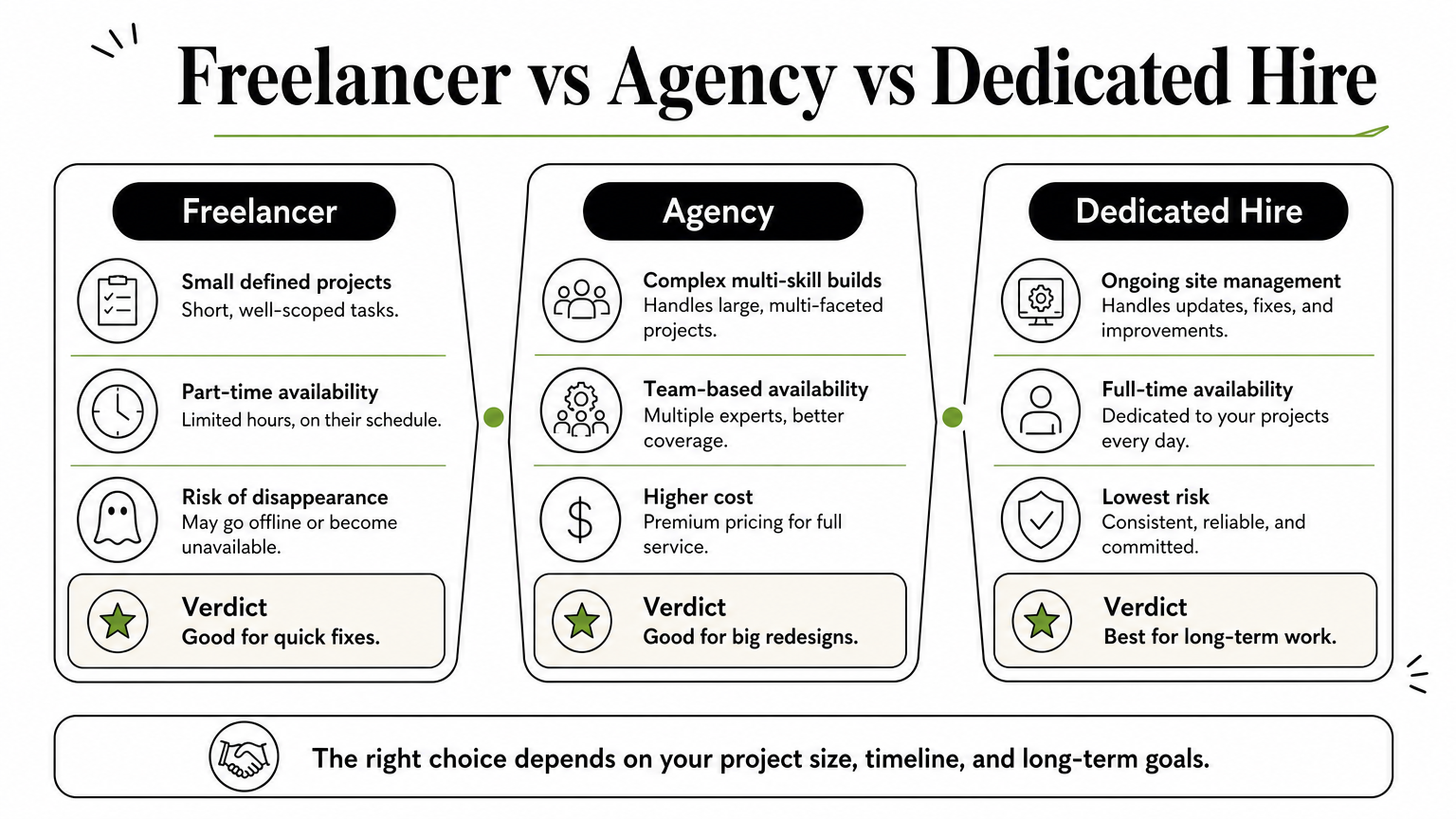
Lay out the tradeoffs before you commit, because each model handles availability, cost, and accountability differently, and this breakdown of staffing, freelance, and agency models compared covers them in depth.
| Model | Best for | Availability | Risk |
|---|---|---|---|
| Freelancer | Small, defined projects | Limited, often part-time | Disappearance mid-project, no backup |
| Agency | Complex builds, multiple skill sets needed | Team-based, project manager included | Higher cost, less direct control |
| Dedicated hire (staffed) | Ongoing site management, long-term teams | Full-time, your business only | Lower risk with vetting and replacement built in |
Matching the hiring model to the project's lifespan matters as much as matching skills to the task.
When a freelancer makes sense
Going the freelancer route works best for narrow, short-term jobs: a broken checkout, a design tweak, a plugin conflict. You get speed and low overhead, but you're also relying on one person's schedule and health. If they get busy with another client or simply stop responding, you have no backup plan, which is the central tradeoff between a freelancer and a full-time remote developer. This is fine for a two-week fix. It's risky when you need someone available every week for months.
When an agency makes sense
Hiring an agency fits projects that need several skills at once, like a redesign that requires front-end, back-end, and design work coordinated together. You pay for project management on top of development, which raises the cost but reduces your own coordination burden. Agencies also handle developer turnover internally, so you're less exposed if one team member leaves mid-project.
When a dedicated hire makes sense
Situations calling for continuous WordPress work, security monitoring, regular updates, new features shipped monthly, favor a dedicated employee over piecemeal freelance contracts. GlobalEmployees places a full-time, pre-vetted developer on your team for around $1,090 a month, with recruitment, payroll, and infrastructure already handled. You get freelancer-level flexibility (no long-term contract required) with the reliability of a staffed employee who works only for you, which solves the disappearance risk that comes with solo freelancers.
Step 4. Find qualified WordPress developers
Once you know what you need and what it should cost, the search itself narrows fast. A wordpress developer for hire shows up on general freelance marketplaces, WordPress-specific job boards, referral networks, and staffing agencies, and each source filters candidates differently before you ever see a profile. Knowing which channel matches your project saves you from wading through hundreds of irrelevant applications.
Where to search by project type
Different platforms suit different needs, and picking the wrong one wastes days scrolling profiles that don't fit your budget or timeline.
| Source | Best for | Vetting level |
|---|---|---|
| Upwork/Fiverr | Small, one-off tasks | Self-reported, low |
| WordPress-specific job boards (WPJobBoard, WordPress.org jobs) | Niche skills, plugin/theme work | Low to moderate |
| Referrals from your network | Trusted, proven work | High, but limited pool |
| Staffing agencies (GlobalEmployees) | Ongoing, dedicated roles | Pre-vetted before you interview |
The platform you search on determines how much vetting work lands on your desk versus how much has already been done for you.
General marketplaces versus specialized boards
Broad platforms give you volume but little quality control, so expect to sift through dozens of underqualified applicants for every solid one. Specialized WordPress job boards attract developers who actually specialize in the CMS rather than treating it as one skill among many, which raises your odds of a good match. Neither option, though, verifies coding quality before you see a profile. That verification step still falls on you.
Referrals and communities
Asking other business owners who they've used cuts through fake reviews entirely, since a direct referral carries real accountability. WordPress-focused Facebook groups, Slack communities, and local meetups also surface hire wordpress web developer leads who aren't actively marketing themselves on freelance platforms, often because they're already busy with repeat clients. The tradeoff is availability. Good referrals get booked fast, and you may wait weeks for an opening.
Skipping the search with pre-vetted staffing
Sourcing takes real time, often 10-20 hours between posting, screening, and interviewing before you make an offer. GlobalEmployees removes that step by handing you free access to vetted resumes upfront, so you're choosing from candidates already screened for coding ability, English communication, and reliability before you spend an hour interviewing anyone, and you can see what the hiring flow looks like end to end. For a business that needs a hire dedicated wordpress developer arrangement without running its own recruitment process, this shortcut alone often justifies the monthly rate.
Step 5. Evaluate skills, portfolios, and experience
Once you've narrowed a stack of applicants down to a handful, the real screening starts. A polished portfolio tells you a developer can build a nice-looking site, but it doesn't prove they can write clean code or handle a project when something breaks. This step is where you separate people who look qualified from people who actually are, and it's the step most business owners rush through because they're eager to start the project.
Look past the portfolio's surface
Asking for live URLs instead of screenshots matters, because screenshots hide slow load times, broken mobile layouts, and console errors. Open each site on your phone, check the browser console for JavaScript errors, and run it through Google's PageSpeed Insights to see real performance data. Portfolios built entirely on page builder templates with swapped colors and stock photos signal a developer who assembles rather than builds. A strong freelance wordpress developer should be able to point to at least one project involving custom functionality, not just theme installation.
A portfolio full of pretty screenshots means nothing if the live site behind it is slow or broken.
Test technical knowledge with targeted questions
Asking a few pointed technical questions during a call filters out candidates fast, without requiring you to know code yourself. Send these ahead of time or ask live:
- "Walk me through how you'd debug a white screen of death."
- "What's the difference between a WordPress hook and a filter?"
- "How do you handle staging versus production environments?" (weigh their answer against a proper local WordPress development environment setup)
- "What's your process for backing up a site before making changes?"
Vague or confused answers to any of these are a warning sign, regardless of how strong the portfolio looked on paper.
Check references and past work directly
Contacting two or three past clients directly, rather than trusting posted testimonials, gives you information nobody edited for public view. Ask former clients specifically about communication speed, whether the developer met deadlines, and how they handled mistakes when something went wrong. Experience level matters here too. A developer with three years of focused WordPress work often outperforms someone with ten years of general web development, since hiring a wordpress developer is about depth in this specific CMS, not years in the industry broadly. GlobalEmployees builds this reference and skills check into its vetting before a candidate ever reaches your resume list, which cuts this step out of your workload entirely.
Step 6. Interview and test your shortlisted candidates
Narrowing your list to three or four candidates means it's time to talk to them directly, not just read about them. A resume or portfolio review tells you what someone claims they've done, but only a live conversation and a small paid task tell you how a wordpress developer for hire actually thinks and works under real conditions. Skipping this step to save time is exactly how businesses end up mid-project with someone who can't solve problems outside their comfort zone.
Structure the interview around scenarios, not resumes
Running the interview as a scenario walkthrough beats asking generic questions about experience, since anyone can memorize buzzwords for a resume screen, and this checklist of questions for remote developers gives you a structure to follow. Describe an actual problem from your project, a slow page, a plugin conflict, a checkout error, and ask the candidate to talk through their diagnostic process out loud. Their answer reveals whether they think systematically or just guess and hope something works. Pay attention to whether they ask clarifying questions before jumping to a fix, since that habit separates careful developers from careless ones.
How a developer talks through a problem tells you more than any certificate on their profile.
Assign a small paid test task
Handing over a real, bounded task before signing a full contract protects you from a bad hire far better than any interview alone. Keep the task small enough to complete in two to four hours and pay for it regardless of outcome, since asking for free work discourages your best candidates from bothering. A good test task looks like:
Test Task Example
------------------
Scope: Fix a specific CSS layout bug on a staging site
Time limit: 3 hours
Deliverable: Working fix + short write-up of what caused it
Payment: Flat $75, paid on submission
Review the code itself, not just whether the bug disappeared, since a hacky fix that hides the symptom often causes bigger problems later.
Judge responsiveness during the process itself
Timing their replies throughout the interview and test process gives you a preview of what working together will actually feel like. Someone who takes two days to confirm a simple interview slot will likely take just as long to respond once you're paying them by the hour. Track how quickly each hire wordpress developer candidate answers, whether they follow through on stated deadlines for the test task, and how clearly they explain technical decisions in plain language. This step is exactly what GlobalEmployees builds into its own screening before a candidate ever reaches your interview stage, cutting the guesswork out of this step entirely.
Step 7. Finalize the contract and terms
Signing off on a candidate feels like the finish line, but a handshake agreement or a two-line email is how good hires turn into billing disputes later. Before any code gets written, put the scope, payment schedule, and ownership terms in writing, even for a small project with a wordpress developer for hire you already trust. A written contract protects both sides and gives you something concrete to point to if the work drifts from what you agreed on.
Put payment terms in writing
Contracts should spell out exactly what triggers a payment, not just a total dollar figure. Break project-based work into milestones tied to deliverables, so you're not paying 100% upfront for work that might stall halfway through. A simple structure looks like this:
Payment Schedule Example
-------------------------
30% deposit before work begins
40% at midpoint milestone (staging site review)
30% on final delivery and sign-off
Avoid full upfront payment on anything beyond a small fixed-price task, and avoid open-ended hourly billing without a not-to-exceed cap. Both protect you from a project that quietly balloons past the original quote.
A contract without payment milestones is an invitation for scope creep.
Cover intellectual property ownership explicitly
Ownership of the code and design needs its own line item, since developers sometimes assume they retain rights to reusable snippets or custom plugins unless the contract says otherwise. State plainly that all custom code, design files, and site content become your property upon final payment. This matters more than most business owners realize when hiring a wordpress developer for custom plugin work, since a dispute over ownership months later can leave you unable to modify your own site without the original developer's involvement.
Define support, revisions, and confidentiality
Revisions deserve a defined limit too, usually two or three rounds of feedback included in the price, with anything beyond that billed separately. Specify how long the developer will fix bugs related to their own work at no extra charge, typically 30 days post-launch is standard. Nail down confidentiality and data handling as well, particularly if the developer will have access to customer data, payment systems, or admin credentials, and require an NDA if none exists already. GlobalEmployees builds NDAs, secured devices, and access controls into every dedicated wordpress developer placement from day one, so this step is already handled before work starts rather than something you have to negotiate separately with each new hire.
Step 8. Onboard and manage your new developer
Signing the contract doesn't end your involvement, it starts the phase most business owners underestimate. A rushed onboarding is why some hires that looked perfect on paper still stumble in the first month. Give your wordpress developer for hire the access, context, and check-in structure they need from day one, and you'll avoid the confusion that turns a good match into a frustrating one.
Grant access without oversharing
Setting up accounts correctly on day one prevents both delays and security risks down the line. Create a separate admin login rather than sharing your own credentials, and only grant access to the specific tools the project requires, hosting panel, staging environment, GitHub repo, analytics dashboard. Revoke access immediately once a freelance engagement ends, since forgotten logins are one of the most common ways old contractors retain unnecessary reach into a site months later.
- Separate WordPress admin account (not your personal login)
- Staging site credentials, not production, for initial work
- Hosting/FTP access scoped to the project only
- Shared password manager entry, not a plain-text email
Access left open after a project ends is a security risk you created, not one the developer created.
Set a communication rhythm early
Agreeing on check-in frequency before work starts prevents the silent stretches where you're left wondering if anything is happening, which is the backbone of the first 90 days with a remote hire. A short weekly update, even just a few bullet points on what shipped and what's blocked, keeps a project on track without requiring daily meetings. Pick one channel, Slack, email, or a project tool like Trello or Asana, and stick to it rather than scattering conversations across three platforms where details get lost.
Set expectations for ongoing work
Ongoing relationships benefit from a light structure that a one-off task doesn't need. If you're keeping the developer on retainer or as a dedicated wordpress developer, define what a normal week looks like: hours worked, response time expectations, and how new requests get prioritized against existing ones. Revisit this after the first month, since real working patterns often differ from what looked reasonable on paper.
Build in a real feedback loop
Checking in honestly after the first few weeks catches small friction points before they become reasons to part ways. Ask directly whether the developer has what they need and whether your instructions have been clear enough, since communication gaps run both directions. GlobalEmployees supports this stage directly, offering replacement candidates at no extra cost if the placement isn't working out, which removes the pressure to stick with a mismatched hire out of sunk-cost thinking.
Making the right hire for your WordPress project
Getting this right comes down to matching the process to the project. Define your scope, price it honestly, and vet skills before you ever discuss a contract. Skip any of these steps and you're gambling with your site's stability, not just your budget. A wordpress developer for hire who looks great on paper can still fall apart without a real test task and a written agreement backing up the relationship.
If you'd rather skip the sourcing and vetting entirely, that's exactly what a staffed hire solves. GlobalEmployees pre-screens every candidate for coding ability, communication, and reliability, and backs each placement with a replacement guarantee if the fit isn't right. You get a dedicated wordpress developer working full-time for your business, without running your own recruitment process from scratch.
Ready to skip the guesswork? Hire a WordPress developer through GlobalEmployees and see vetted resumes before you commit to anyone.
Need to hire dedicated remote talent?
Tell us the role, experience, and AI skills your team needs.
Hire Talent Now