

9 Best Virtual Assistant Services for Small Businesses
9 Best Virtual Assistant Services for Small Businesses
You're drowning in admin work that has nothing to do with actually growing your business. Inbox management, scheduling, data entry, research, the stuff that eats hours but doesn't move revenue. That's exactly the gap virtual assistant services for small businesses exist to fill, and picking the wrong one wastes money and time you don't have.
The right provider depends on what you actually need. Some companies want a part-time assistant for a few hours a week handling email and calendars. Others need a dedicated full-time hire who becomes a real extension of the team, working set hours, learning your systems, and sticking around long enough to get good at your business. Pricing varies just as widely, from $8 an hour gig-style help to $1,000+ monthly for a vetted, full-time offshore employee with no hidden setup costs.
We've reviewed nine of the best small business virtual assistant services available in 2026, covering pricing, hiring process, specialties, and who each one actually fits best. Whether you need one task handled or a dependable full-time hire in India managed end to end, including payroll and compliance, you'll find a clear option below.
1. GlobalEmployees for dedicated offshore employees
GlobalEmployees tops this list because it solves a different problem than most virtual assistant companies. Instead of renting you a few hours of shared help, it places a full-time employee in India who works exclusively for your business, on your schedule, using your tools. The company handles recruitment, payroll, HR, and compliance through a fully managed offshore staffing model, while you manage the actual day-to-day work like you would with any in-house hire. That distinction matters if you've been burned by high-turnover VA marketplaces before.

How it works
Starting is straightforward, and the hiring process runs in four steps: you share your role requirements, GlobalEmployees sends you pre-vetted candidates and sample resumes at no cost, you interview and pick who you like, and the hire starts within days. There's no obligation until you actually select someone, and the company provides the laptop, software, and infrastructure the employee needs, so you're not shipping equipment overseas or setting up remote access from scratch. Zero setup cost and zero HR administration on your end is the whole point.
A dedicated offshore employee costs less than a US part-time VA but works full-time hours exclusively for you.
Who it's for
GlobalEmployees fits small business owners and hiring managers who need more than a few outsourced hours a week, think ongoing marketing execution, dedicated data and admin professionals, customer support, or development work that requires someone learning your systems deeply over months. It also suits companies scaling a team gradually, since you can add or reduce headcount without renegotiating a contract. If your need is truly a one-off task or five hours a month, a lighter-touch VA service further down this list will fit better.
Pricing
Plans start at $1,090 per month for a full-time dedicated employee, which covers salary, HR management, payroll processing, and infrastructure. There are no long-term contracts locking you in, and pricing scales with role seniority and department, whether that's development, design, marketing, or general operations support. Compared to hiring locally, where a single admin hire can run $3,000 to $4,000 a month before benefits, the true total cost of an in-house hire makes the math favor an offshore dedicated hire for most small businesses watching payroll.
Pros and cons
| Pros | Cons |
|---|---|
| Free vetted resumes before you commit to anything | Not built for tiny, one-off tasks |
| Zero setup, HR, and infrastructure costs | Time zone overlap needs planning |
| No long-term contract, scale up or down freely | Full-time hire, not hourly gig work |
| Money-back guarantee or fast replacement | Best value kicks in with ongoing, recurring work |
Explore every remote role you can hire for and sample candidate profiles before you commit to any provider on this list.
2. Time etc for busy small business managers
Time etc built its reputation on matching US-based executive assistants with founders and managers who need help without hiring anyone in-house. It's one of the older names in this space, and it leans heavily on assistants who've worked as EAs for companies like Google or Yahoo before going independent. If your biggest headache is a calendar that's spiraled out of control, this is the kind of service built for exactly that.
How it works
After you sign up, Time etc pairs you with a dedicated assistant based on your task list and working style, not a rotating pool of strangers. You delegate through email, a simple app, or Slack, and the assistant handles it or loops in a specialist from their team for anything outside their skill set. Most clients report their assistant learns their preferences within the first couple of weeks.
A single dedicated assistant who actually learns your preferences beats a rotating pool every time.
Who it's for
Solo founders and small business managers drowning in email and scheduling are the core audience here. It also suits people who want a US-based assistant for language and cultural fit over cost savings, since pricing runs higher than offshore alternatives.
Pricing
Plans start around $320 per month for roughly 10 hours, scaling up through higher-hour packages. There's no long-term contract, and unused hours typically roll over for a short window.
Pros and cons
| Pros | Cons |
|---|---|
| US-based, experienced EAs | Pricier per hour than offshore options |
| Dedicated assistant, not a pool | Limited hours cap heavier workloads |
| No long-term lock-in | Not suited to full-time, ongoing roles |
3. Belay for marketing and social media support
Belay built its name on placing US-based virtual assistants with a specific focus on marketing execution, social media scheduling, and content support, alongside the standard admin and bookkeeping help. It's a good match if your bottleneck isn't email but rather getting a content calendar out the door consistently. The company also offers dedicated bookkeepers and full-time social media managers as separate hire types, so you're not stuck with a generalist trying to run your Instagram.

How it works
Belay starts with a placement specialist call where you outline the role, workload, and skills you need. From there, they match you with a candidate from their vetted network, typically within a couple of weeks, and you get a short trial period to confirm fit before committing longer term. Communication runs through whatever tools you already use, whether that's Asana, Slack, or plain email.
Belay works best when marketing execution, not inbox triage, is your real bottleneck.
Who it's for
Small businesses that need consistent social media account management for business growth or content calendar upkeep, without hiring a full-time marketing coordinator, fit this service well. It also suits companies wanting a US-based assistant for compliance or data-sensitivity reasons over cost.
Pricing
Belay doesn't publish flat rates upfront. Expect custom quotes based on hours and specialty, generally starting near $2,000 a month for part-time marketing or social media support, higher than most generalist VA services on this list.
Pros and cons
| Pros | Cons |
|---|---|
| Specialized marketing and social media assistants | Pricing not transparent upfront |
| US-based talent pool | Higher cost than offshore alternatives |
| Trial period before long-term commitment | Slower matching process than some competitors |
4. Prialto for team-wide virtual assistant support
Prialto takes a different approach than most names on this list: instead of pairing you with one assistant, it builds a backup-supported pod system where a primary assistant works your account but a trained backup covers vacations, sick days, and overflow. That structure matters if you've ever had a VA relationship collapse the moment your assistant took a week off. Prialto also leans toward serving entire teams rather than a single founder, which shows up in how it prices and onboards clients.
How it works
Onboarding starts with a structured discovery process where Prialto maps out your workflows, tools, and recurring tasks before assigning a pod. Your primary assistant handles day-to-day requests through email or your project management tool of choice, while the backup assistant stays trained on your account so coverage never fully drops. Prialto also assigns a client success manager who checks in periodically to catch process gaps before they become recurring problems.
A backup-trained assistant means your workflow doesn't stall just because one person takes a sick day.
Who it's for
Professional services firms and sales teams that need consistent coverage across multiple employees, not just one executive, fit Prialto best. It suits businesses that value continuity and structured onboarding over the lowest possible hourly rate.
Pricing
Prialto requires a minimum commitment, typically starting around $1,800 per month for a set number of hours shared across a small team. Custom enterprise pricing applies for larger rollouts, and contracts usually run longer than the month-to-month options common elsewhere on this list.
Pros and cons
| Pros | Cons |
|---|---|
| Backup coverage prevents workflow gaps | Higher minimum spend than solo-VA services |
| Structured onboarding and account management | Longer contract commitments |
| Built for team-wide, not single-user, support | Less flexible for very small, occasional needs |
5. WoodBows for customer support virtual assistants
WoodBows focuses on something narrower than most names on this list: customer support and help desk staffing. Instead of a generalist assistant who splits time between email and research, you get someone trained specifically to handle tickets, live chat, and customer inquiries at volume. That specialization shows up in how the company recruits and onboards, since support work demands a different skill set than calendar management or bookkeeping.
How it works
You start by outlining your support channels, whether that's Zendesk, Freshdesk, Intercom, or plain email, along with expected ticket volume and hours of coverage. WoodBows then matches you with an agent already trained on that platform, cutting down the ramp-up time you'd otherwise spend teaching someone your help desk software from scratch. Agents work set shifts aligned to your customer base, and WoodBows handles the backend management so you're not supervising shift schedules yourself.
A support agent who already knows your ticketing platform starts solving problems in days, not weeks.
Who it's for
Ecommerce stores and SaaS companies fielding a steady stream of customer tickets fit WoodBows well, especially businesses that need coverage beyond standard US business hours. It's less useful if your support volume is light and inconsistent, since you're paying for dedicated coverage rather than occasional help.
Pricing
WoodBows prices around $1,500 to $2,000 per month per full-time support agent, depending on shift coverage and platform complexity. There's no published hourly tier for light, part-time support work.
Pros and cons
| Pros | Cons |
|---|---|
| Agents pre-trained on major help desk platforms | Pricier than generalist offshore VAs |
| Built for ticket volume, not occasional tasks | Less suited to light, inconsistent support needs |
| Shift coverage beyond US business hours | Limited flexibility outside support-specific roles |
6. MyOutDesk for real estate and property management
MyOutDesk built its business almost entirely around real estate and property management workflows, which shows in how deep its training goes for those industries specifically. Instead of a generalist VA figuring out MLS systems or property management software on the job, you get someone already comfortable with tools like BoomTown, Follow Up Boss, or AppFolio before day one. That head start matters if you've tried onboarding a generalist assistant into real estate before and watched weeks disappear into training.
How it works
MyOutDesk starts with a needs assessment call where you outline the role, whether that's a transaction coordinator, cold caller, listing manager, or property management admin. The company then matches you with a candidate from a pool already trained in real estate-specific tasks, and you interview before signing off. Assistants work set schedules aligned to your market's time zone, and MyOutDesk manages the employment relationship on the backend.
Real estate-specific training beats generic VA skills when your workflow runs through MLS and CRM tools built just for the industry.
Who it's for
Real estate agents, brokerages, and property management companies needing help with lead follow-up, listing coordination, or tenant communication fit MyOutDesk best. It's a weaker match for businesses outside real estate and property niches, since the training and matching process leans so heavily toward those two industries.
Pricing
Plans typically start around $1,988 per month for a full-time dedicated assistant, with pricing varying by role complexity and experience level. MyOutDesk generally requires a longer commitment than month-to-month competitors on this list.
Pros and cons
| Pros | Cons |
|---|---|
| Deep real estate and property management training | Higher price point than generalist VAs |
| Familiar with industry-specific CRM and MLS tools | Longer contract terms than most competitors |
| Dedicated, full-time assistant model | Less flexible for non-real estate businesses |
7. Zirtual for inbox and calendar management
Zirtual carved out a niche as a US-based virtual assistant service built almost entirely around inbox triage and calendar coordination, the two tasks that eat the most hours for busy founders. Unlike broader agencies that pitch marketing or bookkeeping add-ons, Zirtual keeps its focus narrow, and that focus shows in how quickly assistants get comfortable managing a packed schedule or a chaotic inbox.
How it works
Onboarding starts with a kickoff call where Zirtual learns your scheduling preferences, email habits, and any recurring admin tasks you want off your plate. You're then matched with a dedicated assistant who works from a set monthly hour bank, communicating through email, phone, or text depending on what you prefer. Requests typically get handled within a business day, and the assistant keeps notes on your preferences so you're not re-explaining the same instructions every week.
An assistant who already knows how you like your calendar organized saves more time than one who's simply cheap per hour.
Who it's for
Founders and small business owners whose biggest time drain is email and scheduling, rather than specialized marketing or support work, fit Zirtual well. It also suits people who want a single point of contact instead of a shifting pool of freelancers.
Pricing
Plans start around $399 per month for roughly 12 hours, with higher tiers available for teams needing more coverage. Unused hours generally roll over for a limited window, and there's no long-term contract required.
Pros and cons
| Pros | Cons |
|---|---|
| Dedicated assistant, not a rotating pool | Pricier per hour than offshore alternatives |
| Fast response times on daily requests | Hour caps limit heavier workloads |
| No long-term contract | Narrower specialty than full-service agencies |
8. Boldly for personal assistants and scheduling
Boldly (formerly Worldwide101) positions itself as a premium personal assistant service for founders and executives who want senior-level help, not an entry-level generalist learning on the job. The company only hires assistants with years of corporate experience, often former executive assistants from large companies, which shows up in how confidently they handle complex scheduling across multiple time zones. If you've outgrown a junior VA and need someone who can manage a chaotic calendar without hand-holding, Boldly fits that gap.
How it works
Getting started involves a consultation call where Boldly's team reviews your workload, preferred tools, and working style before proposing a match. You then get introduced to a candidate, review their background, and confirm fit before work begins. Communication runs through your existing stack, whether that's Google Workspace, Outlook, or a project management tool, and assistants typically work a consistent set of hours each week rather than sporadic, on-demand tasks.
Senior-level assistants cost more, but they need far less oversight than a junior generalist.
Who it's for
Executives and small business owners who need complex calendar management across multiple stakeholders and time zones fit Boldly well. It also suits companies wanting a long-term assistant relationship rather than frequent rematching.
Pricing
Plans start around $2,300 per month for roughly 40 hours, putting Boldly among the pricier options on this list. There's no hourly, pay-as-you-go tier for lighter workloads.
Pros and cons
| Pros | Cons |
|---|---|
| Senior-level, experienced assistants | High starting price point |
| Strong fit for complex scheduling | No lightweight, hourly tier |
| Consistent, dedicated hours weekly | Overkill for simple admin tasks |
9. Stealth Agents for appointment setting and sales
Stealth Agents specializes in outbound calling and appointment setting, the kind of work most generalist VA services either avoid or handle poorly. Instead of a generalist juggling email between cold calls, you get an assistant trained specifically on scripts, objection handling, and CRM logging for sales pipelines. That focus matters if your bottleneck is lead follow-up sitting untouched for days rather than admin tasks piling up.
How it works
You start with a call to outline your sales process, target lead lists, and the CRM you already use, whether that's HubSpot, Salesforce, or something simpler. Stealth Agents then matches you with an agent trained on cold calling, appointment setting, or follow-up sequences, and provides a short trial period before you commit to ongoing hours. Agents log every call and outcome directly into your CRM, so nothing gets lost between conversations.
A dedicated appointment setter who logs every call properly beats a generalist VA squeezing sales calls between other tasks.
Who it's for
Small businesses and sales teams that need consistent outbound calling or appointment setting support fit Stealth Agents best, especially those without a dedicated inside sales rep. It's a weaker match if your needs are purely administrative, since the training and matching process leans heavily toward sales-specific work.
Pricing
Plans typically start around $1,200 to $1,500 per month for a full-time dedicated agent, with rates varying by call volume and required experience. There's no published hourly tier for occasional, low-volume calling needs.
Pros and cons
| Pros | Cons |
|---|---|
| Trained specifically for cold calling and appointment setting | Less suited to general admin work |
| CRM logging built into the workflow | Pricing scales up with call volume |
| Dedicated, full-time agent model | Limited flexibility for light, sporadic needs |
10. How to choose the right virtual assistant service
Matching your actual workload to the right service matters more than picking whichever name ranks highest on a review site. Start by asking whether you need occasional hourly help or a dedicated full-time hire. Someone forwarding five emails a day doesn't need a full-time employee, and someone running daily operations shouldn't settle for a rotating pool of freelancers who never learn the business, a trade-off laid out in this comparison of freelancers and dedicated remote hires.
Next, look at specialization versus generalist support. A generalist assistant handles email, scheduling, and light research well, but specialized work like customer support ticketing, real estate transaction coordination, or outbound sales calling needs someone trained specifically for that workflow. Hiring a generalist for a specialist role usually means months of training you're paying for anyway.
The right virtual assistant service matches your workload type, not just your budget.
Budget and contract flexibility deserve equal weight. Some small business virtual assistant services lock you into long-term contracts with minimum monthly hours, while others, like flexible staff augmentation plans, let you scale up or down with a week's notice. If your workload fluctuates seasonally, flexibility beats a slightly lower rate every time.
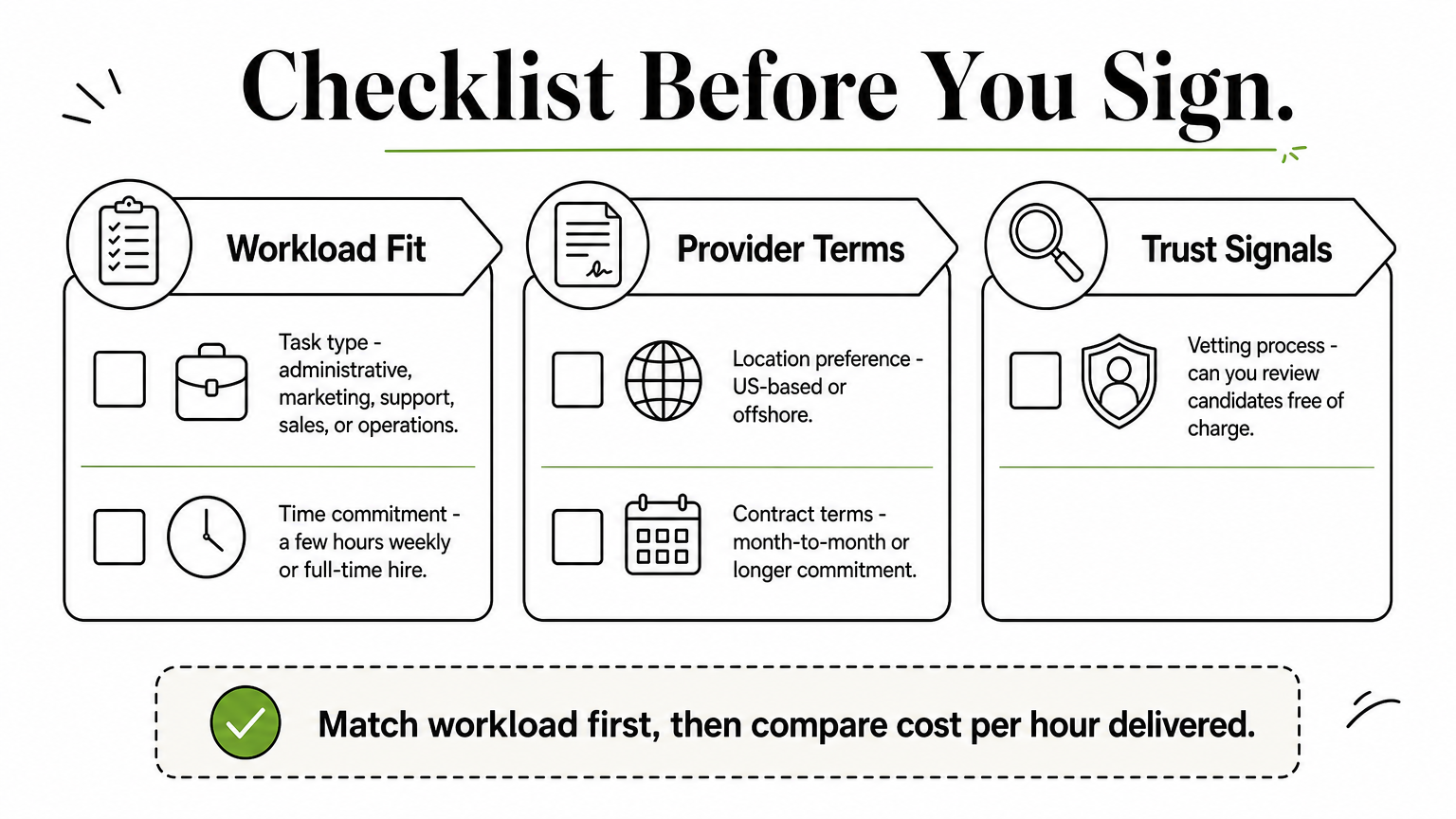
Run through this checklist before signing anything:
- Task type: administrative, marketing, support, sales, or general operations
- Time commitment: a few hours weekly or a full-time dedicated hire
- Location preference: US-based for time zone overlap, or offshore for cost savings
- Contract terms: month-to-month flexibility versus longer commitments
- Vetting process: does the provider let you review candidates before paying anything
Companies that let you interview candidates for free, like GlobalEmployees does before you commit to a hire, remove most of the risk from this decision. That's worth prioritizing over a slightly cheaper hourly rate from a provider that won't show you who you're actually hiring.
11. What virtual assistant services typically cost
Pricing across virtual assistant services for small businesses splits into a few clear tiers, and this full virtual assistant pricing breakdown for 2026 shows why knowing your tier saves you from comparing apples to oranges. Gig-style hourly help through freelance marketplaces runs $8 to $25 an hour with no vetting or accountability built in. Agency-managed VAs with dedicated matching, like Time etc or Zirtual, typically cost $300 to $500 a month for a set hour bank, usually 10 to 12 hours. Specialized services, whether that's marketing support, real estate coordination, or customer ticketing, push higher, often $1,500 to $2,300 a month depending on skill and coverage hours.
Where full-time offshore hiring fits
Dedicated full-time offshore employees sit in a different category entirely, since you're paying for 40 hours a week rather than a capped bucket of hours. GlobalEmployees starts at $1,090 a month for a full-time hire, which works out to roughly $6 to $7 an hour once you account for the full schedule, far below what a comparable US-based hourly VA costs for the same weekly output.
A full-time dedicated hire often costs less per hour than a part-time VA once you compare total hours delivered.
| Service type | Typical monthly cost | Hours included |
|---|---|---|
| Freelance marketplace VA | $8-$25/hour | Pay per hour |
| Agency-managed part-time VA | $300-$500 | 10-12 hours |
| Specialized VA (marketing, support, sales) | $1,200-$2,300 | Varies by role |
| Full-time offshore dedicated hire | $1,090+ | 160+ hours |
Setup fees, HR overhead, and infrastructure costs add up fast with in-house hiring, which is exactly what a small business virtual assistant service with zero setup costs is designed to avoid, as this comparison of staffing, freelancer, and agency models explains. Compare total cost per hour delivered, not just the sticker price, before deciding where your budget actually goes furthest.
12. Frequently asked questions about virtual assistants
What's the difference between a virtual assistant and a dedicated offshore employee?
A traditional virtual assistant usually works a capped block of hours across multiple clients, while a dedicated offshore employee works full-time for one business only, often 40 hours a week. That distinction affects everything from cost per hour to how deeply the person learns your systems. Businesses that need someone embedded in daily operations tend to outgrow the shared-hours model fast.
How much do virtual assistant services for small businesses cost?
Costs range from $8 an hour on freelance marketplaces up to $2,300 a month for premium, specialized providers. Small business virtual assistant services with dedicated matching typically land between $300 and $500 monthly for a limited hour bank, while full-time offshore hires start closer to $1,090 a month for 160-plus hours of work.
Is hiring a virtual assistant in India safe from a data security standpoint?
Reputable providers use NDAs, VPN access, restricted permissions, and secured company laptops rather than personal devices. Ask any provider you're considering how they handle data security before signing anything, since this varies widely between freelance marketplaces and managed staffing companies, and check their answers on payroll, process, and data security first.
Ask about data security policies before you ask about pricing.
Can I try a virtual assistant before committing long-term?
Many providers offer a trial period or free candidate review before you pay anything. GlobalEmployees, for example, lets you review vetted resumes and interview candidates at no cost, so you only commit once you've found the right fit.
How quickly can I get a virtual assistant started?
Most agency-matched assistants start within one to two weeks, though full-time dedicated hires through staffing providers often begin within days once you've picked a candidate from the shared pool.
Finding the right fit for your business
Nine services, nine different problems solved. Zirtual and Time etc handle inbox chaos. Belay and Stealth Agents tackle marketing and sales. MyOutDesk and WoodBows solve industry-specific workflows. But if your business needs consistent, full-time help without the overhead of a traditional hire, GlobalEmployees remains the strongest option on this list.
Quality matters more than the label you put on the hire. A dedicated full-time employee who learns your systems over months beats a rotating pool of freelancers charging by the hour, especially once you factor in total cost per hour delivered. Reliability comes from someone who shows up daily, not someone juggling five other clients alongside yours.
Start by mapping your actual workload against the checklist above, then request vetted candidates before spending a dollar. If your bottleneck is ongoing execution rather than occasional tasks, build a dedicated remote team in India and see who's available to interview this week.
Need to hire dedicated remote talent?
Tell us the role, experience, and AI skills your team needs.
Hire Talent Now