What Is Offshore Staff Augmentation? Costs, Benefits, Risks
You have a roadmap, a budget, and a team that is already stretched thin. Local hiring takes months, and senior developers in the US or Europe cost far more than most small companies can carry. So you start looking abroad and run into a pile of terms that sound alike but work very differently.
Offshore staff augmentation means adding full-time remote professionals from another country, such as India, to your existing team. You assign the work and manage them directly, while a partner handles recruiting, payroll, equipment, and compliance. Done well, you pay a fraction of local salaries. Done badly, you inherit security gaps, turnover, and time zone friction. Offshore IT staff augmentation follows the same model, applied to developers, QA, and DevOps roles.
This guide explains how the model works, what it typically costs, and where the real benefits and risks sit. You will also see how it differs from managed services and traditional outsourcing. At GlobalEmployees, we have placed 950+ people with US and European clients, so we cover the parts that matter in practice, not just theory.
Why offshore staff augmentation matters
Offshore staff augmentation matters because it solves a problem that salary alone cannot: you need skilled people now, and your local market cannot supply them at a price you can sustain. For most small and mid-sized companies, the issue is not a lack of ideas. It is a lack of hands to build them. This model gives you a third option besides overloading your current team or waiting months for a local hire.
The talent and cost gap it closes
Senior developers in the US and Western Europe are expensive and scarce. A single hire often takes months once you count sourcing, interviews, notice periods, and salary negotiation. Meanwhile your roadmap slips and your current engineers absorb the overflow, which is how burnout starts. Hiring offshore opens up a much larger pool of technical talent, and hiring remote developers in India is the clearest example.
Cost is the second driver. A dedicated full-time employee through GlobalEmployees starts at $1,090 per month, and that covers recruiting, HR, equipment, and infrastructure that you would otherwise pay for separately. We break the numbers down in the costs section below. The point here is that the savings are structural, not the result of cutting corners on quality.
Speed and flexibility you cannot get locally
Speed matters as much as price. A partner with a bench of pre-vetted candidates lets you interview within days instead of waiting for applications to trickle in. Because there are no long-term contracts, you can also scale up for a launch and scale back down when the work eases. A local permanent hire rarely gives you that room.
| Factor | Local hire | Offshore staff augmentation |
|---|---|---|
| Time to first interview | Weeks, after posting and screening | Days, from vetted candidates |
| Costs beyond salary | Recruiter fees, benefits, equipment, office space | Handled by the partner |
| Commitment | Permanent employment obligations | No long-term contract |
| Scaling | Slow, tied to hiring and layoff cycles | Add or remove people on short notice |
| Day-to-day management | You | You |
Offshore augmentation turns hiring from a months-long project into a decision you can reverse.
Who gets the most out of it
Different companies use the model for different reasons, and knowing which one fits you saves a lot of wasted effort. Teams with a clear workload and a manager who can direct the work see the best results. Teams that expect the partner to define the strategy for them tend to be disappointed, because you stay in charge of the work by design.
These are the situations where we see it pay off most often:
- Startups that need one or two developers to ship a product without building an HR function first.
- Agencies that need extra designers, marketers, or QA people during busy periods.
- Established companies that want a dedicated multi-person team for ongoing product work.
- Founders and hiring managers with no internal capacity to run payroll, contracts, and compliance in another country.
How offshore IT staff augmentation works step by step
The process is simpler than most first-time buyers expect. With offshore IT staff augmentation, you hand over a role description and get back candidates to evaluate, not a finished product. You stay in control of the work from day one, and the partner handles everything around it.
The four steps from brief to first day
Every engagement we run follows the same four-step hiring process, and you pay nothing until you select a candidate. You can also review sample resumes before you commit to anything, which shows you the quality level up front.

- Share your requirements. Describe the role, tech stack, seniority, working hours, and budget. A clear brief is the biggest factor in match quality.
- Interview and assess candidates. You receive pre-vetted profiles, then run your own technical interviews or coding tests. Your engineers know best what "good" looks like on your stack.
- Pick your choice. Select the person you want. The partner handles the offer, employment paperwork, and payroll setup.
- Kick start the work. The new hire receives a secured laptop, software, and access, then joins your standups, repositories, and project tools.
What happens after kickoff
After day one, your offshore hire works as a full-time member of your team, not as a rotating vendor resource. You assign tickets in your own tools and run the same sprint rhythm as before. Meanwhile the partner runs payroll, HR, and compliance in the background, so you never deal with Indian employment rules yourself.
You manage the work, and the partner manages everything around the work.
Security deserves a direct question before you sign. A reliable partner uses NDAs, VPN access, limited permissions, and secured laptops, so your code and data stay inside controlled systems. Ask for the same in writing, along with the replacement and refund terms. If a hire is not working out, a quick replacement should be a standard option, not a negotiation.
What offshore staff augmentation costs
Offshore staff augmentation pricing is easier to read than most vendor quotes suggest, because you pay one monthly rate per person. At GlobalEmployees, that rate starts at $1,090 per month for a dedicated full-time employee. It is a flat per-person fee, not an hourly bill that grows with every meeting.
What the monthly rate covers
The rate bundles items that show up as separate line items on a local hire. Check any quote you receive against this list:

- Recruiting and candidate vetting
- HR administration and payroll
- Laptop, software licenses, and workspace
- Compliance, NDAs, VPN, and security setup
We charge zero setup, HR, and infrastructure costs on top of the rate. If another partner quotes a lower number but adds those items back later, the comparison is not fair, so ask for the all-in monthly price in writing.
How it compares with a local hire
Salary is only part of what a local employee costs you. The table below shows where the other money goes.
| Cost item | Local hire (US or Europe) | Offshore augmentation |
|---|---|---|
| Salary | Often $100,000+ per year for a developer | Included in the monthly rate |
| Recruiter fees | Commonly a percentage of first-year salary | None until you select a candidate |
| Benefits and payroll taxes | Added on top of salary | Handled by the partner |
| Equipment and office space | Your budget | Provided by the partner |
| Exit cost | Severance and notice periods | Short notice, no long-term contract |
A low monthly rate only matters if it replaces the costs around the salary, not just the salary itself.
Put simply, a $1,090 starting rate is about $13,000 a year. Even after you allow for senior profiles that cost more, the gap against a local salary is large enough to fund a second hire.
What pushes the price up
Rates rise with seniority and niche skills. A junior QA tester costs less than a staff-level DevOps engineer, and machine learning or specialized cloud expertise sits higher still. Team size matters too, since larger dedicated teams often include a lead role.
Costs also exist on your side of the table. Your managers will spend time on onboarding, and you should plan for a ramp-up period of a few weeks before a new hire works at full speed. Overlapping working hours with India may also mean someone starts early or stays late. These are small compared with local salaries, but a realistic budget counts them.
Benefits and risks of offshore staff augmentation
Offshore staff augmentation delivers real gains, but only if you know where it can fail. The benefits are mostly about speed and cost, while the risks are mostly about management and security. You can handle both with the right setup.
Benefits you can count on
Four benefits show up in nearly every engagement we run. You get lower total cost because salary, recruiter fees, equipment, and office space all shrink or disappear. You also keep direct control over priorities, code quality, and tools, which you give up with a project vendor.
- Faster hiring: vetted candidates reach your interview calendar in days.
- Flexible scaling: add or remove people without long-term contracts.
- Wider skill access: find niche stacks that your local market lacks.
- Less admin: payroll, HR, and compliance stay with the partner.
Risks and how to reduce them
Every risk below has a known fix. Most of them come down to choosing the right partner and setting routines in the first two weeks, before bad habits form.
| Risk | What it looks like | How to reduce it |
|---|---|---|
| Time zone gap | Few overlapping hours with a US team | Agree on 3 to 4 shared hours and document handoffs |
| Data security | Code on personal devices | NDAs, VPN, limited access, secured laptops |
| Communication | Vague tickets, silent blockers | Written specs, daily standups, video calls |
| Turnover | A hire leaves mid-project | Replacement guarantee, shared documentation |
| Weak fit | Skills do not match the stack | Run your own technical interview or a short paid task |
Management is the risk buyers underestimate most. Because you direct the work, a vague brief produces vague output, and no partner can fix that for you. Teams that write clear tickets and review work weekly rarely struggle.
Most offshore problems come from weak process, not from geography.
Staff augmentation vs. outsourcing and managed services
These three terms get mixed up, but the difference comes down to one question: who manages the work? With offshore staff augmentation, you do. With managed services and project outsourcing, the vendor does, and you buy a result instead of a person.
How the three models compare
The table below shows the practical differences. Start with the first row, because it drives every other row and decides how much control you keep.
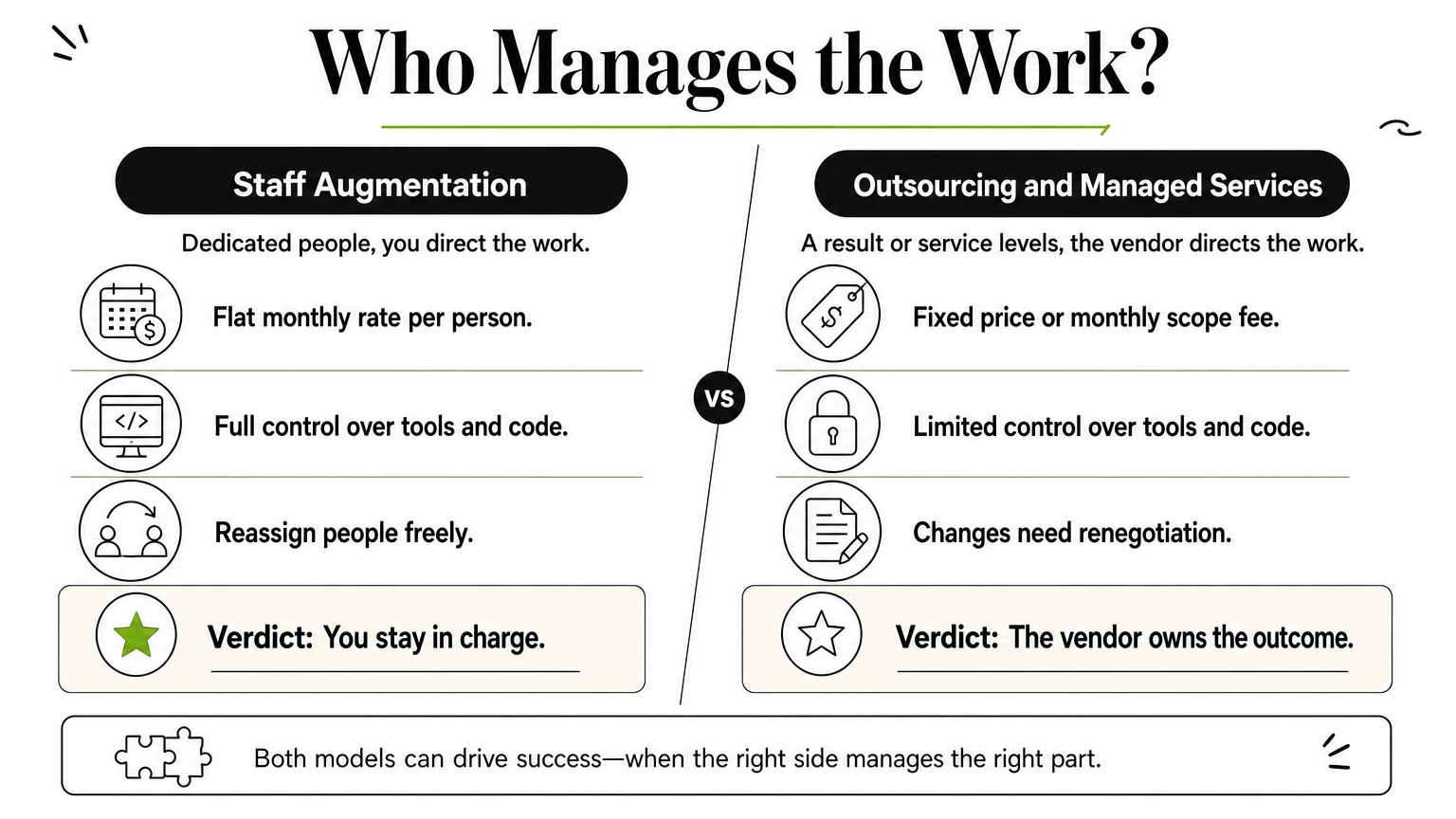
| Factor | Staff augmentation | Managed services | Project outsourcing |
|---|---|---|---|
| Who directs the work | You | The vendor | The vendor |
| What you buy | Dedicated people | Ongoing service levels | A defined deliverable |
| Pricing | Flat monthly rate per person | Monthly fee tied to scope | Fixed price or hourly |
| Control over tools and code | Full | Limited | Limited |
| Scope changes | Reassign people freely | Renegotiate the agreement | Change requests, often extra cost |
| Best for | Teams with a clear workload | Running a function like support or infrastructure | One-off projects with fixed scope |
Choosing between them
Managed services suit work you want off your plate permanently, such as 24/7 monitoring or a help desk. Project outsourcing fits a well-defined build, like a marketing site with a fixed scope. Both work, but you give up day-to-day control, and changing direction mid-project usually costs extra.
Staff augmentation fits when your priorities shift often and someone on your side can lead. If you have a product manager or tech lead, you get the most from augmentation, because you pay for capacity and not for a vendor's margin on management.
Outsourcing buys you an outcome, augmentation buys you capacity, and only one of them keeps you in charge.
Many of our clients mix the approaches over time. A common pattern is to start with one or two augmented developers, prove out the workload, and then grow into a fully dedicated team once the work justifies it.
Deciding if offshore augmentation fits your team
Offshore staff augmentation fits your team if three things are true. You have a clear workload, someone who can direct the work daily, and a need for capacity faster than local hiring allows.
If you would rather have a vendor own the outcome, managed services or project outsourcing suit you better. If you want to stay in charge at a predictable monthly cost, augmentation wins, provided you lock in written security terms and a clear brief in the first two weeks.
Start small. Review sample resumes, interview two or three candidates, and test one hire before you build a larger team. You pay nothing until you select a candidate, so your downside stays limited. When you are ready, hire full-time employees in India and judge the quality yourself before you commit to more.