Nearshore Staff Augmentation: Meaning, Costs, and Risks
Nearshore Staff Augmentation: Meaning, Costs, and Risks
Nearshore staff augmentation is a hiring model where you add software developers, QA engineers, or other tech specialists from a nearby country to your in-house team, usually one within a few time zones of yours. A provider recruits and employs them. You assign the work, run the sprints, and manage them day to day, just as you would with a local hire.
This guide covers why companies choose the model, how an engagement runs from first brief to first sprint, what it costs, where it goes wrong, and how to pick a provider. You will also see how it compares with onshore hiring and with offshore teams, so you can judge whether it fits your situation.
GlobalEmployees places dedicated full-time employees in India for US and European businesses. That is an offshore model, not a nearshore one. We cover both honestly because the right answer depends on one question: how much live overlap with your team do you actually need?
Why nearshore staff augmentation matters
Nearshore staff augmentation matters because it solves two problems that stall engineering teams: a thin local talent pool and slow feedback from teams in distant time zones. You reach qualified people faster than local recruiting allows, and you keep the live collaboration that agile work depends on.
The talent gap that pushes teams abroad
Hiring locally for specialized roles is slow and competitive. Eurostat found that 62.8% of EU enterprises that tried to recruit ICT specialists had trouble filling the roles. Hiring managers in the US know the same pattern: a senior backend engineer can take months to find, and the offer can go to a competitor in the final week.

Nearshore providers widen the pool without moving you out of your working day. US companies usually source from Latin America, with Mexico, Colombia, Brazil, and Argentina as common choices. Western European companies tend to look at Poland, Romania, Portugal, or the Czech Republic.
Nearshore staff augmentation trades a bigger talent pool for a time zone gap small enough that nobody notices it.
What time zone overlap changes
Overlap is the real product you are buying. When your augmented developer is online during the same four to six hours as your product manager, a blocked pull request gets resolved in an hour instead of the next morning. Daily standups, pair debugging, and live code review all work without anyone staying up late.
Offshore teams can still deliver, but the working pattern changes. India sits roughly 10 to 13 hours ahead of the US, depending on coast and daylight saving. Work moves by handoff and written specs, which suits well-defined tasks and punishes vague ones. Nearshore removes that constraint, and you pay more for the privilege.
Nearshore, offshore, and onshore compared
The three models differ mainly in overlap, cost, and the kind of work they suit. Use this table to see where nearshore IT staff augmentation sits between them.
| Model | Overlap with your team | Cost vs. local hire | Best fit |
|---|---|---|---|
| Onshore | Full | Highest | Roles that need on-site presence or strict local compliance |
| Nearshore | Several shared working hours | Often quoted at 30% to 60% lower | Teams that need live collaboration and fast feedback |
| Offshore (India) | Limited for US teams, workable for Europe | Lowest | Well-scoped, steady work and budget-driven team building |
Note that the middle row carries a range, not a promise. Savings depend on role, seniority, and country, which the cost section breaks down.
How to set up a nearshore staff augmentation engagement
Set up an engagement by defining the role in writing, briefing a provider, interviewing candidates yourself, and onboarding them like a regular hire. Providers differ in details, but nearshore staff augmentation services follow this basic sequence, and the quality of your brief decides most of the outcome.
Define the role before you contact anyone
A vague request produces vague candidates. Before you talk to a provider, write down what the person will actually do in their first 90 days. Specific stack and seniority matter more than a job title, because "full-stack developer" can mean five different people.
Cover these points in your brief:
- The tech stack, with versions where they matter
- Seniority level and the expected scope of ownership
- Required overlap hours with your team
- Expected duration, even if it is only a rough estimate
- The tools and processes the person must join, such as Jira, GitHub, and your CI pipeline
The steps from brief to first sprint
Most engagements run in five steps, and the whole process often takes weeks, not the months a local search can take.
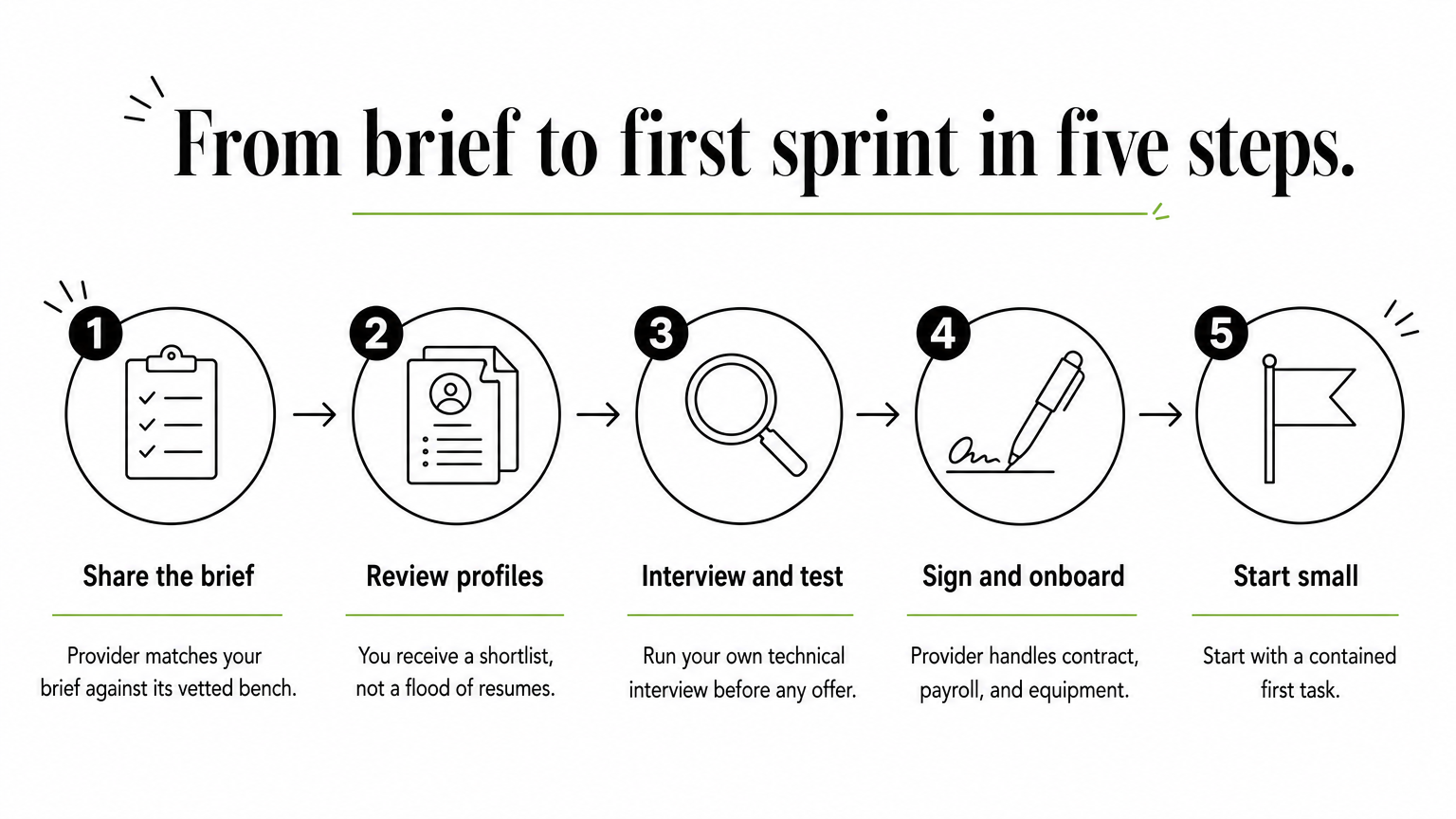
- Share the brief. The provider matches it against its vetted bench or starts sourcing.
- Review profiles. You receive a shortlist, not a flood of resumes.
- Interview and test. Run your own technical interview. Do not rely only on the provider's screening.
- Sign and onboard. The provider handles the contract, payroll, and equipment. You provide access, documentation, and a named point of contact.
- Start with a small scope. Give the new person a contained first task, then widen it once they know the codebase.
Treat step 3 as non-negotiable. A provider's vetting tells you someone can code. Your interview tells you whether they can code in your system.
What you manage and what the provider handles
The division of labor is what separates augmentation from outsourcing. In outsourcing, a vendor owns the deliverable. In augmentation, you own the work and the direction, and the provider owns the employment side.
You manage tasks, priorities, code review, and performance feedback. The provider manages recruiting, local payroll, benefits, legal compliance in the developer's country, and replacement if a placement fails. Keep that split in mind when you read contracts, because any clause that quietly hands project management to the vendor turns your augmentation deal into an outsourcing deal.
In augmentation you direct the work, and the provider handles everything around the employment.
What nearshore IT staff augmentation costs
Nearshore IT staff augmentation usually costs less than a comparable local hire, but the discount is smaller than offshore pricing suggests. Published figures cluster around 30% to 60% savings on a fully loaded local hire, with some Mexico-focused claims going as high as 75%. Treat those as planning ranges, not quotes.
Typical hourly rates by seniority
Hourly billing rates quoted for Latin American and Eastern European developers fall into rough bands. Your actual price depends on stack, country, and provider.
| Seniority | Typical hourly rate | Approx. monthly at 160 hours |
|---|---|---|
| Junior developer | $25 to $45 | $4,000 to $7,200 |
| Mid-level developer | $45 to $65 | $7,200 to $10,400 |
| Senior developer | $65 to $90 | $10,400 to $14,400 |
The monthly column is simple arithmetic on those rates, not a quote. For comparison, GlobalEmployees dedicated full-time employees in India start from $1,090 per month. That is a starting price that varies by role and seniority, but it shows the size of the gap between nearshore and offshore budgets.
Salary versus what you pay
Searches for nearshore staff augmentation salary and pay point at a common confusion. The developer's pay and your bill are two different numbers. The provider's margin sits between them and covers recruiting, payroll, compliance, equipment, and replacement guarantees. Many providers add a margin often quoted at 15% to 25% above the developer's pay.
A margin is not a problem by itself. Doing those jobs in-house costs money too. The problem is opacity. Ask whether the rate is bundled or itemized, and whether the developer's compensation is disclosed. Providers who separate pay from fee make it easier to see what you are paying for and to judge whether the developer is fairly paid, which affects retention.
Costs people forget
The invoice is not the full cost. Budget for these items before you compare quotes:
- Your management time. Someone on your team will spend hours each week on onboarding, review, and feedback.
- Ramp-up. A new developer is rarely fully productive in the first month, even a strong one.
- Turnover. A cheap provider with high attrition makes you pay for onboarding repeatedly.
- Tooling and access. Licenses, security reviews, and VPN or device policies add small recurring costs.
- Minimum terms. Some contracts include notice periods or minimum commitments that limit flexibility.
The cheapest nearshore rate is rarely the cheapest team once you count turnover and management time.
Risks of nearshore staff augmentation and how to reduce them
The main risks of nearshore staff augmentation are uneven candidate quality, turnover, weak security and IP protection, and hidden management overhead. All four are manageable if you plan for them before you sign. Most failed engagements trace back to skipped diligence, not to the model itself.
Quality and turnover
Quality varies by provider more than by country. A strong provider screens for technical skill and communication, and shows you work samples. A weak one forwards resumes with a markup. Run your own interview and use a short paid trial task if the provider allows it.
Turnover is the quieter risk. Developers in high-demand markets get recruiting messages weekly, and underpaid developers leave. Ask for the provider's average placement length and what happens to your ramp-up investment if the person resigns. A replacement guarantee is worth little if the replacement starts from zero every six months.
Security, IP, and legal exposure
Remote developers touch your repositories, credentials, and sometimes customer data. Without controls, a nearshore hire carries the same exposure as any contractor, plus cross-border legal questions. Confirm that the provider uses NDAs and IP assignment clauses that hold up under the developer's local law, not just yours.

Limit access to what the role needs. Use role-based permissions, managed devices where possible, and offboarding steps that revoke access the same day. If you work in healthcare, finance, or another regulated field, ask which compliance frameworks the provider supports, and get that answer in writing. Legal questions about worker classification or data transfer deserve a review from your own counsel.
A risk and response table
Use this table as a pre-signing checklist.
| Risk | Warning sign | Practical response |
|---|---|---|
| Weak candidates | No work samples, no technical screening | Interview yourself, run a paid trial task |
| High turnover | Vague answers about average tenure | Ask for retention data, negotiate a replacement clause |
| IP leakage | No IP assignment clause | Require NDA and IP assignment, limit repository access |
| Opaque pricing | Single bundled rate, no breakdown | Request an itemized pay and fee split |
| Overlap on paper only | Promised hours not in the contract | Write the required overlap hours into the agreement |
Most nearshore failures come from skipped diligence, not from the model itself.
How to choose a provider, and when offshore fits better
Choose a provider by testing how it vets, prices, and replaces people, then decide whether you truly need nearshore overlap. If your work can run on written specs and scheduled check-ins, an offshore dedicated team costs far less. If it needs hours of live collaboration daily, nearshore earns its premium.
Questions to ask nearshore staff augmentation services
Good providers answer these quickly and specifically. Evasive answers tell you what you need to know.
- How do you vet candidates, and can I see the assessment format?
- Can I interview every candidate before I commit?
- What is your average placement length, and what is your replacement policy?
- Is pay separated from your fee, and are there minimum terms or exit penalties?
- Which security controls do you apply to devices, access, and data?
- How many overlap hours will the developer work with my team, and is that in the contract?
When an offshore dedicated team makes more sense
Nearshore is not automatically the smart default. If your budget is tight, your tasks are well defined, and your team can work with a handoff rhythm, a dedicated team in India delivers more capacity per dollar. A US-based product owner can write specs in the afternoon and find finished work in the morning.
GlobalEmployees takes that route. You can look at sample resumes for free, interview candidates, and pay nothing until you pick someone. We handle HR, payroll, infrastructure, and compliance, there are no long-term contracts, and you can scale up or down at short notice. See how a dedicated team works, or browse software developer roles to compare what you would get.
A simple decision rule
Ask what breaks if your developer is offline for your entire working day. If the answer is "everything," buy overlap and go nearshore. If the answer is "nothing, as long as the spec is clear," go offshore and put the savings into stronger specs, code review, and a second developer. Many teams end up with a mix, using nearshore for roles that need live collaboration and offshore for the steady build work.
Is nearshore the right move for your team?
Nearshore staff augmentation gives you a hiring model with real benefits: a wider talent pool, live collaboration, and direct control over the work. It costs more than offshore and less than a local hire, and the quality of the outcome depends on your brief, your interviews, and the provider's retention and security practices.
If you need developers working beside your team for most of the day, nearshore is a sound choice. If your work runs well on clear specs, a dedicated offshore team can deliver the same output at a fraction of the cost. To see what that looks like in practice, explore how GlobalEmployees builds dedicated teams in India.