Hiring a Full Stack Developer: Cost, Process, and Tips
You need someone who can own the front end, the back end, and everything connecting them, without hiring three separate specialists. That's the appeal of hiring a full stack developer, but the real questions start once you get past the job title: what should you actually pay, where do you find qualified candidates, and how do you avoid a costly mismatch six months in.
This guide breaks down exactly that. You'll see current salary ranges for US-based, European, and offshore full stack developers, plus typical freelance hourly rates so you can compare project-based work against full-time hires. We also walk through the hiring platforms worth your time, from freelance marketplaces to staffing partners who pre-vet candidates for you.
Beyond cost, we cover the practical side: writing a job description that attracts real talent, structuring technical interviews, and red flags that signal a candidate can't deliver on the resume promises. Whether you're building your first product or scaling an existing team, this breaks down the full hiring process step by step, with tips drawn from companies who've made both good and bad offshore hiring decisions.
Why hiring a full stack developer matters for your project
A full stack developer works across the entire application, the database, the server logic, the API layer, and the user interface. This matters because most early-stage products and lean teams can't afford three specialists debugging the same bug from three different angles. When hiring a full stack developer, you get one person who can trace a problem from a broken button on the screen all the way back to a misconfigured database query, without waiting on a handoff meeting.
Fewer handoffs, faster shipping
Every time work passes from a front-end developer to a back-end developer, you lose time to context switching, Slack threads, and misunderstood requirements. A full stack developer removes that friction because the same person writes the API endpoint and the component that calls it. Teams we've placed through GlobalEmployees consistently report shipping features in days instead of weeks once they consolidate roles this way, especially for MVPs and internal tools where speed matters more than deep specialization in any one layer.
One full stack developer who understands your whole stack will out-ship two specialists who understand half of it each.
Lower overhead for small and mid-sized teams
Startups and small businesses rarely have the budget to carry a front-end engineer, a back-end engineer, a DevOps person, and a QA tester on payroll from day one. Consolidating those responsibilities into one full stack hire cuts headcount without cutting capability, at least until you reach a scale where deep specialization pays for itself. This is exactly why so many of our clients start with one dedicated full stack developer rather than assembling a full team, then add specialists once the product has real traction and real revenue.
Better ownership of technical decisions
Because a full stack developer sees the whole system, they make architecture decisions with the full picture in mind instead of optimizing their one layer at the expense of everyone else's. A back-end specialist might design an API that's technically clean but painful to consume from the front end. A full stack developer avoids that trap because they'll be the one consuming it too. This ownership tends to produce fewer rewrites and fewer
How to hire a full stack developer step by step
Hiring the right person comes down to a repeatable process, not luck. Skip a step and you'll end up interviewing candidates who look great on paper but can't actually ship working code under real constraints. Here's the sequence that consistently works, whether you're hiring a full stack developer for a three-month project or a permanent seat on your team, and it mirrors what full stack developer recruitment looks like from sourcing to offer.
Step 1: Define the stack and scope before you post anything
Start by writing down the exact technologies your product runs on, React and Node, or Django and Postgres, or whatever your stack actually is. Vague postings like "full stack developer needed" attract vague applicants. Instead, specify the frameworks, the deployment environment, and whether you need someone who can also handle DevOps tasks like CI/CD pipelines. This single step filters out half of unqualified applicants before you spend an hour on interviews.
Step 2: Decide on the engagement model early
Decide whether you want a freelancer, an in-house hire, or a dedicated offshore employee before you start sourcing candidates, because each path has a different timeline and cost structure. Freelance platforms move fast but offer less accountability. In-house hiring gives you full control but takes weeks and adds payroll overhead. Offshore staffing through a partner like GlobalEmployees gives you a pre-vetted candidate matched to your stack within days, without the recruiting cost, and you can see each stage of hiring a dedicated remote employee before you commit.
The biggest hiring mistakes happen when teams pick the engagement model after they've already found a candidate they like, instead of before.
Step 3: Screen resumes for depth, not buzzwords
Anyone can list "React, Node, MongoDB" on a resume. Look instead for specifics: production apps they've shipped, GitHub links, or measurable outcomes like "reduced page load time by 40%." This is where a service that offers free access to vetted resumes before you commit to anything saves you real time, since you're only reviewing candidates who've already passed a technical screen.
Step 4: Run a practical technical interview
Avoid puzzle questions that test trivia instead of real skill. Give candidates a small, realistic problem, like debugging a broken API call or extending an existing component, and watch how they think out loud, using a practical checklist for screening remote engineers to keep the session consistent. This step alone eliminates most candidates who can talk about full stack development but can't actually do it.
Step 5: Check references and start with a trial period
Call at least one former manager or client, and ask specifically about reliability and communication, not just technical output. Then structure the first month as a trial, whether that's a probationary period for an in-house hire or a short initial contract for a freelancer or offshore developer.
Step 6: Onboard with clear ownership from day one
Hand the new developer a real, scoped task in their first week, not a vague onboarding document. Full stack developers prove themselves fastest when they're solving actual problems, not reading wikis. Pair this with a short daily check-in for the first two weeks so misunderstandings surface early instead of six weeks into a sprint.
How much does it cost to hire a full stack developer
Cost is where most hiring decisions actually get made, so let's put real numbers on the table instead of vague ranges. What you pay depends heavily on location, experience level, and whether you're hiring full-time or project-based. A junior developer in Austin and a senior developer in Bangalore might do similar work, but the salary gap between them can be five or six figures a year.
Full-time salary ranges by region
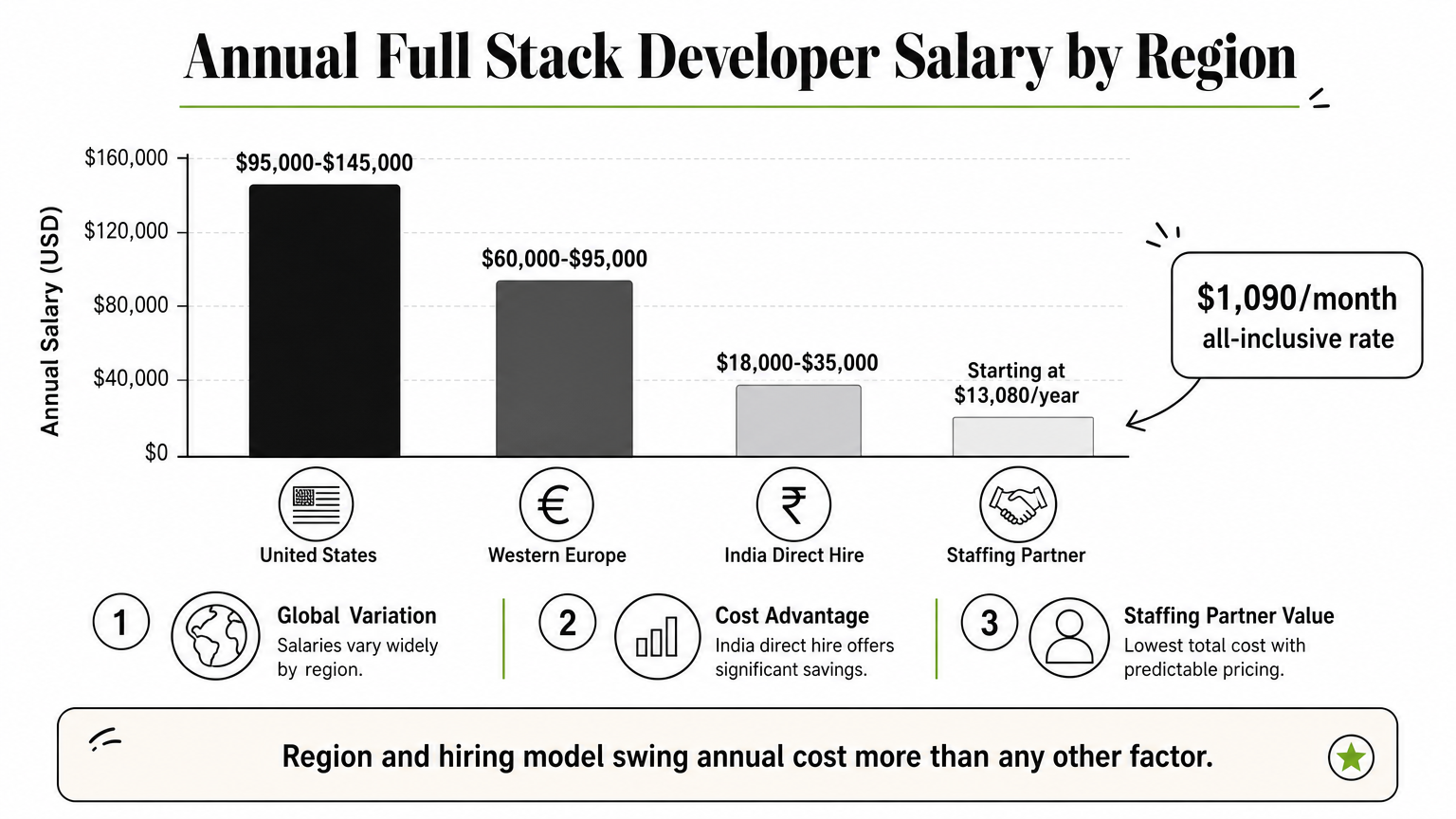
Budget first for the region you're hiring in, since that single variable swings your annual cost more than any other factor. US-based full stack developers command the highest salaries, European rates sit somewhat lower depending on the country, and offshore hires in India typically cost a fraction of either while working the same hours you need covered, as this 2026 breakdown of Indian and American developer pay shows in detail.
| Region | Typical annual salary (full-time) | Notes |
|---|---|---|
| United States | $95,000 - $145,000 | Higher in major tech hubs; add payroll tax and benefits |
| Western Europe | $60,000 - $95,000 | Varies widely by country and labor law |
| India (offshore, direct hire) | $18,000 - $35,000 | Quality varies without proper vetting |
| India (via staffing partner like GlobalEmployees) | Starting at $13,080/year ($1,090/month) | Includes HR, payroll, infrastructure, compliance |
The salary line on a job posting is never the real cost of hiring, once you add recruiting, payroll, benefits, and equipment.
Freelance hourly rates
Freelancers get billed by the hour or the project, so the math looks different than a salary line. A freelance full stack developer in the US typically charges $75 to $150 an hour, while European freelancers land somewhere in the $50 to $100 range. Offshore freelancers on marketplaces often quote $20 to $45 an hour, though quality control becomes your responsibility since there's no vetting layer between you and the candidate pool.
Hourly rates look cheap until you calculate a full month. A freelancer at $30 an hour working 160 hours costs you $4,800 that month, more than triple what a dedicated offshore employee through a staffing partner typically runs, and you still handle onboarding and management overhead yourself, which is the real cost math behind contract and full-time remote hires.
The hidden costs of hiring in-house
Going beyond salary, an in-house hire adds costs that rarely show up in the initial budget conversation. You're covering recruiting fees, background checks, a laptop and software licenses, health benefits, payroll taxes, and the HR staff time spent managing all of it, all of which show up in a line-by-line look at what a local hire costs to own. Industry estimates from the U.S. Bureau of Labor Statistics show benefits alone add roughly 30% on top of base wages for private-sector employees, before you even factor in equipment or office space.
GlobalEmployees removes most of that overhead by bundling HR, payroll, infrastructure, and compliance into one flat monthly rate, starting at $1,090 a month per developer with zero setup cost. You skip the recruiting fees, the laptop purchase, and the HR headcount, and you can scale the team up or down without renegotiating a long-term contract. For a full breakdown of what's included at each price point, check our offshore staffing plans for US businesses.
Key skills and qualifications to look for
A job title tells you almost nothing about what a candidate can actually do. Before you post an opening or ask a staffing partner for resumes, get specific about the skills that separate a developer who can maintain your codebase from one who'll quietly rack up technical debt. Hiring a full stack developer without a clear skills checklist is how teams end up with someone who can talk fluently about architecture but freezes when asked to fix a broken deployment.
Core technical skills every full stack developer needs
Start with the fundamentals that apply regardless of which specific frameworks your product uses. A capable full stack developer should be comfortable across the following:
- Front-end frameworks like React, Vue, or Angular, plus solid HTML/CSS and responsive design
- Back-end languages such as Node.js, Python, or Ruby, with the ability to build and secure REST or GraphQL APIs
- Database management, including both relational databases like PostgreSQL and NoSQL options like MongoDB
- Version control through Git, with real experience resolving merge conflicts on a team, not just solo projects
- Basic DevOps knowledge, covering CI/CD pipelines, containerization with Docker, and cloud deployment on AWS or similar platforms, though heavy infrastructure work usually calls for a full-time DevOps and Kubernetes specialist
- Testing practices, including unit tests and debugging skills that go beyond console.log statements
Match this list against your actual stack before you interview anyone. A developer who's strong in Django but has never touched your specific database won't need months to ramp up, but they will need weeks, so budget for that reality upfront.
Soft skills that matter more than they seem
Beyond the technical checklist, communication skill often determines whether a hire works out. Full stack developers frequently work with minimal supervision, especially in remote or offshore hiring arrangements, which means they need to flag blockers before those blockers become missed deadlines. Consider how a candidate explains a past project during the interview: do they walk you through their reasoning clearly, or do they lean on jargon to skip past gaps in their actual understanding.
A developer who can explain a bug to a non-technical founder is more valuable than one who can only explain it to another engineer.
Dependability matters just as much, particularly with distributed teams working across time zones. Given the choice between a slightly stronger coder who misses check-ins and a slightly weaker one who communicates proactively and hits deadlines, most experienced hiring managers pick the second candidate every time.
Certifications and portfolio signals worth checking
Formal certifications carry less weight than a working portfolio, so don't over-index on credentials alone. Look instead for a GitHub profile with real commit history, deployed projects you can actually click through, or a portfolio site that demonstrates the exact stack you're hiring for. Ask candidates to walk you through one project in detail, including decisions they'd make differently now, since that reveals more about their judgment than any certificate ever could.
Experience level should match your project's complexity, not just your budget. A junior developer can handle a straightforward CRUD app, but a complex, high-traffic platform needs someone who's already made the scaling mistakes elsewhere and learned from them. GlobalEmployees pre-screens every candidate against this exact skills framework before you ever see a resume, which is why clients skip the guesswork stage entirely.
In-house, freelance, or offshore: choosing a hiring model
Every hiring decision eventually comes down to which model fits your budget, timeline, and appetite for management overhead. Hiring a full stack developer in-house, through a freelance platform, or via an offshore staffing partner each solves a different problem, and picking the wrong one is one of the most common reasons a good candidate turns into a bad hire. The right choice depends less on which model sounds best and more on what your project actually needs over the next six to twelve months.
In-house hiring: full control, less flexibility
Bringing a developer onto your payroll gives you the tightest control over culture fit, daily availability, and long-term continuity. Companies building a core product with sensitive IP often lean this direction because it keeps everything under one roof and one contract. But in-house hiring takes the longest timeline of the three options, often six to twelve weeks between posting a role and getting someone productive, and it locks you into salary, benefits, and equipment costs whether or not the workload stays steady.
Freelance: fast but inconsistent for ongoing work
Freelance platforms solve the speed problem. You can have a developer working within days, and for a short, well-defined project, like building a landing page or fixing a specific bug, that speed is worth a lot. The tradeoff shows up on longer engagements: freelancers juggle multiple clients, availability shifts week to week, and there's no vetting layer standing between you and a candidate pool that ranges from excellent to unreliable. Freelance hiring works best when the scope is narrow and finite, not when you need someone embedded in your team for the next year.
Offshore staffing: full-time commitment without the overhead
Offshore staffing sits between the two, giving you a dedicated, full-time developer without the payroll, recruiting, and infrastructure costs of an in-house hire. Through a partner like GlobalEmployees, you get someone working your hours, on your stack, pre-vetted before you ever see a resume, all for a flat monthly rate with zero setup cost. This model fits teams that want the continuity of a full-time employee without carrying the administrative weight that comes with it.
Choose the hiring model based on how long you need the work done, not on which option looks cheapest this month.
Comparing the three models side by side
| Factor | In-house | Freelance | Offshore staffing |
|---|---|---|---|
| Time to hire | 6-12 weeks | 2-5 days | 3-7 days |
| Cost overhead | Highest (benefits, equipment, HR) | Low, but variable quality | Low, bundled into flat rate |
| Long-term availability | Full-time, dedicated | Inconsistent | Full-time, dedicated |
| Vetting responsibility | You | You | Handled by staffing partner |
| Contract flexibility | Low (formal employment) | High | High, no long-term lock-in |
Weighing these factors against your actual runway, not just this quarter's budget, keeps you from picking a model that solves this month's problem while creating next quarter's, and a broader look at how staffing, freelance, and agency models differ helps here. GlobalEmployees exists specifically for the middle ground: teams that need dedicated, full-time capacity but don't want to build an HR department to get it.
Where to find full stack developers to hire
Once you know your budget and engagement model, the next question is simple: where do you actually find these candidates? The answer depends heavily on the model you picked in the last section, since freelance marketplaces, job boards, and staffing partners each pull from different candidate pools with wildly different vetting standards. Hiring a full stack developer from the wrong source wastes weeks even when the platform itself is legitimate.

Freelance marketplaces
Platforms built for short-term, project-based work put you in front of a huge volume of candidates fast, which is exactly their appeal and exactly their weakness. You'll wade through hundreds of profiles with inflated skill claims to find a handful worth interviewing, and you're responsible for every step of the vetting yourself: portfolio review, technical screening, reference checks. This route makes sense for a two-week project with a narrow, well-defined scope. It makes far less sense when you need someone embedded in your team for the next year, since the lack of a vetting layer means quality swings wildly from one contractor to the next.
Job boards and professional networks
Posting directly on general job boards or LinkedIn works reasonably well for in-house hiring, particularly if your company already has a recognizable brand that attracts applicants on its own. The tradeoff is volume and speed: you'll manage the entire funnel yourself, from writing the posting to screening resumes to scheduling interviews, and a strong opening can still take six to twelve weeks to fill. Developer-specific communities and technical forums sometimes surface stronger candidates than general job boards, but they still leave the vetting entirely on your plate.
Staffing and outsourcing partners
A staffing partner flips the sourcing problem around. Instead of you searching through a pool of unknown quality, the partner has already built and vetted that pool before you ever see a resume. GlobalEmployees, for example, maintains a bank of 2,800+ vetted candidates across development, marketing, design, and operations, and matches you with pre-screened developers on your exact stack within days, not weeks; this comparison of platforms for sourcing Indian full stack talent shows how the options stack up.
The fastest path to a qualified developer isn't a bigger applicant pool. It's a smaller, pre-vetted one.
This approach solves the two biggest pain points of the other options at once: the slow timeline of in-house hiring and the inconsistent quality of open freelance marketplaces. You also get free access to vetted resumes before committing to anything, so you're reviewing real candidates instead of gambling on a job posting that might not attract anyone qualified.
Matching the source to your hiring goal
| Source | Best for | Vetting responsibility |
|---|---|---|
| Freelance marketplaces | Short, narrow-scope projects | You |
| Job boards / LinkedIn | In-house, brand-driven hiring | You |
| Staffing partner (GlobalEmployees) | Full-time, ongoing offshore capacity | Handled for you |
If you're building toward a dedicated, long-term team rather than filling a one-off gig, start with a staffing partner that's already done the vetting work, and skip the months of sourcing entirely.
Interview questions that reveal real full stack skills
Good interview questions do more than confirm a resume, they expose how a candidate actually thinks under pressure. Generic questions like "what's your experience with React" invite rehearsed answers that tell you nothing. When you're hiring a full stack developer, the goal is to recreate a small slice of real work and watch how they navigate it, because that's the only reliable signal for what they'll do on your codebase in month two.
Front-end questions that separate doers from talkers
Start with problems tied to actual user-facing behavior instead of syntax trivia. A candidate who's genuinely comfortable across the stack should be able to reason through these without hesitation:
- "Walk me through how you'd debug a component that renders correctly but won't update after an API call."
- "How would you handle a form that needs to validate on both the client and the server?"
- "Show me how you'd optimize a page that's loading slowly on mobile."
Answers that stay abstract, heavy on buzzwords but light on specifics, usually mean the candidate has read about these problems more than they've solved them.
Back-end and architecture questions
Move next into how they'd structure the parts of the app users never see. This is where hiring a full stack developer pays off, because you want someone who can reason about the database and the API in the same breath as the interface. Try questions like these and pay attention to whether the candidate explains tradeoffs or just names a technology:
| Question | What it reveals |
|---|---|
| "How would you design the database schema for a multi-tenant app?" | Understanding of data modeling and scale |
| "Walk me through securing a REST API endpoint." | Awareness of authentication and common vulnerabilities |
| "How do you decide between SQL and NoSQL for a new feature?" | Judgment, not just familiarity with tools |
| "Describe a time a deployment broke production. What happened?" | Honesty and debugging process under pressure |
Candidates who can only answer the front-end set or only the back-end set aren't full stack yet, no matter what the resume claims.
Behavioral questions that predict reliability
Technical skill only tells half the story, especially for remote or offshore roles where you can't glance over at someone's desk. Ask how they've handled a disagreement with a project manager over scope, or how they communicate when they're stuck on a problem for hours. The answers here often predict success better than any coding question, because most failed hires don't fail on skill, they fail on communication and follow-through.
A candidate who admits what they don't know is more trustworthy than one who has an answer for everything.
Sitting through a live coding exercise together, rather than a take-home test scored in isolation, also lets you watch how a candidate reacts to feedback in real time. Someone who gets defensive when you point out a bug during the interview will likely react the same way six months into the job, and that's worth knowing before you sign a contract, not after.
Common mistakes to avoid when hiring
Even experienced hiring managers repeat the same errors when hiring a full stack developer, mostly because these mistakes look reasonable in the moment and only reveal themselves months later. Knowing the pattern ahead of time saves you the cost of a bad hire, which typically runs far higher than the salary line itself once you count lost productivity and the time spent hiring again.
Mistake 1: Hiring on resume alone
Buzzword-heavy resumes get through screening far too often because they list the right technologies without proving the candidate can actually use them under pressure. Skipping a practical technical interview, the kind we outlined earlier with a real debugging task, is how teams end up with a developer who can discuss architecture fluently but stalls on the first production bug. Always verify claims against a live problem before you sign anything.
Mistake 2: Skipping the trial period
Jumping straight into a long-term contract without a trial window removes your safety net if the fit isn't right. A short initial period, whether a 30-day probationary stretch for an in-house hire or a limited first contract for an offshore developer, gives both sides a low-stakes way to confirm the working relationship actually works before either party commits further.
The cost of a 30-day trial is nothing compared to the cost of a six-month mismatch.
Mistake 3: Ignoring time zone and communication style
Great coding skills mean little if updates arrive at 2 a.m. your time with no context and no heads-up. Many teams pick a technically strong candidate and only discover the communication gap after the project is already underway. Confirm overlapping working hours, response expectations, and preferred communication tools during the interview, not after the first missed deadline, then follow a clear plan for managing a remote developer through the first 90 days.
Mistake 4: Underestimating the full cost of a hire
Quoting a low hourly rate or an attractive base salary without factoring in recruiting time, equipment, benefits, and management overhead leads to budget surprises later. Compare the real all-in cost across your options before committing.
| Mistake | Consequence | How to avoid it |
|---|---|---|
| Hiring on resume alone | Weak candidate slips through | Run a practical, real-world technical test |
| Skipping the trial period | No exit if the fit is wrong | Start every hire with a 30-day trial |
| Ignoring communication fit | Missed deadlines, frustration | Confirm working hours and tools upfront |
| Underestimating total cost | Budget overruns mid-project | Calculate all-in cost, not just salary |
| Locking into long contracts early | Stuck paying for unused capacity | Choose flexible terms until fit is proven |
Underestimating flexibility is its own trap too. Locking into a rigid, long-term contract before you've confirmed a developer's fit removes your ability to scale down if the project changes direction. This is one reason GlobalEmployees offers no long-term contracts and a money-back guarantee, so you can adjust or replace a hire without renegotiating a full agreement from scratch.
Finding the right developer for your team
Getting this hire right comes down to process, not luck. Define your stack before you post anything, pick an engagement model that fits your actual timeline, and never skip the practical technical interview, no matter how strong a resume looks. Judge candidates on real problems solved, not buzzwords listed, and confirm communication fit before you sign anything long-term.
Knowing all this still takes time to execute well, and that's exactly the gap a staffing partner closes. Rather than spending weeks sourcing and screening on your own, you can review pre-vetted developers matched to your stack, backed by a money-back guarantee and zero long-term commitment. That combination removes most of the risk from hiring a full stack developer in the first place.
If you're ready to skip the sourcing grind and start reviewing qualified candidates this week, get matched with pre-vetted full stack engineers from $1,290 a month and see real resumes before you commit to anything.