How to Hire a Content Writer in India: Cost and Tips
You need content, consistently, and your options are freelance marketplaces, agencies, or a full-time hire. If you've searched hire content writer india and gotten lost comparing Upwork profiles, agency retainers, and vague hourly rates, you're not alone. Most guides on this topic skip the actual decision-making part and jump straight to a list of platforms.
This guide answers the real question: how do you hire a content writer in India who fits your budget, understands your niche, and sticks around long enough to learn your voice? We'll break down realistic pricing for freelancers versus dedicated full-time writers, and show you what separates a one-off gig hire from a long-term content partner.
You'll get a straightforward comparison of hiring models, the red flags that signal a writer won't scale with you, and a practical process for vetting candidates before you commit. We built GlobalEmployees around placing dedicated, full-time Indian talent for exactly this kind of role, so we've seen firsthand what separates a writer who delivers for a few weeks from one who becomes a reliable, full-time resource on your team.
Why hire a content writer in India
India produces more English-language content professionals than almost any other country outside the US and UK, and the cost difference is the first thing most business owners notice. A mid-level content writer in the US typically runs $50 to $80 per hour on freelance platforms. In India, you'll find writers with the same skill level, sometimes better research habits and faster turnaround, for a fraction of that cost. That gap isn't a quality compromise. It's a byproduct of a lower cost of living and a massive, well-educated talent pool competing for remote work.
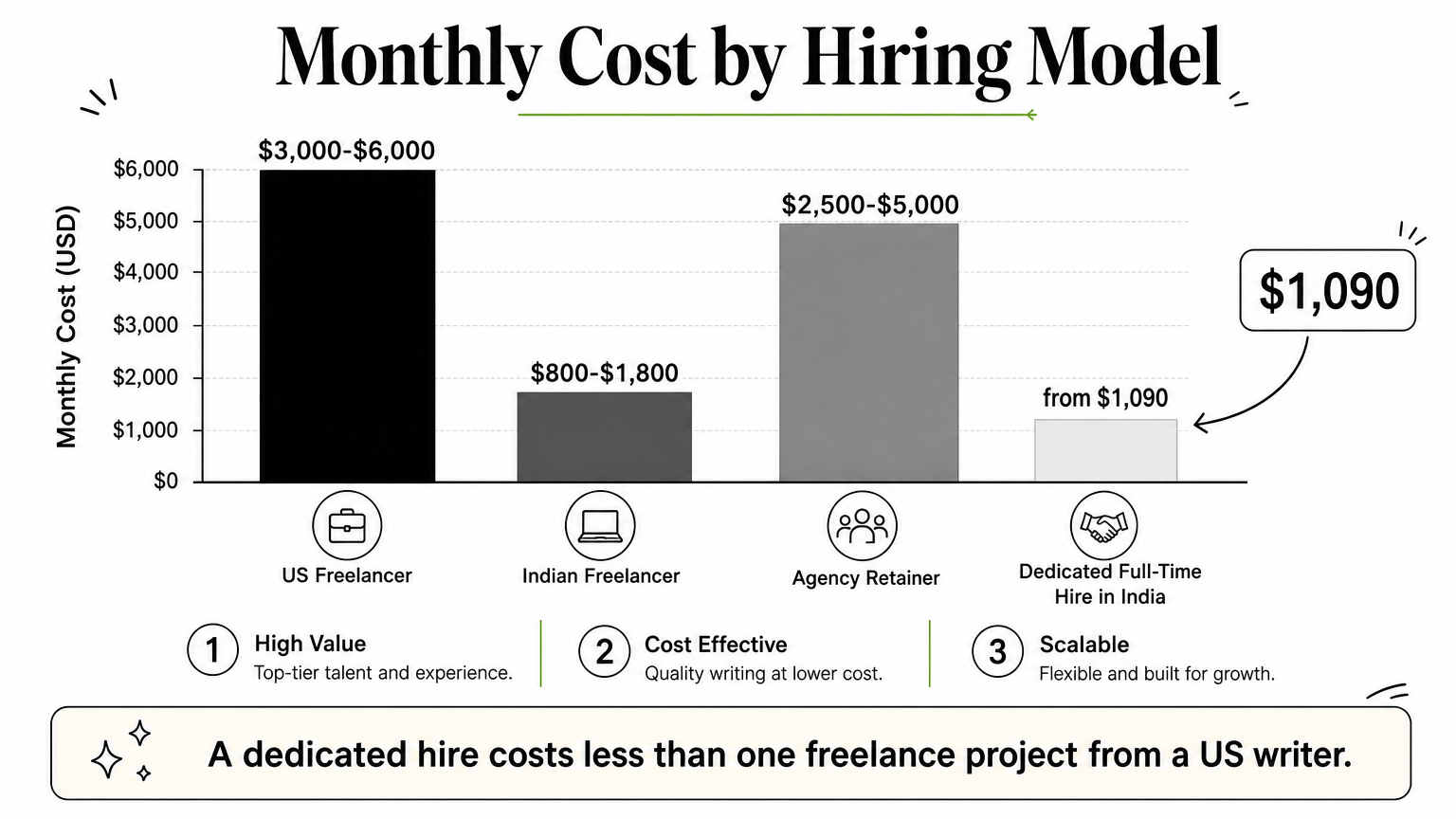
The cost advantage, broken down
Before you commit to a hiring model, it helps to see the numbers side by side. Freelance marketplaces charge per project or per hour with no guarantee of availability next month, which is the core of the freelancer versus dedicated remote hire tradeoff. Agencies mark up writer rates to cover their own overhead. A dedicated full-time hire, by contrast, gives you a fixed monthly cost with no per-project renegotiation.
| Hiring Model | Typical Monthly Cost (1 writer, full-time equivalent) | Availability | Voice Consistency | |---|---|---| | US freelancer (per project) | $3,000-$6,000+ | Inconsistent, juggles multiple clients | Low, rebuilds context each time | | Indian freelancer (per project) | $800-$1,800 | Inconsistent, juggles multiple clients | Low to medium | | Agency retainer | $2,500-$5,000+ | Consistent, but writer may rotate | Medium | | Dedicated full-time hire in India | Starting around $1,090 | Full-time, dedicated to you | High, builds over months |
A dedicated full-time writer costs less than a single freelance project from a US-based writer, and works for you exclusively.
English proficiency isn't a gamble
Business owners worried about hiring offshore talent often assume language quality will suffer. That fear made sense a decade ago, but it doesn't hold up today. India's education system runs largely in English past the primary grades, and the country has the second-largest English-speaking population in the world after the US, one of several reasons India remains the top country for hiring remote talent. When you review portfolios (which we'll cover in Step 3), you'll find writers who've spent years producing content for American and European brands, and who already understand idioms, tone shifts, and SEO conventions that US audiences expect.
Time zone overlap works in your favor, not against it
Going further, the 9.5 to 13-hour time difference between India and US time zones gets treated as a drawback, but flip it around: your writer works while you sleep. Submit a brief at the end of your workday, and a draft is often waiting when you log back in the next morning. This asynchronous rhythm suits content work particularly well, since writing rarely needs real-time back-and-forth once expectations are set. European clients see an even smaller gap, usually 3.5 to 5.5 hours, which allows for some overlapping working hours if you need live check-ins.
Scaling without rebuilding your hiring process
Here's the part most comparisons miss: a single freelance hire doesn't scale. If your content needs double next quarter, you're back on Upwork, vetting strangers again. A dedicated content writer hired through a staffing model can be paired with a second or third writer under the same process, same account manager, same onboarding standards. GlobalEmployees clients often start with one writer for blog content and add a second for email or product copy six months later, without repeating the vetting cycle from scratch. That's the practical case for hiring in India: not just lower rates, but a hiring model built to grow with you instead of one you outgrow within a year.
Step 1. Define your content needs and budget
Before you start browsing profiles, get specific about what you actually need written. "I need a content writer" is too vague to hire against, and it's why so many businesses end up with a mismatch three weeks in. Content needs vary wildly between a SaaS company that needs 2,000-word technical blog posts and an e-commerce brand that needs 50 punchy product descriptions a week. Nail down the specifics first, because that's what determines whether you need a generalist freelancer or a full-time specialist who can go deep on your niche.
Map out volume, format, and cadence
Start by listing what you'll actually assign in a normal month. This isn't busywork, it's the spec sheet you'll hand to any writer or staffing partner during Step 2.
- Content types: blog posts, landing pages, email sequences, product copy, whitepapers, social captions
- Monthly volume: how many pieces, and what average word count
- Research depth: does this require interviews, data analysis, or technical SME input
- SEO requirements: keyword targeting, on-page optimization, internal linking
- Publishing cadence: weekly, biweekly, or as-needed batches
Getting this down on paper also reveals whether you need one writer or a small team. A business publishing four blog posts a month has very different needs than one running a content-heavy SEO strategy across ten pages weekly, and that volume is usually what signals when to bring on a dedicated content marketing professional.
Set a budget that matches reality
Once you know the volume, price it against what you learned in the cost comparison above. A common mistake is budgeting like you're hiring a single freelance article at a time, then being surprised when a full-time writer's monthly rate looks different from a per-piece quote. Compare apples to apples: a dedicated full-time hire starting around $1,090/month typically produces far more output than a $200-per-article freelancer arrangement once you account for research time, revisions, and turnaround delays.
If your budget is built around per-article freelance pricing, you're likely overpaying for less consistency than a full-time hire delivers.
Question your assumptions here too. If you're planning to hire content writer india talent for ongoing, recurring work, a monthly retainer model almost always beats piecing together one-off gigs, both on cost and on your own time spent managing handoffs. Realistic budgeting at this stage saves you from restarting the whole search in two months because the numbers didn't hold up.
Step 2. Choose your hiring channel
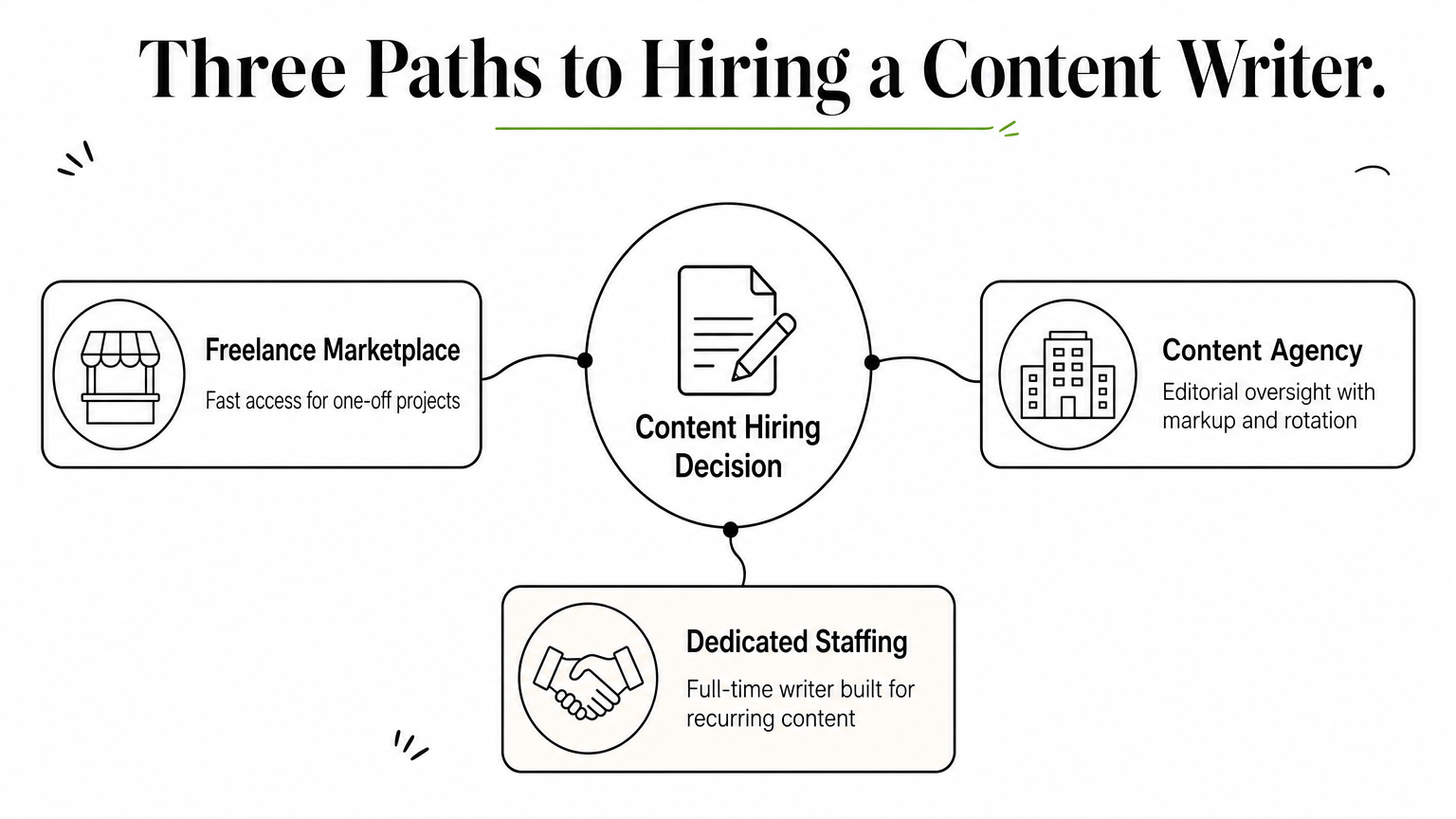
Once you know what you need, the next decision is where you go to find it. Three channels dominate this space: freelance marketplaces, content agencies, and dedicated staffing services. Each one trades cost, control, and consistency differently, and picking the wrong one for your situation is how businesses end up re-hiring every few months.
Freelance marketplaces
Platforms like Upwork or Fiverr give you fast access to thousands of Indian writers, and you can post a job today and get proposals by tomorrow. Freelance marketplaces work well for one-off projects, like a single whitepaper or a short burst of blog posts before a launch. The tradeoff is that you're doing all the vetting yourself, there's no guarantee the writer stays available past their current gig, and quality varies wildly between profiles that look identical on paper.
Content agencies
Agencies package writers, editors, and account managers into a retainer, so you get a layer of quality control you won't find on marketplaces. That structure comes at a price: agencies mark up writer rates to cover their own overhead, and you often don't get to pick or keep a specific writer long-term. If your account writer leaves the agency, you may find your content's tone and quality shifting without much warning.
Dedicated staffing services
A staffing model, which is what GlobalEmployees runs, sits between the two. You get a full-time dedicated employee who works exclusively for you, but the recruiting, HR, payroll, and infrastructure are handled on the offshore staffing partner's side. This is the model built for recurring, long-term content needs rather than sporadic projects, since the writer is committed to your account full-time and builds institutional knowledge of your brand over months instead of restarting context with every gig.
Match the channel to the commitment: one-off projects suit marketplaces, ongoing content needs suit a dedicated hire.
Matching the channel to your situation
| Your Situation | Best-Fit Channel |
|---|---|
| One-time project, tight deadline | Freelance marketplace |
| Need editorial oversight, no time to manage | Agency retainer |
| Recurring content, want brand consistency | Dedicated full-time hire |
| Planning to scale to multiple writers | Dedicated staffing service |
Take stock of how you answered Step 1 before choosing. If your monthly volume is stable and expected to grow, a hiring channel built around dedicated placement, rather than transactional gigs, saves you the repeated cost of vetting strangers every quarter. If you genuinely only need a handful of pieces this year, a marketplace hire is the more sensible starting point, and you can always graduate to a dedicated writer once your volume justifies it.
Step 3. Shortlist writers and review portfolios
Once you've picked a channel, you'll have a pile of applications or agency profiles to sort through. Resist the urge to hire the first writer who sounds confident in a cover letter. A strong portfolio tells you more in five minutes than a proposal tells you in five paragraphs, so start there before you schedule a single call.
What to look for in a writing sample
Good samples show more than clean grammar. You want proof the writer can research, structure an argument, and adapt tone to different audiences. When you review work, check for these specifics:
- Published, verifiable links, not just Google Docs the writer controls
- Range across formats, blog posts, landing pages, or email if that's what you need
- Evidence of SEO awareness, headers, scannable structure, natural keyword use
- Original analysis, not just summarized research from other articles
- Consistent quality across samples, not one polished piece propping up weaker ones
One strong sample tells you what a writer can do; three consistent samples tell you what they will do.
Narrow your list with a scorecard
Evaluating five or ten candidates on gut feeling alone leads to inconsistent decisions, especially if more than one person on your team is involved in hiring. Build a simple scorecard instead, scoring each candidate 1 to 5 on the criteria that matter for your content:
| Criteria | Weight | Notes |
|---|---|---|
| Writing clarity and tone match | High | Read a sample aloud, does it sound like your brand |
| Research depth | High | Look for data, quotes, or original angles, not filler |
| SEO structure | Medium | Headers, keyword placement, scannability |
| Turnaround examples | Medium | Ask directly, don't assume from samples |
| Communication in emails | Low | Clear, responsive, asks good clarifying questions |
Aim to get your shortlist down to three to five candidates before moving further. Anything more, and you'll spend more time managing the search than the actual content once you hire.
Ask for niche-specific samples if you have one
Since a generalist writer and a specialist can look identical on a resume, always ask candidates for a sample close to your industry, even if it means a short custom writing sample rather than a published clip. Someone who's written fintech explainers for two years will grasp compliance language faster than a generalist ever could, and that difference shows up in your first month of assigned work, not just in theory. If a candidate can't produce anything close to your niche, that's not automatically disqualifying, but it should lower their spot on your shortlist relative to someone who can.
Step 4. Test candidates with a paid trial
Portfolios show past work, but a paid trial shows you how a writer performs on your content, under your guidelines, on your deadline. Skipping this step is the single biggest reason businesses end up mismatched with a writer three weeks into an engagement. Pay for a real assignment, something you'd actually publish, rather than a throwaway test topic that tells you nothing about how the writer handles your actual brief.

Structure the trial like real work
Give candidates the same brief you'd hand a hired writer: target word count, keyword focus, tone notes, and a deadline. Don't simplify the assignment just because it's a trial, since an easier task hides the gaps you're trying to find. A useful trial run typically includes:
- One full piece, not an outline or a partial draft
- A real deadline, 48 to 72 hours is standard for a single blog post
- Your actual style guide, if you have one, so you can judge how well they follow direction
- One round of revision, to see how they respond to feedback, not just how they write cold
A trial only tells you something useful if the assignment mirrors the work you'll actually assign after hiring.
What separates a pass from a fail
Judging a trial isn't just about whether the final draft reads well. Watch for how the candidate handles the process itself, since that's what you'll be living with month after month.
| Signal | Good Sign | Warning Sign |
|---|---|---|
| Clarifying questions before starting | Asks 2-3 sharp questions | Starts writing with no questions, guesses wrong |
| Deadline handling | Delivers on time or flags delays early | Goes silent, misses deadline without notice |
| Revision response | Incorporates feedback precisely | Defensive, or changes unrelated sections |
| Tone match | Sounds close to your brand on the first try | Generic, could belong to any brand |
Running two or three candidates through the same trial, side by side, makes the differences obvious in a way that reading resumes never does.
Pay for the work, every time
Skip candidates who won't do a paid trial, and never ask for free work in the name of
Step 5. Negotiate terms and finalize your hire
Passing a paid trial narrows your list, but before you send an offer, put actual terms on paper. Rate, scope, revision policy, and payment terms all need to be settled before the first real assignment lands, not four weeks in when a disagreement over "how many revisions is included" derails your first month together.
Settle the numbers first
Negotiation with an Indian writer or dedicated hire rarely resembles a US salary negotiation. Rates are often more flexible than freelance platforms suggest, especially for long-term hires, but you should still nail down:
- Monthly or per-project rate, and whether it's fixed or scales with volume
- Revision limits, two rounds is standard, unlimited is a red flag for scope creep
- Ownership of content, confirm you own full rights the moment you pay
- Notice period, for either side, if the arrangement isn't working
Every term you skip negotiating now becomes a disagreement you have to resolve mid-project later.
Get it in writing
A handshake agreement over email or chat isn't enough once real money and deadlines are involved. Draft a short written agreement, even a one-page one, covering rate, scope, deliverables, and termination terms. Here's a simple structure to adapt:
Role: Full-time Content Writer
Rate: $X/month, fixed
Deliverables: 8 blog posts/month, 1,500-2,000 words each
Revisions: 2 rounds per piece
Ownership: Full rights transfer on payment
Start date: [date]
Notice period: 2 weeks, either party
Keeping this on file protects both sides and gives you something concrete to reference if expectations start to drift.
Finalize onboarding, not just the contract
Signing terms isn't the finish line. Hand over your style guide, brand voice notes, and a few of your best-performing pieces before day one, so the writer isn't guessing during their first real assignment. If you're hiring through a dedicated staffing model, this is also where a good partner's hiring and onboarding process handles payroll, compliance, and equipment setup on their end, so you're not managing tax forms or laptop procurement on top of managing content. GlobalEmployees, for instance, builds this into every dedicated content writer placement, meaning your only job after finalizing terms is reviewing drafts, not chasing paperwork.
Building a content team that lasts
Hiring a writer isn't a one-time task you check off, it's the start of a working relationship that either scales with your business or forces you back into the search every few months. The five steps above, defining your needs, choosing a channel, vetting portfolios, running paid trials, and locking terms in writing, exist to protect you from that churn. Skip a step, and you're more likely to end up rehiring by month three.
Getting this right the first time matters more than saving a few dollars per article. A dedicated full-time writer who understands your brand voice by month two is worth more than three freelancers cycling through by month six. That's the whole case for treating this as a hire, not a gig.
If you'd rather skip the vetting cycle entirely, GlobalEmployees pre-vets Indian writers for exactly this kind of long-term fit. Hire a dedicated content writer from India and start with vetted resumes before you commit to anything.