What Is the Salary of a Full Stack Developer in India?
What Is the Salary of a Full Stack Developer in India?
If you are trying to pin down the full stack developer salary India employers actually pay, you have probably seen numbers that range from $3,000 to $40,000 a year. That spread is real, and it confuses job seekers and hiring managers alike. Pay depends on experience, city, and tech stack, not on the job title alone.
Here is the short answer. The average salary of a full stack developer in India is roughly ₹6 to ₹12 lakh per year, or about $7,000 to $14,000. Juniors start closer to ₹3 to ₹5 lakh. Senior engineers in Bangalore or Hyderabad working with React, Node.js, or cloud tooling can pass ₹25 lakh. Treat these as market ranges, not fixed rates.
Below, we break down pay by experience level, by city, and by stack, so you can benchmark your own salary or judge an offer. At GlobalEmployees, we place dedicated full-time developers in India for US and European companies, so we also show what a realistic hiring budget looks like and how it compares to Western rates.
Why full stack developer pay in India matters
Salary numbers drive real decisions, and bad numbers cost real money. The full stack developer salary in India is not one figure, because the same title covers a junior who builds forms in React and a lead who designs payment systems on AWS. Titles also overlap. A full stack web developer salary in India and a full stack software developer salary in India usually point to the same pay band, while a full stack app developer salary in India can run slightly higher when React Native or Flutter skills are involved.
Why job seekers need a benchmark
Candidates who skip benchmarking tend to undersell themselves. Offers for identical skills can differ by a third or more between a large service company and a funded product startup. If you do not know the band for your city and stack, you cannot tell a fair offer from a low one.
Raises work the same way. Developers who change jobs often see jumps of 20 to 40 percent, while annual increments inside one company tend to be far smaller. Walking into a negotiation with a documented salary range gives you a number you can defend instead of a feeling.
Why employers need one too
Hiring managers face the opposite problem. Offer too little and strong candidates ignore you or leave within a year. Offer too much and you strain your budget and create pay gaps with existing staff. Attrition in Indian software roles runs high, so a below-market salary shows up fast as turnover, and every replacement costs you weeks of lost output.
A salary benchmark is cheap insurance against both a bad offer and a bad hire.
The table below shows who uses salary data and what goes wrong without it.
| Who is asking | Core question | Risk of guessing |
|---|---|---|
| Job seeker | Is this offer fair? | Accepting 20 to 30 percent below market |
| Hiring manager | What should I budget? | Rejected offers, early resignations |
| Founder comparing offshore vs. local | How much will I really save? | A cost model that ignores hidden costs |
Why the gap with Western pay changes the math
Offshore buyers add a third angle. A US full stack developer commonly earns $90,000 to $150,000 a year, while the Indian average sits near $7,000 to $14,000. That India versus US developer salary gap explains why so many companies look at India. But salary is not the whole cost. Recruiting, payroll, equipment, software licenses, and compliance all add to the real figure, and the sections below show how to account for each one.
How to estimate a fair full stack salary in India
Estimating pay means narrowing a wide range, not hunting for one magic number. When someone asks what is the salary of full stack developer in India, the useful answer is a band that you tighten with a few specific inputs.
Start with four inputs
Every credible full stack developer salary India estimate rests on the same variables. Collect them before you look at any market data, because vague inputs produce vague numbers.
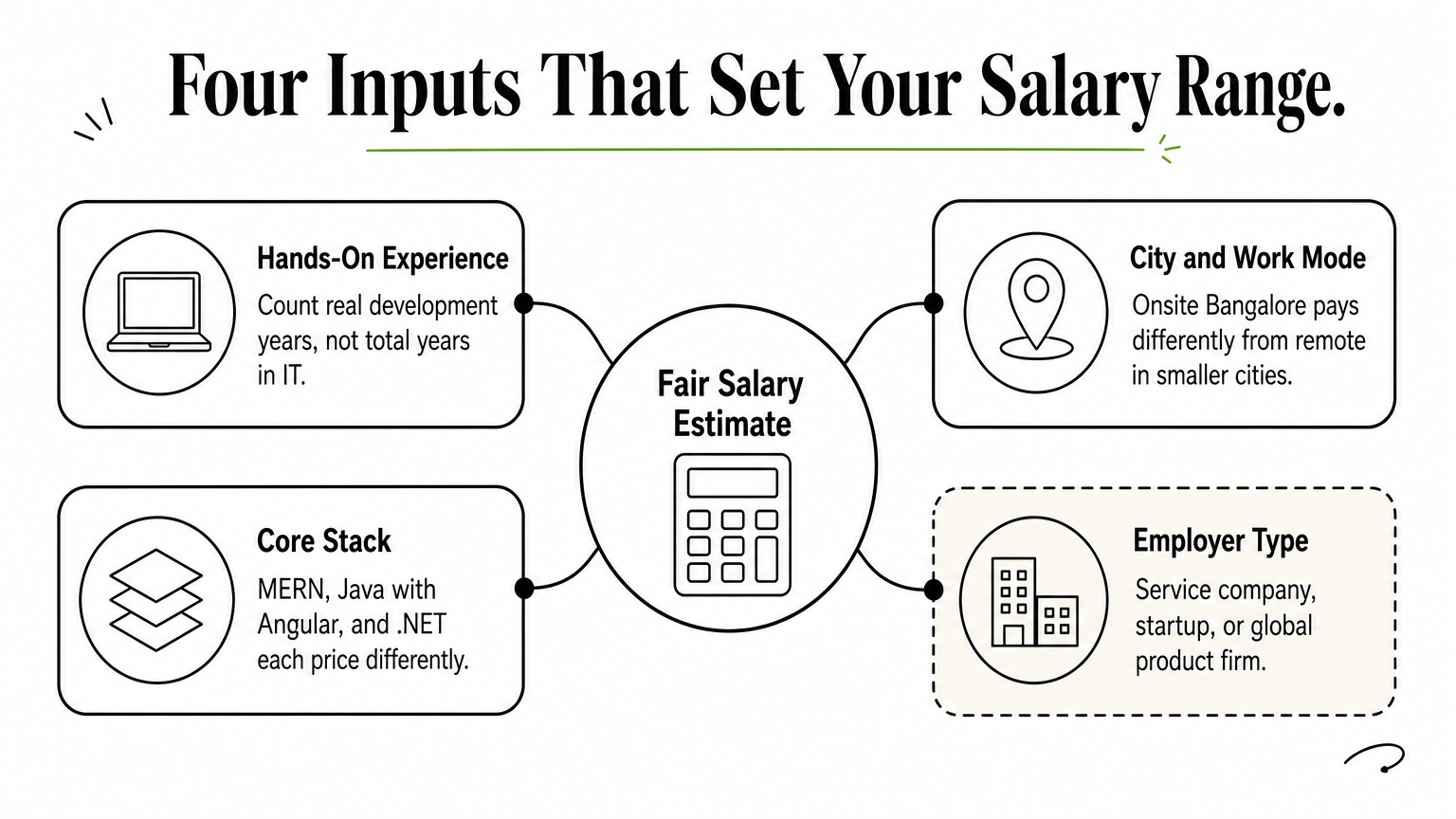
- Hands-on experience: count years of real development work, not total years in IT.
- City and work mode: onsite in Bangalore pays differently from remote in a smaller city.
- Core stack: MERN, Java with Angular, and .NET with React each price differently.
- Employer type: service company, startup, or global product firm.
Build a range from three sources
One source can mislead you, so cross-check at least three. Job boards skew toward advertised pay, recruiters know what offers actually close at, and your own data shows what your team or past candidates accepted.
- Pull 10 to 15 current job postings that list pay for your exact role and city.
- Ask two or three local recruiters for recent accepted offers.
- Compare both against offers you or your team have already seen.
Throw out the highest and lowest figures, then keep the middle band. For example, a developer with four years of experience in MERN, working at a Pune product startup, typically lands between ₹10 and ₹15 lakh. A fair offer sits around ₹12 to ₹13 lakh.
A fair salary is the middle of a tight range, not the midpoint of a wide one.
Check CTC against take-home pay
Indian offers are quoted as cost to company, or CTC. That figure includes employer provident fund, gratuity, insurance, and variable pay, so it overstates what lands in the bank. A ₹12 lakh CTC can mean roughly ₹9.5 to ₹10.5 lakh in annual take-home.
Always ask for the fixed versus variable split. Candidates should judge an offer on fixed pay. Employers should budget on full CTC, then add the costs that sit outside it, which the budgeting section covers later.
Full stack developer salary by experience level
Experience is the biggest single driver of the full stack developer salary in India, so start here before you adjust for city or stack. The figures below are annual CTC for developers with hands-on experience, and they assume a mainstream stack in a mid-size or large city.
Salary ranges at a glance
| Level | Experience | Annual pay (INR) | Approx. USD |
|---|---|---|---|
| Entry | 0 to 2 years | ₹3 to ₹6 lakh | $3,500 to $7,000 |
| Mid-level | 2 to 5 years | ₹6 to ₹15 lakh | $7,000 to $17,500 |
| Senior | 5 to 10 years | ₹15 to ₹30 lakh | $17,500 to $35,000 |
| Lead or architect | 10+ years | ₹30 to ₹50+ lakh | $35,000 to $58,000+ |

Treat the dollar column as a rough guide, based on about ₹86 to the dollar. Exchange rates move, so check the current rate before you build a budget, and remember that the mid-level band is the widest because stack and employer matter most there.
What you get at each stage
Entry-level developers build features under review. They write REST APIs, UI components, and bug fixes, and they need guidance on architecture. Pay stays low because you are paying for learning time. Bootcamp graduates often start near ₹3 lakh, while engineering graduates from strong colleges land closer to ₹5 to ₹6 lakh.
Mid-level developers own features from database to browser. They ship without hand-holding, write tests, and handle deployments. This is where the average salary of a full stack developer in India sits, and where changing jobs pays off most, often with a 20 to 40 percent jump.
Seniors are paid for judgment. They design systems, review code, mentor juniors, and make trade-offs on cost and scale. A senior with cloud and system design skills can pass ₹25 lakh at a product company.
You are paid for the decisions you own, not the years on your résumé.
Years are a proxy, not a promise
Titles inflate in India, so a "senior developer" with three years of experience is common. When you benchmark a candidate or an offer, ask what the person has actually owned: a production system, a payment flow, a team. Someone who has run releases and fixed live incidents is worth more than someone with the same years spent on maintenance tickets.
Use this quick check to place a candidate in the right band:
- Can they design a database schema and API without a template?
- Have they deployed and monitored an app in production?
- Have they mentored or reviewed other developers' code?
Three yeses point to the senior band, whatever the title says.
How city, tech stack, and employer type change pay
Experience sets the base, and three other factors move it up or down by 20 to 50 percent. Adjust for each one in turn and your estimate of the full stack developer salary India employers pay gets much tighter.
City
Location still matters, even for remote roles, because many companies anchor pay to the city where the team sits. Bangalore leads since product firms and global capability centers compete for the same people. The table shows typical annual CTC for mid-level developers with 3 to 5 years of experience.
| City | Typical annual CTC |
|---|---|
| Bangalore | ₹10 to ₹18 lakh |
| Hyderabad | ₹9 to ₹16 lakh |
| Delhi NCR and Mumbai | ₹8 to ₹15 lakh |
| Pune | ₹8 to ₹14 lakh |
| Chennai | ₹7 to ₹13 lakh |
| Tier 2 (Jaipur, Indore, Kochi) | ₹5 to ₹9 lakh |
Smaller cities pay 25 to 40 percent less, but living costs drop too, and the talent pool is often more stable. For offshore hiring, a tier 2 city can cut your cost without hurting quality.
Tech stack
Common stacks such as MERN have large talent pools, so pay stays moderate. Scarcer or enterprise-heavy combinations cost more. Use these adjustments against a MERN baseline:
- Java Spring Boot with React or Angular: about 10 to 15 percent higher, driven by enterprise demand.
- .NET with React: similar to Java in banking and enterprise settings.
- Python (Django or FastAPI) with React: higher when paired with data or AI work.
- PHP, Laravel, or WordPress: 10 to 20 percent lower.
- Cloud, Docker, or React Native skills: add 10 to 20 percent on top of any stack.
Employer type
Who signs the paycheck changes the number as much as what the developer knows. Service companies pay least, often ₹4 to ₹8 lakh at mid-level, because they bill by volume. Funded startups pay more cash and sometimes equity. Global product firms and capability centers pay the most, with senior packages above ₹25 lakh plus stock.
The same developer can earn 40 percent more by changing employer type, with no new skills.
Stack the adjustments in order. Take a Hyderabad developer with four years of Java and React experience. Start at a ₹12 lakh baseline, add 10 percent for the stack, and add 20 percent for a product company. You land near ₹16 lakh, which is a realistic offer to benchmark against.
What to budget when hiring a full stack developer in India
Salary is the floor of your budget, not the total. The full stack developer salary India ranges above describe what goes into the developer's CTC, but a real hiring budget covers more. If you hire directly, plan for 25 to 45 percent on top of CTC in the first year.
The salary is what the developer earns. The budget is what the developer costs you.
What sits on top of CTC
Take a mid-level developer at ₹12 lakh CTC, about $14,000. These are the costs that CTC does not include.

| Cost item | Typical year-one amount |
|---|---|
| Recruiting fee (8 to 15 percent of CTC) | $1,100 to $2,100 |
| Laptop and peripherals (one-time) | $800 to $1,200 |
| Software licenses and dev tools | $400 to $800 |
| Workspace, internet, power backup | $600 to $1,500 |
| Payroll, HR, and compliance admin | $500 to $1,000 |
That adds $3,400 to $6,600, so the first-year cost lands near $17,400 to $20,600. The one-time items fade after year one. Attrition risk does not, because every resignation sends you back to the recruiting line.
Choosing a hiring model
Your model decides how much of that overhead you carry yourself. Most US and European teams pick one of three.
- Direct hire through your own Indian entity: full control, but you handle setup, legal work, payroll, and compliance yourself.
- Freelancer or contractor: the lowest commitment, but weaker continuity and harder IP and data protection.
- Offshore staffing partner: the partner recruits, runs HR and payroll, and supplies equipment, while you manage the daily work.
With GlobalEmployees, dedicated full stack developers start from $1,090 per month, with zero setup, HR, and infrastructure cost. That works out to about $13,080 a year, so you budget one predictable monthly line instead of five. Senior engineers cost more than the entry price, so use the experience bands above to set your ceiling before you request resumes.
Putting the salary numbers to use
The full stack developer salary India employers pay comes down to four inputs: experience, city, stack, and employer type. Start with the experience band, adjust for the other three, and check the result against three sources. Then separate CTC from take-home if you are the candidate, or CTC from total cost if you are the employer.
Most mistakes happen when people treat a wide range as a single number. A tight, well-sourced band gives you something to negotiate with, whether you are weighing an offer or setting a budget. If you hire offshore, the overhead on top of salary decides your real savings.
If you want that overhead handled for you, hire a full-stack developer through GlobalEmployees. You can review vetted resumes for free before you commit, and you pay nothing until you pick a candidate.