Virtual Assistant Services Prices: 2026 Rates and Packages
Budgeting for a virtual assistant is harder than it should be. One provider quotes $8 an hour, another quotes $45, and a third sells a monthly package with hours you may never use. Without context, virtual assistant services prices look random, and it is easy to overpay or hire someone who can't do the job.
Here is the short answer. In 2026, hourly rates run from about $6 to $50, depending mainly on where the VA is based and how skilled the work is. US-based assistants sit at the top of that range. Offshore VAs, especially in India, cost far less. Full-time offshore hires at GlobalEmployees start at $1,090 per month, with no setup, HR, or equipment costs on top.
Below, you'll see typical rates by region, how pricing differs for admin, marketing, and technical tasks, and how hourly, part-time, and full-time packages compare. You'll also learn which hidden costs to watch for, so the number you budget is the number you actually pay.
Why virtual assistant pricing varies so much
Two assistants can both manage your inbox and calendar, yet one charges five times what the other does. That gap is not random. Virtual assistant services pricing follows a handful of drivers, and once you can name them, quotes become much easier to compare.
Location sets the baseline
Where your VA lives has the biggest effect on price. Local living costs shape what a fair wage looks like, so a US-based assistant has to earn far more per hour than one in India or the Philippines to cover rent, taxes, and health insurance. The work can be identical. The paycheck is not.
Labor markets add a second layer. A US freelancer builds self-employment taxes and benefits into the rate. Offshore rates often run 60 to 80 percent lower for comparable admin work, which is the main reason virtual assistant services cost less overseas.
Location decides the price range, and skill decides where you land inside it.
Skill level and task complexity
Skill is the second lever. Answering email and scheduling is entry-level work. Bookkeeping, SEO research, social media management, and CRM administration require training, so specialized virtual assistant services rates often sit 30 to 100 percent above general admin rates. Tools and platform knowledge, such as QuickBooks or HubSpot, raise the price further.
Experience works the same way. A VA with five years of managing executive calendars moves faster and needs less supervision than a newcomer. You pay more per hour, but you often buy fewer hours, which can make the senior hire cheaper per task.
Employment model and what's included
Finally, how you hire changes what the rate actually covers. A freelancer's hourly rate is usually bare. An agency adds a margin for vetting and backup coverage. A dedicated employee placed through a staffing partner is billed monthly. Commitment matters too: pay-as-you-go hours cost more per hour than a monthly block, and a full-time hire costs the least per hour. Before you compare numbers, check whether a quote includes any of these:
- Laptop, software licenses, and internet
- Recruiting and free replacement if the fit is wrong
- HR, payroll, and compliance handling
- Management oversight and backup coverage
- Data security measures such as NDAs and VPN access
Always ask which items are bundled. Two virtual assistant services packages with the same sticker price can differ by hundreds of dollars a month once you add whatever one of them left out.
How to estimate your virtual assistant budget
A usable budget needs only three inputs: hours, skill level, and a buffer. You don't need a quote to start. Once you run the numbers yourself, virtual assistant services prices stop looking arbitrary, and you can spot an inflated offer fast.
Count the hours first
Write down every task you want to hand off in a typical week, then estimate the minutes each one takes. Most owners guess low, so track your own time for five working days before you commit to a number. Next, sort the tasks into admin, specialized, and technical. Each group carries a different rate, so a single blended guess will mislead you.
Run the formula
Multiply weekly hours by 4.33 to get monthly hours, then multiply by the hourly rate. Add 10 percent for a buffer on top.
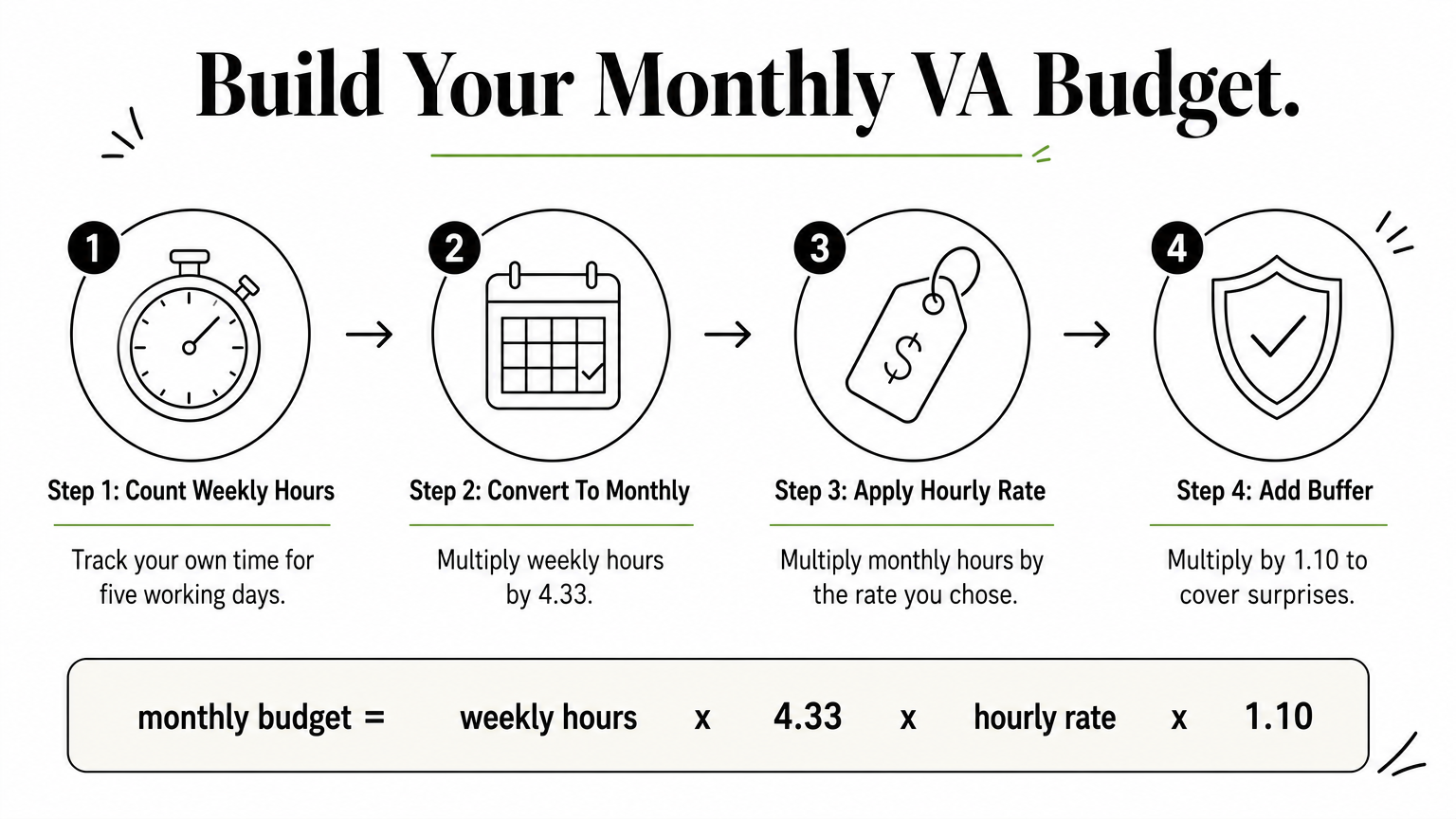
monthly budget = weekly hours x 4.33 x hourly rate x 1.10
Here is what 20 hours a week costs at three rate levels, before the buffer:
| Hourly rate | Monthly hours | Monthly cost |
|---|---|---|
| $10 | 86.6 | $866 |
| $25 | 86.6 | $2,165 |
| $40 | 86.6 | $3,464 |
Build your budget from the hours you need, not from the lowest hourly rate you can find.
Compare that with a full-time hire. At 40 hours a week you get about 173 hours a month, so a $1,090 monthly starting price works out to roughly $6.30 an hour. That is why virtual assistant services cost far less per hour once you move from scattered hours to a dedicated employee.
Add a buffer and test both options
Finally, plan for 10 to 15 percent extra. Onboarding runs longer than expected, and tasks multiply once your VA proves useful. A small buffer prevents mid-month surprises and keeps you from cutting hours right when the work starts paying off.
If you're torn between part-time and full-time, price both. When your part-time hours climb toward 100 a month, a flat monthly rate usually beats hourly billing, and you gain a consistent person who learns your processes.
Virtual assistant hourly rates by location
Geography is the fastest way to narrow your search. The ranges below show typical 2026 virtual assistant services rates for general admin work, and they assume a freelancer or small agency billing by the hour. Specialized tasks cost more, which the next section covers.
Typical hourly rates by region
| Region | Typical hourly rate |
|---|---|
| United States and Canada | $25 to $50 |
| UK and Western Europe | $20 to $45 |
| Eastern Europe | $12 to $25 |
| Latin America | $8 to $20 |
| Philippines | $6 to $14 |
| India | $6 to $15 |
Read these as ranges, not fixed prices. A VA at the low end of any row usually has less experience or a thinner portfolio. A VA at the top often brings specialist skills or strong English and client references. Treat any quote far outside its regional range as a warning sign in either direction.
What the gaps mean for your budget
India and the Philippines offer the lowest virtual assistant services prices for a reason. Wages are lower, and both countries have large pools of English-speaking graduates. For a US or European small business, that means one US-based assistant at $35 an hour costs about the same as a full-time offshore employee.
A US assistant at $35 an hour costs roughly what a dedicated full-time hire in India costs for the whole month.
Time zones deserve a line in your budget too. An assistant in India can work your evening as their morning, which suits tasks like overnight inbox triage or research you want waiting at 9 a.m. If you need live phone coverage during US business hours, confirm the shift schedule before you sign, because some providers charge a premium for night shifts. Dedicated hires through a staffing partner, such as the offshore employees at GlobalEmployees, typically set the schedule up front, so the overlap hours are part of the agreement rather than an add-on.
Virtual assistant rates by task type and experience
Task type and seniority decide where a quote lands inside a regional range. When you compare virtual assistant services prices, match the work first, then the experience level. Otherwise you end up comparing a data-entry assistant with a bookkeeper and wondering why the numbers disagree.
Typical rates by task type
The table shows typical 2026 hourly rates for offshore VAs in India and the Philippines next to US-based assistants. Specialized work carries a premium in every region, but the dollar gap between regions stays wide at every skill level.
| Task type | Offshore (India, Philippines) | US-based |
|---|---|---|
| General admin (email, scheduling, data entry) | $6 to $12 | $25 to $40 |
| Customer support and phone | $7 to $14 | $20 to $35 |
| Bookkeeping and invoicing | $9 to $18 | $30 to $55 |
| Social media and content | $9 to $18 | $30 to $60 |
| SEO, research, lead generation | $10 to $20 | $35 to $60 |
| Technical (CRM setup, automation, web updates) | $12 to $25 | $40 to $80 |
Tools move the price as well. Pricing for virtual assistant services rises when a VA holds certifications in QuickBooks, HubSpot, or Shopify, and certified specialists usually quote at the top of their row. If your tasks need one tool every day, pay for that skill. If they don't, you are paying for a credential you won't use.
How experience changes the rate
Experience adds a second multiplier on top of task type. Think of it in three tiers, measured against the entry-level rate for the same task:
- Entry level (0 to 2 years): bottom of the range. Good for routine, well-documented work.
- Mid level (2 to 5 years): roughly 25 to 50 percent higher. Works independently and spots problems early.
- Senior (5+ years): roughly 50 to 100 percent higher. Handles executive calendars, vendor follow-ups, and training newer team members.
Most owners overbuy here. A senior VA sorting receipts is wasted money, while an entry-level hire managing your client escalations is a risk. Match the tier to the judgment the task demands, and consider a mixed setup: one senior assistant to run the process and a junior one to execute it.
Pay for experience only where judgment matters, and pay entry-level rates for everything you can document.
Monthly packages and retainers: what you get
How packages are structured
Most virtual assistant services packages bundle a fixed block of hours for a flat monthly fee. You pay the same whether you use every hour or not. In return, the hourly rate drops, usually by 5 to 15 percent compared with pay-as-you-go. Retainers work the same way but add a commitment, often three to six months.
Typical package tiers and prices
The table shows what to expect at each size. Offshore figures reflect India and the Philippines. US figures reflect freelancers and small agencies.
| Package | Hours per month | Offshore price | US-based price |
|---|---|---|---|
| Starter | 10 to 20 | $100 to $250 | $400 to $900 |
| Standard | 40 | $320 to $600 | $1,200 to $2,000 |
| Growth | 80 | $600 to $1,100 | $2,400 to $4,000 |
| Full-time dedicated | about 173 | From $1,090 | $4,500 and up |
Look closely at the last row. Past roughly 100 hours a month, a dedicated employee beats a block of hours on cost. You also get one person who learns your systems instead of a rotating pool.
Fine print that changes the real price
Rollover rules matter more than the headline fee. Many providers expire unused hours at month's end, so a 40-hour package where you use only 28 hours costs you 43 percent more per hour than the sticker rate. Ask whether hours roll over, and for how many months.
An unused hour is still a paid hour, so buy the package you will actually use.
Beyond rollover, check overage rates, which commonly run 10 to 25 percent above the package rate. Then read the cancellation terms. Long lock-ins make it expensive to scale down when work slows. Month-to-month arrangements with short notice periods protect you, and they are the standard at GlobalEmployees, where there are no long-term contracts. When you compare pricing for virtual assistant services, the flexibility to change course is worth real money.
Hiring models compared: freelancer, agency, dedicated VA
The model you pick changes your real cost as much as the hourly rate does. Virtual assistant services prices look very different once you compare a freelancer, an agency, and a dedicated employee, because each one bundles different things into the number.

The three models at a glance
| Freelancer | Agency | Dedicated VA | |
|---|---|---|---|
| Typical cost | $6 to $50 per hour | Freelancer rate plus 20 to 40 percent | From $1,090 per month, full-time |
| Tools and equipment | You supply | Sometimes included | Included |
| Backup if absent | None | Usually yes | Depends on provider |
| HR and payroll | Not applicable | Handled by agency | Handled by provider |
| Best for | Small, one-off tasks | Short projects, quick starts | Ongoing daily work |
The two low numbers here are not the same kind of low. A freelancer is cheap per hour but bare, so you cover the tools, backup, and oversight yourself. A dedicated employee costs more per month, yet the laptop, software, and HR work are already paid for.
The cheapest rate is not the cheapest model once you count what you must supply yourself.
Which model fits your workload
Match the model to your weekly hours and how much management time you can spare. Most owners who outgrow a freelancer do it quietly, by adding more hours until the invoice looks like a salary.
- Freelancer: best under 15 hours a week. You get the lowest commitment, but you handle vetting, security, and gaps when they get sick or leave.
- Agency: best when you need someone this week for a defined project. You pay the margin for vetting and replacement coverage, and you may get a rotating person rather than one assistant.
- Dedicated VA: best past 100 hours a month. You get one full-time person who learns your systems, at the lowest cost per hour.
Hiring a dedicated virtual assistant is the route GlobalEmployees provides. You manage the daily work directly, and the company handles recruiting, payroll, equipment, and compliance. Review sample resumes before you commit to anyone, and you will know the quality before you pay for it.
Hidden costs and how to avoid overpaying
Overpaying rarely happens at the hourly rate. It happens in the line items nobody mentions up front. When you compare virtual assistant services prices, add the extras below first, because a cheap quote with add-ons can end up costing more than a higher all-in monthly price.

Fees that don't appear on the quote
Most surprises come from small charges that stack up. The table lists the usual ones, with a typical impact and a way to avoid each.
| Hidden cost | Typical impact | How to avoid it |
|---|---|---|
| Marketplace and payment fees | 3 to 10 percent on top | Hire directly or through a flat-fee provider |
| Tool licenses (CRM, VPN, project software) | $20 to $100 per month | Choose a provider that supplies software |
| Recruiting or setup fees | $200 to $1,000 one time | Ask for zero setup cost in writing |
| Overage and rush charges | 10 to 25 percent above rate | Cap overages in the agreement |
| Replacement fees | Full recruiting cost again | Require free replacement |
Your time and turnover
Your own hours are the cost owners forget. Training a new assistant usually takes 10 to 20 hours of your time in the first month, and a freelancer who disappears sends you back to the start. Multiply those hours by what your time is worth, and a bargain rate looks less like one.
Turnover is the second leak. Every restart repeats the training, so a stable full-time hire is cheaper than a cycle of low-cost short stints. Ask what happens if the fit is wrong. GlobalEmployees offers quick replacement or a 100% money-back guarantee, which removes most of that risk.
A quote is only comparable once you know exactly what is missing from it.
Quick check before you sign
Run through these questions with every provider. Written answers beat verbal promises, and a vague reply is itself an answer.
- What is the full monthly cost, including tools, equipment, and payroll?
- Do unused hours roll over, and for how long?
- What is the overage rate, and is there a cap?
- Is replacement free, and how fast does it happen?
- What is the notice period if you scale down?
Sample budgets for common VA hiring scenarios
Numbers make more sense when they're tied to a real situation. The scenarios below apply the formula from earlier, including the 10 percent buffer, so you can see how virtual assistant services prices turn into an actual monthly budget.
Budgets at a glance
Each row uses mid-range rates from the tables above. Your numbers will shift with task type and experience, but the pattern holds across most small businesses.
| Scenario | Setup | Monthly estimate |
|---|---|---|
| Solo consultant, offshore | 10 hours a week, general admin, $10 per hour | About $476 |
| Solo consultant, US-based | 10 hours a week, general admin, $30 per hour | About $1,429 |
| Online store | 20 hours a week, support and bookkeeping, $12 per hour | About $1,143 |
| Growing agency | 40 hours a week, full-time dedicated hire | From $1,090 |
What the scenarios show
Start with the solo consultant. The offshore option costs about a third of the US-based one for the same ten hours. If the work is email, scheduling, and data entry, the extra $950 a month buys you very little.
Then look at the online store. At about $1,140 for 87 hours, you already pay more than the $1,090 starting price of a full-time hire who gives you roughly 173 hours. Once your part-time spend reaches that level, price the full-time option before you add more hours.
When part-time spend nears $1,100 a month, a full-time hire gives you twice the hours for the same money.
Finally, consider the agency owner who needs steady daily help with social posts and client reporting. A dedicated employee covers the laptop, software, and payroll inside the monthly fee, so the main extra cost is your own training time, usually 10 to 20 hours in the first month. Senior or specialized roles quote above the starting price, so review sample resumes and ask for the exact figure before you budget.
Choosing a price that fits your needs
Virtual assistant services prices make sense once you know what drives them. Location sets the range, task complexity and experience set your spot inside it, and the hiring model decides what the number includes. Compare quotes only after you know what each one leaves out.
Your next step is simple. Count your weekly hours, run the formula, and add a buffer. If the result nears $1,100 a month, a full-time dedicated hire usually gives you more hours for the same money, and you stop paying separately for tools, setup, and recruiting.
Ready to see real numbers? Review free sample resumes and hire employees in India with no setup cost and no long-term contract. You pay nothing until you pick a candidate, and a money-back guarantee covers the fit.