Virtual Assistant Bookkeeper: What They Do and Cost to Hire
You started the business to do the work, not to chase receipts. But the invoices pile up, reconciliations slip, and tax season arrives with a shoebox of surprises. A virtual assistant bookkeeper is a remote professional who takes over that routine financial upkeep so your books stay current without a full-time local hire.
So can one handle your books? For most small businesses, yes. A bookkeeper virtual assistant can record transactions, reconcile bank accounts, send invoices, and chase payments in tools like QuickBooks or Xero. They are not a CPA, so tax strategy and audits still need a licensed accountant. Cost depends heavily on where you hire. A US-based freelancer often runs $25 to $60 an hour, while a dedicated full-time offshore hire in India can start around $1,090 per month.
Below, you'll see exactly what these professionals do day to day, what they cost, and where to find them. We'll also cover how to protect your financial data. At GlobalEmployees, we place vetted, full-time bookkeepers and assistants in India for US and European businesses, so we'll share what we've learned from over 950 placements.
Why small businesses hire a virtual assistant bookkeeper
Most owners don't hire a virtual assistant bookkeeper because they enjoy spreadsheets. They hire one because the books quietly eat their week. The reasons almost always come down to three things: time, cost, and accuracy.
You get your hours back
Many owners we talk to lose several hours every week to data entry, invoicing, and payment follow-ups. That is time taken from sales, product work, and customers. A bookkeeper virtual assistant takes over the repeating tasks, so your involvement shrinks to a quick review and a few approvals.
Speed matters too. A remote bookkeeper who works through your transactions daily keeps reconciliations current within days, not months. You see real numbers when you need to make a decision, not a guess based on last quarter.
Books that are updated weekly cost far less to fix than books that get cleaned up once a year.
The math against a local hire
A full-time in-house bookkeeper in the US earns a median wage in the high $40,000s a year, according to the Bureau of Labor Statistics. That is before payroll taxes, benefits, software seats, and a desk. Most businesses under 20 people don't have 40 hours of bookkeeping work to fill that role anyway.
Virtual assistant bookkeeping services change the equation because you pay only for the capacity you need. Here is how the common options compare:
| Option | Typical cost | Best fit |
|---|---|---|
| In-house US employee | High $40,000s per year in wages, plus overhead | Complex or multi-entity finances |
| US freelance bookkeeper | $25 to $60 per hour | Light or irregular workload |
| Dedicated offshore hire in India | From $1,090 per month | Steady, daily workload |
With a managed offshore hire, you also skip recruiting, payroll administration, and equipment. At GlobalEmployees, the laptop, software, and HR work are covered, so the monthly rate is close to your full cost.
Fewer surprises at tax time
Consistent bookkeeping is what keeps your accountant's bill reasonable. A CPA who receives clean, categorized records spends time on advice. One who receives a shoebox spends time on cleanup, and bills you for it. A virtual bookkeeper assistant handles the steady work that prevents that:
- Bank and credit card accounts reconciled every month
- Invoices sent on time and overdue ones chased
- Bills and receipts categorized as they arrive
- Month-end reports ready for you and your CPA
Flexibility is the last draw. A virtual assistant and bookkeeper in one role can split the week between finance tasks and general admin, such as inbox management and scheduling. You get one dependable person who knows your business instead of two part-time strangers.
How to hire and work with a virtual assistant bookkeeper
Where to find one
Three hiring models work for most small businesses. Freelance marketplaces are quick and cheap to try, but you handle vetting, contracts, and backup if the person disappears. Bookkeeping firms add supervision, though they usually charge a package fee. A managed provider like GlobalEmployees places a full-time dedicated bookkeeper and covers HR, payroll, and equipment, which fits a steady daily workload.
How to vet candidates
Resumes only tell you so much, so run a short test before you commit:
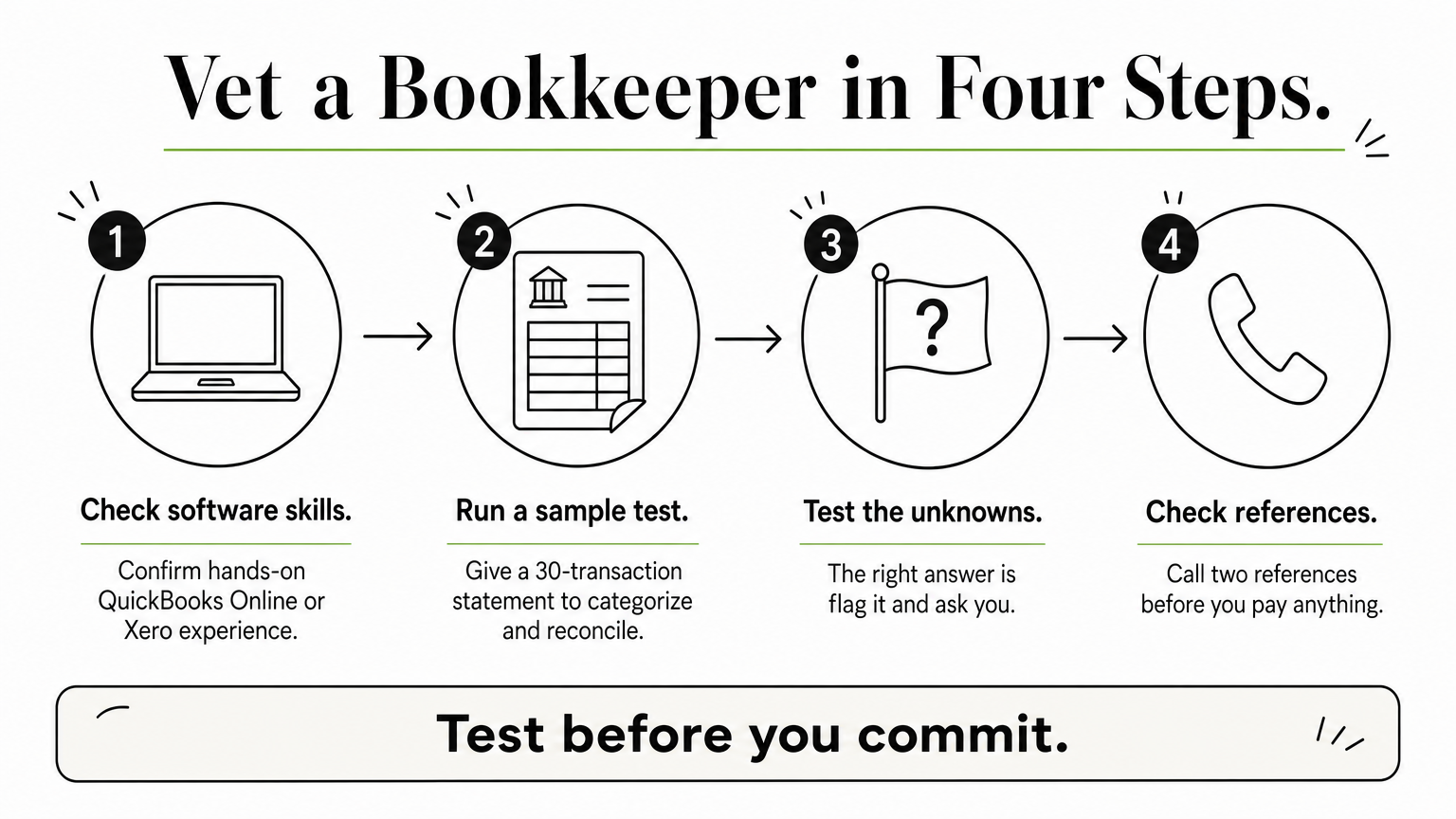
- Confirm hands-on experience in your software, such as QuickBooks Online or Xero.
- Hand over a sample bank statement with about 30 transactions and ask for categorization and a reconciliation.
- Ask what they do with a transaction they can't categorize. The right answer is "flag it and ask you."
- Check two references, or review sample resumes through a staffing partner before you pay anything.
Watch the questions a candidate asks during the test. A good virtual assistant bookkeeper asks about your chart of accounts, your invoicing terms, and how your CPA wants reports. Candidates who ask nothing tend to guess later, and guesses show up as errors in your books.
How to set up access and a routine
Access comes next, and it deserves care. Create a separate user login in your accounting software instead of sharing your own password. Give bookkeeper-level permissions, and keep bank approvals and payment release with you. Ask for a signed NDA, and confirm that work happens on a secured laptop or VPN.
Give your bookkeeper access to record the books, never the authority to move your money.
Finally, build a rhythm. A 15-minute weekly check-in and a shared task checklist keep small questions from piling up. Review the monthly reports yourself, even if you only skim them. Owners who stay lightly involved catch problems early, and their bookkeepers tend to stay sharp.
What a virtual assistant bookkeeper can and cannot do
The short answer is that a virtual assistant bookkeeper handles the recording side of your finances very well and the advisory side poorly. Knowing where that line sits protects your books and your tax return.
Tasks they handle well
Anything repeatable and rule-based fits. Think of work where the right answer is visible in your records, like matching a bank line to an invoice. Day to day, that covers:
- Entering and categorizing transactions
- Reconciling bank and credit card accounts each month
- Sending invoices and following up on overdue payments
- Entering vendor bills and queuing them for your approval
- Tracking expenses and organizing receipts
- Producing profit and loss statements and balance sheets
Where you still need a licensed professional
Judgment calls are different. A bookkeeper virtual assistant is usually not a CPA, so tax strategy, return filing, and IRS representation belong with a licensed accountant. The same goes for audits and any financial statement that a lender or investor wants certified.
| Task | Virtual bookkeeper | CPA |
|---|---|---|
| Categorizing transactions | Yes | Reviews |
| Monthly reconciliation | Yes | Reviews |
| Invoicing and collections | Yes | No |
| Tax planning and filing | No | Yes |
| Audits and IRS representation | No | Yes |
A bookkeeper keeps the record accurate, and a CPA tells you what to do with it.
Accuracy also depends on what you feed the system. Mixed personal and business spending and missing receipts create messy books no matter who does the work. Open a dedicated business bank account and card before you hire, and your new bookkeeper starts from a clean base instead of a cleanup project.
How much a virtual assistant bookkeeper costs
The price of a virtual assistant bookkeeper depends less on the job title and more on how you buy the time. Three billing models cover most small businesses, and each one rewards a different workload.
Three ways you get billed
Pick the model first, because it decides whether you pay for hours worked or for hours available.

| Model | Typical price | Watch for |
|---|---|---|
| Hourly freelancer | $25 to $60 per hour | Costs climb as your workload grows |
| Flat monthly package | Set by the firm, based on transaction volume | Limits on revisions and extra requests |
| Dedicated full-time hire | From $1,090 per month | Paying for capacity you don't use |
Run the numbers against your own hours. A freelancer at $40 an hour for 10 hours a week comes to about $1,730 a month. A dedicated full-time hire at $1,090 works out to roughly $6 to $7 an hour. That only pays off if you keep the person busy, which is easy when bookkeeping shares the week with admin work.
What moves the price
Several factors push a quote up or down:
- Monthly transaction volume and number of bank accounts
- Backlog cleanup, such as months of unreconciled books
- Software you use, since QuickBooks, Xero, and payroll add-ons all carry their own fees
- Experience level and any specialty, like inventory or multi-currency work
- Scope, meaning bookkeeping only or bookkeeping plus general admin
Backlog work deserves special attention. Cleanup is usually priced separately from ongoing upkeep, and it can cost more than several months of regular service. Ask for both numbers up front.
Costs people forget
The hourly rate is rarely the whole bill. Freelancers may not cover software seats, and some firms charge extra for rushed month-ends. With a self-managed hire, you also absorb your own time for vetting, training, and review. A managed provider folds equipment, HR, and payroll into the monthly rate, so the number you see is the number you pay.
The cheapest rate is rarely the cheapest bookkeeper once you count rework and cleanup.
Before you sign anything, ask what happens when the person is sick, when your volume doubles, or when the fit is wrong. Replacement terms and notice periods tell you more about real cost than the rate card does.
Examples of tasks to hand off and how to set expectations
A new virtual assistant bookkeeper works best when you hand over work in clear, named pieces. "Take care of the books" is too vague to act on. Start with the routine tasks, then add more once the first month runs clean.
A sample split by rhythm
Here is how a typical handoff looks for a business with one or two bank accounts and a few dozen transactions a week.
| Rhythm | Task handed off | Your part |
|---|---|---|
| Daily | Categorize new transactions, file receipts | None |
| Weekly | Send invoices, chase overdue payments, queue bills | Approve payments |
| Monthly | Reconcile accounts, produce P&L and balance sheet | Review the reports |
| Quarterly | Assemble a summary pack for your CPA | Answer CPA questions |
Every row ends with you or your accountant. That is deliberate. Recording is delegated, but approval stays with you, which keeps control of your money where it belongs.
Put expectations in writing
Vague requests produce vague books. Write a one-page scope and standards sheet before the first day. It should cover:

- Deadlines, such as books reconciled by the fifth business day
- Response time, such as questions answered within one business day
- A rule for unknowns: flag any uncategorized item instead of guessing
- Report format and who receives it
- Backup coverage when your bookkeeper is out
If a task isn't written down, you can't fairly hold anyone to it.
Use the same sheet to define what "done" means. "Reconciled" should mean every account matches its statement to the penny, with differences explained in a note.
Treat the first month as a trial
Test early and often. Each week, spot-check 20 transactions against receipts and bank lines, and compare the month-end balance to your statement. Errors in the first 30 days are normal. Repeated errors in the same category point to a missing instruction, so fix the sheet rather than the person.
A good virtual bookkeeper assistant welcomes this kind of checking and will suggest improvements to your process. Once two clean month-ends in a row land on schedule, you can widen the scope to invoicing follow-ups, vendor management, or general admin.
Choosing the right bookkeeping help
The right virtual assistant bookkeeper keeps your records current while you keep control of the money. Match the model to your workload: a freelancer for light, irregular needs, a firm when you want supervision, and a dedicated full-time hire when the work shows up every day.
Whoever you choose, keep a CPA for tax strategy and filing, write down the scope, and spot-check the first month closely. Those habits protect your books more than any rate card will.
If a steady, full-time bookkeeper fits your business, GlobalEmployees can help. You can review vetted resumes for free, with zero setup cost and no long-term contract. Hire a bookkeeper in India and see who could take the books off your plate this month.