Staff Augmentation vs Outsourcing: Which Model Fits Best?
You need extra hands on a project, but you're stuck on how to get them. Hire more people directly, hand the whole thing to an agency, or bring in remote talent who work inside your existing team? That decision gets expensive fast if you get it wrong. Comparing staff augmentation vs outsourcing before you sign anything saves you months of frustration.
The short answer: staff augmentation means adding individual professionals to your team who follow your processes and report to your managers, while outsourcing means handing an entire project or function to an outside company that controls how the work gets done. One gives you control and flexibility, the other gives you hands-off convenience. Which one fits depends on how much oversight you want and how defined your project scope already is.
In this article, we'll break down how each model actually works, weigh the cost differences, and cover the specific scenarios (including IT projects) where one clearly beats the other. We've placed 950+ offshore hires for US and European companies, so we'll draw on what actually plays out once contracts get signed and work begins.
Why choosing the right model impacts your business
Getting this decision wrong doesn't just cost you money, it costs you time you can't get back. Pick staff augmentation for a project that actually needs a full outsourced solution, and you'll spend months managing people you don't have the internal expertise to direct. Pick outsourcing when you needed tight control over a core product feature, and you'll watch a third party make decisions that don't match your roadmap. Either mistake shows up in missed deadlines, blown budgets, and a team that loses trust in the process.

The financial fallout of the wrong choice
Money is where this decision hits hardest. Staff augmentation typically runs on a monthly or hourly rate for each professional you bring on, which means costs scale directly with headcount and stay predictable. Outsourcing contracts, by contrast, often bundle a fixed project fee that looks attractive upfront but hides change-order costs once requirements shift, which they almost always do. Businesses that outsource a poorly scoped project frequently end up paying 20 to 40 percent more than the original quote once revisions start piling up.
The wrong staffing model doesn't just slow down one project, it changes how much every future project costs you.
Control over quality and process
Quality control looks completely different under each model. With augmented staff, your managers review code, copy, or designs daily, using your existing standards and tools. With outsourcing, you're reviewing finished deliverables against a contract, often with less visibility into how decisions got made along the way. That's fine when the vendor has a strong track record and the work is well-defined. It's a real problem when your product is still evolving and you need to redirect effort week to week rather than waiting for a milestone review.
Compliance and long-term flexibility
Regulatory exposure and scalability also ride on this choice. Companies handling sensitive data, healthcare records and HIPAA-bound processes, or financial information need to know exactly who touches that data and under what security protocols, something easier to enforce when workers report directly into your systems under NDAs and access controls. The Federal Trade Commission has flagged data handling by third-party vendors as a growing area of scrutiny, which makes this more than a theoretical concern. Flexibility matters too: augmented teams let you add or remove one person without renegotiating a master contract, while outsourcing agreements often lock you into scope and headcount for the life of the engagement. Get the model right from the start, and you avoid renegotiating everything six months in.
How to decide between staff augmentation and outsourcing
Deciding between staff augmentation vs outsourcing starts with a hard look at your project, not a preference for one model over the other. Ask yourself how defined the scope actually is, how much daily oversight your team can realistically provide, and whether the skill gap is temporary or permanent. Skip this step and you'll pick based on habit or whatever a sales rep pitched last, which is how companies end up locked into contracts that don't fit, so it helps to see how staffing, freelancers, and agencies stack up against each other first.
Questions that actually clarify the choice
Before you reach out to any vendor, run through this checklist:
- Do you have a manager who can direct daily work? If yes, staff augmentation fits. If not, outsourcing hands off that responsibility.
- Is the scope fixed and well documented? Clear specs favor outsourcing. Evolving requirements favor augmented staff you can redirect quickly.
- How long do you need this resource? Under six months, augmentation is usually cheaper. Multi-year functions often make sense to outsource entirely.
- Does the work touch your core product? Keep it in-house with augmented staff. Peripheral work is safer to hand off.
If you can't name who manages the work day to day, you're not ready to outsource it.
When the decision gets clearer
Often the answer becomes obvious once you separate IT staff augmentation vs outsourcing by function rather than by project name. Development work tied to your product roadmap almost always favors software development staff augmentation because priorities shift weekly. Standalone functions like a full marketing campaign or a one-time data migration favor outsourcing because the deliverable is fixed and measurable. Match the model to how tightly the work connects to decisions you make every day, and the choice stops feeling like a gamble.
Staff augmentation vs outsourcing: cost, control, and scalability
Laying the numbers side by side makes the tradeoffs obvious in a way that abstract arguments never do. Staff augmentation charges you per person, per month, so you know exactly what next quarter costs before you sign anything. Outsourcing bundles everything into a project fee that looks simpler until scope changes trigger a change order. Neither model is universally cheaper, but each behaves predictably in different situations, which is really what you're paying for, and the same holds when you compare the full cost of building a team in-house against a remote one.
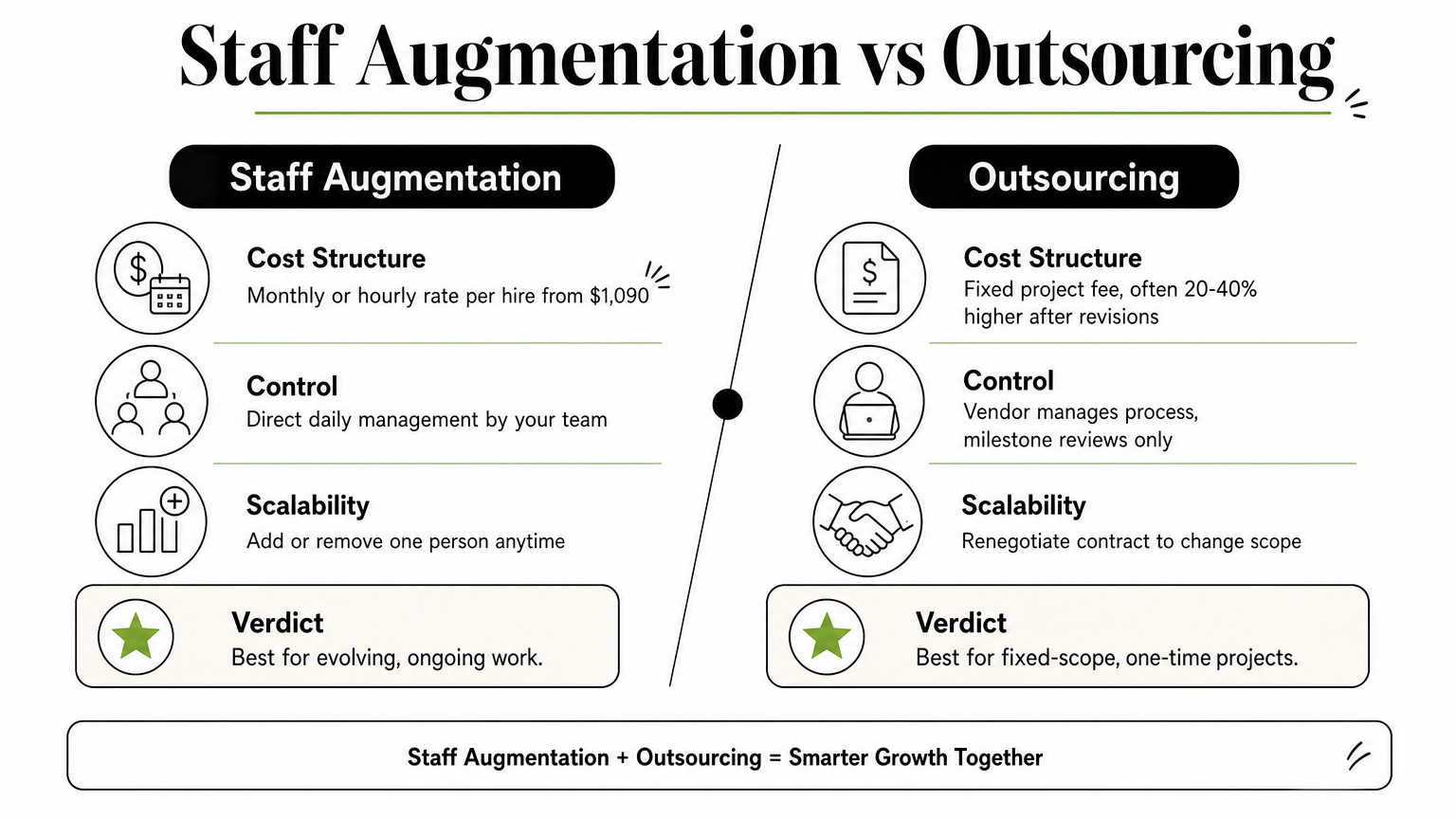
Comparing the three factors that matter most
| Factor | Staff Augmentation | Outsourcing |
|---|---|---|
| Cost structure | Monthly/hourly rate per hire, starting around $1,090/month | Fixed project fee, often 20-40% higher after revisions |
| Control | Direct daily management by your team | Vendor manages process, you review milestones |
| Scalability | Add or remove one person anytime | Renegotiate contract to change scope |
| Best for | Ongoing product work, evolving requirements | Fixed-scope projects, one-time deliverables |
Quality control follows the same pattern. Under augmented staffing, your team sets the standards and catches problems the same day they happen. Under outsourcing, you find out at the milestone review, which is fine for a well-scoped website build and risky for anything touching your core product.
Cost predictability and control almost always move together, and outsourcing trades both for convenience.
Scalability is where augmentation usually wins
Vendors selling outsourcing vs staff augmentation contracts rarely mention that scaling down mid-project means renegotiating the whole agreement. With pre-vetted professionals added to your team from $1,090 a month, GlobalEmployees clients add a developer this month and drop a designer next month without touching a master contract. That flexibility matters most when your roadmap shifts quarter to quarter, which for most growing businesses, it does.
Which model fits common hiring scenarios
Scenarios make this decision concrete in a way theory can't. A startup building its first product needs a developer who understands the codebase intimately and can pivot with the founder daily, which points straight to staff augmentation. An established company launching a one-off rebrand, on the other hand, wants a full team that handles strategy, design, and execution without daily hand-holding, which is exactly what outsourcing delivers.

Matching the model to the work
Run through these common situations before you commit to either approach:
- Building a new SaaS feature on a tight roadmap: staff augmentation, since priorities shift week to week and you need direct control.
- Launching a one-time marketing campaign: outsourcing, since the scope is fixed and the deliverable is measurable.
- Filling a temporary gap during busy season: staff augmentation, since you add headcount fast and release it just as fast.
- Migrating legacy systems to a new platform: outsourcing, since the project has a clear start and end date.
- Scaling an engineering team long-term: staff augmentation, since ongoing product work benefits from continuity and institutional knowledge.
Match the model to how often the work changes direction, not to how big the project sounds.
Mixed scenarios need mixed answers
Sometimes the honest answer is both. Companies running a core product while also needing a one-time compliance audit often augment their development team while outsourcing the audit entirely. That split isn't a compromise, it's the correct read on staff augmentation outsourcing decisions when a single company has both ongoing and one-off needs. Businesses that force every hiring decision into one model end up either overpaying for flexibility they don't need or losing control they can't afford to give up, which is why US business owners should know how these two models really differ.
Making the right call for your team
Weighing staff augmentation vs outsourcing always comes down to the same question: how much control do you need versus how much convenience can you afford to trade for it? Fixed-scope, one-time projects favor outsourcing. Ongoing product work that shifts week to week favors augmented staff who plug directly into your team. Get honest about which situation you're actually in before you sign anything, and the rest of the decision follows naturally.
Skip the guesswork by talking to people who've placed hundreds of hires under both models. GlobalEmployees has built dedicated offshore teams for US and European businesses for over 12 years, with zero setup cost and no long-term contract locking you in. If your roadmap needs a developer, marketer, or designer who works inside your existing process starting this month, browse vetted candidates and hire employees in India before you commit to anything else.