

Staff Augmentation Services: What They Are and How They Work
Staff Augmentation Services: What They Are and How They Work
You need a developer, a marketer, or an ops person fast, but posting a job, screening resumes, and running payroll for a new hire takes weeks you don't have. That's the gap staff augmentation services exist to close. Instead of building an internal hiring pipeline from scratch, you plug in pre-vetted professionals who work as an extension of your team, without the overhead of a full-time local employee.
At its core, staff augmentation means bringing in external talent to fill specific skill gaps on a temporary or ongoing basis, while your company still directs the day-to-day work. A staff augmentation provider handles recruitment, payroll, and compliance behind the scenes, so you get the resource without the administrative burden. This model differs from project outsourcing because you keep control over how the work gets done.
In this article, we'll break down exactly how staff augmentation works, when it makes sense over hiring locally or using a full-service agency, and what to look for in a staff augmentation company. We'll also cover typical costs and engagement structures, so you can decide if this approach fits your hiring needs right now.
Why staff augmentation services matter for growing teams
Most founders don't wake up thinking about workforce strategy, they wake up thinking about a deadline they can't hit with the team they have. That's the moment a staff augmentation agency earns its keep. Instead of freezing a project until you find the right local candidate, you add a qualified professional to your existing team within days, not months, and you keep full control over what they work on and how.

The real cost of hiring locally
Hiring a full-time employee in the US or Europe costs far more than the salary line on the offer letter, as a full breakdown of in-house versus remote team costs makes clear. You're paying for recruiting time, benefits, payroll taxes, office space or remote equipment, and the weeks of lost productivity while the role sits open. A staff augmentation provider absorbs most of that overhead because the employee is already recruited, equipped, and payrolled before you ever see a resume.
| Cost factor | Local full-time hire | Staff augmentation |
|---|---|---|
| Recruiting and screening | Weeks, internal HR time | Handled by provider |
| Payroll and compliance | Your responsibility | Provider's responsibility |
| Equipment and software | You buy it | Provider supplies it |
| Time to start | 4-8 weeks typical | Days to 2 weeks |
| Contract flexibility | Often locked in | Scale up or down freely |
Once you see the columns side by side, the appeal of staff augmentation services stops being theoretical and starts looking like a straightforward cost decision.
Filling skill gaps without slowing down
No team has every skill in-house all the time. Maybe you need a React developer for three months to ship a feature, or a paid media specialist to run a Q4 campaign. Waiting to hire locally for a need that might shrink again in six months rarely makes sense, and it's exactly where technical staff augmentation fits best.
The teams that grow fastest aren't the ones with the biggest headcount, they're the ones that can add the right skill at the right moment.
Scaling up or down without long-term risk
Business needs change quarter to quarter, and a rigid hiring plan punishes you for guessing wrong. Staff augmentation solutions let you add a developer for a sprint, bring on a full marketing hire for a launch, or scale a five-person dev team down to two once a project wraps, all without severance costs or awkward conversations. GlobalEmployees builds this flexibility into every staff augmentation engagement, with no long-term contracts and the option to swap or drop resources on short notice.
Growing companies also carry more risk than established ones when a hire doesn't work out. A bad local hire can cost months of salary and momentum before you even realize the fit is wrong. With augmented staff, replacement is fast and, in GlobalEmployees' case, backed by a money-back guarantee if the person isn't the right match. That safety net matters more the faster you're trying to grow.
How staff augmentation works in practice
Working with an it staff augmentation service follows a predictable pattern once you strip away the marketing language. You describe the skill gap, the provider matches candidates against that need, you interview and approve who joins your team, and that person starts reporting into your existing workflow, tools, and manager. The provider stays in the background handling payroll and HR, but the day-to-day direction comes from you, not from them.
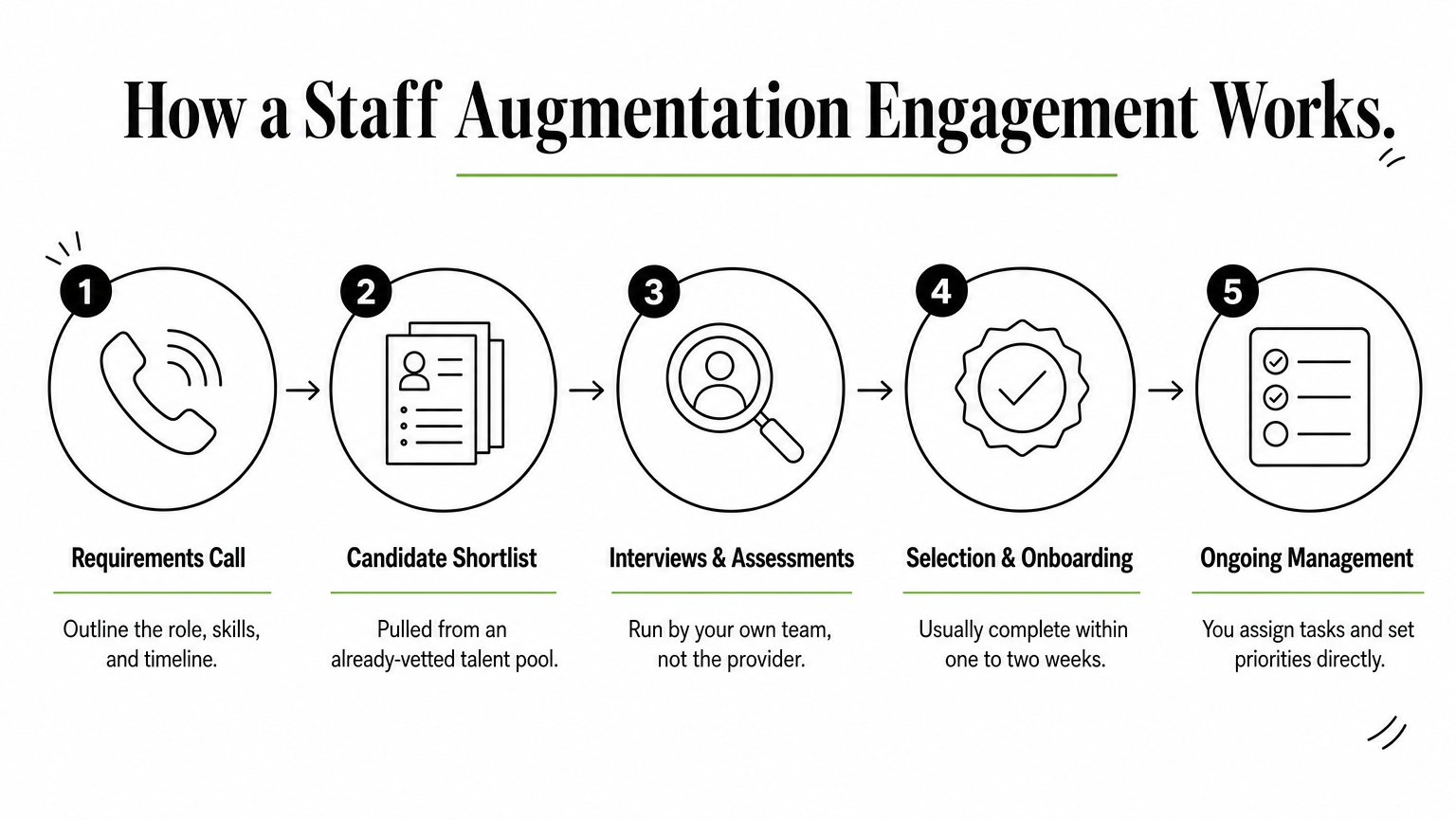
The typical engagement process
Most staff augmentation providers run through a version of the same steps, though the speed and rigor vary a lot between vendors.
- Requirements call where you outline the role, skills, and timeline.
- Candidate shortlist pulled from an already-vetted talent pool.
- Interviews and technical assessments run by your team, not the provider's.
- Selection and onboarding, usually within one to two weeks.
- Ongoing management, where you assign tasks and set priorities directly.
The provider finds and supports the talent, but you still run the work.
GlobalEmployees follows this exact hiring structure, step by step, giving clients free access to vetted resumes before any commitment, so you can compare candidates before spending a dollar.
Who owns the day-to-day work
Control is the detail that separates staff augmentation from a full outsourced project. Once someone joins through an it consulting and staff augmentation arrangement, they show up in your Slack, your sprint planning, and your standups like any other employee. You set deadlines, review output, and course-correct in real time, which matters most for technical roles where requirements shift weekly.
Where infrastructure and compliance sit
Behind that daily relationship, the provider quietly handles the parts most companies dread: local labor law compliance, payroll taxes, laptops, secured VPN access, and NDAs. That's the practical value of good staff augmentation consulting services, you get a fully equipped, legally compliant employee and can hire an employee in India without setting up an entity or learning the local labor code yourself.
Staff augmentation vs outsourcing, consulting, and managed services
Confusing these four models is the fastest way to hire the wrong kind of help. Each one solves a different problem, and picking the wrong one means paying for control you don't need or losing control you actually wanted. A staff augmentation company hands you a person; a staff augmentation agency built around outsourcing hands you a finished deliverable. Knowing which one you're buying changes how you manage the relationship from day one.
What actually separates the four models
Outsourcing means you hand over an entire project or function and the vendor decides how it gets done, you just receive the result, which is the core of the staff augmentation vs outsourcing comparison. Consulting means you're paying for advice and strategy, not day-to-day execution. Managed services means a vendor runs an ongoing function, like IT support or payroll, under a service-level agreement, again with them controlling the process. Staff augmentation is the only one of the four where you keep direct, daily control over the person's work while someone else handles employment logistics.
| Model | Who directs the work | Typical contract length | Best fit |
|---|---|---|---|
| Staff augmentation | You | Flexible, month to month | Filling a specific skill gap on your team |
| Outsourcing | Vendor | Project-based | Handing off an entire deliverable |
| Consulting | Shared, advisory | Short, engagement-based | Strategy, audits, one-time expertise |
| Managed services | Vendor | Long-term SLA | Ongoing function like IT support |
If you want to direct the work yourself, staff augmentation is the only model built for that.
Why the distinction matters when you're comparing vendors
Regardless of terminology, and whether you're weighing dedicated staffing against freelancers and agencies, ask any staff augmentation service provider one direct question: who manages the person day to day, you or them? If the answer is "we manage the delivery," you're actually looking at outsourcing dressed up in staff augmentation language. Genuine resources and staff augmentation arrangements put your manager, your tools, and your priorities in charge, with the provider staying out of the actual work and focused only on recruitment, payroll, and support in the background.
Types of staff augmentation and typical costs
Not every skill gap looks the same, so staff augmentation providers typically offer a few different structures rather than one fixed model. Understanding which type fits your situation keeps you from overpaying for flexibility you don't need or locking into a structure too rigid for a short-term problem.

The main types of engagements
Most companies land in one of four buckets when they bring in outside talent this way:
- Individual hire: one developer, designer, or marketer added to fill a specific gap, common in tech staff augmentation for a single sprint or campaign.
- Dedicated team: a small group, say two developers and a QA tester, working exclusively on your product under your management.
- Project-based augmentation: talent brought on for a defined scope with a clear end date, then released once the work ships.
- Ongoing augmentation: a role treated like a permanent seat on your team, renewed indefinitely with no fixed end date.
Operations and admin roles follow the same four patterns, so this isn't limited to technology staff augmentation alone. GlobalEmployees supports all four structures across development, marketing, design, and operations roles.
What you'll actually pay
Pricing varies by role, seniority, and provider, but the range is wide enough that comparing numbers, like what a developer costs in India versus the US, matters more than trusting a single quote.
| Engagement type | Typical monthly range | Notes |
|---|---|---|
| Junior developer or ops hire | $1,090 - $1,800 | Entry point for most GlobalEmployees roles |
| Mid-level developer or marketer | $1,800 - $2,800 | Most common hire for growing teams |
| Senior specialist or lead | $2,800 - $4,500 | Includes architects, senior designers |
| Dedicated multi-person team | Scales per headcount | Priced per role, added or removed as needed |
Compare the monthly rate against a local salary plus benefits, taxes, and equipment, and the real savings usually run 50 to 70 percent.
GlobalEmployees starts placements at $1,090 a month with zero setup, HR, or infrastructure cost added on top, which is rare among staff augmentation solutions that quote a base rate and then bill extras separately.
Deciding if staff augmentation is right for you
Staff augmentation makes sense when you know exactly what work needs doing but don't want to carry the cost and risk of a full-time local hire. It's the wrong fit if you need someone to own strategy without your input, that's what consulting is for. But for filling a real skill gap while you keep control of the day-to-day, it's hard to beat the math: faster starts, lower overhead, and the flexibility to scale as your team's needs shift.
GlobalEmployees built its model around exactly this use case, with vetted talent across development, marketing, design, and operations starting at $1,090 a month, zero setup cost, and a money-back guarantee if the fit isn't right. If you're ready to see who's available, explore staff augmentation plans and available profiles and start hiring today.
Need to hire dedicated remote talent?
Tell us the role, experience, and AI skills your team needs.
Hire Talent Now