How to Hire an SEO Expert Who Actually Delivers Results
You've probably already talked to two or three SEO agencies that promised the moon and delivered a monthly PDF report nobody reads. Learning how to hire an seo expert who moves rankings and revenue, not just vanity metrics, is harder than it sounds because almost anyone can call themselves an SEO consultant after watching a few YouTube tutorials.
The short answer: you need a structured vetting process that checks real case studies, technical knowledge, and communication style before money changes hands, not a sales pitch with impressive-sounding jargon. The best hires are usually dedicated specialists who work inside your business day to day, not a rotating cast of freelancers juggling twenty clients at once.
This guide walks through exactly what to look for at each stage, from writing a job description that filters out the wrong candidates, to the interview questions that expose whether someone actually understands technical SEO, to red flags that should end the conversation immediately. We'll also cover where to find qualified talent and what a fair budget looks like, so you stop guessing and start hiring someone who moves the needle.
What to know before you hire an SEO expert
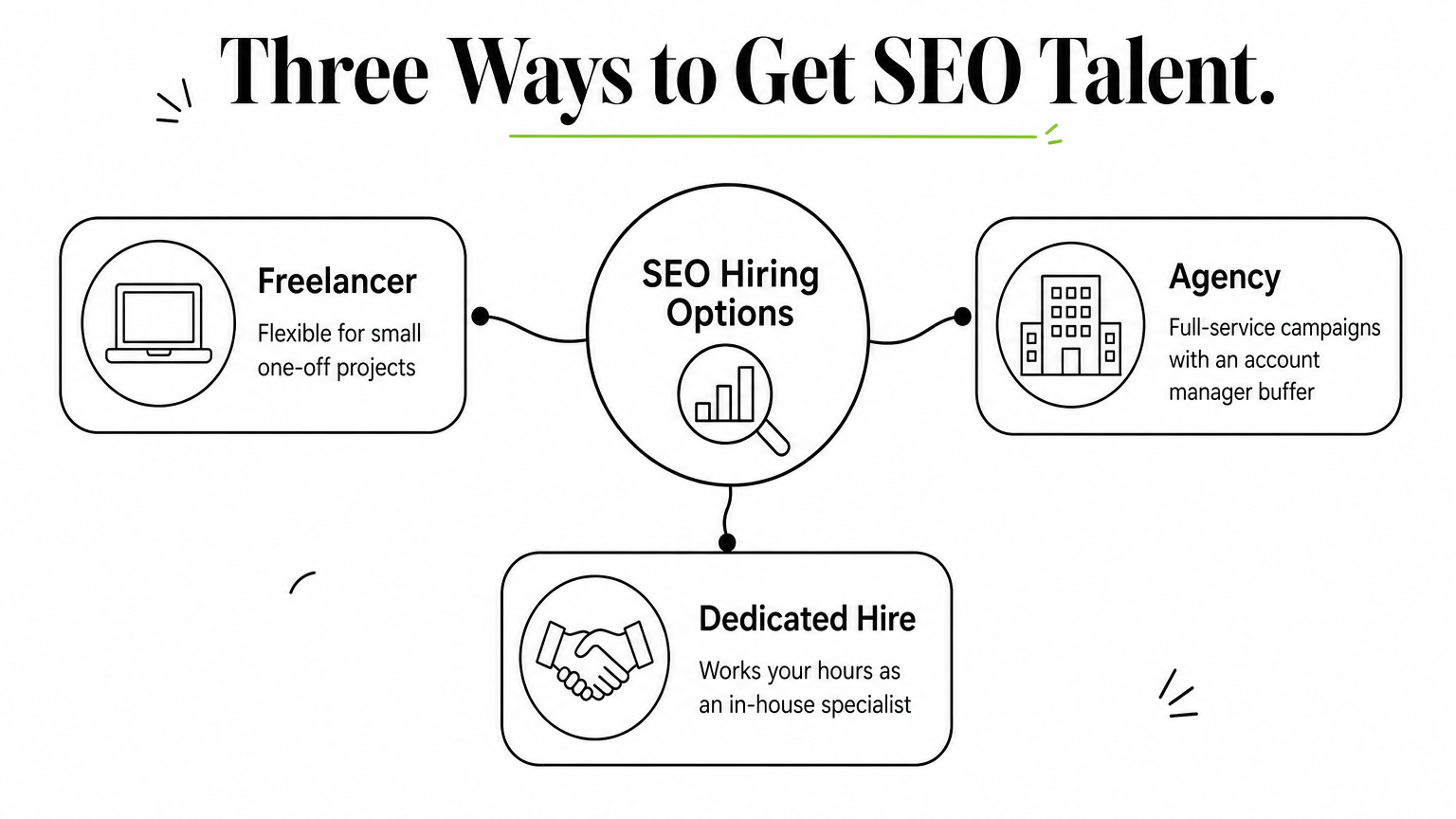
Before you post a job listing or start emailing agencies, you need to understand what you're actually shopping for. SEO talent comes in three flavors: solo freelancers, agencies, and dedicated in-house specialists (often hired offshore to keep costs down), and it's worth seeing how these business models compare on scope, budget, and management before you commit. Each option changes your budget, your oversight burden, and how fast you'll see results. Picking the wrong structure is the single biggest reason companies waste six months and thousands of dollars before hiring an SEO expert who actually fits.
Getting this decision right matters more than any interview question you'll ask later.
The engagement model you choose determines your results more than the individual you hire.
Here's how the three main options stack up:
| Model | Typical Cost | Oversight Needed | Best For |
|---|---|---|---|
| Freelancer | $30-$150/hr | High (juggling multiple clients) | Small, one-off projects |
| Agency | $2,500-$10,000+/mo | Medium (account manager buffers you) | Companies wanting full-service campaigns |
| Dedicated full-time hire | $1,090-$2,000/mo (offshore) | Low (works your hours, your priorities) | Ongoing, in-house SEO strategy |
Industry pricing data from sources like Backlinko generally shows agencies charging well above what a dedicated offshore hire costs for comparable weekly hours, which is why more small businesses now build in-house SEO capacity through staffing partners like GlobalEmployees instead of paying agency retainers for shared attention; the full breakdown of what an SEO expert really costs in 2026 lays out the numbers side by side.
Set a realistic budget and timeline
Just as important as the model is your budget expectation. Rankings don't move in two weeks. Real technical fixes, content builds, and link acquisition typically take three to six months before you see meaningful traffic shifts, and Google itself notes that SEO changes can take weeks to months to show up in Search Console data. Someone promising page-one rankings in 30 days is either lying or planning to use tactics that get you penalized later.
Know what SEO can't fix
Skilled SEO consultants can't rescue a broken product, a slow website nobody wants to convert on, or a business with no real demand. Treat SEO as an amplifier for a business that already works, not a magic fix. Once you accept these realities, you're ready to define exactly what you want the hire to accomplish, which is where the actual hiring process starts.
Step 1. Define your SEO goals and scope
Before you write a single job listing, decide what success actually looks like. Vague goals like "improve our SEO" attract vague candidates who talk in generalities and never commit to a number. Get specific: are you chasing organic traffic growth, keyword rankings for a defined list of terms, lead volume from organic search, or technical fixes after a Google penalty? Each goal calls for a different skill set, so nailing this down before hiring an SEO consultant saves you from mismatched expectations later.
A hire without a defined target is a hire you can't hold accountable.
Write a scope document, not a wish list
Draft a one-page scope document before you talk to anyone. This becomes your filter during interviews and your accountability tool after the hire starts. Include:
- Primary KPI (organic traffic, rankings, leads, or revenue)
- Timeline for first checkpoint (usually 90 days) and full evaluation (6-12 months)
- Scope boundaries: technical audits, content creation, white-hat link building and outreach, local SEO, or all of the above
- Existing assets the hire will inherit (current site, past audits, analytics access)
- Reporting cadence you expect (weekly, biweekly, monthly)
Match scope to engagement type
Deciding scope also tells you which engagement model from earlier fits best. Narrow, one-time technical audits suit a freelancer, and the short-project versus ongoing-work tradeoff is the same one you face with any remote hire. Full-funnel campaigns spanning content, links, and conversion work usually justify a dedicated full-time specialist who learns your business instead of juggling five other accounts. Skipping this step is why so many companies end up mid-contract realizing the agency they hired never actually understood what they needed in the first place. Once your scope document exists, you're ready to go find people who can actually deliver against it.
Step 2. Find qualified SEO candidates
With your scope document in hand, you're ready to source candidates instead of just accepting whoever emails you first. Sourcing channels matter because each one attracts a different type of talent: job boards skew toward generalists, referrals skew toward proven performers, and staffing partners skew toward pre-vetted specialists who are ready to start within days. Casting a wide net without a filter wastes weeks reading resumes that don't match your scope.

The channel you recruit from filters candidates before you ever open a resume.
Where to actually look
Don't limit yourself to a single job board when you're trying to find an SEO expert who fits your budget and timeline. Consider these sources side by side:
- Referrals from other founders who've hired SEO help and can vouch for actual results, not just a good sales call
- Niche job boards for marketing and SEO roles, which filter out generalist applicants automatically
- LinkedIn searches for people who've held an in-house SEO title for 2+ years, not just "consultant" in their bio
- Staffing partners like GlobalEmployees that pre-vet SEO candidates and send sample resumes within 48 hours before you commit to anything
Screen resumes before you schedule calls
Running every applicant through a 30-minute call is a waste of your week. Instead, screen resumes for specifics: named clients or industries, actual traffic or ranking numbers, and tools they've used daily (Ahrefs, Screaming Frog, Search Console). Anyone whose resume reads like a job description copy-paste, full of buzzwords and no metrics, gets cut before the interview stage. This screening pass typically shrinks a stack of twenty applicants down to four or five worth talking to, which is exactly the number you want heading into the vetting stage next.
Step 3. Vet their track record and expertise
Now you get to the part most business owners skip: actually verifying the claims on a resume. Track record verification separates candidates who talk about SEO from candidates who've shipped measurable results. Ask for three specific case studies, each with a before-and-after traffic or ranking chart, not a testimonial paragraph. If a candidate can't produce screenshots from Search Console or Google Analytics, treat that as a hard stop rather than a minor gap.

A candidate who can't show you a chart can't show you results.
Ask questions that expose real expertise
Offshore SEO experts and local hires alike should be able to walk you through their reasoning, not just their results. Use these questions during the vetting call, and borrow from this checklist of questions for vetting remote hires if you want more structure:
- Walk me through how you'd audit this exact website in the first 30 days.
- What's your process when a page's rankings drop suddenly?
- Which tools do you use daily, and why those over alternatives?
- Describe a campaign that failed and what you changed afterward.
Candidates who dodge specifics or default to generic answers like "it depends" without following up with a real example usually lack hands-on depth.
Check references the right way
Don't just call the reference and ask "were they good to work with?" Ask instead what the traffic numbers looked like before and after, whether deadlines were met, and whether the SEO consultant communicated proactively when something wasn't working. Staffing partners that pre-vet candidates, like GlobalEmployees, already run this reference and portfolio check before you ever see a resume, which cuts your vetting time down from weeks to a single afternoon. That saved time matters once you're ready to move into interviews and actually negotiate terms.
Step 4. Interview, negotiate, and make the hire
By the time you sit down for a live interview, you've already confirmed the resume checks out. Final interviews exist to test communication style and problem-solving speed, not to re-ask questions your reference calls already answered. Watch for candidates who explain technical concepts in plain English instead of burying you in jargon, since that's exactly how they'll talk to your team once they're hired.
If you can't understand their explanation, your team won't understand their reports either.
Run a paid test project first
Giving a candidate a small paid audit or content brief before the full hire protects you from a bad long-term fit. Ask for:
- A one-page technical audit of your homepage
- A prioritized list of the top five fixes and why
- A short content brief for one target keyword
Quality and turnaround time on this test tells you more than any interview answer ever could.
Negotiate terms that protect you
Once a candidate clears the test, negotiate scope, reporting cadence, and exit terms before signing anything. Avoid long-term contracts that lock you in past 90 days without a performance checkpoint. This is one reason hiring an SEO expert through a staffing model with no long-term contracts, like the one GlobalEmployees offers, tends to reduce risk compared to agency retainers that quietly auto-renew.
Formalize the hire
Put the KPI, timeline, and reporting cadence from your scope document directly into the signed agreement. Skipping this step is how founders end up arguing over expectations six months later instead of measuring results against something both sides agreed to upfront.
Choosing an SEO partner who fits your business
Getting how to hire an seo expert right comes down to process, not luck. Define your scope before you talk to anyone, source candidates from channels that filter for quality, verify their track record with real numbers instead of testimonials, then test them with a small paid project before you sign anything. Skip any of these steps and you're back to gambling on a sales pitch.
Honestly, the fastest path to a good hire is working with people who've already done this vetting for you. A dedicated offshore specialist who works your hours, learns your business, and costs a fraction of an agency retainer solves the two biggest problems most business owners face: budget and oversight.
If you're ready to skip months of screening resumes yourself, hire a vetted SEO expert through GlobalEmployees and start with sample resumes before you commit to anything.