How to Hire a Front-End Developer: Find, Vet, and Pay
You need a front-end developer, and every path looks risky. Freelance marketplaces are cheap but unreliable. Local hires cost $120,000 or more once you add benefits. Agencies bill by the hour and the meter never stops. Knowing how to hire a front-end developer means picking the right route first, then vetting and paying fairly.
Here is the short answer. For ongoing product work, a full-time dedicated developer beats a rotating cast of freelancers. Test real skills with a paid, small task instead of trivia questions. Budget $1,090 to $1,500 per month for a vetted offshore hire in India, versus several times that in the US, as this 2026 breakdown of what developers cost in India and the US shows.
This guide walks you through each step. You will learn where to find candidates, how to judge HTML, CSS, JavaScript, and React skills, and what to ask in interviews. We also cover costs, contracts, and data security basics. At GlobalEmployees, we have placed 950+ people over 12 years, so the advice comes from hiring work we do every week.
What to know before you hire
Most bad front-end hires fail before the first interview. The job post was vague, the budget did not match the market, or the team hired a skill set it never needed. A few minutes of groundwork prevents all three.
What a front-end developer actually does
A front-end developer builds everything users see and touch in a browser. The core tools are HTML, CSS, and JavaScript, the daily work of any HTML5 and CSS specialist, usually through a framework such as React, Vue, or Angular. Good ones also care about accessibility and speed, including Google's Core Web Vitals, which measure how fast and stable your pages feel.
Front-end work is not design, and it is not back-end. Developers turn designs into working screens and connect them to APIs. If you need someone to create the designs, that work belongs to a product designer for wireframes and design systems, and building databases and servers is a different role again. Mixing up these roles is the most common reason scopes balloon and budgets slip.
What it costs
Price depends on the route more than on the person. These are typical ranges for a mid-level developer:
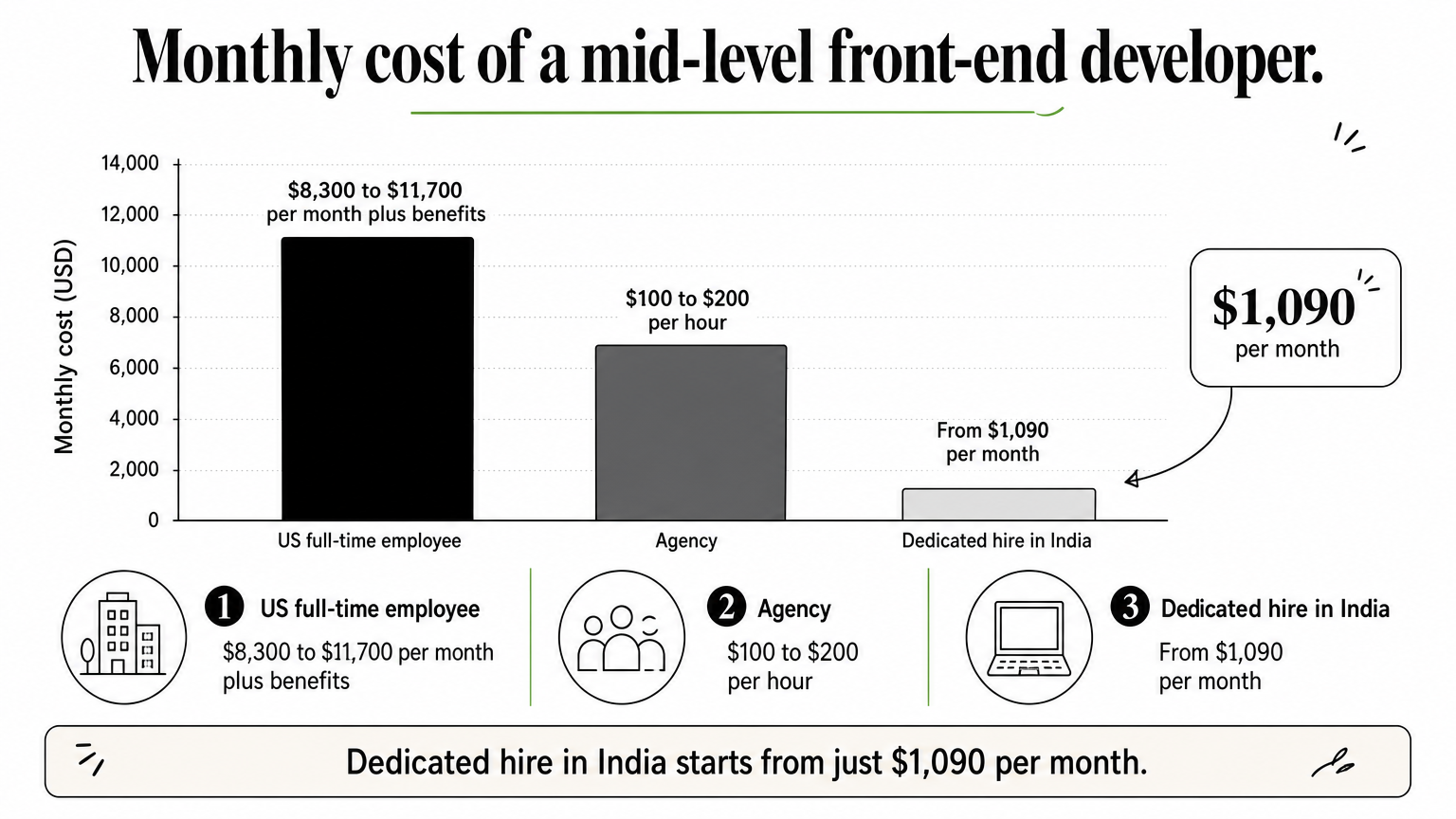
| Hiring route | Typical cost | What you get |
|---|---|---|
| US full-time employee | $100,000 to $140,000 per year plus benefits | Long-term hire, you handle HR and payroll |
| US or EU freelancer | $50 to $120 per hour | Flexible, but availability can change |
| Agency | $100 to $200 per hour | Project team, hourly billing |
| Dedicated hire in India | From $1,090 per month | Full-time, HR and equipment included |
The headline rate hides extra costs. A US employee adds payroll taxes, benefits, equipment, and recruiting fees, often 20 to 30 percent on top of salary, which is where the real cost of owning an in-house team shows up. Freelancers carry none of that overhead, but nothing keeps them on your project next month. With a dedicated hire from GlobalEmployees, HR, payroll, laptops, and software sit inside one monthly fee.
Compare total monthly cost, not the advertised rate.
Questions to settle first
Answer these before you write a single line of your job post:
- Is the work ongoing or a one-off? A landing page suits a freelancer. A product that ships every sprint needs someone full-time.
- Which framework does your codebase use? A React expert is not automatically fast in Angular.
- Who manages the developer day to day? Someone on your side must review pull requests and set priorities.
- How sensitive is your data? This decides whether you need NDAs, VPN access, and locked-down devices.
Write the answers down. They become the backbone of your job description in Step 1, and they give you a clear yardstick for judging every candidate you meet.
Step 1. Define the role and scope
Before you decide how to hire a front-end developer, decide what that person will build. A clear scope shortens the search, filters out poor fits, and gives you something concrete to measure after the hire. Spend one hour on it now and you will save weeks later.
Write a one-page role brief
Start with the work, not the job title. List the screens, features, and integrations the developer will own in their first 90 days, plus the tools they will use. Candidates respond far better to "rebuild our checkout flow in React" than to "seeking rockstar developer."

A scope you can't measure is a scope you can't hire for.
Use this copy-paste template and fill in every line before you post anything:
Role: Front-end developer (mid-level)
Stack: React, TypeScript, Tailwind CSS
Work: Build and maintain the customer dashboard
Design handoff: Figma files from our designer
Integrations: REST APIs from our Node.js back end
Hours: Full-time, overlap with 10am-1pm Eastern
Manager: Product lead reviews pull requests daily
Success at 90 days: 3 features shipped, Lighthouse score above 90
Match seniority to the work
Seniority drives both price and management load, so choose it deliberately. Use this table as a guide:
| Level | Experience | Best for |
|---|---|---|
| Junior | 0 to 2 years | Bug fixes and small UI tasks, with a mentor on your team |
| Mid-level | 2 to 5 years | Features from design to production with little supervision |
| Senior | 5+ years | Architecture, performance work, code reviews, mentoring |
Most small teams should hire mid-level. Juniors need review time you may not have, and seniors cost more than a typical dashboard project justifies. Go senior only when nobody on your team can review front-end code.
Step 2. Choose a hiring model and budget
Your scope from Step 1 now points toward a model, and it helps to see how freelance, agency, and dedicated staffing models differ. Match the model to the workload, because the wrong one costs more than any hourly rate difference ever saves you.
Pick the model that fits the work
Use this table to find your starting point:
| Situation | Best model |
|---|---|
| One landing page or a two-week fix | Freelancer |
| Fixed-scope project that needs design and back end | Agency |
| Ongoing product work with a small team | Dedicated offshore hire |
| Core team that must sit in your time zone and office | US full-time employee |
Most founders who ask how to hire a front-end developer for a product that ships every sprint land on the dedicated model, for the reasons set out in this look at why ongoing work suits a dedicated hire over a freelancer. You get full-time focus without setting up payroll in another country. You can also scale down on short notice, because there is no long-term contract to unwind.
Set a realistic budget
Budget for the first quarter, not the first invoice. Add a paid test task of $100 to $200 per finalist, and expect two to four weeks of ramp-up while the developer learns your codebase.
Budget for the whole first quarter, not just the first invoice.
Build your number from these lines:
- Monthly fee or salary for the developer
- Tools and licenses such as Figma seats, GitHub, and BrowserStack, if the provider does not include them
- Your management time, usually 3 to 5 hours per week for pull request reviews
- A 10 percent buffer for scope changes
Finally, ask every provider exactly what the fee covers. With GlobalEmployees, laptops, software, HR, and payroll sit inside the monthly price, so a $1,090 to $1,500 budget is the real number and not a starting point for add-ons.
Step 3. Source candidates
Sourcing is where most hiring timelines slip. Match the channel to the model you picked in Step 2, and give yourself two weeks to build a shortlist of three to five finalists.
Where to find front-end developers
Each channel has a clear strength and a clear risk:
| Channel | Best for | Watch out for |
|---|---|---|
| Freelance marketplaces | Short projects, fast starts | Uneven quality, changing availability |
| LinkedIn and job boards | US or EU full-time hires | Hundreds of unfiltered applicants |
| GitHub and developer communities | Senior, open-source minded hires | Slow replies from passive candidates |
| Staffing partner | Dedicated offshore hires | Unclear fees, so ask what is covered |
Anyone learning how to hire a front-end developer on a tight budget should look hard at the last row. GlobalEmployees keeps a pool of 2,800+ pre-vetted developers across 20+ tech stacks and lets you review sample resumes for free before you commit. You skip the job post and the inbox full of unqualified applicants.
Screen before you interview
Every channel produces noise, so screen on evidence, not on keywords. Live work beats a resume because you can open it, break it, and judge it in five minutes.
Ask to see live work before you read a resume.
Run each candidate through this quick checklist:
- Live projects: Open the site, resize the window, and tab through it with only a keyboard.
- Code samples: Look for readable components and clear commit messages on GitHub.
- Framework match: Confirm hands-on experience in your stack, not just a skill listed on a profile.
- Written communication: Notice how clearly they answer your first email. You will rely on it daily.
Finally, cut the pool hard. Three to five candidates who pass this screen are enough to carry into Step 4, where you test their skills properly. A longer list only slows your decision and tempts you to interview people you already doubt.
Step 4. Vet skills and make the offer
Vetting confirms what your screen suggested. When you work out how to hire a front-end developer, this step decides whether you get a reliable teammate or an expensive lesson. Keep it to one test and one interview per finalist.
Give a paid test task
Pay each finalist $100 to $200 for a task that takes two to three hours. Use a real slice of your product, such as a responsive pricing card built from a Figma file that pulls data from a public API. Unpaid, open-ended tests drive away the best people, so pay for the time.

Score every submission against the same list:
- Fidelity: Does it match the design at mobile and desktop widths?
- Code quality: Are components small, clearly named, and free of copy-paste?
- Accessibility: Do keyboard navigation, labels, and color contrast work?
- Performance: What does a Lighthouse run in Chrome report?
A paid, real task tells you more than any round of trivia questions.
Interview for judgment
Next, spend 30 minutes walking through their submission together, using a structured interview checklist for remote candidates. Ask why, not what, because strong developers explain trade-offs and weak ones recite definitions. Listen for how they handle problems, not for memorized answers.
| Ask | A strong answer sounds like |
|---|---|
| Why did you structure the components this way? | Reuse, trade-offs, and what they would change |
| How would you speed up a slow page? | Measures first, then images, bundle size, rendering |
| What do you do when a design can't work on mobile? | Flags it early and proposes an alternative |
Make the offer
Move within 48 hours of your decision, because good developers field several offers at once. Put everything in writing: scope, hours, start date, monthly fee, and an NDA. Then plan a two-week check-in with clear goals from your Step 1 brief.
With a dedicated hire through GlobalEmployees, the money-back guarantee or quick replacement covers you if the fit is wrong. NDAs, VPN access, and secured laptops are part of the setup, so your code stays protected from day one.
Making the right hire
Knowing how to hire a front-end developer comes down to four decisions. Define the scope, pick the model that fits your workload, source from channels that match, and test real work before you make an offer. Skip any one of them and the rest get harder.
The pattern holds whether you hire in Austin or Bangalore. Pay for a small test task, judge how candidates explain their choices, and put the terms in writing within 48 hours. For ongoing product work, a full-time dedicated developer gives you focus without the payroll, equipment, or contract headaches.
If that sounds like your situation, you can hire a front-end developer through GlobalEmployees. Review sample resumes for free, interview your picks, and pay nothing until you choose someone. You manage the work. We handle everything around it.