How Much Does a PPC Manager Cost? Pricing Models Explained
If you are trying to budget for paid search, the quotes you get back probably look all over the map. One agency wants $2,500 a month. Another wants 15% of your ad spend. A freelancer says $75 an hour. So how much does a PPC manager cost in reality, and which number should you trust?
Here is the short answer. In the US, most PPC managers and agencies charge a flat monthly fee of $500 to $5,000, a percentage of ad spend, usually 10% to 20%, or an hourly rate of $50 to $200. The right model depends on your ad budget, how many campaigns you run, and how much reporting you need. Hiring a full-time in-house manager in the US costs far more than any of these, often $70,000 or more a year in salary alone.
Below, we break down each pricing model, what it typically includes, and where hidden costs show up. We also cover a fourth option we see at GlobalEmployees: a dedicated full-time PPC specialist in India starting around $1,090 a month, so you can compare quotes with real numbers.
Why knowing PPC manager pricing matters before you hire
Management fees and ad spend are two separate bills
Most first-time buyers mix up two costs. Ad spend is the money you pay Google, Microsoft, or Meta for clicks. The management fee is what you pay the person or agency who runs the account. A quote of "$2,000 a month" almost never includes the first. If you budget $2,000 total, you can end up with a manager and no money left to buy traffic.
Percentage models make this trickier. Fifteen percent of spend sounds small until you notice it grows every time your budget does. Before you compare any two proposals, confirm which bill each number belongs to and whether it is fixed or variable.
The same fee can be cheap or expensive
Fee size means little without context. What matters is the fee as a share of your ad spend. Take a flat $1,500 monthly management fee and see how it behaves as the budget changes:
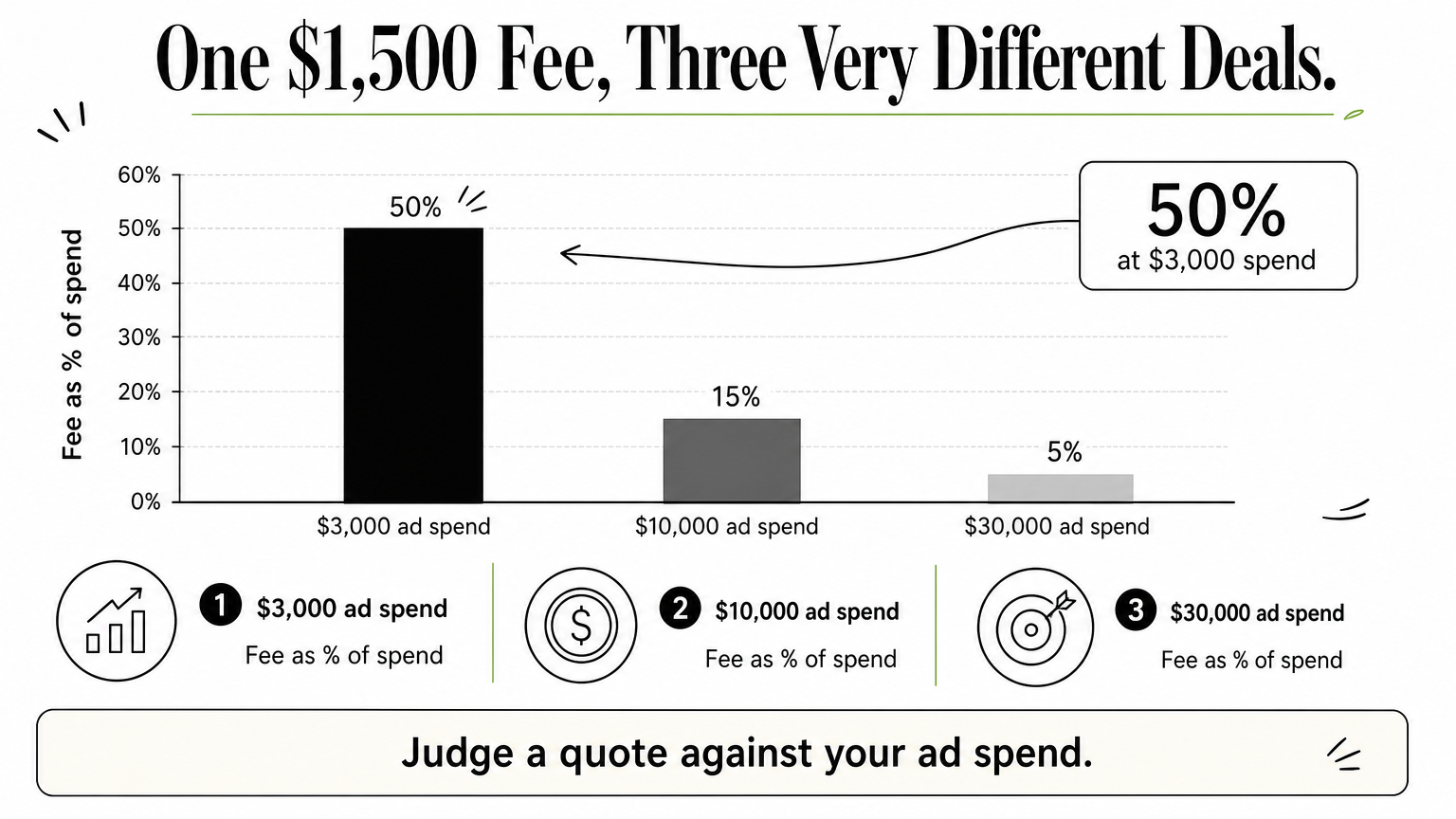
| Monthly ad spend | Flat fee | Fee as % of spend |
|---|---|---|
| $3,000 | $1,500 | 50% |
| $10,000 | $1,500 | 15% |
| $30,000 | $1,500 | 5% |
The identical quote is a bad deal at $3,000 and a bargain at $30,000. My rule of thumb is simple. If the fee climbs past roughly 30% of spend, you are paying more to manage the traffic than to buy it. That can still make sense for a small, complex account, but you should choose it on purpose.
Judge a PPC quote by what it costs relative to your ad spend, not by the number on the page.
Price shapes how the work gets done
Every pricing model creates an incentive. A percentage of spend pays the manager more when you spend more, whether or not results improve. A flat fee rewards efficiency, but it can also cap the hours someone is willing to put in. Hourly billing is transparent, yet it can balloon when an account needs a lot of cleanup.
None of these is wrong. They simply push behavior in different directions, so the model should match your goals. If you want steady optimization on a modest budget, a flat fee usually fits. If you plan to scale spend fast, a percentage may be reasonable, as long as it steps down at higher tiers.
Finally, weak management costs more than its invoice. A manager who leaves campaigns on broad match with no negative keyword list can burn hundreds of dollars a week on irrelevant clicks. Cheap and careless is often the most expensive choice you can make. Knowing typical rates lets you spot a quote that is too low to be credible, and one that is padded.
How to budget for and evaluate PPC manager quotes
Before you ask anyone how much does a PPC manager cost for your account, set your own numbers. A quote only means something when you hold it against a budget you defined first.
Start with your own numbers
Work backward from what a customer is worth. If a lead is worth $200 to you and you can pay $50 to get one, that target cost per lead tells you how much traffic you need, and so how much ad spend. The fee comes on top of that. Follow these steps:
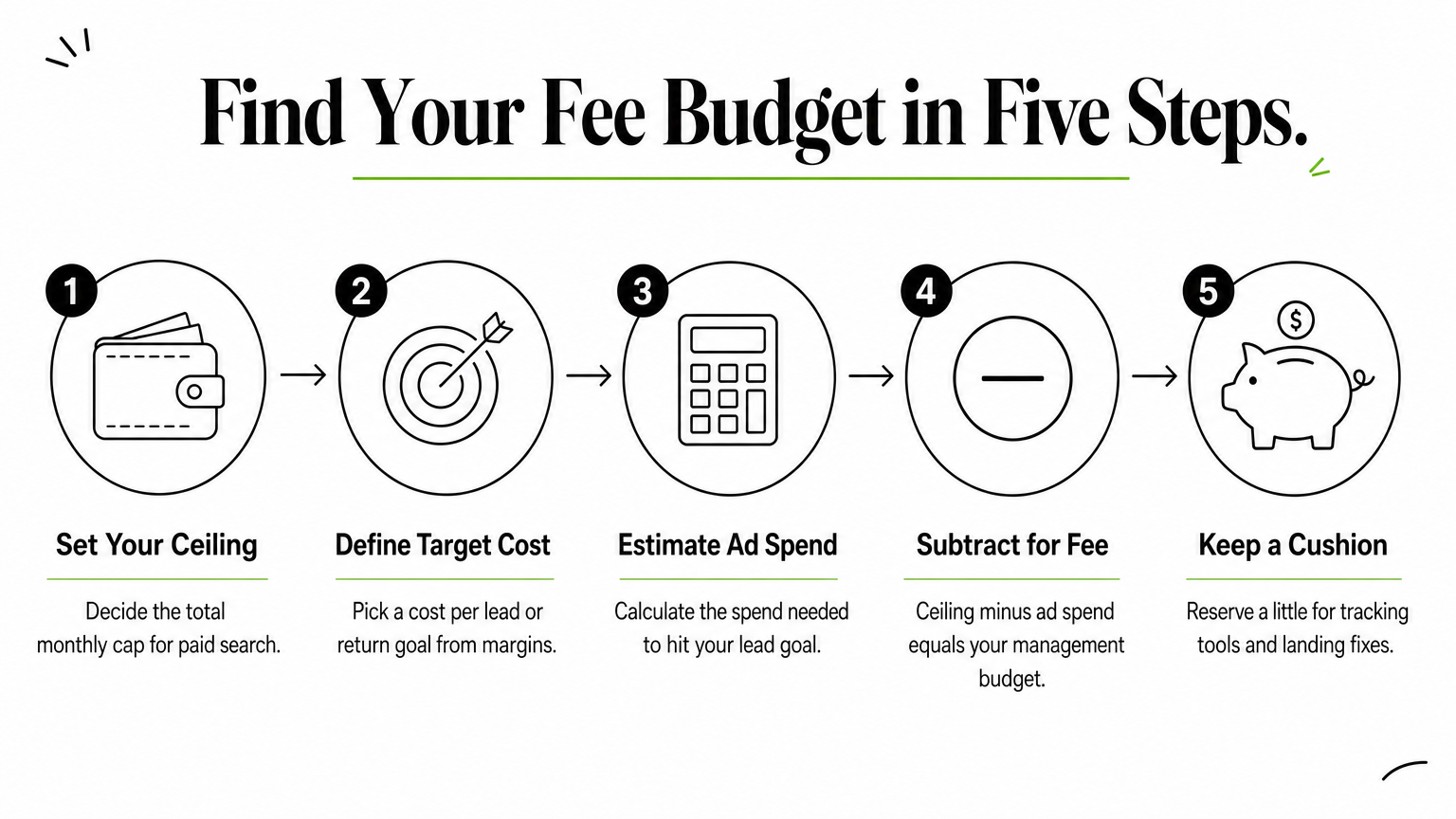
- Set a total monthly ceiling for paid search.
- Decide your target cost per lead or return on ad spend, based on your margins.
- Estimate the ad spend needed to hit your lead goal.
- Subtract that from the ceiling. What is left is your fee budget.
- Keep a small cushion for tracking tools and landing page fixes.
For example, with a $6,000 ceiling and $4,500 of planned ad spend, you have $1,500 for management. Any quote far above that needs a strong reason.
Make every quote comparable
Vendors package their services differently, so ask each one the same questions and get the answers in writing. Otherwise you end up comparing a $1,200 bundle to a $900 quote that leaves out half the work.
- Is the fee flat, a percentage, or hourly, and does it change as spend grows?
- Which platforms and how many campaigns are covered?
- Are setup, creative, landing pages, and conversion tracking billed separately?
- How often will you get reports and strategy calls?
- What is the minimum term and the notice period to cancel?
A quote you cannot compare line by line is a quote you cannot trust.
Check proof before you sign
Ask for a sample monthly report and two references with budgets close to yours. A good report shows spend, conversions, cost per conversion, and what the manager changed and why. If all you get is clicks and impressions, keep looking.
Finally, protect yourself on ownership and terms. Insist that the ad accounts stay in your name, with the manager added as a user, so you can leave without losing your history. Prefer a three-month starting term with 30 days' notice over a 12-month lock-in. A confident manager does not need a long contract to keep you.
PPC manager cost by pricing model
So how much does a PPC manager cost under each model? Here are typical US quotes for 2026. Treat them as starting ranges for negotiation, because scope moves the price more than the model does.
| Model | Typical price | Best for | Watch out for |
|---|---|---|---|
| Flat monthly fee | $500 to $5,000 | Steady budgets of $3,000 to $30,000 | Limits on campaigns and hours |
| Percentage of ad spend | 10% to 20% | Accounts that scale fast | Fees that rise even when results don't |
| Hourly rate | $50 to $200 | Audits, cleanups, one-off fixes | Open-ended hours |
Pick the pricing model that fits how your account will grow, not the one with the lowest number.
Flat monthly fee
Most agencies and freelancers default to a flat monthly fee. A single-platform account with a few campaigns usually runs $500 to $1,500. Larger accounts that span Google, Microsoft, and Meta run $1,500 to $5,000.
Budgeting is easy because the invoice never changes. The catch is scope. Ask exactly how many campaigns, ad groups, and strategy calls the fee covers, or you will meet an "extras" charge in month two.
Percentage of ad spend
Under a percentage model, you pay 10% to 20% of ad spend. Many agencies add a minimum fee of $500 to $1,000, so a small budget does not shrink the invoice to nothing.
Run the math before you agree. At $20,000 in monthly spend and a 12% rate, you pay $2,400. At $50,000, that same rate means $6,000 for roughly the same workload. Negotiate tiered rates that step down as your spend rises.
Hourly rate
Consultants and freelancers often bill $50 to $200 an hour. US-based specialists usually sit above $100, while overseas freelancers sit near the bottom of the range.
Hourly billing fits audits, cleanups, and one-off fixes. For ongoing work, a typical account takes 5 to 15 hours a month, so expect $500 to $3,000. Insist on a monthly cap so the bill cannot drift.
What affects what a PPC manager charges
Two managers can quote the same account and land $2,000 apart. When you ask how much a PPC manager costs, the honest answer is that scope and complexity move the number more than anything else. Five factors do most of the work, and knowing them helps you tell a justified premium from padding.
Ad spend and account complexity
Bigger budgets cost more to manage because more spend means more to monitor. A $5,000 account might need a weekly check. A $50,000 account needs daily bid and budget decisions. An ecommerce store with 2,000 products in Google Shopping takes far more work than a plumber running three search campaigns.
Count the moving parts: campaigns, ad groups, locations, and conversion actions. Each one adds hours. Product feeds, multiple languages, and call tracking each raise the price because they raise the setup and monitoring time.
Platforms, services, and reporting
Every extra channel and deliverable adds hours to the month. These items move the quote most:
- Platforms: Google Ads alone is cheapest. Adding Microsoft, Meta, or LinkedIn raises the fee.
- Extra services: Ad creative, landing page edits, and conversion tracking setup are often billed on top.
- Reporting: A monthly PDF costs less than weekly calls and a live dashboard.
- Contract terms: Longer commitments sometimes earn a lower rate, but shorter ones keep you flexible.
The more platforms, deliverables, and calls you ask for, the more hours you are buying.
Experience, location, and industry
Experience sets the floor. A manager with a decade of results and Google certifications charges $100 or more an hour in the US, while a junior can start near $50. Location matters just as much. A US agency carries office and payroll costs, and those costs show up in your invoice.
Industry competition shifts the price too. Legal, insurance, and SaaS keywords can run $50 or more per click, so a mistake gets expensive fast. Your click costs hit your ad bill, not the fee, but high-stakes accounts attract senior people, and senior people charge more. Ask each vendor which of these factors drove their number.
What your management fee should include
Before you compare quotes, know what the fee actually buys. When someone asks how much does a PPC manager cost, the better question is what the manager does for that money. A fair fee covers ongoing optimization, not just a login to your account.
Work that belongs in the base fee
Every monthly fee should cover the routine work that keeps campaigns healthy. If a proposal skips any of these items, ask why before you sign.
- Keyword research, expansion, and weekly negative keyword cleanup
- Ad copy writing and A/B testing
- Bid and budget adjustments
- Conversion tracking checks
- A monthly report and a strategy call
You can verify most of this yourself. If none of it shows up in the monthly report, you are not getting it.
Extras that are often billed separately
Some work sits outside a standard fee, and that is fair when it is priced upfront. Trouble starts when extras appear on an invoice after you have already committed.
| Extra | Typical cost |
|---|---|
| Account audit or setup | $500 to $2,000 one time |
| Landing page build | $300 to $1,500 per page |
| Video or display creative | $100 to $500 per set |
| Tracking and analytics setup | $200 to $600 one time |
A good fee lists what is included and puts a price on what is not.
Get the scope in writing
Ask for a one-page scope that names the platforms, campaign count, report schedule, and response time. Then add a line on extras: any work outside scope needs your written approval and a quoted price.
Also confirm who does the work. Some agencies sell you a senior strategist and hand the account to a junior. Request the name of the person who will log in to your account every week.
Agency, freelancer, in-house or offshore: cost compared
Who runs your account changes the bill as much as the pricing model does. Below are four routes side by side, with monthly costs excluding ad spend and the tradeoff behind each number.
Monthly cost side by side
Numbers first. In-house looks expensive because salary is only part of the cost. Payroll taxes, benefits, and software usually add 20% to 30%, so a $70,000 hire lands near $7,000 to $9,000 a month.
| Route | Typical monthly cost | What you get | Main tradeoff |
|---|---|---|---|
| Agency | $1,000 to $5,000 | A team, tools, and a set process | Junior handoffs, minimum terms |
| Freelancer | $500 to $3,000 | Direct access to one specialist | Limited capacity, single point of failure |
| In-house (US) | $7,000 to $9,000+ | Full focus on your brand | Slow to hire, one person's skills |
| Offshore dedicated (India) | From $1,090 | A full-time specialist working only for you | You direct the work day to day |
Which route fits your account
Agencies and freelancers suit small to mid budgets, roughly $3,000 to $30,000 in monthly spend. You buy a slice of someone's week, which is enough when the account has a handful of campaigns. In-house starts to pay off when spend passes about $50,000 a month or you run several channels at once.

Offshore staffing in India sits in the gap. A dedicated full-time PPC specialist from GlobalEmployees costs about what a freelancer charges for part-time hours, but all of their working time goes to your account. We handle recruitment, payroll, laptops, and compliance, and you manage the work directly. The tradeoff is real: you need to supply goals, feedback, and a weekly rhythm.
Choose the route that matches your ad spend and your management time, not the one with the lowest headline fee.
Finally, price the hours you will spend managing the person. An agency takes the least of your time. An offshore hire or in-house manager takes the most, and that time has a cost too.
Red flags and hidden costs in PPC proposals
Asking how much does a PPC manager cost gets you a number. It does not tell you what sits behind it. Vague scope and buried charges are where budgets break, so read the fine print before you read the price.
Red flags to walk away from
Some warning signs show up in the first call or the first proposal. Treat any of these as a reason to pause:
- A guarantee of first-page rankings or a fixed number of leads. Nobody controls the ad auction.
- Ad accounts opened in the agency's name instead of yours.
- A 12-month lock-in with an early termination fee.
- No named person who will work on your account.
- Reports that show only clicks and impressions.
- A fee far below the ranges above, such as $200 a month for several campaigns. That buys almost no attention.
Account ownership is the one point I would never bend on. If the agency owns the account, you lose your keyword history, audience data, and conversion tracking the day you leave. Make sure the account stays in your name from day one.
If you do not own the ad account, you do not own your results.
Hidden costs that inflate the bill
A low management fee can grow once extras arrive. Ask about each of these items in writing, and request a total for the first three months, not just the monthly rate.
| Hidden cost | What to look for |
|---|---|
| Setup or onboarding fee | $500 to $2,000 charged before any work starts |
| Software or reporting tool fee | $50 to $300 a month added to the invoice |
| Ad spend markup | You pay the agency more for clicks than Google charged |
| Overage hours | Billed at $100 or more once flat-fee hours run out |
| Cancellation fee | Early exit charges on 6 to 12 month terms |
The markup is the hardest one to spot. Some agencies bill ad spend through their own card and keep the difference. Compare your invoice against the platform's billing page each month, and pay Google or Microsoft directly whenever you can.
Choosing a PPC budget that makes sense
The answer to how much does a PPC manager cost comes down to three things: your ad spend, the scope of work, and the pricing model. Expect $500 to $5,000 a month from an agency or freelancer, and judge every quote as a share of your ad spend, not as a standalone number.
Before you sign anything, get the scope in writing, keep the ad account in your name, and ask for a three-month total that includes setup and extras. Those habits protect your budget more than haggling over the rate ever will.
If you want someone who works only on your campaigns, consider hiring a dedicated PPC specialist from GlobalEmployees. You get full-time focus from about $1,090 a month, with no setup cost and no long-term contract, so you can test the fit before you commit.