
How to Hire a Full-Stack Developer: Step-by-Step Guide
How to Hire a Full-Stack Developer: Step-by-Step Guide
Hiring a full-stack developer in San Francisco right now means competing with every funded startup and tech giant on the peninsula for the same shallow pool of talent. Post a job on LinkedIn and you'll get flooded with applicants who list React and Node on their resume but can't actually ship a working feature end to end. The real challenge isn't finding people who apply, it's finding people who can build.
If you want a straight answer: you either recruit locally through job boards and accept San Francisco salaries north of $150,000, or you widen your search to vetted offshore talent who can do the same work at a fraction of the cost. Both paths work, but they require different vetting steps, interview questions, and onboarding processes to avoid an expensive hiring mistake.
This guide walks through the entire process step by step: defining the role, writing a job description that filters out weak candidates, running technical interviews that actually test full-stack skills, and comparing traditional hiring against staffing alternatives like dedicated offshore developers, so you can pick the approach that fits your budget and timeline.
What a full-stack developer actually does
A full-stack developer builds and maintains both the parts of an application users see and the parts running behind the scenes on a server. That means one person can move from designing a login screen to writing the database query that checks the password to configuring the server that hosts the whole thing. Companies like this arrangement because it cuts down on handoffs between specialists, but it also means you're hiring for range, not just depth in one area.
The layers a full-stack developer owns
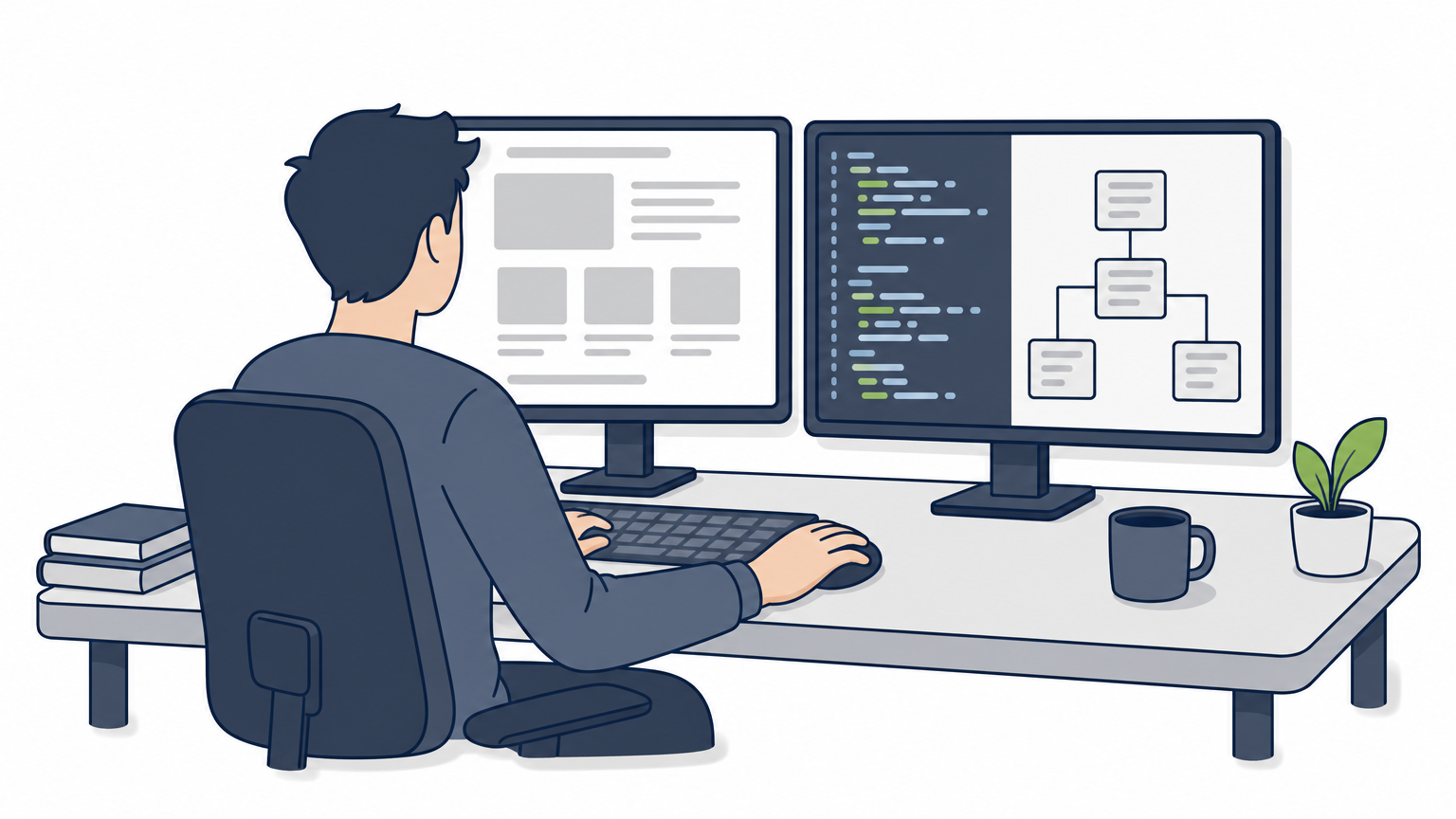
Before you write a job posting, understand the actual layers of work involved. Full-stack development spans four distinct areas, and a strong candidate should be comfortable in at least three of them.
| Layer | What it covers | Common tools |
|---|---|---|
| Front end | User interface, interactivity, browser rendering | React, Vue, Angular, HTML/CSS |
| Back end | Business logic, APIs, authentication | Node.js, Python (Django/Flask), Ruby on Rails |
| Database | Data storage, queries, schema design | PostgreSQL, MySQL, MongoDB |
| DevOps/Infrastructure | Deployment, hosting, monitoring | AWS, Docker, CI/CD pipelines |
Candidates rarely master all four at an expert level. Most have a strong front end or back end lean, with working knowledge of the rest.
Front-end responsibilities you should test for
On the front end, the developer builds the user interface and handles client-side logic, everything from form validation to how a page updates without a full reload. This is the part of the job most visible to end users, so bugs here get noticed fast. If your product is customer-facing, like an e-commerce site or a SaaS dashboard, weight your evaluation toward front-end skill and give real weight to how the candidate handles responsive design and browser compatibility issues.
Back-end responsibilities you should test for
Behind that interface, the developer writes server-side logic and manages database management tasks like structuring tables, writing efficient queries, and securing user data. This is where performance problems and security holes usually originate. A candidate who can't explain how they'd prevent a SQL injection attack or handle a spike in concurrent users hasn't done real back-end work at scale, no matter what their resume claims.
Why "full-stack" doesn't mean "master of everything"
Many hiring managers assume a full-stack developer is a jack of all trades who can replace an entire team. That's a mistake. Real full-stack developers have a specialized skill they lean on, paired with enough breadth to work independently across the stack without constant handoffs to other specialists.
A good full-stack developer isn't someone who knows everything equally well, they're someone who can move across the stack without getting stuck waiting on someone else.
Setting expectations this way changes how you write your job description and score interviews. Instead of hunting for a mythical unicorn who's equally elite at React, PostgreSQL, and AWS, look for someone with a clear primary strength and demonstrated comfort handling the rest. That's the profile that actually ships features on time, and it's the profile you'll be screening for in the steps that follow.
Step 1. Define the role and tech stack you need
Before you post a single job listing, write down exactly what your product needs, not what sounds impressive on a job board. Too many hiring managers copy a generic "full-stack developer" template and end up with 200 applicants who don't match the actual work. Start by mapping your current tech stack and being honest about whether you need someone who can build new features from scratch or someone who can maintain and extend an existing codebase. Those are different skill sets, and conflating them wastes everyone's time in the interview process.
Next, decide how much ownership this person will have. A solo hire at a five-person startup needs to be more self-directed than a full-stack developer joining a 40-person engineering team with senior architects making the big calls. If you're the only technical hire, you need someone comfortable making infrastructure decisions without much oversight. If you're slotting them into an existing team, you can prioritize collaboration skills over independent decision-making.
Write the job description around the problems you need solved, not a checklist of trendy frameworks.
Use this checklist to lock down the role before you write the posting:
- Primary stack: List the specific languages and frameworks already in production (e.g., React, Node.js, PostgreSQL), not the ones you wish you were using.
- Scope of ownership: Clarify whether they'll own a full feature end to end or work within a defined slice of the codebase.
- Seniority level: Decide if you need someone who can mentor junior developers or someone who just needs clear direction.
- Deployment responsibility: Specify whether they'll touch DevOps and CI/CD pipelines or hand that off to a dedicated DevOps and cloud infrastructure engineer.
- Team size and structure: Note who they'll report to and whether they'll manage anyone.
Once you've answered these, translate them into a job description that filters candidates before they ever reach an interview. Vague postings that say "looking for a rockstar developer" attract vague resumes. Specific postings that mention your actual stack, your deployment tools, and the size of your team attract candidates who've done that exact work before.
Realistically, this step also determines your hiring timeline. A narrowly defined role with a specific stack takes longer to fill locally, since you're competing for a smaller pool of specialists. A broader definition, paired with a wider search radius that includes vetted offshore candidates, opens up more qualified applicants faster. Either way, get this definition right first. Every later step, from budgeting to interviewing, depends on knowing precisely what you're hiring for.
Step 2. Choose the right hiring model
Once you know the role, you need to decide who's actually going to fill it. Four models dominate the market: full-time local hires, freelancers, agencies, and dedicated offshore staffing, and it helps to see dedicated staffing, freelancers, and agencies compared side by side before you commit. Each comes with different tradeoffs in cost, control, and speed, and picking the wrong one is often more expensive than picking the wrong candidate.
Freelance platforms work fine for short, well-defined projects, like a one-off integration or a landing page rebuild. They fall apart for ongoing product work, since freelancers juggle multiple clients and rarely stick around long enough to build real context in your codebase, which is the core of the freelancer or dedicated remote developer decision. Agencies solve the reliability problem but add a markup layer that pushes costs well above what you'd pay a direct hire, and you often lose visibility into who's actually writing the code.
The hiring model matters more than the resume, because even a great developer fails in the wrong engagement structure.
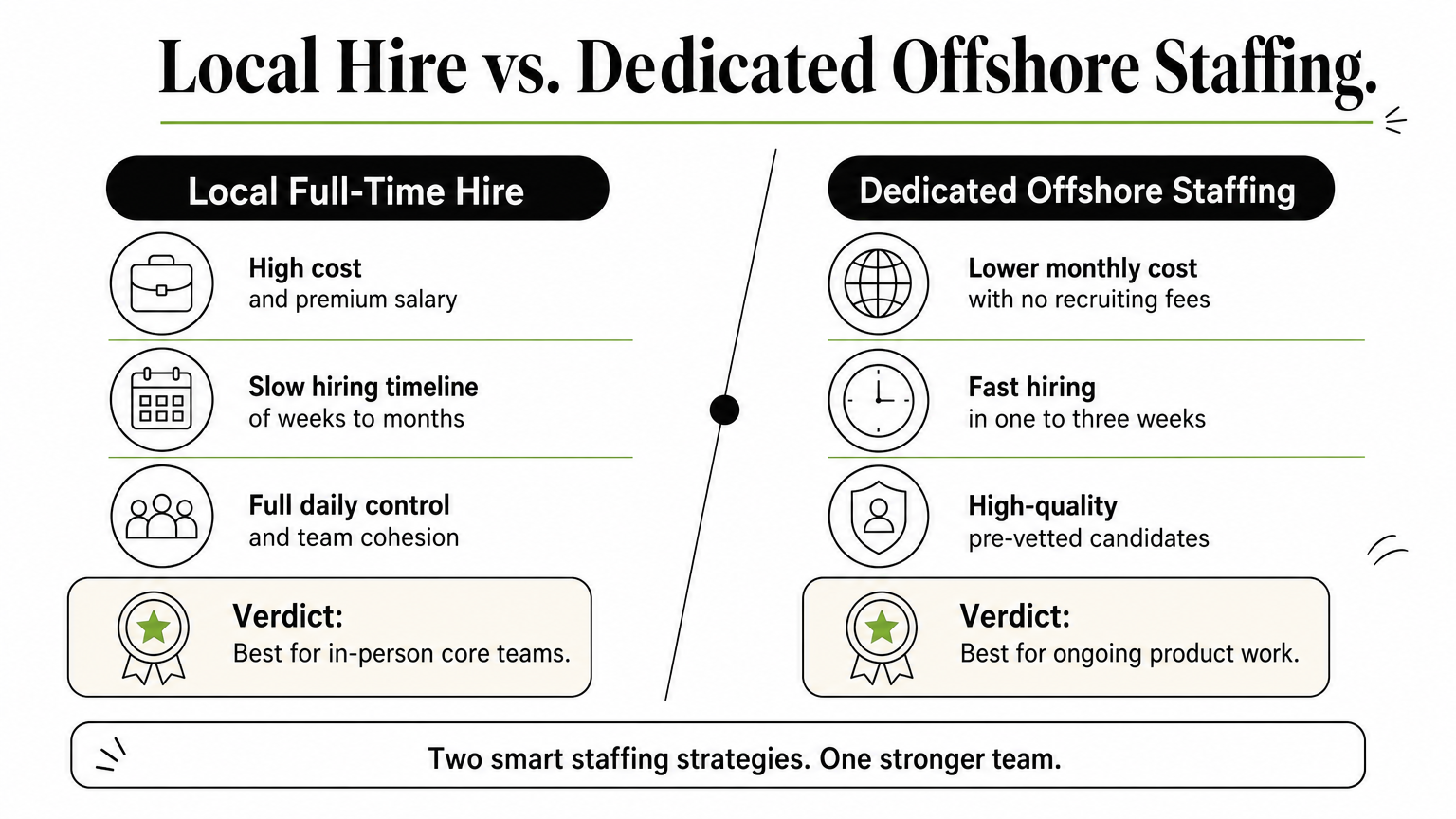
Local full-time hiring gives you the most control and the tightest team cohesion, but in San Francisco you're paying premium salaries and competing against companies with unlimited recruiting budgets. Dedicated offshore staffing services flip that equation: you get a full-time employee who works exclusively on your product, at a fraction of local salary costs, without the overhead of running payroll, benefits, and HR compliance yourself. Services like GlobalEmployees handle the recruitment, vetting, and administrative burden, so you interview pre-screened candidates and start managing actual work within weeks instead of months.
Here's how the models stack up on the factors that matter most:
| Model | Cost | Control | Speed to hire | Best for |
|---|---|---|---|---|
| Local full-time | Highest | Full | Slow (weeks-months) | Core teams needing deep in-person collaboration |
| Freelancer | Low-medium | Limited | Fast | Short, defined projects |
| Agency | High | Low-medium | Medium | Outsourced projects with fixed scope |
| Dedicated offshore staffing | Low | High | Fast (1-3 weeks) | Ongoing product work needing full-time focus |
Match the model to your actual constraints. If you need someone embedded in daily standups with your San Francisco team and budget isn't a concern, local hiring still makes sense. If you need a dedicated full-time employee who can own real feature work without the six-figure salary and long recruiting cycle, a staffing model built around vetted, dedicated offshore developers gets you there faster and cheaper. The next step is figuring out what that actually costs, and how the numbers compare across each option.
Step 3. Set a realistic budget
Budgeting for a full-stack developer isn't just about the salary line, it's about every hidden cost that stacks on top of it. In San Francisco, a mid-level full-stack developer commands a base salary of $140,000 to $180,000, and that's before payroll taxes, health benefits, equity, recruiting fees, and the laptop and software licenses you'll need to provide. Add it all up and a single local hire often costs your company $200,000 or more in the first year alone, as this developer salary comparison between India and the US lays out in detail.
Recruiting fees alone can blow up a budget fast. Agencies and executive recruiters typically charge 15% to 25% of first-year salary, which means a $160,000 hire can cost another $25,000 to $40,000 just to fill the seat. That's money spent before the developer writes a single line of code, and it's why so many founders end up stretching their runway thin over one engineering hire.
The real cost of a developer isn't the salary you offer, it's the salary plus everything else attached to it.
Compare that to a dedicated offshore developer through a staffing model, where the total monthly cost, including HR, infrastructure, and management overhead, starts around $1,090 a month. That's a fraction of even the base salary for an equivalent San Francisco hire, with no separate recruiting fee, no benefits administration, and no long-term contract locking you in if the role changes.
| Cost factor | Local SF hire | Dedicated offshore hire |
|---|---|---|
| Base compensation | $140,000-$180,000/yr | From $1,090/month |
| Recruiting fees | $25,000-$40,000 | None |
| Benefits/payroll admin | $15,000-$25,000/yr | Included |
| Equipment/software | $2,000-$4,000 upfront | Provided |
| Contract flexibility | Low (severance risk) | High (no long-term lock-in) |
Once you have real numbers in front of you and a clear view of the total cost of ownership for in-house versus remote teams, decide what you're actually budgeting for: a single hire, or a scalable team you can grow or shrink as the product evolves. If you expect headcount to double or halve within a year, locking into a full local salary with severance obligations carries real risk. Offshore staffing models built around short-notice scaling let you add or remove developers without the same financial exposure. Check current full-stack developer pricing before you finalize a number, since actual rates vary by seniority and specialization, then use that figure to decide how many candidates you can realistically source and interview in the next step.
Step 4. Source qualified candidates
With your role defined, your hiring model chosen, and a budget in hand, it's time to actually find people. Sourcing candidates is where most hiring managers waste the most time, posting on generic job boards and sorting through hundreds of resumes that don't match the role. Where you look should match the model you picked in Step 2, since a freelance marketplace and a dedicated offshore staffing service require completely different sourcing tactics.
Sourcing locally in San Francisco
If you're recruiting for a local full-time hire, expect to compete on LinkedIn, AngelList, and niche developer communities like Hacker News's "Who's Hiring" threads against every funded startup in the Bay Area. Local job boards still work, but response rates drop fast once candidates see a salary range below market. Referrals from your existing network typically produce stronger candidates than cold applications, so ask your current engineers before you post publicly.
Sourcing through staffing and offshore services
For offshore staffing, the process looks different, and it's worth reviewing the best staff augmentation companies in the USA before picking a partner. Instead of posting a job and waiting for applicants, you work with a service that already maintains a pool of pre-vetted developers matched to your stack. GlobalEmployees, for example, gives you free access to sample resumes before you commit to hiring anyone, so you can gauge the quality of candidates against your actual requirements before spending time on interviews. This flips the usual sourcing sequence: vetting happens upfront, and you only interview people who've already cleared a technical bar.
Sourcing isn't about generating more applicants, it's about generating fewer applicants who actually fit.
Comparing sourcing channels
Here's how the common sourcing channels stack up on speed and candidate quality:
| Channel | Speed | Candidate quality control | Cost to source |
|---|---|---|---|
| LinkedIn/job boards | Slow (weeks) | Low, self-reported | Free-$500/post |
| Referrals | Medium | High | Free |
| Freelance marketplaces | Fast | Variable | Platform fees |
| Dedicated offshore staffing | Fast (days) | High, pre-vetted | Included in monthly rate |
Whichever channel you choose, resist the urge to source from just one place. Combining a referral push with a staffing partner's vetted pool usually gets you a stronger shortlist faster than relying on a single job board and hoping the right person applies. Once you've got candidates in the pipeline, the next job is separating the resumes that look good from the ones that hold up under scrutiny.
Step 5. Screen resumes and portfolios
Once candidates start arriving, resist the temptation to skim for keywords. A resume that lists React, Node, and AWS tells you nothing about whether the person actually shipped a working product with those tools. Screening resumes properly means looking past the buzzword list and checking for evidence: specific projects, measurable outcomes, and a work history that matches the seniority level you defined in Step 1.
Start with the portfolio, not the resume. A portfolio review should show you real, deployed applications, not just GitHub repos full of tutorial clones. Click through the actual site if it's live. Check whether the front end is responsive, whether forms validate properly, and whether the app handles errors gracefully instead of crashing. If the candidate can link a live project, open the browser console and look for obvious errors. Sloppy console output on a portfolio piece is a preview of what your production app will look like.
A resume tells you what someone claims to have built, a portfolio shows you what they actually did.
Use this checklist when screening each candidate:
- Live projects over screenshots: Prioritize candidates with deployed, clickable applications over static images or PDFs.
- Depth on GitHub: Look for commit history, meaningful pull requests, and code comments, not a single upload dated years ago.
- Consistency with the job description: Match past roles and project types against the stack and scope you defined in Step 1.
- Career trajectory: Watch for steady growth in responsibility, not just a string of short stints with no clear progression.
- Red flags: Unexplained employment gaps, vague project descriptions, or a portfolio that hasn't been touched in years.
If you're working with a staffing service, this step largely disappears from your plate. GlobalEmployees pre-screens every candidate's resume and portfolio before you ever see a profile, which means the shortlist you receive has already cleared the filtering work described above. That's a meaningful time savings if you're hiring without an internal technical recruiter, since manual resume screening for a single role can easily eat several hours a week during an active search.
Whatever your sourcing channel, don't skip straight to interviews once a resume looks strong. A polished resume and an impressive-looking portfolio still need to survive a real technical test, since plenty of candidates can talk convincingly about work they didn't actually do themselves. The next step separates the candidates who can explain their code from the ones who can actually write it under real conditions.
Step 6. Test technical skills with a real assessment
A resume and portfolio only get you so far. Technical assessments are where you find out whether a candidate can actually solve problems on your stack, under conditions that look something like the real job. Skip this step and you're hiring on trust alone, which is how teams end up with a developer who can talk fluently about React hooks but takes three days to ship a simple form.
Choosing the right kind of test
Generic algorithm puzzles like reversing a linked list tell you almost nothing about full-stack skills. They test whether someone memorized a pattern, not whether they can build a working feature end to end. Instead, build an assessment around a small, realistic slice of your actual product: a CRUD feature, an API integration, or a bug fix pulled from your own codebase with the identifying details stripped out. This gives you a far better read on how the candidate thinks through tradeoffs and structures code they didn't write from scratch.
A coding test should look like a Tuesday at your job, not a computer science exam.
Use a structure like this for a take-home or live assessment:
- Front-end task: Build a small form or dashboard component that fetches data from an API and handles loading and error states.
- Back-end task: Write an endpoint that reads/writes to a database, including basic validation and error handling.
- Debugging task: Hand over a small file with an intentional bug and ask the candidate to find and fix it, then explain their reasoning out loud.
- Code review task: Show them a snippet of mediocre code and ask what they'd change and why.
Live versus take-home assessments
Take-home assignments respect a candidate's schedule and let them work without pressure, but they're easy to outsource or copy from an old project. Live, pair-programming style assessments, done over a video call with screen share, are harder to fake and show you how someone thinks in real time, which matters more for a role with this much autonomy. A 60 to 90 minute live session covering a small feature build usually tells you more than a 4-hour take-home nobody has time to complete honestly.
If you're hiring through a staffing service like GlobalEmployees, candidates have already cleared a technical bar before you see them, but running your own short assessment on your actual stack still confirms fit for your specific codebase before you commit to onboarding.
Step 7. Interview for skills and team fit
By the time a candidate reaches the interview, you already know they can code. The interview's job is different: it tests whether they can explain their decisions, work with a team, and handle the kind of ambiguity that shows up in real projects. A technical interview built around live problem-solving reveals more than a scripted Q&A session, because you get to watch how someone reasons through a problem instead of just hearing a rehearsed answer, and this checklist for interviewing distributed engineers covers the structure in full.
Go beyond the resume walkthrough
Skip the standard "walk me through your resume" opener and ask about specific decisions instead. Have the candidate explain a tradeoff they made on a past project, like why they chose a NoSQL database over a relational one, or how they handled a production bug under time pressure. These questions surface problem-solving skills that a polished resume can't show you, and they're hard to fake without real hands-on experience.
An interview should test how someone thinks under pressure, not how well they've rehearsed their answers.
Check for team fit, not just skill
Technical strength means little if the person can't work inside your team's existing process. Ask how they've handled disagreement with a teammate over a code review comment, or how they've communicated a missed deadline to a project lead. Team fit matters more on a distributed or offshore team, where async communication and clear written updates replace the hallway conversations a local team relies on. A developer who writes vague status updates or goes quiet for days is a bigger risk than one with a slightly thinner resume.
Run every interview against a short list so you don't miss anything under time pressure:
- Technical reasoning: Can they explain the "why" behind a past architectural decision, not just the "what"?
- Debugging under pressure: How did they diagnose and fix a production issue, and what did they learn from it?
- Communication clarity: Do they explain complex ideas in plain language, or do they lean on jargon to sound competent?
- Ownership: Do they talk about work in terms of "we shipped" or "I was assigned"?
- Availability and overlap: For remote or offshore hires, confirm working hours overlap enough for daily check-ins.
If you're hiring through a staffing partner, this stage is usually a fit check rather than a full vetting process, since the technical bar has already been cleared earlier in the pipeline. Use the time instead to confirm working style, availability, and whether this specific person clicks with how your team actually operates day to day.
Step 8. Make an offer and onboard your hire
Once you've picked your candidate, move fast. Strong full-stack developers, local or offshore, get multiple offers within days, and a slow approval process is how you lose the person you just spent weeks vetting. Making the offer promptly signals that you run a decisive operation, which matters to candidates weighing you against a competing offer.
Structuring the offer
Put the offer in writing immediately after the final interview, even if it's a short email confirming the verbal terms discussed on the call. Include the start date, compensation, working hours expectations, and a brief outline of the first 30 days so the candidate knows exactly what they're walking into.
Subject: Offer to Join [Company] as Full-Stack Developer

Hi [Name],

We'd like to offer you the Full-Stack Developer role starting [date].

- Compensation: [amount/terms]
- Working hours: [overlap window]
- Reporting to: [manager name]
- First 30 days: [feature/project you'll own]

Please confirm by [date] so we can finalize onboarding.
The offer isn't the finish line, it's the start of the trial period that actually proves you hired the right person.
If you're hiring through a staffing model, this step is largely handled for you. GlobalEmployees backs every placement with a money-back guarantee, so if the fit isn't right after the person starts, you get a replacement instead of absorbing the full cost of a bad hire.
Onboarding for real productivity
Onboarding determines how fast your new hire ships real work, and a scattered first week costs you weeks of lost output later. Run through this checklist on day one:
- Access first: Provision repo access, environment credentials, and communication tools before their first day, not during it.
- Assign a buddy: Pair them with an existing engineer for their first two weeks to answer questions without waiting on you.
- Small first ticket: Give them a contained, low-risk task in week one so they can ship something and build confidence in the codebase.
- Set check-in cadence: Schedule daily standups for the first month, then shift to async updates once trust is established.
- Document expectations: Write down communication norms, especially for offshore hires managing overlapping but different working hours.
Get these basics right, follow the 90-day management playbook, and your new full-stack developer is writing production code within the first week, not still waiting on Slack access three days in.
Interview questions worth asking every candidate
Some questions work across every full-stack hire, regardless of stack, seniority, or whether you're hiring a full-stack developer locally or through an offshore staffing partner. These aren't trick questions. They're designed to surface real experience fast, so you can spot the candidates who've actually done the work versus the ones who've only read about it.
Questions that test real technical depth
Ask candidates to walk through a specific technical decision rather than define a term. Anyone can recite what REST means; far fewer can explain why they chose it over GraphQL for a specific project and what tradeoff that created down the line. The goal is to hear reasoning, not vocabulary.
| Question | What it reveals |
|---|---|
| "Walk me through how you'd design the database schema for [simple app relevant to your product]." | Data modeling instincts and attention to scale |
| "Tell me about a time a deployment broke production. What happened?" | Debugging process and accountability |
| "How do you decide when to optimize performance versus ship a working feature?" | Judgment under real business constraints |
| "What's a piece of your own code you'd rewrite today, and why?" | Self-awareness and growth over time |
The best interview questions have no perfect answer, only better and worse reasoning.
Questions that test collaboration and ownership
Beyond code, you need to know how someone behaves inside a team, especially if this hire is joining a distributed team across time zones. Ask how they've handled a disagreement over a pull request, or what they do when a task is blocked and no one's around to unblock them. A strong candidate describes specific actions they took, not general philosophy about teamwork.
Use these as reliable follow-ups in any technical interview:
- "Describe a project where the requirements changed midway through. How did you handle it?"
- "What's your process for writing documentation others will actually read?"
- "How do you communicate progress when you're stuck for more than a day?"
Grade every answer against the same rubric across candidates so you're comparing apples to apples, not just judging who interviewed best on a given afternoon. Consistency here matters more than clever questions, since it's the only way to fairly compare a candidate sourced through a job board against one who came through a vetted staffing pipeline.
Finding the right developer for your team
Hiring a full-stack developer comes down to discipline, not luck. Define the role clearly, pick a hiring model that matches your budget and timeline, then run every candidate through the same technical and team-fit screening before you make an offer. Skip a step and you'll feel it three months in, when a bad hire costs you far more than the salary you paid.
Getting this right in San Francisco often means looking past local job boards entirely. Between six-figure salaries and a shallow talent pool, vetted offshore hiring gives you the same skill level at a fraction of the cost, without the recruiting fees or long-term risk of a bad local match, as this 2026 guide to hiring developers in India for a US business explains.
If you're ready to skip months of sourcing and start interviewing pre-screened candidates this week, hire a full-stack developer through GlobalEmployees and see real resumes before you commit to anything.
Need to hire dedicated remote talent?
Tell us the role, experience, and AI skills your team needs.
Hire Talent Now