Hire Salesforce Developer in India: Cost, Process, and Tips
Salesforce implementations rarely stay simple. You start with a basic CRM setup and six months later you need custom Apex triggers, Lightning components, and someone who actually understands your integrations. Hiring locally for that skill set often means $120,000+ salaries plus benefits, and most US companies can't justify that for one developer. That's why so many founders and IT managers decide to hire Salesforce developer India talent instead, and why the demand keeps growing every year.
This guide answers the practical questions you actually have: what a Salesforce developer in India costs, how the hiring process works from shortlisting to onboarding, and how to avoid the mistakes that sink offshore projects. You'll get real pricing benchmarks and a clear breakdown of engagement options, from freelance platforms to dedicated staffing models.
We'll also cover the red flags to watch for when vetting candidates or agencies, since certification alone doesn't guarantee someone can handle a complex org migration. Whether you need one certified admin or a full development team, you'll leave with a framework for making the right hire without overpaying or getting stuck with the wrong fit.
Why hire a Salesforce developer in India
Businesses turn to India for Salesforce talent for one simple reason: the math works. India produces more Salesforce-certified professionals than any other country outside the US, and the cost to hire them runs a fraction of what you'd pay locally. But cost isn't the only driver. Companies that hire Salesforce developer India talent also gain access to specialists who've worked across industries like healthcare, retail, and financial services, often on implementations more complex than what a single in-house hire has ever touched.

The cost gap is real and it's large
Consider how much a developer costs in India compared to the US for comparable experience and certifications at the mid level.
| Location | Average Monthly Cost | Annual Cost (approx.) |
|---|---|---|
| United States | $8,000 - $12,000 | $96,000 - $144,000 |
| Western Europe | $6,500 - $10,000 | $78,000 - $120,000 |
| India (offshore dedicated hire) | $1,090 - $2,500 | $13,000 - $30,000 |
That gap doesn't mean lower quality. It reflects a lower cost of living and a currency exchange rate that stretches your budget further. A certified Salesforce developer in India with five years of experience typically costs less than a junior admin in San Francisco.
A Salesforce developer in India can cost 70-85% less than a comparable US hire without sacrificing certification level or project experience.
A deep, growing talent pool
India graduates over 1.5 million engineers every year, and a significant chunk of them funnel into Salesforce ecosystems through Trailhead, certification bootcamps, and partner-led training programs, which is a big part of why India is still the best place to hire remote developers. This means you're not choosing between three freelancers on a marketplace. You're choosing from a large talent pool that includes admins, developers, architects, and consultants who've handled everything from basic Sales Cloud setups to multi-org integrations with SAP and NetSuite. Salesforce itself has invested heavily in the region, running certification programs and partner accreditations that keep the pipeline strong, as detailed on Salesforce's own Trailhead platform (trailhead.salesforce.com).
Coverage without the overtime bill
Eight to twelve hours of time difference sounds like a drawback until you use it correctly. Development work continues while your US team sleeps, and you wake up to progress instead of a stalled ticket queue. Overlap windows of two to four hours, usually early morning US time or evening India time, are enough for daily standups and code reviews. Founders running lean teams often say this near round-the-clock coverage speeds up their release cycles more than adding a second in-house developer would.
Reduced hiring risk with the right partner
Going direct to a freelance platform means you absorb all the vetting risk yourself. Working with a managed offshore staffing partner that already screens for Salesforce certifications, communication skills, and past project outcomes cuts that risk substantially. GlobalEmployees, for example, gives clients free access to vetted resumes before any commitment, and backs every placement with a money-back guarantee if the fit isn't right. That structure removes the two biggest fears clients have when they decide to outsource Salesforce development: wasted budget and a mismatched skill set.
Hiring in India isn't just about saving money, though the savings are substantial. It's about tapping into a market built around Salesforce specifically, with enough scale and structure that you can find the exact skill set your project needs, whether that's a single admin fixing validation rules or a full team building a custom Lightning app from scratch.
How to hire a Salesforce developer in India
Hiring a Salesforce developer in India follows a different rhythm than posting a job on LinkedIn and waiting for applications. The market moves through platforms, referrals, and staffing partners more than open job boards, so read up on how US businesses hire dedicated developers in India and build a plan before you start reaching out. Getting this right the first time saves you weeks of back-and-forth interviews with candidates who never should have made your shortlist.
Define the role before you search
Before anything else, write down exactly what you need. A Salesforce admin who manages workflows and permission sets is a completely different hire than a developer who writes Apex triggers or builds Lightning Web Components. Vague job specs are the number one reason companies waste time interviewing candidates who don't fit, so spend an hour mapping out the technical stack, expected deliverables, and whether you need someone full-time or project-based.
Choose your sourcing channel
Once your requirements are clear, you have three real paths: freelance marketplaces, IT outsourcing agencies, or a dedicated staffing partner. Each comes with tradeoffs in cost, oversight, and speed, which the next section covers in detail. Companies that want to hire dedicated Salesforce developer talent without managing recruitment logistics themselves usually go with a staffing partner that pre-vets candidates and handles payroll.
Run a structured vetting process
After narrowing your channel, follow a consistent process and a checklist of questions to ask a remote developer rather than judging candidates on gut feeling alone:
- Screen resumes for relevant certifications and project history, not just years of experience.
- Test technical skills with a scenario close to your actual use case, like a validation rule bug or a flow automation task.
- Interview for communication, since offshore success depends heavily on how clearly someone reports progress and blockers.
- Check references from past clients, especially projects similar in scope to yours.
Skipping structured vetting is the fastest way to end up with a certified developer who still can't deliver on your specific project.
GlobalEmployees builds this vetting into its process by default. You get access to sample resumes and interview candidates directly before committing to anything, which mirrors the way hiring works from requirement to onboarding for the many US and European businesses already filling development roles across time zones.
How much does it cost to hire a Salesforce developer
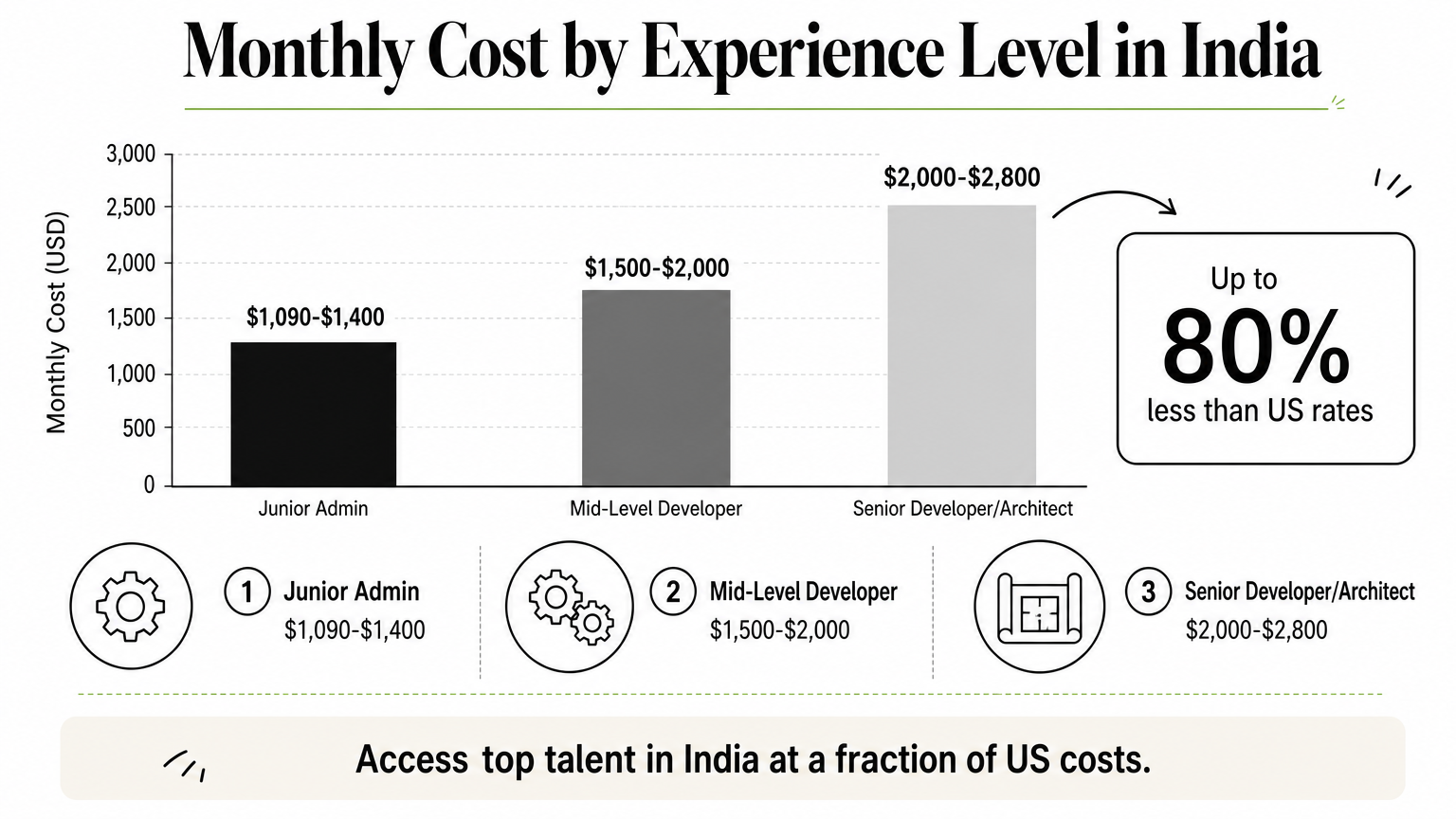
What a Salesforce developer costs in 2026 depends on three things: experience level, engagement model, and whether you're hiring a generalist admin or a specialist developer who codes Apex and Lightning components. Most companies budget too narrowly, assuming a flat rate applies across the board, then get surprised when a senior architect quotes double what a junior admin costs. Understanding these tiers upfront helps you set a realistic budget before you start interviewing.
Cost by experience and role type
Budget shifts significantly based on seniority and specialization. A junior admin handling basic configuration costs far less than a senior developer architecting integrations across multiple Salesforce clouds.
| Role Level | Monthly Cost (India, dedicated hire) | Typical Responsibilities |
|---|---|---|
| Junior Admin | $1,090 - $1,400 | Workflows, permission sets, basic reports |
| Mid-Level Developer | $1,500 - $2,000 | Apex triggers, Lightning components, integrations |
| Senior Developer/Architect | $2,000 - $2,800 | Multi-org migrations, custom platform builds, technical leadership |
GlobalEmployees lists dedicated hires starting from $1,090 per month, which covers salary, HR administration, and infrastructure like laptops and secure VPN access, so there's no separate line item to budget for later.
What actually drives the price up or down
Certifications matter, but not evenly. A Platform Developer II certification adds more to the rate than a basic Administrator badge, since it signals someone can handle complex Apex logic and governor limit challenges. Industry experience matters too. A developer who's built health cloud implementations for HIPAA-compliant clients charges more than someone who's only touched standard Sales Cloud setups. Location within India also plays a small role, since talent based in Bangalore or Hyderabad sometimes commands slightly higher rates than smaller tech hubs, though the difference rarely exceeds 10-15%.
The biggest cost driver isn't location, it's whether you're paying for a generalist admin or a specialist who can architect complex integrations.
Freelance rates versus dedicated hire rates
Many businesses start by comparing hourly freelance rates against a full-time remote hire, which typically run $15-40 per hour on marketplaces. That sounds cheap until you calculate a full-time equivalent, which often lands close to or above what a dedicated Salesforce developer costs through a staffing model, minus the reliability. Freelancers juggle multiple clients, so availability fluctuates. A dedicated hire works exclusively for you, at a fixed monthly rate, with none of the scheduling unpredictability that comes with hourly freelance work.
Key skills and certifications to look for
Certifications tell you a candidate studied the material, not that they can solve your specific problem. Before you shortlist anyone, get clear on which credentials matter for your project and which technical skills actually predict good work. A resume packed with badges means little if the person has never touched a real integration under deadline pressure.

Certifications that actually matter
Salesforce runs a tiered certification system, and each tier signals a different depth of capability. Use this table as a quick filter when screening resumes:
| Certification | Skill Level Signaled | Best For |
|---|---|---|
| Administrator | Basic configuration, workflows, reports | Simple orgs, routine maintenance |
| Platform App Builder | Custom app design, process automation | Mid-complexity builds without heavy code |
| Platform Developer I | Apex, Visualforce, basic integrations | Standard development work |
| Platform Developer II | Advanced Apex, governor limits, architecture | Complex integrations, multi-cloud builds |
| Application/System Architect | Enterprise-level design decisions | Large-scale migrations, technical leadership |
Don't stop at the badge. Ask candidates to walk you through a project where they applied that certification's core skill, like a governor limit workaround or a bulk data migration.
A certification proves someone studied Salesforce. Only a portfolio and a technical interview prove they can build with it.
Technical skills beyond the badge
Beyond formal credentials, look for hands-on experience with the tools your project actually needs:
- Apex and Lightning Web Components for custom logic and UI
- Flow Builder and Process Automation to reduce reliance on custom code where possible
- API integrations with tools like MuleSoft, REST/SOAP services, or third-party platforms such as NetSuite
- Data migration experience, including deduplication and field mapping between systems
- DevOps familiarity, since version control and sandbox management prevent deployment disasters
GlobalEmployees screens for this exact mix when building candidate shortlists, so clients see verified project history alongside certification badges rather than a resume that only lists exam names.
Soft skills that make offshore work
Getting a great developer only pays off if you can actually communicate with them. Look for candidates comfortable with async updates, clear written documentation, and daily standups during overlap hours. Someone who flags blockers early saves you more time than someone who codes fast but stays silent until a deadline slips.
Freelancers vs agencies vs dedicated staffing
Once you know your budget and required skill level, the next decision matters more than most people realize: which engagement model actually fits how you work. Each engagement model trades off cost, control, and reliability differently, and picking the wrong one causes more offshore hiring failures than a bad candidate ever does.
Freelance marketplaces
Platforms like Upwork put you in direct contact with individual Salesforce developers at hourly rates, which feels flexible when you only need a few weeks of work. The catch is oversight. You handle vetting, contracts, and quality control yourself, and most freelancers split their time across two or three clients at once. That works fine for a small fix, like a validation rule bug, but it falls apart on anything requiring sustained focus over months.
IT outsourcing agencies
Agencies sit a level up. They assign a project manager, handle basic quality checks, and often bundle multiple developers into a package rate. You get more structure than a freelance marketplace, but you also pay a markup for the management layer, and you rarely get to choose the exact person working on your project. Turnover on the agency side can mean a new developer picks up your codebase halfway through, without you ever approving the switch.
Dedicated staffing
A dedicated staffing model lets you build a dedicated remote team of full-time employees who work exclusively on your project, hired and vetted specifically for your requirements, with payroll, HR, and infrastructure handled by the staffing partner. You interview the actual person before committing, and that same person stays with your project long-term instead of rotating between clients. This is the model GlobalEmployees uses to help companies hire Salesforce developer India talent without building an internal recruitment pipeline.
Dedicated staffing gives you the control of an in-house hire with none of the payroll and compliance overhead.
| Model | Cost | Control | Reliability |
|---|---|---|---|
| Freelance marketplace | Low upfront, variable overall | Low, self-managed | Inconsistent availability |
| Outsourcing agency | Moderate to high | Moderate, shared with PM | Depends on agency turnover |
| Dedicated staffing | Predictable monthly rate | High, direct interviews | Full-time, exclusive focus |
Companies scaling past a single project usually land on dedicated staffing once they've tried the other two and hit their limits. It costs slightly more than a bargain freelancer's quoted rate, but the predictability and direct oversight pay for themselves the first time a deadline actually matters.
Common mistakes to avoid when hiring
Even with a solid process, plenty of companies still get burned when they try to hire Salesforce developer India talent. Most failures trace back to a handful of predictable mistakes rather than bad luck or bad candidates. Knowing these traps ahead of time saves you from repeating them on your own project.
Choosing the cheapest quote
Price shopping feels smart until the cheapest developer turns out to be juggling five other clients or lacks the certification depth your project needs. Rock-bottom rates usually mean junior talent, inconsistent availability, or both. Compare quotes against actual deliverables and experience level, not just the number on the invoice.
The cheapest quote almost always costs more once you factor in rework, missed deadlines, and a second hiring round.
Skipping the technical interview
Relying on a resume and a certification badge without a live technical conversation is one of the most common shortcuts companies take, and it backfires often. A short scenario-based test, like debugging a broken flow or explaining a governor limit workaround, reveals far more than any list of exam names. Certifications prove someone studied. Interviews prove they can build.
Ignoring time zone and communication fit
Underestimating the communication gap sinks otherwise well-qualified hires. A brilliant developer who never flags blockers or writes unclear status updates will frustrate you within weeks, regardless of how many badges they hold. Confirm overlap hours and communication habits during the interview, not after the contract starts.
Skipping a written scope or SLA
Vague expectations around deliverables, response times, and escalation paths cause more disputes than actual coding errors. Put deadlines, review cycles, and support hours in writing before work begins so both sides know what "done" looks like.
No exit plan if the fit is wrong
Assuming every hire works out is a costly bet. Ask upfront what happens if the developer isn't a match after a few weeks. GlobalEmployees builds a money-back guarantee and fast replacement option into every placement specifically because fit issues happen even with good vetting.
Quick checklist before you sign anything:
- Confirm certifications match your project's actual complexity
- Run a paid technical test, not just an interview
- Verify overlap hours in writing
- Get scope, deadlines, and support terms documented
- Ask what your replacement or refund options look like
Making the right hire for your business
Getting this decision right comes down to matching your project's complexity to the right skill level and engagement model, then vetting hard before you commit. Skip the cheapest quote, test technical skills directly, and put communication expectations in writing before day one. Junior admins handle routine configuration fine, but multi-cloud migrations need someone with Platform Developer II depth and real project scars to show for it.
Remember that cost savings and quality aren't a tradeoff here. India's talent pool is deep enough that you can find both if you vet properly instead of guessing. Whether you need one certified admin or a full build team, the framework in this guide gives you a repeatable process instead of a one-off gamble.
If you'd rather skip the sourcing legwork entirely, browse vetted Salesforce developer profiles and get transparent pricing and a money-back guarantee built into the process from day one.