

Hire ASP.NET Developer: What It Means and How to Do It Right
Hire ASP.NET Developer: What It Means and How to Do It Right
You need someone who can build or maintain a .NET application, and you're realizing that "hire an ASP.NET developer" means something different depending on where you look. Hire ASP.NET developer searches usually turn up three different paths: freelance marketplaces, agency contracts, or dedicated offshore staffing, and each one changes your cost, timeline, and control over the work.
The right answer depends on what you're actually trying to solve. Are you patching a legacy system, building a new product from scratch, or replacing an internal hire who just left? This article breaks down what hiring an ASP.NET developer really involves, from the technical skills worth screening for to the hidden costs that freelance platforms and staffing markups don't advertise upfront.
We'll walk through how vetting should work, what a fair monthly rate looks like in 2026, and how dedicated offshore hiring compares to going through Upwork or a local agency. If you've been burned by a bad freelance hire before, or you're just tired of guessing at rates, this guide gives you a clear framework for hiring right the first time.
Why hiring the right ASP.NET developer matters
ASP.NET rarely runs a side project. Most companies use it to power billing systems, internal tools, customer portals, or e-commerce platforms that the business can't afford to have go down. When you hire an ASP.NET developer, you're not just filling a seat, you're handing someone the keys to code that other departments depend on every day. Get the hire wrong and the damage doesn't stay contained to one project; it spreads into missed deadlines, frustrated stakeholders, and technical debt someone else has to clean up later.

The real cost of a bad hire
Bad hires cost more than the salary or contract rate you paid them. You lose the weeks spent onboarding, the client relationships strained by missed milestones, and the money spent fixing code that has to be rewritten from scratch. A junior developer posing as a senior can pass a resume screen and still leave you with spaghetti code that nobody else wants to touch. Consider what a mis-hire actually costs across a typical engagement:
- Recruiting and screening time: 15 to 40 hours depending on how you source candidates
- Onboarding and ramp-up: 2 to 6 weeks before real output starts
- Rework after a bad delivery: often 30 to 50% of the original project cost
- Delayed launches: lost revenue or lost trust with your own customers
A cheap ASP.NET hire that can't deliver clean, maintainable code always ends up the most expensive option.
ASP.NET's technical learning curve
ASP.NET isn't one skill, it's a stack of related decisions, starting with how .NET compares to Java for enterprise apps. A developer comfortable in classic Web Forms might struggle with a modern ASP.NET Core microservices setup, and someone who's only built REST APIs may have never touched Entity Framework migrations or Azure deployment pipelines. When you hire a .NET developer, you need to know which version of the framework your project actually runs on and whether the candidate has shipped real work in that exact environment, not just studied it. This is where generic recruiting falls short: a resume full of buzzwords doesn't tell you if someone can debug a production issue in a legacy MVC app at 2 a.m.
What's on the line for your business
Security is the part most business owners underestimate until something breaks. ASP.NET applications that handle customer data, payments, or internal records need developers who understand authentication, input validation, and secure API design, not just feature delivery. Microsoft documents baseline security practices for ASP.NET Core applications, and a developer who ignores them is building risk into your product from day one, as outlined in Microsoft's own ASP.NET Core security guidance. Scalability matters just as much: the person you hire today is often the same person maintaining that codebase two years from now, so their habits around documentation, testing, and code structure determine how expensive your next feature request will be.
How to hire an ASP.NET developer step by step
Hiring an ASP.NET developer works best as a sequence, not a scramble. Skip a step and you either waste weeks interviewing people who were never a fit, or you end up with a signed contract and a developer who can't actually do the work. Here's the order that keeps you from backtracking.
Define scope before you post anything
Start by writing down the actual problem, not just the job title. Are you maintaining a legacy Web Forms app, building a new ASP.NET Core API, or need someone who can own the whole stack including SQL Server and Azure? This scope document becomes your filter for every resume and interview that follows, and it stops you from hiring a generalist for a job that needs deep framework experience.
A vague job description guarantees a vague hire.
Source, screen, and test in that order
Once scope is locked, move through candidates methodically:
- Source candidates from a platform or staffing partner that matches your engagement model (freelance, agency, or dedicated hire).
- Screen resumes for framework version, industry experience, and years working in production environments, not just years of employment.
- Run a technical interview that includes a real code sample or live debugging exercise, not just conceptual questions.
- Check references from actual clients or employers, and ask specifically about deadlines and communication, not just code quality.
- Confirm terms including rate, availability, time zone overlap, and what happens if the fit isn't right.
That last step matters more than most people realize. A structured hiring process that lets you review vetted candidates before committing, like the one GlobalEmployees uses for its dedicated ASP.NET developer hires, removes most of the guesswork from steps two and three since the screening already happened before you see a resume.
Skipping any of these steps doesn't save time, it just moves the cost to later, usually in the form of a rewrite or a rehire three months in.
Where to find ASP.NET developers: agencies vs freelancers vs offshore teams
Once your scope is defined, the sourcing channel you pick shapes everything downstream: cost, control, and how much of the vetting burden falls on you. The three main paths, freelance marketplaces, local agencies, and dedicated offshore teams, all claim to solve the same problem, but they solve it in very different ways, as this comparison of staffing, freelance, and agency models lays out.

Freelance marketplaces
Platforms like Upwork or Toptal give you access to a huge pool of individual developers fast, sometimes within a day. The tradeoff is that you're doing the vetting yourself, every time. There's no institutional memory if a freelancer disappears mid-project, and rates swing wildly based on who's bidding that week. Freelance hiring works best for short, well-defined tasks where you can verify output quickly, not for a system you'll depend on for years.
Local and boutique agencies
Agencies and staff augmentation companies in the USA bundle project management with development, which sounds convenient until you see the markup. You're often paying for a layer of coordination you don't need if you already have someone managing the work internally. Contracts also tend to run longer than they should, locking you into a scope that doesn't flex when your priorities shift mid-quarter.
Dedicated offshore teams
Offshore staffing, done right, gives you a full-time dedicated employee who works exclusively on your project, without the overhead of running payroll, HR, or IT setup yourself. GlobalEmployees handles that infrastructure directly, so you interview vetted ASP.NET candidates through a dedicated offshore hiring model before committing to anyone, with no setup cost and no long-term contract locking you in.
The channel you choose determines who absorbs the vetting risk, you, an agency, or a staffing partner that's already done it.
| Model | Speed to hire | Vetting done for you | Long-term cost |
|---|---|---|---|
| Freelance marketplace | Fast | No | Variable, often rises |
| Local agency | Slow | Partial | High, markup-heavy |
| Dedicated offshore team | Moderate | Yes | Predictable, lower |
Match the channel to the job. A two-week bug fix doesn't need a dedicated hire, but a product you'll maintain for years probably shouldn't run through a rotating cast of freelancers.
What ASP.NET developers cost and what drives the price
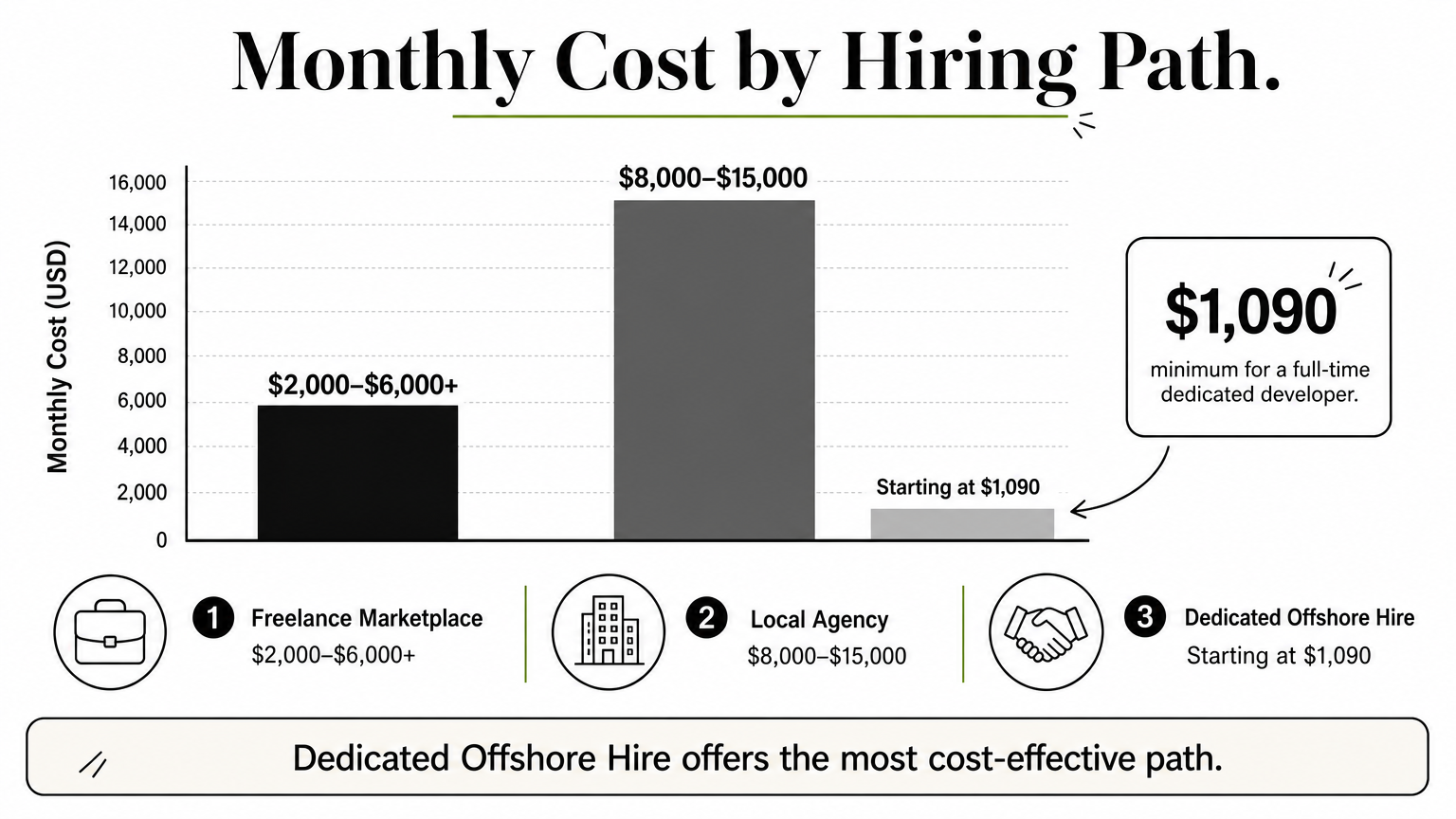
Rates for ASP.NET talent swing wildly depending on where you look, and that range confuses more buyers than it helps. A freelance ASP.NET developer on Upwork might quote $25 an hour one week and $85 the next, based purely on how busy they are, not how skilled they are. Agencies typically bill $100 to $180 an hour once you factor in their project management markup, which adds up fast on anything longer than a few weeks. Dedicated offshore hiring flips the model entirely: you pay a flat monthly rate for a full-time ASP.NET developer, not an hourly rate that punishes you for asking questions or requesting revisions.
What drives the price up or down
Seniority is the biggest lever. A developer who's only built CRUD apps costs less than one who's architected microservices with Azure Kubernetes Service, and that gap should show up in your budget, not surprise you mid-project. Specialization matters too: someone fluent in Entity Framework Core migrations and SQL Server performance tuning commands more than a generalist who touches .NET occasionally. Location plays a role as well, and developer salaries in India compared to the US show how wide that gap runs, though it's smaller than most people assume once you account for the vetting and infrastructure a staffing partner already handles.
Hourly rates punish you for communication; flat monthly rates reward it.
What a fair monthly rate looks like
Here's a rough breakdown of what you should expect to pay across common hiring paths in 2026, and it's worth reading alongside what an in-house hire really costs to own:
| Hiring path | Typical monthly cost | What's included |
|---|---|---|
| Freelance marketplace | $2,000 to $6,000+ | Just the hours billed |
| Local agency | $8,000 to $15,000 | Dev time plus PM overhead |
| Dedicated offshore hire | Starting at $1,090 | Full-time dev, HR, payroll, infrastructure |
GlobalEmployees keeps its dedicated ASP.NET developer pricing transparent from the first conversation, with no setup fees or hidden HR costs layered on after you've already committed. Whatever path you choose, get the full cost structure in writing before you sign anything, because the sticker rate rarely tells the whole story.
Skills and questions to vet before you commit
Before you sign anything, you need proof that the person in front of you can actually do the work, not just talk about it. A polished resume tells you what someone claims; a structured technical interview tells you what they can deliver. When you hire a dot net developer, the vetting stage is where most of the risk gets removed, so treat it as non-negotiable rather than a formality.
Core technical skills to confirm
Check for depth in these areas before you move a candidate forward:
- C# and .NET fundamentals: object-oriented design, LINQ, async/await patterns
- Framework version experience: ASP.NET MVC, Web API, or ASP.NET Core, matched to your actual stack
- Database work: Entity Framework Core, raw SQL, and migration handling under real production data
- Cloud and deployment: Azure App Service, CI/CD pipelines, containerization if your app runs in Docker
- Testing habits: unit tests, integration tests, and whether they write tests before or only after something breaks
A candidate who can explain their testing habits usually writes cleaner code than one who can't.
Questions that separate real experience from rehearsed answers
Ask candidates to walk you through a specific production issue they debugged, not a hypothetical one. Push for details: what broke, how they found the root cause, and what they changed afterward so it didn't happen again. Request a code sample from an app they actually shipped, and ask them to explain a design decision they'd make differently today. That last question tells you more than any certification, since it reveals whether they've grown past their first few projects or are still repeating the same patterns.
Red flags worth walking away from
Watch for vague answers about past projects, an inability to explain their own code choices, or reluctance to provide references. A candidate who dodges questions about deadlines missed on past work is telling you something important. GlobalEmployees runs this exact vetting process before you ever see a resume, which is why its dedicated hires arrive already screened against these standards.
Choosing the right path forward
Every path in this guide, freelance marketplaces, agencies, or dedicated offshore hiring, can work if you match it to the actual job in front of you. The mistake isn't picking the wrong channel outright, it's skipping scope definition, vetting, or reference checks because the deadline felt more urgent than the process. Hire ASP.NET developer decisions that skip those steps almost always cost more later, whether that shows up as a rewrite, a missed launch, or a rehire three months down the road.
If you're maintaining a system your business depends on, treat the hire with the same seriousness you'd give any other critical vendor relationship. That means clear scope, real technical vetting, and pricing you understand before you sign anything.
When you're ready to skip the guesswork, you can hire ASP.NET developers from $1,290 a month, vetted and placed with no setup cost and no long-term contract.
Need to hire dedicated remote talent?
Tell us the role, experience, and AI skills your team needs.
Hire Talent Now