
Full Stack Developer Recruitment: What It Is and How It Works
Full Stack Developer Recruitment: What It Is and How It Works
If you searched for full stack developer recruitment, you're probably trying to figure out where to find qualified candidates fast, whether that means posting listings, reviewing applicants, or hiring through a service that already has vetted talent lined up. Los Angeles has one of the most competitive tech hiring markets in the country, and sorting through resumes for someone who can handle both front-end and back-end work eats up weeks you don't have.
This article breaks down exactly what full stack developer recruitment means, how the process actually works from job description to offer letter, and what separates a traditional hiring process from working with a staffing partner who hands you pre-vetted candidates ready to start. You'll see the steps, the costs, and the tradeoffs at each stage.
We'll also cover why more US and European companies are skipping the local hiring grind altogether and building dedicated offshore teams in India instead, cutting recruitment time and monthly costs without sacrificing the quality of a full stack hire. By the end, you'll know which approach fits your timeline and budget.
Why full stack developer recruitment matters now
Every software team eventually hits the same wall: you need someone who can build a feature end to end, not just push pixels or write API endpoints. Full stack developer recruitment has become a priority for companies of every size because the role solves a real operational problem. One person who understands the database, the server logic, and the user interface can ship a working product faster than a team of narrow specialists waiting on each other's handoffs. That efficiency matters more now than it did five years ago, because budgets are tighter and runway is shorter for most startups and small businesses.
The demand for full stack talent keeps climbing
Job postings for full stack roles have stayed elevated even as overall tech hiring cooled after 2022. The U.S. Bureau of Labor Statistics projects software developer employment to grow much faster than the average for all occupations through the next decade, and full stack roles sit at the center of that growth because they cover the widest range of use cases. Startups want generalists who can wear multiple hats. Enterprises want flexible engineers who can rotate between projects without retraining. Demand outpaces supply in almost every major U.S. tech hub, which pushes salaries up and stretches recruitment timelines out.
A full stack hire lets you build a product with one engineer instead of coordinating three.
Why companies want one hire instead of two or three
Hiring a front-end specialist and a back-end specialist separately doubles your recruitment workload and your management overhead. You need two job descriptions, two interview loops, two onboarding processes, and two salaries that often add up to more than a single full stack developer earning a slight premium. Smaller teams especially benefit from this consolidation because they don't have the headcount to run separate front-end and back-end squads. Full stack hiring also reduces communication gaps. When one developer owns a feature from database schema to button click, there's no finger-pointing when something breaks in production.
The Los Angeles hiring crunch
Los Angeles now ranks among the most competitive markets in the country for full stack talent, driven by a mix of entertainment tech, ad tech, gaming studios, and a growing fintech scene pulling from the same shallow talent pool. Local companies compete not just with each other but with fully remote roles at companies headquartered elsewhere, which means a Los Angeles candidate can often earn the same or more working for a company in Austin or New York without moving. That competition drives up both salary expectations and time-to-hire. Recruiters in LA report that a strong full stack candidate rarely stays on the market more than a week or two before accepting an offer, which puts real pressure on any company still relying on a slow, multi-stage internal hiring process.
Why the traditional approach is straining
Most companies still run recruitment the same way they did a decade ago: post the job, wait for applications, screen resumes, run two or three rounds of interviews, then negotiate an offer. That process routinely takes six to eight weeks for a mid-level full stack role, and longer for senior candidates. Every week spent hiring is a week your roadmap slips. Here's a quick comparison of what companies are up against depending on the hiring path they choose:
| Hiring approach | Typical time to fill | Typical monthly cost (US mid-level) |
|---|---|---|
| Traditional local hire | 6-8 weeks | $8,000-$11,000 |
| Staffing agency (local) | 3-5 weeks | $9,000-$12,000 |
| Freelance marketplace | 1-3 weeks | Variable, often $4,000-$7,000 |
| Offshore dedicated hire | 1-2 weeks | $1,090-$2,500 |
These numbers explain why so many US and European businesses are rethinking where they look for talent. Offshore staffing models, particularly through providers that already maintain a bench of pre-vetted candidates, compress the timeline dramatically because the screening and technical vetting already happened before you ever saw a resume.
What's actually changed
Speed and cost aren't the only reasons this matters more now. Remote work normalized the idea that a developer doesn't need to sit in your building to be part of your team, and companies that resisted that shift five years ago are now the ones losing candidates to competitors who embraced it. Businesses that once limited their search to a 30-mile radius around their office now compare candidates across time zones and continents, which changes the entire calculus of full stack developer recruitment from a local staffing problem into a global sourcing decision.
How to recruit a full stack developer step by step
Good full stack developer recruitment follows a repeatable sequence, whether you're running it internally or handing it to a staffing partner. Skipping steps is what turns a two-week search into a two-month ordeal. Here's the process broken into the phases that actually matter, with the decisions you need to make at each one.
Define the role before you post anything
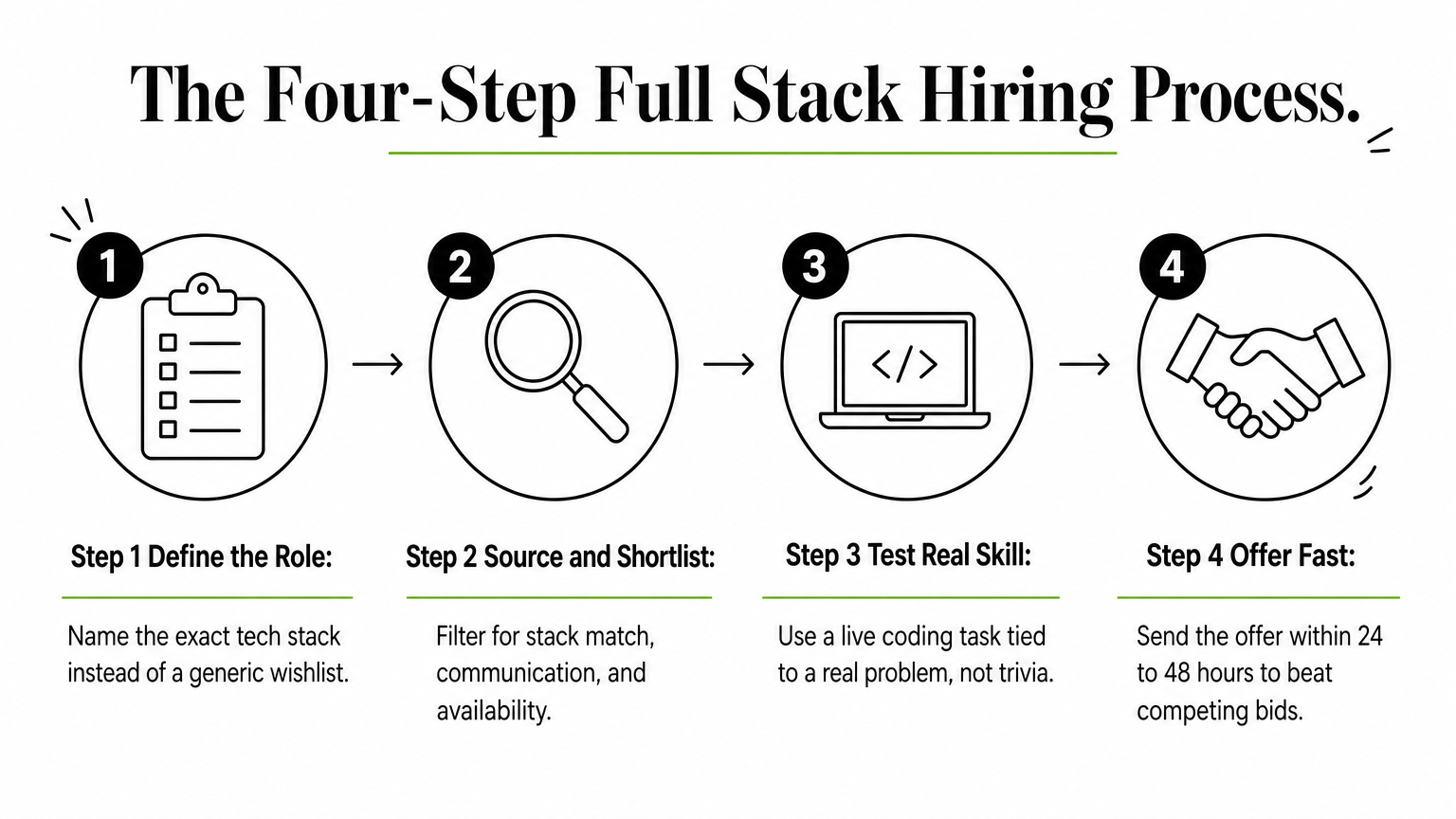
Start by writing a job description that names the actual stack, not a wishlist copied from a competitor's posting. If your product runs on React and Node, say that instead of listing every framework you might someday touch. Vague postings attract vague applicants, and you'll waste screening time weeding out people who padded their resume to match generic keywords. Decide upfront whether you need a generalist who can move between projects or a specialist who happens to touch both ends of the stack, because that distinction changes who you should be looking at.
Source, screen, and shortlist
Once the role is defined, you need candidates in front of you, and this is where most companies lose weeks. Sourcing through job boards means sorting hundreds of applications by hand, while a staffing partner with an existing bench of pre-vetted candidates can hand you a shortlist within days. Either way, the screening phase should filter for three things before anyone touches a calendar invite:
- Relevant project experience matching your actual tech stack, not adjacent tools
- Communication clarity, especially for remote or offshore hires who won't be in your office
- Availability and notice period, since a great candidate who can't start for two months doesn't solve your immediate problem
The fastest recruitment process is the one that never lets an unqualified resume reach an interview slot.
Run technical interviews that actually test skill
Next comes the part most companies get wrong: interviews that test trivia instead of ability. A short take-home task or live coding session tied to a real problem from your codebase tells you more in 45 minutes than three rounds of behavioral questions. Pair the technical round with a short conversation about how the candidate has handled a production bug or a tight deadline, because full stack roles demand judgment under pressure as much as raw coding ability.
Extend the offer and onboard fast
Finally, move fast once you've found your candidate. Delays between interview and offer are the single biggest reason companies lose strong applicants to competing offers, particularly in tight markets like Los Angeles where a good full stack developer rarely stays available more than a week or two. Send the offer within 24 to 48 hours of the final interview, and have onboarding logistics, laptop, accounts, access, ready before day one so the new hire is writing code in their first week, not waiting on IT tickets, which is also where a 90-day plan for a new remote employee pays off.
GlobalEmployees compresses this entire sequence by handling sourcing, screening, and technical vetting before you ever see a resume, so the steps that normally take six to eight weeks collapse into a short interview and a start date. You still make the final hiring decision, you just skip the weeks of unpaid screening work that come before it.
Core skills and technologies to look for in candidates
Knowing what to screen for is half the battle in full stack developer recruitment. A candidate who lists ten frameworks on a resume isn't automatically qualified, and a candidate who only knows two might be exactly what your product needs. Focus on depth in the languages your product actually uses rather than breadth across every trend from the last five years.

Front-end skills that matter
Look for solid command of HTML, CSS, and JavaScript first, since everything else builds on that foundation. Beyond the basics, most companies today run on a component-based framework like React, Vue, or Angular, so match the candidate's experience to whichever one powers your product, the same standard you'd apply when you hire front end developers outright. Ask about state management, responsive design, and accessibility, because a developer who ignores accessibility standards will cost you rework later when a client or regulator flags it. Front-end proficiency also includes comfort with version control workflows, since a developer who can't manage a clean git history slows down every teammate who has to review their code.
Back-end and database skills that matter
On the server side, check for real experience with a language like Node.js, Python, or Java, paired with the frameworks built on top of them, such as Express, Django, or Spring, and if your stack leans on JavaScript end to end, look at what dedicated Node.js and Express engineers cost. A strong candidate should be able to explain how they design a REST or GraphQL API, not just consume one someone else built. Database knowledge is where a lot of resumes fall apart under questioning, so probe for actual experience with both relational systems like PostgreSQL or MySQL and NoSQL options like MongoDB, along with basic query optimization. Server-side competence separates a developer who can maintain an app from one who can only extend a tutorial project.
A full stack candidate who can't explain how their front-end code talks to the database isn't full stack yet.
The skills resumes never show
Beyond specific languages, look for familiarity with cloud platforms like AWS or Azure, containerization tools like Docker, and basic CI/CD pipeline knowledge, since almost every modern deployment touches at least one of these, and deeper infrastructure work usually calls for a dedicated CI/CD and Kubernetes specialist. According to the Bureau of Labor Statistics, software developers increasingly need cross-functional skills spanning design, testing, and deployment, which mirrors exactly what a full stack role demands. A quick reference for what to expect at each experience level:
| Experience level | Front-end expectation | Back-end expectation | DevOps familiarity |
|---|---|---|---|
| Junior (0-2 yrs) | Basic React/Vue components | Simple CRUD APIs | Minimal, guided deploys |
| Mid-level (2-5 yrs) | State management, testing | Auth, database design | Docker, basic CI/CD |
| Senior (5+ yrs) | Performance tuning, architecture | Scalable APIs, caching | Full pipeline ownership |
Soft skills round out the list, and they're easy to overlook when you're focused on syntax. A developer working remotely or offshore needs to communicate blockers proactively, document their decisions, and ask clarifying questions before writing code, not after. Testing these traits during the interview matters just as much as testing whether they know the difference between a left join and an inner join.
Where to find qualified full stack developer talent
Sourcing is where most full stack developer recruitment efforts either speed up or stall completely. Knowing every technical skill to screen for doesn't help if you're still waiting for qualified applicants to show up in your inbox. Where you look determines how fast you fill the role and how much filtering you have to do before anyone reaches an interview.
General job boards
Posting on LinkedIn or Indeed casts the widest net, but it also produces the most noise. Expect hundreds of applications for any decent full stack listing in a market like Los Angeles, and expect maybe five percent of them to actually match your stack. General job boards work best when you have an in-house recruiter with time to screen volume, and they work poorly for a small team that needs a hire this month, not this quarter.
Specialized tech staffing agencies
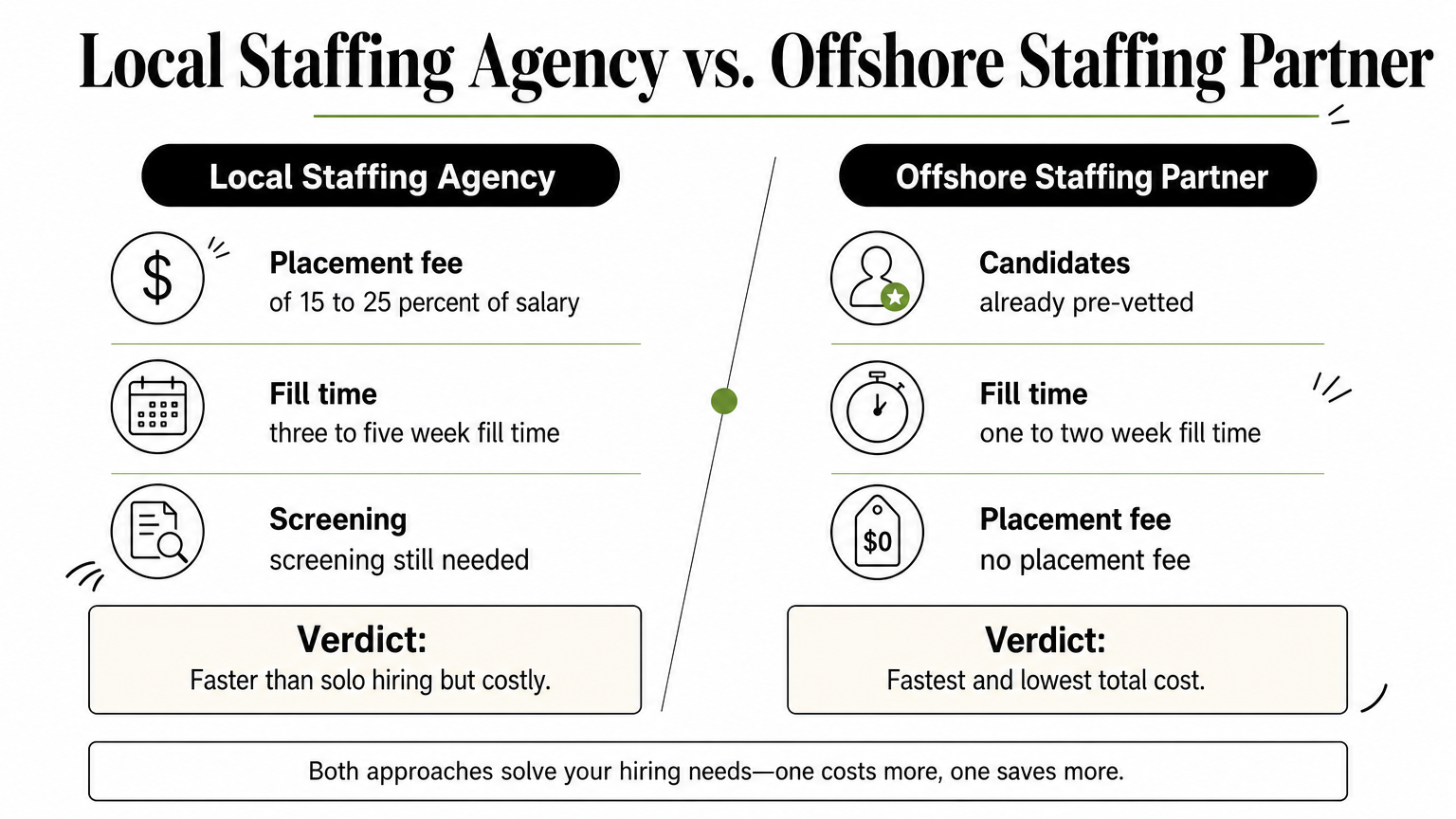
Agencies that focus specifically on software roles filter out a lot of that noise before you see it, since they already maintain relationships with active candidates and understand the difference between a React developer and someone who watched a few tutorials. Local tech staffing agencies charge a placement fee, often 15 to 25 percent of first-year salary, which adds real cost even though it saves screening time. Staffing agencies shine when you need one strong candidate fast and don't mind paying a premium for the shortcut.
Freelance marketplaces
Platforms built for freelance work give you access to independent developers fast, sometimes within days, but quality varies wildly and few freelancers commit to the kind of long-term, full-time role most product teams actually need. Freelance marketplaces suit short projects or a temporary bridge, not the dedicated ownership a growing codebase requires.
Offshore staffing partners
Working with an offshore staffing company for US businesses flips the sourcing problem entirely, since the vetting already happened before your job description existed. GlobalEmployees keeps a bench of over 2,800 vetted candidates across development roles, so instead of posting and waiting, you review resumes of developers who already passed technical screening, then interview only the ones who match your stack.
The best sourcing channel is the one that hands you qualified candidates, not the one that hands you the most applications.
Here's how the main channels stack up on speed and screening effort:
| Sourcing channel | Time to candidates | Screening burden on you |
|---|---|---|
| General job boards | 2-4 weeks | High, hundreds of resumes |
| Local staffing agency | 1-3 weeks | Low, but costly fees |
| Freelance marketplace | Days | Medium, inconsistent quality |
| Offshore staffing partner | Days | Minimal, pre-vetted shortlist |
Most companies end up combining channels: job boards for junior roles they can afford to screen slowly, and a staffing partner for the senior full stack hire they need running by next month. The right mix depends on how much internal time you have to burn on screening versus how quickly your roadmap needs a working developer in the seat.
What full stack developer recruitment really costs
Most founders budget for a salary and stop there, but the real cost of full stack developer recruitment includes far more than the number on the offer letter. Recruiter fees, lost productivity during the search, onboarding time, and the cost of a bad hire all stack on top of base pay. Add those together and a single US-based full stack hire often runs 20 to 30 percent more than the salary alone suggests, which is clearest in a side-by-side salary breakdown for India and the US.
The hidden costs beyond salary
Every week a seat sits empty costs you in missed deadlines and overworked teammates covering the gap. Payroll taxes, benefits, workers' comp, and equipment add another chunk on top of base salary, typically 15 to 20 percent for a US employee. Onboarding time matters too, since a new hire rarely ships production code in week one, and that ramp-up period is unpaid productivity you're still funding. Total cost of hire almost always exceeds what a job posting implies, which is why so many companies underestimate their recruitment budget until the invoices start arriving, and why a total cost of ownership comparison is worth running before you post.
Recruitment fees and agency costs
If you route your search through a local staffing agency, expect a placement fee of 15 to 25 percent of first-year salary, due whether the hire stays six months or six years. Job board postings and applicant tracking software carry smaller but recurring costs, and an in-house recruiter's time is a real expense even if it doesn't show up as a separate line item. None of these fees guarantee a faster or better hire, they just shift who does the screening work. Recruitment costs climb fastest when a hire doesn't work out and you have to restart the entire search from scratch.
The true cost of a bad hire is never the salary you paid, it's the months you lost waiting to notice the mistake.
Comparing the full cost by hiring model
Laying out the numbers side by side makes the gap obvious. Here's what a mid-level full stack hire actually costs once you factor in fees, overhead, and typical ramp time:
| Hiring model | Base monthly cost | Added fees/overhead | Realistic total monthly cost | |---|---|---| | Traditional US hire | $8,000-$11,000 | 15-20% payroll/benefits | $9,200-$13,200 | | Local staffing agency | $9,000-$12,000 | 15-25% placement fee (one-time) | $9,000-$12,000 + fee | | Freelance marketplace | $4,000-$7,000 | Variable, inconsistent quality | $4,000-$8,000 | | Offshore dedicated hire | $1,090-$2,500 | Zero setup, zero HR cost | $1,090-$2,500 |
Offshore staffing wins on the total cost line because the model eliminates the fees that quietly inflate every other option. GlobalEmployees builds its pricing around a single monthly rate with zero setup cost and zero HR cost, no recruiter percentage, no benefits administration, no equipment purchase. Small businesses evaluating full stack developer recruitment against a tight budget usually find this the deciding factor once they see the real math laid out instead of just the base salary comparison.
In-house, freelance, or offshore: choosing the right model
Choosing a hiring model isn't a one-size-fits-all decision, and the right answer depends on how long you need the role filled, how tightly you control the budget, and how much oversight you want day to day. Full stack developer recruitment through an in-house process, a freelance marketplace, or an offshore staffing partner each solves a different problem, as a comparison of dedicated staffing, freelancers, and agencies makes clear, and picking the wrong one is how companies end up rehiring the same role twice in a year. Match the model to your actual constraints instead of defaulting to whatever your last company did.
When in-house hiring makes sense
Building a local, in-house team still makes sense when you need someone physically present, whether for client-facing work, tight security requirements, or a culture that genuinely depends on in-person collaboration. In-house recruitment gives you the most direct control over management and team integration, but it also comes with the highest cost and the slowest timeline, since you're competing for the same shrinking pool of local candidates everyone else wants. Companies with deep pockets and a long hiring runway can absorb that cost. Companies without either usually can't.
When freelance hiring makes sense
Freelancers solve a narrower problem well: short projects, temporary coverage during a busy stretch, or a proof of concept that doesn't need a permanent owner. A freelance developer can start fast and disappear just as fast, which is exactly the flexibility you want for a two-month sprint and exactly the liability you don't want for a product that needs a consistent hand on the codebase for years, a tradeoff worth weighing when you choose between a freelancer and a dedicated remote developer. Quality also swings widely from one freelancer to the next, so budget extra time for vetting even on a marketplace that claims to pre-screen talent.
When offshore hiring makes sense
Offshore staffing fits the gap between those two extremes: you get a full-time, dedicated employee without the local salary premium or the freelancer's lack of commitment. GlobalEmployees structures its dedicated hiring model so you can build a dedicated offshore team in India with a full-time developer working only for you, with zero setup cost and no long-term contract locking you in if your needs change. That combination, full commitment without full-time local overhead, is why so many growing teams treat offshore hiring as the default rather than the fallback, and why India remains the top place to hire remote developers.
The right hiring model isn't the cheapest one or the fastest one, it's the one that matches how long you actually need the role filled.
Here's a quick way to match your situation to a model:
| Your situation | Best-fit model |
|---|---|
| Need someone on-site, client-facing, or in a regulated role | In-house |
| Short project, proof of concept, or temporary coverage | Freelance |
| Ongoing, full-time need with a tight budget | Offshore dedicated hire |
| Scaling a team up or down with short notice | Offshore dedicated hire |
Small teams evaluating full stack developer recruitment against a real budget usually land on offshore once they compare the total monthly cost against local salaries and agency fees, but the right call still depends on how much control and physical presence your specific product actually requires.
Common hiring mistakes that slow down recruitment
Even companies with a clear budget and a solid job description can stall out because of avoidable mistakes baked into the process itself. Full stack developer recruitment fails less often because of a talent shortage and more often because of process errors that repeat hire after hire. Spotting these patterns early saves you from restarting the search a few months in.
Writing a job description that filters out the right people
Generic postings copied from a template attract generic applicants, and vague requirements like "experience with modern frameworks" waste everyone's time. Job description clarity determines who applies in the first place, so name your actual stack, your team size, and what a typical week looks like. A posting that reads like every other posting on the board gets buried under a hundred others that say the same thing.
Running interviews that test the wrong things
Too many hiring loops lean on whiteboard trivia or generic behavioral questions instead of real problems tied to your codebase. This mistake costs you twice: strong candidates lose patience with irrelevant tests, and weak candidates slip through because they memorized the right answers. Interview design should mirror the actual work, a short, scoped coding exercise beats three rounds of abstract questions every time.
A hiring process that takes two months to fill a role you needed filled last month isn't a process, it's a bottleneck.
Letting the process drag between steps
Slow scheduling, delayed feedback, and offers that sit unsent for a week are the fastest way to lose a strong full stack candidate to a competing offer. Recruitment timelines matter more than most hiring managers admit, especially in markets like Los Angeles where good candidates rarely stay available more than two weeks. Set internal deadlines for every stage, resume review within 48 hours, feedback within a day of the interview, and hold the team to them.
Skipping reference and portfolio checks
Some teams move so fast to fill a seat that they skip verifying past work entirely, then discover months later that the candidate's resume claims didn't match their actual output. A quick look at a GitHub history or a real project walkthrough catches this before it becomes a costly mistake. Here's a short list of checks that take under an hour but prevent most bad hires:
- Review actual code samples or a live portfolio, not just a resume list of technologies
- Confirm the notice period and start date match your timeline before extending an offer
- Ask one former manager or teammate about how the candidate handled a missed deadline
- Verify remote work experience if the role isn't in-office, since not everyone thrives without daily supervision
Overlooking any one of these rarely sinks a hire by itself, but stacking two or three together is how companies end up rehiring the same role within a year. GlobalEmployees builds these checks into its vetting before a candidate ever reaches your shortlist, which is part of why clients skip most of the mistakes on this list entirely.
Interview questions that reveal real full stack skill
Getting past the resume is only half the job in full stack developer recruitment. The questions you ask in the interview room decide whether you hire someone who can actually ship a feature or someone who only sounds like they can. Skip the generic "tell me about yourself" filler and go straight to questions that force a candidate to explain their reasoning, not just recite a definition, and structure the loop around a remote developer interview checklist.
Questions that expose front-end depth
Start with something concrete instead of abstract. Asking a candidate to walk through how they'd optimize a slow-loading page tells you more than asking them to define the virtual DOM from memory. Practical scenarios force candidates to think out loud, which is exactly what you need them doing on your team every day. A few that consistently separate real experience from memorized answers:
- "Walk me through how you'd debug a component that re-renders too often."
- "How would you handle state that needs to persist across page refreshes?"
- "What's your approach to making a form accessible for screen readers?"
Questions that expose back-end depth
Move to the server side once you've tested the front end, and keep the format the same: real scenarios over textbook definitions. A candidate who can explain how they'd design an API that handles a sudden traffic spike is showing you judgment, not just syntax knowledge. Database reasoning is where weak candidates usually stumble, since they can describe a table structure but can't explain why they'd choose one indexing strategy over another. Try these in the interview:
- "How would you design a database schema for a feature with one-to-many relationships?"
- "What would you check first if an API endpoint suddenly got slow in production?"
- "How do you decide when to use a relational database versus a NoSQL option?"
A candidate who can explain their reasoning out loud will always beat one who just gives you the right answer.
Questions that test system thinking
Finish with a question that spans the whole stack, since that's the actual job. Ask the candidate to describe how they'd build a feature from the database up to the button a user clicks, including where they'd put validation and how they'd handle an error at each layer. System-level thinking is what separates a true full stack developer from someone who's comfortable in two disconnected skill sets. Pair this with a short question about a real production incident they've handled, since how someone reacts under pressure tells you more about day-to-day reliability than any coding puzzle.
None of these questions require a whiteboard or a trick answer, and that's the point. Full stack developer recruitment goes faster and produces better hires when the interview mirrors the actual work instead of testing memorization. GlobalEmployees runs candidates through exactly this kind of scenario-based technical screening before they ever reach your shortlist, so by the time you're asking these questions yourself, you're confirming skill rather than discovering it for the first time.
Finding the right full stack developer for your team
Getting full stack developer recruitment right comes down to matching the model to your actual constraints, not defaulting to whatever process your last company used. A clear job description, a screening process that tests real skill, and a fast offer will beat a slow, generic hiring loop every time, whether you're building in-house or looking overseas. Los Angeles companies especially feel this pressure, since strong candidates rarely stay on the market more than a week or two before someone else scoops them up.
If you're tired of watching good candidates disappear while your internal process grinds through week six, skip the grind entirely. Talk to GlobalEmployees about your requirement, browse pre-vetted resumes for free, and hire a full stack developer in India from $1,290 a month with a start date in days instead of months.
Need to hire dedicated remote talent?
Tell us the role, experience, and AI skills your team needs.
Hire Talent Now