Freelance WordPress Developer: Costs, Platforms, and Tips
Hiring a freelancer wordpress developer sounds simple until you post a job and get fifty proposals ranging from $15 to $150 an hour, with no clear way to tell who actually delivers. You need a site built, fixed, or maintained, and you want to know what it should cost, where to find someone reliable, and how to avoid the ghosting and scope creep that plague freelance marketplaces.
This guide breaks down what a wordpress developer freelance hire actually costs in 2026, which platforms consistently produce vetted talent versus a pile of unqualified bids, and how to write a job post that filters out the wrong candidates before you waste time interviewing them. We also cover the flip side: if you're trying to build a career as a wordpress freelance developer, you'll get practical tips on pricing your work and landing steady clients.
We'll also walk through when freelance platforms make sense and when a dedicated full-time offshore developer is the smarter, more predictable option for ongoing WordPress work, since not every project fits a project-by-project freelance model.”
Why businesses hire freelance WordPress developers
WordPress runs over 43% of all websites, according to W3Techs, which means the pool of businesses needing WordPress work never shrinks. Most of them don't need a full-time employee for it. They need someone to fix a broken plugin, build a landing page, migrate a site, or troubleshoot a speed issue, and then they need that person to disappear until the next project comes up. A freelancer wordpress developer fits that pattern because you pay for the work done, not for a seat at a desk.
Small businesses lean on freelancers because hiring a full-time developer for occasional work doesn't pencil out. A local retailer that needs quarterly updates to a WooCommerce store isn't going to justify a $70,000 salary plus benefits for maybe 40 hours of actual work a year. Project-based pricing solves that math. You hire, you pay, you move on. Agencies do the same thing when they're overbooked and need overflow capacity without adding permanent headcount.
Common project types
Freelance WordPress work tends to fall into a handful of recurring categories, and knowing which one you're in shapes both the cost and the type of developer you should be looking for.
| Project type | Typical scope | Typical timeline |
|---|---|---|
| New site build | Custom theme or page builder setup, 5-15 pages | 2-6 weeks |
| Plugin customization | Modify existing plugin behavior or fix conflicts | 3-10 days |
| Site migration | Move hosts, merge sites, or switch page builders | 1-2 weeks |
| Performance/speed fixes | Caching, image optimization, database cleanup | 2-5 days |
| Security cleanup | Malware removal, hardening, ongoing monitoring | 1-3 days initial, then recurring |
| WooCommerce setup | Store configuration, payment gateways, shipping rules | 2-4 weeks |
Someone running a small agency will often bring in a wordpress developer freelance specialist for the migration row above, since it's specialized enough that keeping that skill in-house year-round isn't worth it, but common enough that they need it several times a year.
Access to niche skills without a hiring cycle
Beyond cost, businesses hire freelancers because WordPress isn't one skill, it's a dozen adjacent ones. A developer who's great at custom Gutenberg blocks might have never touched WooCommerce's tax logic, which is why finding WooCommerce talent is its own search. Someone who can debug a slow database query might not know the first thing about ACF field groups or headless WordPress setups with a React frontend. Running a traditional hiring process for every one of these narrow needs would take months and cost thousands in recruiter fees before you even get someone in a seat.
Freelance platforms shortcut that. You post the specific problem, filter by portfolio and reviews, and have someone working within days instead of weeks. That speed matters most when something is actively broken, like a site that's down or a checkout flow that's failing during a sales push. Nobody wants to run a six-week hiring process while their online store bleeds revenue.
The real reason businesses turn to freelancers isn't just cost, it's getting a narrow, specific skill fast without committing to a permanent role.
Testing the waters before committing to a bigger build
Owners who aren't sure their WordPress project will even work out often start with a freelancer as a low-commitment test. Maybe you're not sure if a membership site idea will attract paying users, or you want to see if a WooCommerce store is worth the investment before building out a full catalog. A freelancer lets you build a minimum viable version, see if it gets traction, and only then decide whether to invest in a bigger, more permanent development setup.
That same logic applies to agencies vetting a new market. If a US-based agency wants to test offering WordPress services to a new client vertical, contracting a freelancer for the first project avoids the risk of hiring someone permanently for work that might not repeat.
The tradeoff businesses eventually run into
Though freelancers solve the immediate problem, most business owners eventually hit a ceiling with the model. Once WordPress work stops being occasional and becomes constant, weekly plugin updates, ongoing feature requests, content changes, security patches, the freelance relationship starts to strain. Availability becomes inconsistent, pricing creeps up as the relationship matures, and you're often competing with the freelancer's other five clients for their attention that week.
Understanding why businesses hire freelancers in the first place also tells you when to stop. If your WordPress needs are genuinely occasional and well-defined, a freelancer remains the right call. If you're finding yourself hiring the same type of help every month, that's usually the signal to look at a more predictable staffing model, which we'll get into later in this guide.
How to hire a freelance WordPress developer
Hiring a freelancer wordpress developer well comes down to sequencing: define the work before you post it, screen for proof rather than promises, and lock the terms before any code gets touched. Skip any of those steps and you end up with the classic freelance horror story, a developer who disappears halfway through, or a "quick fix" that quietly breaks three other things on the site.

Define the scope before you post anything
Start by writing down exactly what "done" looks like. Not "fix the site" but "resolve the 3-second load time on the homepage to under 1 second, without breaking the existing WooCommerce checkout." A clear scope is the single biggest predictor of whether a freelance project finishes on budget. Vague job posts attract vague proposals, and vague proposals turn into scope creep the moment work actually starts.
Write a job post that filters candidates for you
Your job post should do the screening work before you ever open a message thread. Include the WordPress version, active plugins, hosting environment, and a specific example of the bug or feature you need. Ask applicants to answer one technical question in their proposal, something only someone who actually read the post would answer correctly. This alone cuts a fifty-proposal pile down to a manageable shortlist, since most low-effort bidders won't bother.
Vet before you hire, not after
A portfolio link and a five-star rating tell you almost nothing about whether someone can handle your specific problem. Before hiring, run candidates through a short checklist, and if you want a deeper script, use these questions for screening a remote developer:
- Ask for a live site they built or maintained, not just screenshots, so you can inspect the actual code in browser dev tools
- Request a short paid trial task, something small and real, like fixing one minor bug, rather than a free spec test
- Check their WordPress-specific experience, not generic PHP work, since theme conventions and hooks are their own skill set
- Verify communication speed during the interview stage, since slow replies before you've paid are a preview of slow replies after
- Ask what they'd do differently on a past project, which reveals more honest self-assessment than a highlight reel
A five-star rating tells you a freelancer finished something for someone else; it doesn't tell you they can finish your project.
Lock the terms before work starts
Once you've picked someone, put the agreement in writing even if the platform has its own contract layer. Specify deliverables, revision limits, a fixed price or hourly cap, and who owns the code and any premium plugin licenses once the project ends. If the relationship is going to be ongoing rather than one-off, agree on a monthly retainer rate up front rather than renegotiating hourly rates every few weeks.
When hiring feels like more work than the project itself
Some businesses go through this entire process and realize the overhead of screening, testing, and contracting eats up more time than the actual WordPress fix would have taken. If that's you, and the work keeps recurring rather than being a one-time job, it's worth comparing this hiring cycle against bringing on a dedicated offshore developer through an offshore staffing company for US and European businesses, where the vetting, contracts, and infrastructure are already handled before you ever see a candidate. We'll compare the two models directly later in this guide.
How much does a freelance WordPress developer cost
Pricing for a freelancer wordpress developer swings wildly depending on where they're based, how they price their work, and what kind of project you're hiring for. A simple rate comparison across regions and pricing models gives you a realistic starting point before you start collecting quotes.
Typical rates by experience and region
Geography still drives most of the price difference, even on global platforms where everyone competes for the same job posts. A developer in the US or UK typically charges more not because the work is better, but because their cost of living and market rates are higher, a gap you can see clearly in this India versus US developer pay comparison.
| Experience level / region | Hourly rate (USD) | Typical project minimum |
|---|---|---|
| Entry-level, South Asia | $10-$25 | $100-$300 |
| Mid-level, South Asia | $20-$40 | $300-$800 |
| Entry-level, US/UK/EU | $30-$60 | $500-$1,200 |
| Senior, US/UK/EU | $60-$150+ | $1,500-$5,000+ |
| Specialized (headless, enterprise WooCommerce) | $80-$200+ | $2,000+ |
Numbers like these explain why a job post can attract a $15/hour bid and a $150/hour bid for what looks like the same task on paper, and why so many buyers end up hiring a WordPress developer in India once they compare the math. The lower bid isn't necessarily worse, and the higher bid isn't automatically better; it depends on what you're actually buying.
Hourly, fixed-price, or retainer
Once you know the rough rate range, the next decision is how you want to pay. Each pricing model fits a different kind of project, and picking the wrong one is where most disputes start.
- Hourly billing works best for open-ended debugging or maintenance where the scope genuinely can't be pinned down in advance
- Fixed-price contracts fit well-defined builds, like a landing page or a plugin install, where both sides agree on deliverables up front
- Monthly retainers make sense once the relationship becomes ongoing, since they lock in availability and often come with a discounted effective rate
The cheapest hourly rate rarely produces the cheapest total cost once you factor in revisions, delays, and rework.
Retainers deserve a second look here because they're the pricing model most businesses skip until they've already been burned by hourly billing creep. A developer with no fixed monthly commitment has less incentive to prioritize your tickets over a higher-paying client's, and hourly rates on ongoing work tend to drift upward as the relationship continues.
What actually drives the price beyond the hourly rate
Several factors push a quote up or down regardless of the developer's base rate, and it helps to know which ones are legitimate versus which ones are just markup. Custom functionality (a bespoke plugin instead of an off-the-shelf one) costs more than configuration work. Tight deadlines add a rush premium, often 20-50% on top of the standard quote. Ongoing communication overhead, like daily standups on a project that doesn't need them, also inflates the effective rate even if the quoted number looks reasonable.
Setting a realistic budget before you post the job saves you from both extremes: overpaying an inflated bid because you don't know what's fair, or underpaying and getting rushed, low-quality work that costs more to fix later. For comparison, a full-time dedicated WordPress developer through a staffing model like GlobalEmployees starts around $1,090 a month with no hourly billing at all, which is worth keeping in mind once you start doing the math on recurring freelance costs.
Where to find freelance WordPress developers
Finding a freelancer wordpress developer isn't the hard part, dozens of platforms will hand you a list of profiles in seconds. The hard part is knowing which platform's vetting process actually means something versus which one just lets anyone sign up and bid on your job, a problem that looks much the same when you're figuring out where to hire PHP developers. Where you look determines the baseline quality of who applies before you've screened a single candidate yourself.
General freelance marketplaces
Broad platforms like Upwork and Fiverr carry the largest volume of WordPress talent simply because they cover every skill under the sun, not just development. That volume cuts both ways. You'll get proposals within minutes of posting, but you'll also wade through bids from people who copy-pasted a template response without reading your job description. Ratings and reviews on these platforms help, but they're gameable, a developer can pad their profile with small, easy five-star jobs before bidding on something they're not actually qualified for. Treat the star rating as a starting filter, not a hiring decision.
Specialized WordPress-only platforms
Smaller, niche platforms that focus only on WordPress or only on developers tend to produce a tighter applicant pool. Codeable, for instance, screens developers before they're allowed onto the platform at all, which means you skip a chunk of the unqualified-bid problem you'd hit on a general marketplace. The tradeoff is smaller supply and higher average rates, since the platform's vetting cost gets passed on to you. If you need someone fast for a narrow WordPress task and don't want to screen fifty proposals yourself, this is usually worth the premium.
A platform's vetting process is worth more to you than its size; a smaller pool of screened developers beats a huge pool of unverified ones.
Comparing where to look
| Source | Typical vetting | Rate level | Best for |
|---|---|---|---|
| Upwork/Fiverr | Self-reported, review-based | Wide range, low to high | One-off tasks, budget flexibility |
| Codeable and similar niche platforms | Pre-screened before joining | Mid to high | Complex builds, less time to vet yourself |
| WordPress.org forums/community | None, informal | Often free or low-cost | Small bug fixes, community goodwill |
| Referrals from agencies or peers | Informal but reputation-backed | Mid to high | Ongoing relationships, higher trust |
| Staffing partners (offshore dedicated hires) | Formally vetted before you see a candidate | Fixed monthly, often lower total cost | Recurring or full-time WordPress work |
Community forums and direct referrals
The official WordPress.org support forums and Slack communities like Advanced WordPress are underused sources for finding a wordpress freelance developer, especially for small, specific fixes. Developers active in these spaces are often demonstrating real expertise in public, which is a stronger signal than a polished portfolio page. Asking your network directly, other agency owners, developers you've worked with before, or your hosting provider's support team, often surfaces someone reliable faster than any marketplace search, since the recommendation already carries a track record attached to it.
When the search itself becomes the bottleneck
If you're spending more hours searching, screening, and comparing bids than the project itself would take to complete, the platform search has become its own cost. That's usually the point where businesses stop treating every hire as a fresh search and start looking at IT staff augmentation companies in the USA that hand them a pre-vetted candidate directly, which we'll unpack next when comparing freelancers against dedicated offshore developers.
Freelancer or dedicated offshore developer: which fits you
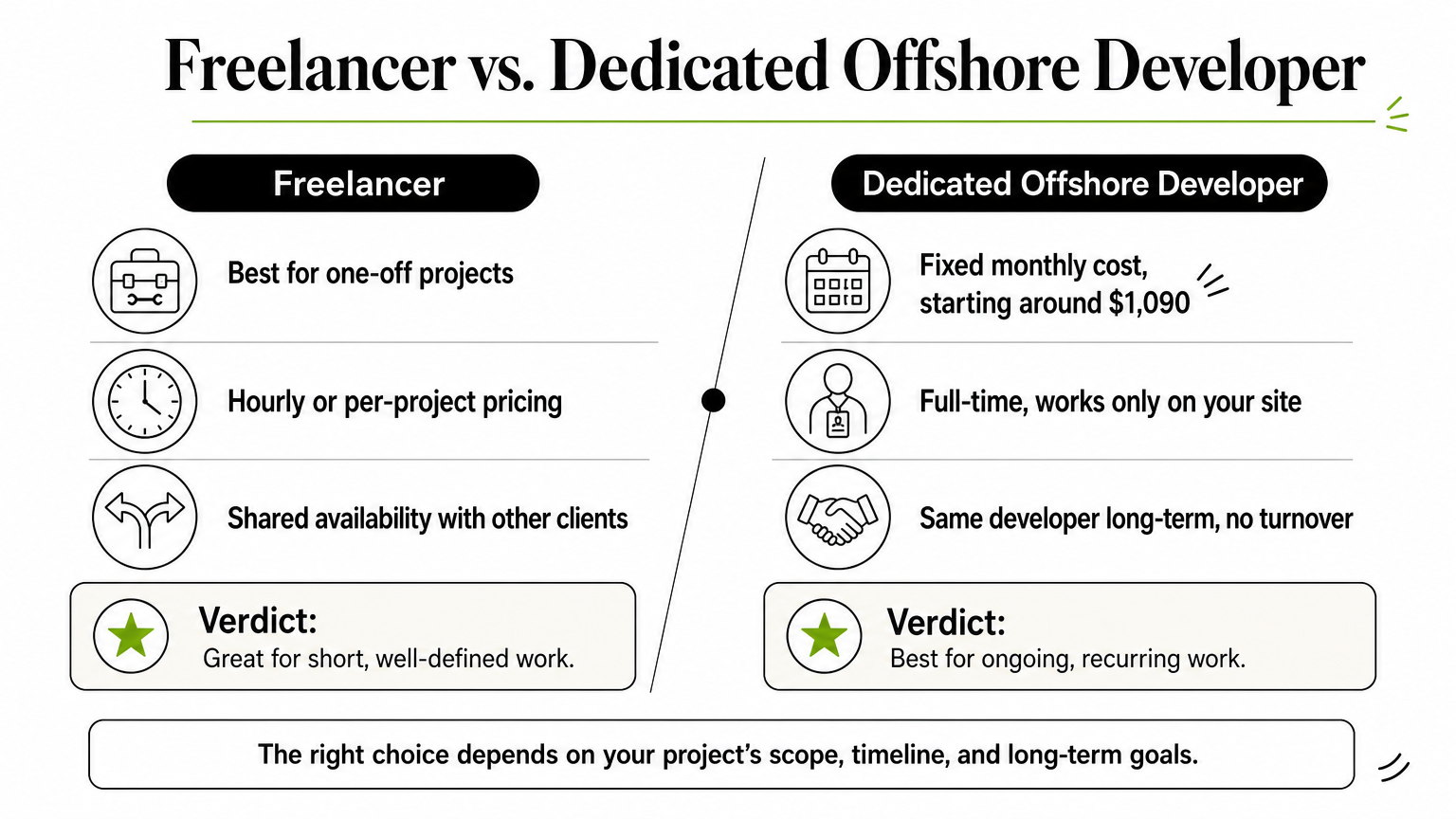
Deciding between a freelancer wordpress developer and a dedicated offshore hire comes down to one question: is the work occasional or ongoing, the same question behind choosing between short-project and long-term remote help? Everything else, cost, communication, reliability, flows from that answer, and the same tradeoffs show up when you weigh staffing against freelance and agency models. Get this call wrong and you either overpay a freelancer for recurring work or lock yourself into a full-time hire for a project that needed three days of effort.
When a freelancer still makes sense
Business owners with a single, well-defined project, a site rebuild, a one-time migration, a plugin conflict, are almost always better off with a freelancer. You don't need someone on payroll for a task that ends in two weeks. Paying project-by-project keeps the relationship simple and lets you walk away clean once the work is done. If your WordPress needs genuinely stop after the launch, don't overthink this; hire the freelancer and move on.
When a dedicated offshore developer wins
Once WordPress work becomes a weekly rhythm rather than a one-off event, the freelance model starts working against you. You're re-negotiating rates, re-explaining context to a new hire when someone drops off, and competing for attention with the freelancer's other clients. A dedicated offshore developer through a staffing partner solves this by giving you one person, full-time, working only on your site, for a fixed monthly cost instead of an hourly meter that never stops running.
If you're re-hiring for the same kind of work every month, you don't have a freelance need anymore, you have a staffing need.
Side-by-side comparison
| Factor | Freelancer | Dedicated offshore developer |
|---|---|---|
| Best for | One-off projects | Ongoing, recurring work |
| Pricing | Hourly or per-project, variable | Fixed monthly, starting around $1,090 |
| Availability | Shared with other clients | Full-time, dedicated to you |
| Continuity | Risk of turnover between projects | Same developer long-term |
| Setup/HR overhead | None, but you manage the relationship | Handled by the staffing partner |
| Contract flexibility | Project-based, easy to end | No long-term lock-in, scalable up or down |
The decision test
A simple gut check settles most of these calls before you spend a week weighing options, and these signs your business is ready for a dedicated remote team cover the rest. Run through it honestly:
- Will this work repeat monthly or more often? If yes, lean toward a dedicated hire.
- Do you need the same person to retain context over time? Freelancers rotate; dedicated hires don't.
- Is your budget better spent as a predictable monthly line item or a variable hourly one? Fixed costs are easier to plan around.
- Do you have the bandwidth to keep screening and re-hiring freelancers every few months? If not, that overhead alone often justifies a switch.
GlobalEmployees exists specifically for businesses that land on the second side of that test. Instead of running your own vetting process every time you need WordPress help, you get a pre-vetted, full-time WordPress developer with no setup cost, no HR overhead, and no long-term contract forcing your hand. You still get the flexibility that made freelancing appealing in the first place, scale up, scale down, no strings, just without the constant re-hiring cycle that comes with project-based freelance work.
Risks of hiring a freelance WordPress developer
Even a well-run hiring process doesn't eliminate every risk. Freelance platforms connect you with strangers, and no amount of screening fully substitutes for the accountability that comes with an ongoing employment relationship. Knowing the specific failure modes ahead of time helps you build safeguards into your contract and workflow before something goes wrong, not after.
Ghosting mid-project
Ghosting is the risk every business owner who's hired a freelancer wordpress developer eventually hears about from someone else, right before it happens to them. A developer takes a deposit, does 30% of the work, then stops answering messages entirely. This happens more often on general marketplaces where accountability is thin and the freelancer has little reputation invested in the platform yet. Paying in milestones rather than a lump sum up front is the single best protection here, since it caps your exposure to whatever stage the project is actually at when contact drops.
Low code quality and technical debt
A site that looks finished on the surface can be hiding serious problems underneath. Hardcoded values instead of proper settings, missing sanitization on form inputs, or a custom function stuffed directly into a theme's functions.php file instead of a proper plugin, all pass a quick visual check while creating real technical debt. You often don't discover this until a future developer opens the codebase and has to untangle it, usually at a higher hourly cost than it would have taken to do it right the first time.
A site that works today can still be a liability tomorrow if nobody checks what's actually inside the code.
Security and data exposure
Granting a stranger admin access to your WordPress site and hosting account carries real risk, especially if you skip basic precautions. A careless or malicious freelancer can leave backdoors in the code, reuse weak credentials across projects, or access customer data they had no reason to touch. The WordPress.org security guidelines recommend limiting access scope and rotating credentials after any external contractor's work ends, a step many businesses skip simply because nobody remembers to do it once the invoice is paid.
Ownership and licensing disputes
Without a clear contract, who actually owns the code once the project ends isn't as obvious as it sounds. Some freelancers reuse premium plugin licenses across multiple clients without disclosing it, which can violate the plugin's terms and leave you without support if the license gets revoked. Others build custom functionality they consider their own intellectual property, then push back if you hire someone else to modify it later. Spelling out code and license ownership in the contract before work starts closes this gap entirely.
Reducing the risk without eliminating freelancers
None of this means freelancers are a bad option, it means the model has predictable failure points you can plan around:
- Use milestone payments tied to specific, verifiable deliverables rather than time elapsed
- Require staging environment access first, keeping the developer off the live production site until work is tested
- Keep your own backups independent of anything the freelancer sets up, so you're never dependent on their infrastructure
- Put IP and license ownership in writing before the first invoice, not after a dispute starts
Businesses that get burned by one or two of these risks are often the same ones who eventually move toward a dedicated offshore hire, where the staffing partner carries responsibility for vetting, security practices, and continuity, rather than leaving each safeguard up to the business to manage on its own project by project.
How to become a freelance WordPress developer
Some readers landed here not to hire, but to build a career as a wordpress freelance developer. The path isn't complicated, but it does require more than knowing how to install a theme. Clients pay for problem-solving, not button-clicking, and the developers who succeed treat freelancing like a small business from day one, not a side hustle they'll formalize later.
Build skills clients actually pay for
Start with PHP, since WordPress core and nearly every plugin is built on it, then layer in the WordPress-specific knowledge that separates a hobbyist from someone billable: the hook system (actions and filters), custom post types, the REST API, and at least one page builder or block editor workflow in depth. Skip trying to learn everything at once. Pick a lane, WooCommerce development, performance optimization, or custom theme builds, and go deep enough that you can speak to it confidently in an interview. Generalist skills get you low-ball gigs; a specialty gets you referrals.
Build a portfolio before you have paying clients
You don't need ten finished client projects to start applying. Build two or three real sites in a local WordPress development environment, even for a fictional business or a nonprofit willing to let you build for free, and document the technical decisions you made, not just the finished screenshots. A strong portfolio shows the problem, your approach, and the result, which reads very differently to a hiring business than a generic "I built this" gallery.
Clients don't hire the developer with the most finished sites; they hire the one who can explain why they built it that way.
Price your work like a business, not a favor
New freelancers routinely underprice themselves out of fear of losing the bid, then burn out working twice the hours for half the rate they need. Use the rate table from earlier in this guide as a floor, not a ceiling, and raise your rate every time you land three straight projects without pushback. A few practical rules worth following from the start:
- Never quote hourly on fixed-scope work; you'll eat the cost of every revision request
- Add a 15-20% buffer to any estimate for the inevitable scope questions that surface mid-project
- Require a deposit before starting, even a small one, since it filters out clients who were never serious
- Raise rates for existing clients annually, not just new ones, since inflation and your growing skill both justify it
Land your first clients without a track record
Early on, the fastest path to paid work is rarely the big marketplaces, where you're competing against hundreds of underpriced bids. Local business associations, WordPress meetups, and referrals from web designers who don't code themselves tend to convert faster because there's less price competition. Once you have two or three completed projects, general platforms like Upwork become more useful, since reviews start doing the selling for you.
Decide whether freelancing is the end goal
Worth saying plainly: not every skilled WordPress developer wants to run the business side of freelancing forever, chasing invoices, managing five client relationships at once, and never knowing if next month brings enough work. Some developers eventually prefer the stability of a full-time role, even a remote one, over the constant hustle of freelance client acquisition. If that's you down the road, staffing companies that place WordPress developers into dedicated, full-time roles with US and European businesses are worth exploring as an alternative career path, one that trades some independence for steady, predictable income.
Choosing the right WordPress talent model
A freelancer wordpress developer remains the right call for a single, well-scoped project: a rebuild, a migration, a plugin fix you need done and forgotten. Nothing about that changes once you know the platforms, the rates, and the vetting steps this guide walked through. What should change is how you treat recurring work. The moment you're re-hiring for the same tasks every month, re-explaining context to someone new, or absorbing rate creep on an hourly meter, you're paying freelance prices for what's really a staffing problem.
That's the gap a dedicated offshore hire closes. You get one developer, full-time, pre-vetted, without the setup cost or hiring cycle you'd otherwise repeat every few months. If your WordPress needs have outgrown the project-by-project model, it's worth comparing the numbers directly. Hire a WordPress developer through GlobalEmployees and see what a fixed monthly rate actually gets you.