Engineering Staff Augmentation: What It Is and How It Works
Engineering Staff Augmentation: What It Is and How It Works
Your roadmap is full, your sprint backlog keeps growing, and your team is already stretched. Hiring a senior engineer locally can take three to six months and cost far more than a salary. That gap between work and capacity is exactly where engineering staff augmentation comes in.
In short, it means adding external engineers to your existing team for as long as you need them. They work in your tools, join your standups, and answer to your managers. A vendor handles recruiting, payroll, and HR, so you only manage the work. This differs from traditional outsourcing, where a vendor owns the project and its delivery.
At GlobalEmployees, we have placed 950+ dedicated engineers and other professionals with US and European companies, so we have seen what works and what doesn't. This guide explains how staff augmentation works step by step, the main types, and best practices for onboarding and security. It also compares augmentation with outsourcing, so you can decide which model fits your team.
Why engineering staff augmentation matters
Most engineering leaders do not have a talent problem. They have a timing problem. Work arrives faster than a hiring pipeline can fill seats, and engineering staff augmentation closes that distance. Three benefits explain why so many teams use it.
It closes skill gaps faster than hiring
A typical local search for a senior engineer runs three to six months, from job post to first commit. Augmentation shortens that to a few weeks, because the vendor already holds a bench of pre-vetted candidates. At GlobalEmployees, you can review sample resumes for free before you commit to anything.
Specialized skills make the gap worse. You might need a DevOps engineer for a cloud migration, a mobile developer for one release, or a QA automation specialist before launch. Used well, staff augmentation engineering lets you buy the exact skill for the exact window, instead of hiring a generalist and hoping the fit works out.
It turns fixed headcount into flexible capacity
Permanent hires are a long bet. Product priorities change every quarter, but a salaried engineer stays on your payroll for years. Augmentation flips that math. You add people for a launch or a rewrite, then reduce the team when the work slows. With no long-term contracts at GlobalEmployees, scaling down takes short notice, not a restructuring.
| Factor | Permanent local hire | Augmented engineer |
|---|---|---|
| Time to start | Three to six months | Weeks |
| Commitment | Open-ended | Scale up or down on short notice |
| Recruiting, payroll, HR | Handled by you | Handled by the vendor |
| Laptops and software | Bought and configured by you | Provided by the vendor (at GlobalEmployees) |
| Daily management | You | You |
Notice the last row. You keep control of priorities, code review, and architecture decisions. Only the administrative load moves off your desk.
It lowers cost and risk
Cost is the other driver. A US engineer's real price includes benefits, equipment, recruiting fees, and management overhead on top of base salary. Dedicated engineers in India through GlobalEmployees start at $1,090 per month, with zero setup, HR, or infrastructure cost, so a small team can add a full-time developer without a six-figure commitment.
Risk drops too. You interview and approve every candidate, and a money-back guarantee or quick replacement covers you if the match is wrong. Undoing a bad permanent hire takes months of paperwork and morale damage. Undoing a bad augmented hire is a replacement request.
Augmentation lets you buy engineering capacity on your timeline, not the local labor market's.
How to use engineering staff augmentation step by step
Engineering staff augmentation is shorter to set up than most teams expect. It runs on four steps, and you stay in control of the decisions that matter at each one.
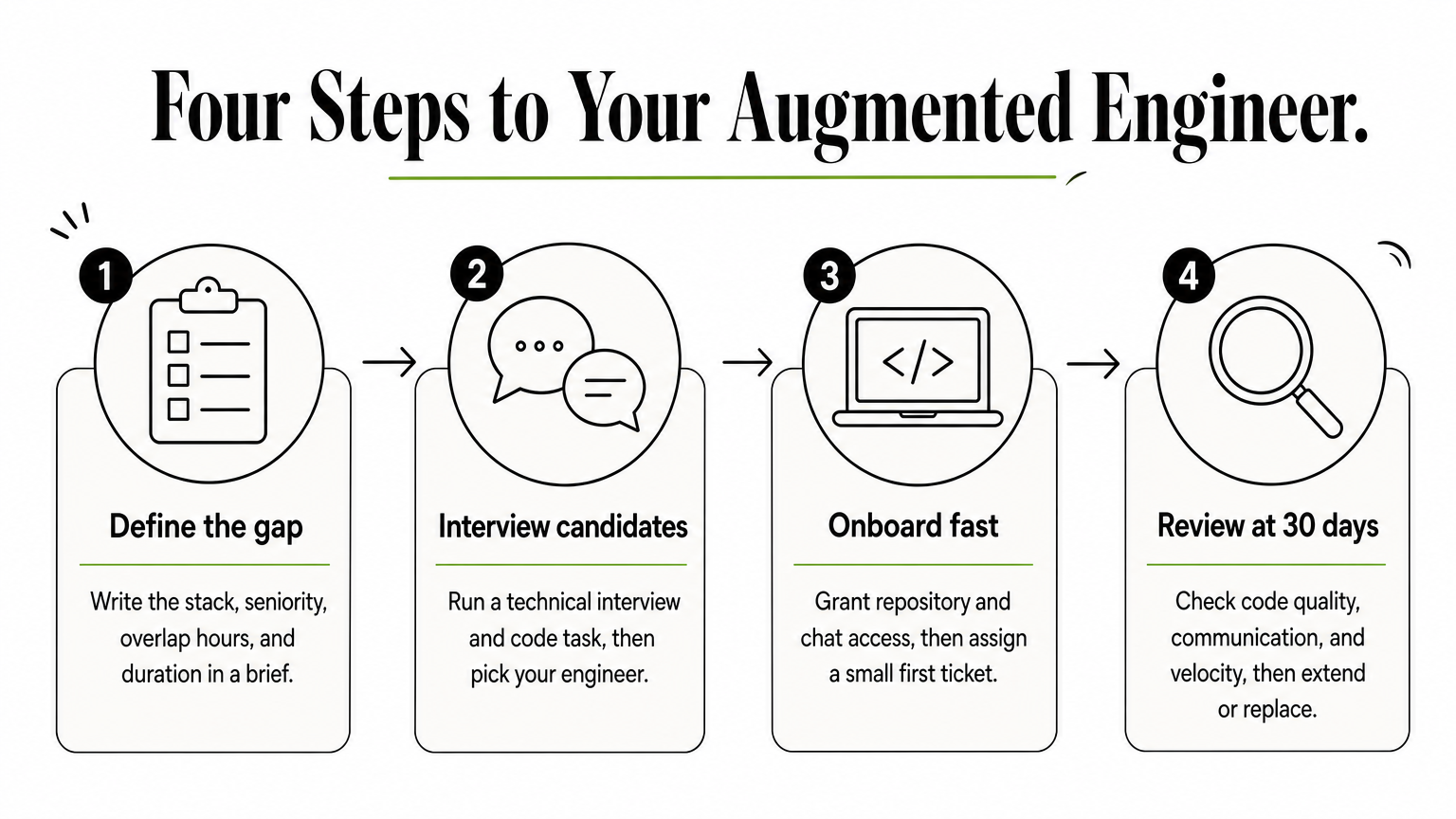
Step 1: Write down the gap and the requirements
Start with the work, not the job title. Define what needs to ship and by when, and note what your team lacks today. A vague request like "a backend developer" gets you vague candidates.
Include these details in your brief:
- Stack and seniority, such as Node.js at a senior level
- Hours of time zone overlap you need
- Expected duration and target start date
- Tools and workflows the engineer will join
Share that brief with your vendor. A specific brief produces a tight shortlist, and at GlobalEmployees it also gets you free sample resumes to review before you commit.
Step 2: Interview and assess candidates
Next, treat the shortlist like any hiring pipeline. Run a technical interview and a short code task or pair-programming session, then check how the person communicates. Interview every candidate yourself. The vendor's vetting screens for skills, but only you can judge fit with your codebase and team.
You write the brief and you pick the engineer, so the vendor never decides who joins your team.
Pick one candidate when you are satisfied. With GlobalEmployees, the process costs nothing until you select a candidate, so comparing two or three people carries no risk.
Step 3: Onboard and start work
Kick off with access, not paperwork. The vendor supplies the laptop, software, and secured setup. You grant repository access, the ticketing system, and chat. Assign a small first ticket in week one, so you see real output quickly.
Finally, review after 30 days. Check code quality, communication, and velocity against your brief. If the match is off, ask for a replacement. If it works, add more people or extend the engagement. Because you manage daily work directly, you will know within weeks whether the setup is right.
Types of engineering staff augmentation
Not every setup looks the same. Engineering staff augmentation splits along three lines: where the engineers sit, how long they stay, and how many you add. Choose each one on purpose, because together they set your cost and your management load.

By location: onshore, nearshore, and offshore
Location drives price and time zone overlap more than any other choice. The table shows the usual trade-off.
| Model | Where engineers sit | Cost | Overlap with your hours |
|---|---|---|---|
| Onshore | Your own country | Highest | Full |
| Nearshore | Nearby time zones | Medium | Mostly full |
| Offshore | Distant region, such as India | Lowest | Partial, planned |
Offshore works best when you want to cut cost sharply and can plan a few hours of daily overlap for standups and code review. Teams that need constant real-time pairing often lean nearshore instead.
By duration: short-term and long-term
Short-term augmentation covers a launch, a cloud migration, or a rewrite. You bring in specialists for a defined window, then scale back. It works best when the scope and end date are clear.
Long-term augmentation treats the engineer as a permanent extension of your team. They learn your codebase and domain, so their value grows each quarter. A common path is to start with one hire and extend once the engineer proves out. With no long-term contracts, nothing forces that decision early.
By scope: individual engineers and dedicated teams
Single-engineer augmentation fills one gap, such as a senior backend developer or a QA automation specialist. It is the lowest-risk way to test the model, and you can judge the results within a month.
Dedicated team augmentation adds three or more engineers, often with a lead, who work as a unit. Use it for a new product line or a large rewrite where one person cannot carry the load. GlobalEmployees offers both individual developer hires and fully dedicated teams, so you can start small and grow.
Match the type of augmentation to the shape of the work, not to whatever package a vendor offers first.
Staff augmentation vs. outsourcing and direct hiring
Engineering staff augmentation sits between two familiar options. The difference comes down to one question: who manages the daily work, and who owns the result?
Augmentation vs. outsourcing
Outsourcing means you hand a project to a vendor. The vendor picks the team, sets the process, and is accountable for delivery. You get a finished product, but you give up day-to-day visibility. Changing scope midway usually means a change order and a new quote.
Augmentation works the other way. The engineers sit inside your team, and you set priorities, review code, and change direction any sprint. The trade-off is responsibility. If the plan is wrong, that is on you, so you need a technical lead who can run the work.
Outsourcing buys a result, while augmentation buys capacity that you direct.
Augmentation vs. direct hiring
Direct hiring gives you the deepest commitment and the strongest long-term ownership of knowledge. It is also the slowest and least flexible route. You carry recruiting, payroll, equipment, and the cost of a bad hire, and scaling down is painful.
Augmented engineers answer to you just like employees do. The difference is that the vendor handles the administrative side, and you can adjust team size without a restructuring. Many teams use both, keeping core architects in-house and augmenting around them.
Side-by-side comparison
This table summarizes how the three models differ in practice.
| Factor | Outsourcing | Staff augmentation | Direct hiring |
|---|---|---|---|
| Daily management | Vendor | You | You |
| Owns delivery | Vendor | You | You |
| Time to start | Weeks to months, after scoping | Weeks | Three to six months |
| Flexibility | Fixed scope | High | Low |
| Best for | Well-defined projects | Skill gaps and scaling | Core, long-term roles |
If you can write a precise spec and do not want to manage anyone, outsourcing fits. If you know your product and need more hands, augmentation is the better match.
Best practices for managing augmented engineers
Engineering staff augmentation only pays off if you manage the engineers well. Treat them as full team members, and build three habits from the first day.
Onboard them like employees
Onboarding sets the tone for everything after it. Give each augmented engineer the same welcome a new hire gets, and share context, not just tickets. An engineer who understands your users makes better decisions without asking. Cover these items in week one:
- Product overview and who the users are
- Architecture notes, coding standards, and branching rules
- A named buddy on your team for questions
- One small, well-scoped first ticket
Treat augmented engineers as teammates, not as contractors working off to the side.
Communicate on a fixed rhythm and measure output
Daily rhythm beats ad hoc messages. Invite the engineer to your standups, sprint planning, and retros, and agree on a few hours of overlap each day for code review and questions. Write decisions down so offshore teammates are never waiting on a hallway conversation.
Judge results the way you judge your own staff. Track merged pull requests, review feedback, and sprint commitments met, not hours online. Hold a short one-on-one every week for the first month. Problems surface early, and you can ask for a replacement before they cost you a release.
Protect your code and data
Security belongs in the plan before the first login. Apply least privilege, which means each engineer gets only the repositories and systems the job requires. Our own setup at GlobalEmployees includes these controls, and you should ask any vendor for the same:

- NDAs signed before any access is granted
- VPN connections for all work on your systems
- Limited access scoped to the engineer's role
- Secured company laptops, so no code lives on personal devices
Review access every quarter and remove it the day an engagement ends.
When engineering staff augmentation is the right fit
Engineering staff augmentation is not right for every team. It works best when you have clear direction but too few hands, and it struggles when nobody is free to steer the work. The checks below show you where you land.
Signs it fits your team
Honestly assess your situation first. Augmentation is a strong fit when most of these statements are true:
- You have a funded backlog and a roadmap, but not enough engineers to ship it.
- A technical lead or senior engineer can review code and assign work.
- The gap is specific, such as QA automation, mobile, or DevOps.
- Local hiring would take too long or cost too much for the budget.
Consider a six-person SaaS team with a launch in ten weeks. Adding two developers and a QA specialist keeps the roadmap on schedule without permanent headcount. The founders keep deciding what gets built, and the extra capacity disappears from the budget when the launch is done.
Signs it does not fit
Skip augmentation if no one on your side can lead engineers. Added developers still need priorities, feedback, and code review. Without that, you pay for capacity that drifts.
Augmentation adds hands to a team that can direct them, but it does not replace the person who directs.
Outsourcing suits you better when you can write a precise spec and want a finished product without managing anyone. Direct hiring suits the core architects who will own your system for years. Many teams keep those roles in-house and use staff augmentation engineering for everything around them.
A quick test before you commit
Try one engineer for 30 days before building a larger team. Give that person a real ticket in week one, then review code quality, communication, and velocity against your brief. With no long-term contracts, the test costs you little, and you will know within a month whether the model works for your team.
Making the call for your team
Engineering staff augmentation comes down to one trade. You keep control of the work, and a vendor takes on the recruiting, payroll, and infrastructure burden. It fits when you have a roadmap, a technical lead, and a specific skill gap. If nobody on your side can direct engineers, outsourcing or direct hiring will serve you better.
Start small and let results decide. Pick one gap, write a clear brief, and run a 30-day trial with a single engineer. If code quality and communication hold up, add more people. If they don't, you ask for a replacement and lose very little. When you are ready to see candidates, you can hire software developers through GlobalEmployees, review free sample resumes, and pay nothing until you choose someone.