Business Process Outsourcing (BPO): What It Is and How It Works
You've probably heard the term thrown around in board meetings or LinkedIn posts, but you still need a straight answer: what does outsourcing a business process actually involve, and does it make sense for your company? The business outsourcing process covers everything from handing off payroll and customer support to building an entire offshore development team, and the details matter more than the buzzword.
At its core, business process outsourcing (BPO) means hiring an outside company or dedicated employee to handle a specific function of your business, like recruitment, bookkeeping, IT support, or marketing, so your internal team can focus on core work. It's not the same as hiring a freelancer for a one-off project. BPO typically means an ongoing relationship with dedicated staff or systems built around your workflows, often at a fraction of the cost of hiring locally.
In this article, we'll break down how BPO actually works, the different types of outsourcing services available, the real benefits and tradeoffs, and how businesses like yours can use offshore staffing in India to cut costs without sacrificing quality or control.
Why businesses turn to business process outsourcing
Cost is usually the first reason a founder even looks into the business outsourcing process, and it's the easiest to justify to a board or a co-founder. A full-time developer in California might cost you $130,000 a year once you add benefits, payroll taxes, and office space, a number worth setting against 2026 developer pay in India versus the US. The same skill level through a dedicated offshore hire in India can run under $15,000 a year. That gap doesn't shrink when you scale it across a five-person team, it multiplies.

Outsourcing a business process isn't about cutting corners, it's about paying only for the output you actually need.
Beyond the paycheck, hiring locally means you're also on the hook for recruiting time, HR administration, benefits management, and the software or hardware each employee needs to do their job, all of which belong in the total cost of owning an in-house team. Companies exploring outsourcing of business process work quickly realize they're not just saving on salary, they're eliminating an entire back-office cost center. That's why the business process outsourcing bpo industry has grown into a multi-billion-dollar sector globally, with providers handling everything from call centers to full IT departments for companies that would rather not build those functions in-house.
Access to talent you can't find locally
Talent scarcity pushes just as many companies toward BPO as cost does. If you're trying to fill a niche role, say, a WordPress developer with e-commerce experience, or a paid media specialist who understands Google Ads and Meta simultaneously, your local hiring pool might only have a handful of qualified candidates, and they're already employed. Outsourcing opens up a global bench of vetted professionals, which is exactly why it business process outsourcing has become so common among startups that can't compete with enterprise salaries for scarce technical skills.
Speed and flexibility without long-term risk
Speed matters too. Posting a job, screening resumes, running interviews, and onboarding a new hire can take six to eight weeks through a traditional process. A BPO partner that already maintains a pool of pre-vetted candidates can get you a working professional in days, not months. That flexibility extends to scaling down, as well. If a project ends or revenue dips, you're not stuck managing a layoff or severance package. Most business process outsourcing services operate without long-term contracts, so you can adjust headcount as fast as your business needs change.
Focusing on what actually grows your business
Finally, outsourcing frees up your leadership team's attention. Every hour your ops manager spends managing payroll compliance or troubleshooting a laptop issue is an hour not spent on product, sales, or strategy. GlobalEmployees, for example, handles the recruitment, payroll, and infrastructure side of hiring dedicated offshore employees, so your team manages the actual work while someone else manages the administrative weight behind it. That division of labor is often the real reason companies stick with outsourcing long after the initial cost savings pitch.
How business process outsourcing works, step by step
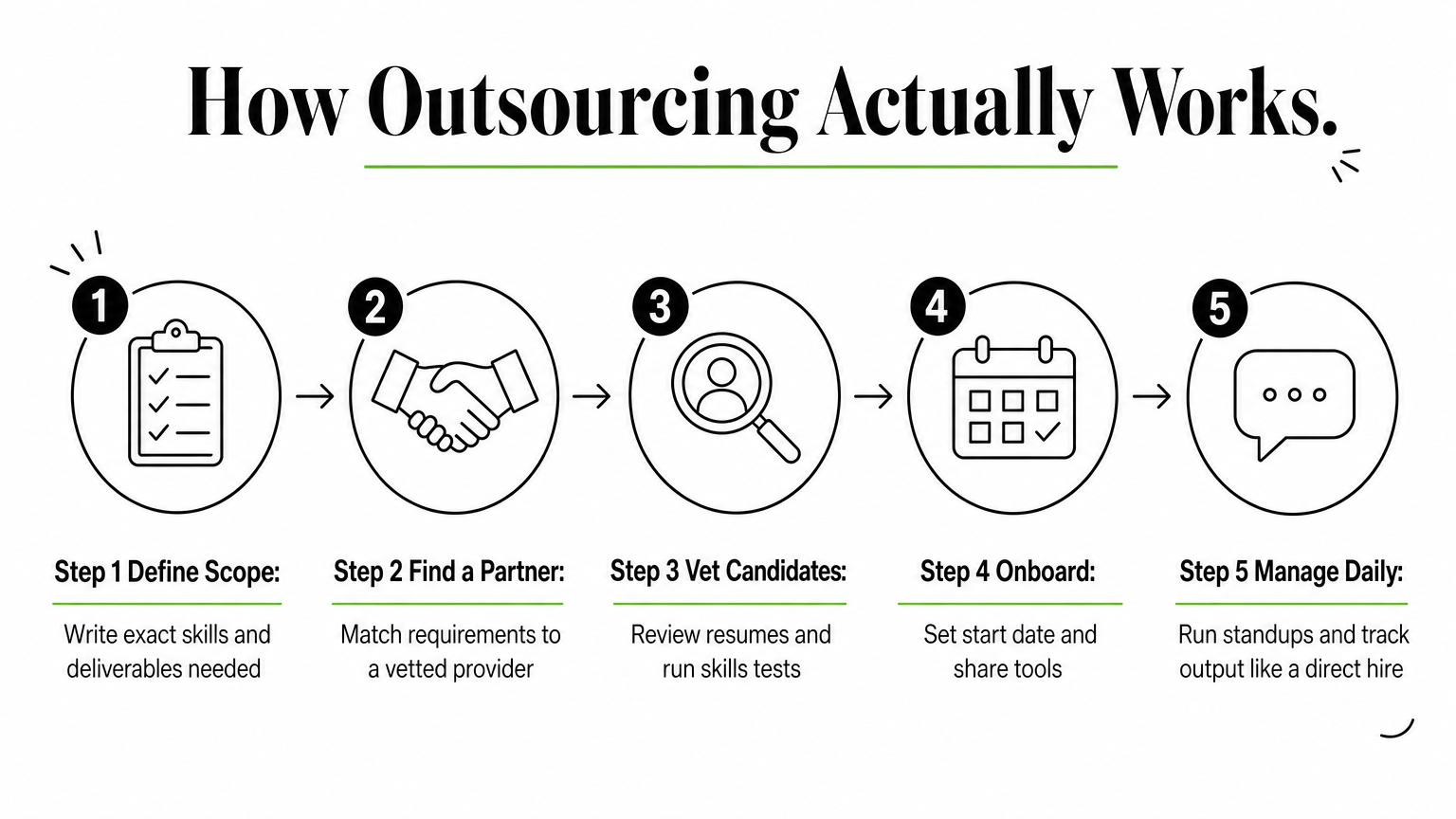
Every business process outsourcing process follows a similar pattern, whether you're hiring one developer or building a ten-person offshore team. You define the work, find a provider who can staff it, vet the actual people who'll do it, and then manage the relationship like you would any employee, just remotely. Skipping steps here is where most outsourcing arrangements go wrong, so it helps to know what each stage actually looks like before you sign anything.
Defining the scope and finding a partner
Start by writing down exactly what you need done, not just a job title. A vague request for "a marketer" gets you mismatched candidates; a request for "a paid media specialist who's run Google Ads budgets over $10k/month for e-commerce clients" gets you the right ones. Once scope is clear, you approach a provider and share those requirements directly.
Vetting, interviewing, and onboarding
This is where outsourcing business process decisions get made or broken. A serious provider gives you access to pre-screened resumes within 48 hours before you spend a minute interviewing, and lets you run your own technical or skills assessment on top of that.
A rushed vetting step is the single biggest reason outsourced hires disappoint their new employer.
A typical hiring sequence looks like this:
- Share your role requirements and must-have skills
- Review resumes and portfolios from vetted candidates
- Interview your top two or three picks directly
- Run a paid trial task or skills test if the role warrants it
- Select your hire and set a start date, often within days
Managing the relationship day to day
Once someone starts, treat them like a direct hire, not a vendor, and plan the first 90 days with a dedicated remote employee deliberately. Daily standups, shared project boards, and normal performance reviews all apply. GlobalEmployees, for instance, handles payroll, equipment, and compliance in the background, but you retain full control over the dedicated employee's daily tasks, deadlines, and output, which is what keeps the arrangement functioning like a real team rather than a transaction.
Types of business process outsourcing to know
Not every arrangement under the business outsourcing process umbrella looks the same, and mixing up the categories is how companies end up with the wrong kind of help. Providers generally split their business process outsourcing bpo services into a few buckets: back-office support, front-office support, and specialized IT work, each delivered onshore, nearshore, or fully offshore depending on cost and time zone needs.
Back-office vs. front-office outsourcing
Back-office outsourcing covers the functions customers never see: bookkeeping, payroll processing, data entry, and HR administration. Front-office outsourcing puts outsourced staff in direct contact with your customers, think call centers, live chat support, or sales development reps making outbound calls. Both fall under the same industry, but the skills, training, and management style differ a lot.
| Type | What it covers | Customer-facing? |
|---|---|---|
| Back-office | Payroll, bookkeeping, data entry, HR admin | No |
| Front-office | Customer support, sales calls, live chat | Yes |
| IT/technical | Development, QA, DevOps, IT support | Rarely |
Onshore, nearshore, and offshore models
Location changes the economics more than almost anything else. Onshore outsourcing keeps the provider in your own country, which costs more but removes time zone friction. Nearshore puts them in a neighboring region with overlapping business hours. Offshore, the model GlobalEmployees specializes in, moves the work to a country like India through managed offshore staffing, where labor costs are dramatically lower without sacrificing English fluency or technical skill.
The biggest savings in business process outsourcing almost always come from where your provider is located, not just who they are.
IT business process outsourcing
Software development, QA testing, and technical support make up their own category because the vetting bar is higher. IT business process outsourcing requires providers who can verify coding skills, not just resumes, which is why platforms offering dedicated developer hires across 20+ tech stacks built around pre-vetted technical talent tend to outperform generic staffing agencies for engineering roles specifically.
Real-world examples of BPO in action
Picture a Series A startup in Austin that needs to ship a new product feature in eight weeks but can't justify a $140,000 senior engineer salary on their current burn rate. This is the most common business process outsourcing bpo scenario GlobalEmployees sees: a founder hires a dedicated offshore developer in India for a fraction of the domestic rate, gets a working professional inside the code base within a week, and keeps the hire on retainer for the next release cycle instead of laying them off after launch. That single hire often becomes two or three as the roadmap grows.
Marketing teams that scale content without scaling headcount
Agencies and in-house marketing teams run into a different version of the same problem. A ten-person agency juggling content calendars, paid ad accounts, and SEO audits for a dozen clients can't add a full-time hire for every skill gap. Instead, they bring on a dedicated outsourced content writer or paid media specialist through a staffing partner, run them through the agency's own workflow tools, and treat them exactly like an internal employee, minus the recruiting overhead.
The best BPO examples don't look like outsourcing at all, they look like a normal team member who happens to work remotely.
Operations and back-office functions
Smaller operations teams lean on business process outsourcing services for the unglamorous work that still has to get done correctly: invoice processing, payroll administration, full-time data entry support, and customer support ticket queues. A common setup looks like this:
- A US e-commerce brand outsources order processing and customer chat support to a dedicated offshore team
- A healthcare startup outsources HIPAA-compliant data entry to vetted specialists working under NDA
- A SaaS company outsources tier-1 technical support so its engineers stay focused on product work
Each of these examples shares a pattern. The company defines the task clearly, hires a dedicated person rather than a rotating vendor, and keeps direct oversight of daily work while the provider handles payroll and compliance in the background.
Weighing the risks before you outsource
Every business process outsourcing arrangement carries real risk, and pretending otherwise sets you up for a bad surprise six months in. Data security tops the list for most founders, especially if you're handling customer payment details, health records, or proprietary code. Before you sign with any provider, ask what's actually in place: NDAs with individual employees, restricted system access, encrypted or VPN-only connections, and secured company-owned laptops rather than personal devices. GlobalEmployees builds these protections into every dedicated hire, but not every provider in the business process outsourcing bpo industry takes it as seriously, so verify rather than assume.
The providers worth trusting can tell you exactly how they protect your data, not just that they do.
Communication and time zone friction
Offshore teams in India run roughly 9.5 to 12.5 hours ahead of US time zones, which means real-time collaboration needs planning. Overlap windows of two or three hours in the morning US time (evening in India) usually work fine for standups and quick check-ins, but you'll lose the instant Slack-message convenience you get with a local hire. Teams that succeed here build async habits early: written task briefs, recorded video walkthroughs, and shared project boards that don't depend on someone being online at the same moment you are.
Quality control and vendor lock-in
Quality varies wildly across the industry, and a cheap outsourcing of business process deal that skips proper vetting almost always costs you more in rework later. Watch for these warning signs before committing:
- No access to sample resumes or portfolios before you pay anything
- Long-term contracts with steep cancellation penalties
- No trial period or replacement guarantee if the hire underperforms
- Vague answers about who actually owns your data and code
Providers like GlobalEmployees address the lock-in problem directly with no long-term contracts and a money-back or replacement guarantee, which shifts the risk back onto the provider instead of leaving you stuck. That structure matters more than any single feature on a sales page, because it's the difference between a partner you can adjust and a vendor you're stuck justifying to your board.
Putting BPO into practice
The business outsourcing process isn't complicated once you strip away the jargon: define the work clearly, vet the people doing it, and keep direct oversight while someone else handles payroll, compliance, and equipment. Companies that get burned usually skipped the vetting step or signed a contract with no exit ramp, not because outsourcing itself failed them.
You don't need to outsource your whole operation to see the benefit. Start with one role that's hard to fill locally or too expensive to justify at a US salary, a developer, a marketer, an ops hire, and see how the arrangement actually runs before scaling it further. Reviewing sample resumes costs you nothing, and it tells you more about a provider than any sales pitch will.
If you're ready to test the model, browse the roles GlobalEmployees can staff and see which one solves your most immediate hiring problem.