7 Advantages of Business Process Outsourcing Explained
7 Advantages of Business Process Outsourcing Explained
The main advantages of business process outsourcing are lower operating costs, more time for core work, access to specialist skills, easy scaling, better tools, longer coverage across time zones, and shared risk. Cost and flexibility matter most to startups and small teams. Expertise and focus matter most to growing firms that have outgrown generalists. Coverage and compliance support matter most to businesses whose customers or regulators do not wait for office hours.
Knowing that outsourcing can save money is easy. Knowing which benefit you will actually capture is harder, because vendors promise all of them and each one comes with a trade-off. This article walks through seven advantages, the mechanism behind each, and what you need to do to get it, so you can judge the fit before you sign anything.
Business process outsourcing, or BPO, simply means handing a function such as support, bookkeeping, or development to an outside provider. At GlobalEmployees, we place dedicated full-time employees in India with US and European businesses and handle recruitment, HR, payroll, infrastructure, and compliance. You manage the work directly. That is a close cousin of classic BPO, and the examples below draw on both.
1. Lower operating costs
Cost is the first of the advantages of business process outsourcing that most buyers check, and the saving comes from overhead as much as pay. Salary is one line in the true cost of an in-house hire. Recruiting fees, benefits, payroll taxes, office space, and equipment sit on top of it, along with the manager time you spend on all of it.

Outsourcing saves money mainly by removing the overhead around each hire, not just by lowering the hourly rate.
What you gain
A provider spreads fixed costs across many clients, so you pay for output without funding the infrastructure behind it. With us, a dedicated full-time employee in India starts from $1,090 per month, and there is zero setup, HR, and infrastructure cost because we supply the laptop, software, and workspace. These are the lines that typically leave your books:
- Recruitment fees and job-board spend
- Payroll processing and benefits administration
- Office space, laptops, and software licenses
- Replacement hiring when someone resigns
How to capture it and what to watch
Your location model sets the size of the saving. The further away the provider sits, the larger the gap, and the more planning the time difference needs.
| Model | Where the provider sits | Cost advantage | Main trade-off |
|---|---|---|---|
| Onshore | Same country | Smallest | Easiest communication, same time zone and laws |
| Nearshore | Neighboring country | Moderate | Minor cultural and language differences |
| Offshore | Distant country | Largest | Time zone gap needs a planned overlap |
Hidden costs are the usual trap. Unclear scope, rework, and your own management time can eat a large share of the saving, so ask for a flat monthly price and a clear definition of what it covers. Check that the exit terms do not lock you in. We work without long-term contracts for exactly that reason.
2. More focus on core work
Outsourcing gives your best people their time back for the work that earns revenue. When support queues, data entry, or routine development sit with an outside team, founders and senior staff stop being the fallback for every task. The benefit of business process outsourcing here is attention, not only hours.
If a task does not set your business apart, someone else can do it while you work on what does.
What you gain
A founder who spends evenings on invoicing and inbox triage is not selling or building. Moving repeatable work out shortens the list of things only you can do, and it protects the work that compounds, such as product development and customer relationships. For admin and operations roles, you can hire employees in India to take over tasks like these:
- Back office: data entry, bookkeeping, payroll, scheduling
- Front office: customer support, lead generation, appointment setting
- Technical upkeep: bug fixes, site maintenance, routine updates
- Content production: blog posts, product descriptions, reporting
How to capture it and what to watch
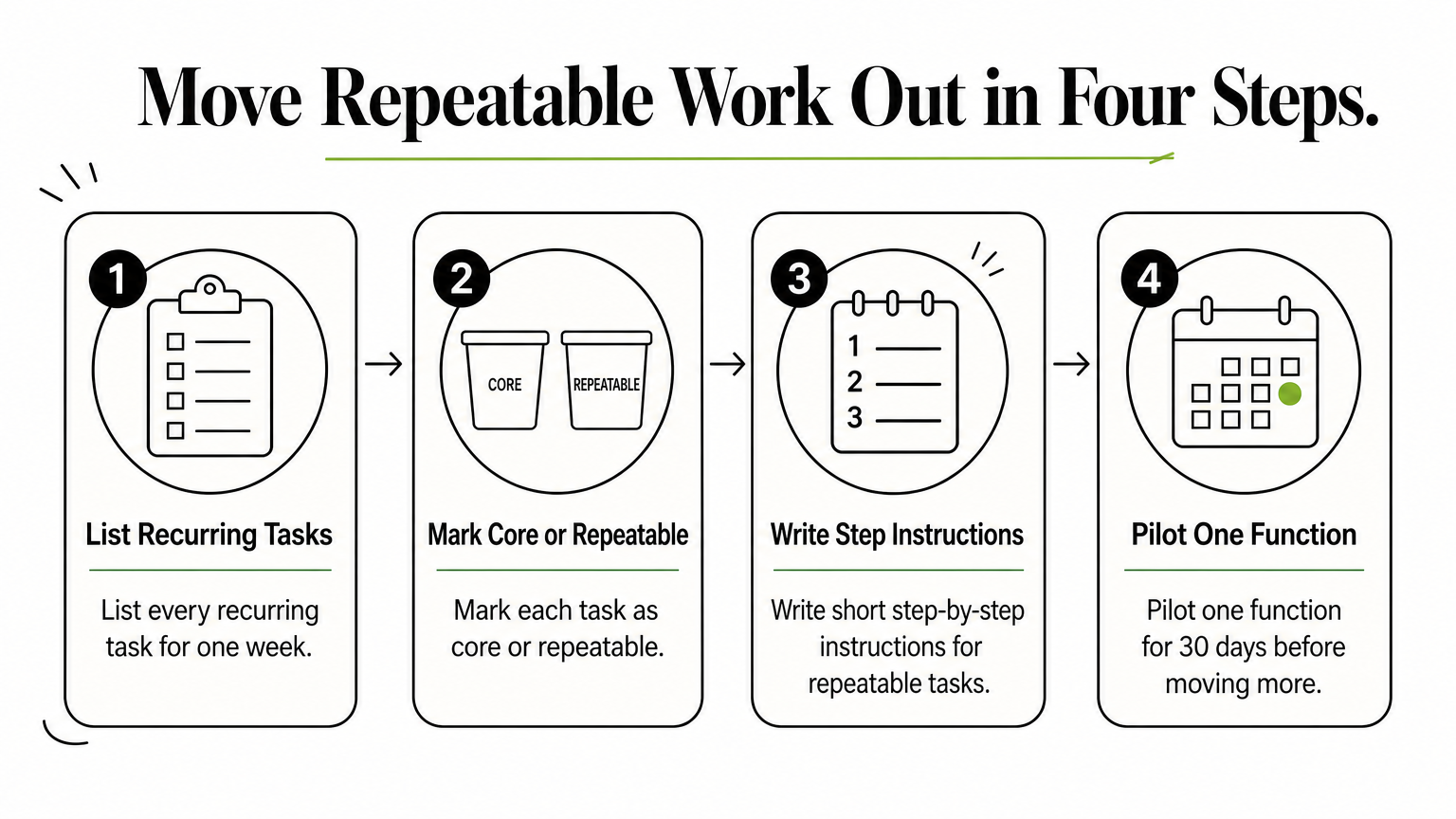
Sort every recurring task with two questions. Does it set us apart, and does it need deep company context? Outsource the tasks that score no on both, and keep the rest close. The mistake to avoid is handing off a process you cannot explain, because undocumented work turns into rework.
- List every recurring task for one week.
- Mark each as core or repeatable.
- Write short step-by-step instructions for the repeatable ones.
- Pilot one function for 30 days before moving more.
3. Access to specialized expertise
Outsourcing gives you trained specialists that would be slow or expensive to hire alone. A growing company rarely needs a full-time Salesforce architect, a PPC specialist, and a .NET engineer at once, yet it needs each of those skills at some point. That depth is one of the business process outsourcing benefits that matters most as your needs get specific.
You rent proven skills instead of spending months finding and training them.
What you gain
Specialists arrive with practice on similar projects, so they make fewer beginner mistakes and need less training. You also skip a long search. We have run 12+ years of placements, with 2,800+ vetted candidates and 950+ successful placements behind that work. Roles you can hire through us include:
- Software developers
- Salesforce developers
- .NET developers
- SEO experts
- PPC experts
- Content writers
How to capture it and what to watch
Skill claims need testing, so verify before you commit. Ask to see sample resumes first, interview the person who will do your work, and give a small paid task before a full start. We offer free access to vetted sample resumes, and you pay nothing until you select a candidate.
Some providers rotate staff between clients, which erases the expertise you paid for. Ask these questions up front:
- Who exactly will do my work, and can I interview them?
- How do you test skills before presenting a candidate?
- What happens if the person leaves or is a poor fit?
4. Flexibility to scale up or down
Outsourcing lets you change team size in weeks instead of quarters. A permanent hire takes months to recruit and is costly to undo, while an outsourced team can grow for a launch and shrink afterward. That flexibility is one of the clearest business process outsourcing advantages for firms with uneven demand.
Flexibility means paying for capacity only in the months you actually use it.
What you gain
Demand rarely moves in a straight line. With no long-term contracts and short notice for changes, you can match headcount to the work in front of you. A dedicated team can also start as one hire and grow as results justify it. Common scenarios include:
- A product launch that needs extra developers for a quarter
- A seasonal peak in e-commerce support volume
- A slow quarter where you pause one function
- A test of a new service line before you commit to it
How to capture it and what to watch
The contract decides how flexible you really are, so read the terms before the rates. A low price with a 12-month minimum is not flexible. Start with one hire, confirm the process works, then add people in small steps.
| Term | What to ask |
|---|---|
| Minimum commitment | Is there a lock-in period? |
| Notice period | How fast can you reduce headcount? |
| Ramp-up time | How long from request to first working day? |
| Replacement | Who covers a resignation, and how quickly? |
Constant churn has its own cost, because knowledge walks out with every change. Keep a stable core team and flex only the edges.
5. Higher productivity and better tools
Specialist providers run tested processes and current tools, so the same task takes less time and produces fewer errors. They do similar work all day for many clients, which builds routines that an occasional in-house owner never develops. The provider also carries the tool and licensing bill.
Productivity comes from repeatable process and the right tools, not from longer hours.
What you gain
When a provider supplies hardware and software, a new team member works on a standard, secured setup from day one. Documented workflows, quality checks, and tracked metrics make output predictable instead of dependent on one person's habits. These are the numbers you can start measuring:
- Turnaround time per task or ticket
- Error or rework rate
- Output per week
- Customer satisfaction scores
How to capture it and what to watch
Productivity gains only show up if you measure them. Set targets in writing before the start date and compare against your in-house baseline. Review weekly at first, then ease off once results are steady.
- Pick two or three metrics before work begins.
- Record a baseline from your current numbers.
- Review weekly for 60 days, then monthly.
Automation and AI tools speed up repetitive steps, but they also make confident mistakes. Keep human review on anything customer-facing or financial.
6. Longer coverage across time zones
A team in another time zone extends your working day without anyone working nights in your office. India sits roughly 9 to 13 hours ahead of the US mainland, depending on region and season, and a few hours ahead of Europe. Work moves forward while your own staff sleep, so response times shrink and your business hours effectively double.

A time zone gap turns your overnight hours into working hours.
What you gain
The clearest win is the overnight handoff. You describe the work at the end of your day, and by morning it is done or ready for review. Customers who write in after hours get answers sooner, which supports satisfaction without a night shift on your payroll. Typical uses:
- Overnight support queue triage
- Bug fixes and builds ready for your morning review
- Data entry and reporting finished before your day starts
- Faster follow-up on leads that arrive after hours
How to capture it and what to watch
Coverage works when both sides share a fixed overlap window. Agree a couple of hours when everyone is online for questions and decisions, and many offshore teams will shift their schedule to match your morning. Use written handoff notes so nothing depends on memory.
The weak point is a blocked task. If a question stalls work overnight, you lose a full day, so answer open questions during the overlap. Also check whether off-hours shifts cost extra and how the provider's public holiday calendar differs from yours.
7. Shared risk and compliance support
A good provider carries part of the risk of hiring: bad hires, employment paperwork, equipment security, and turnover. Outsourcing shifts the administrative risk, but not your accountability. You still own your data and your customers.
You can hand off the paperwork and the setup, but never the accountability for your data.
What you gain
The provider handles employment contracts, payroll compliance in its own country, and company equipment. We add NDAs, VPNs, limited access, and secured laptops, and we back the arrangement with a 100% money-back guarantee or quick replacement if you are unsatisfied. A poor fit becomes a replacement request instead of a months-long restart.
How to capture it and what to watch
Treat security as part of the buying decision, not an afterthought. If you process personal data of EU residents, GDPR obligations stay with you, so get data processing terms in writing and consider legal advice. Use this checklist:
- Signed NDA before you share any files
- VPN and role-based access limited to what the job needs
- Company-managed, secured devices
- Same-day access removal when someone leaves
- Data return or deletion terms on exit
Overdependence is the quieter risk. Keep your documentation and admin credentials in your own hands so you can change providers without losing the work.
Matching the advantages to your business
Business process outsourcing pays off when you pick the benefits that fit your situation and manage the trade-offs. Lower cost and flexibility suit small teams with uneven demand. Focus and expertise suit firms that are growing past their founders. Coverage, tools, and shared risk suit businesses that need steady output at any hour. Each advantage depends on clear scope, measured results, and contract terms that keep you free to change course.
If you want these advantages through dedicated full-time employees in India, we handle recruitment, HR, payroll, infrastructure, and compliance, and you see resumes before you pay anything. Tell us the roles you need and your budget, and request a quote.