Accounting Business Process Outsourcing: A Complete Guide
Accounting Business Process Outsourcing: A Complete Guide
Accounting business process outsourcing (BPO) means hiring an outside provider to run recurring accounting work under a service agreement instead of doing it with your own staff. That work usually includes bookkeeping, accounts payable, accounts receivable, payroll, bank reconciliations, and month-end reporting. You may also see it called finance and accounting BPO. You keep ownership of decisions and results, and the provider owns the day-to-day execution of the processes you define.
This guide covers everything you need to decide whether to outsource. You will see why companies do it, how an engagement works step by step, which functions to hand over and which to keep, how to evaluate providers, and which risks deserve attention before you sign anything.
At GlobalEmployees, we place dedicated, full-time offshore employees in India with US and European businesses, and we handle recruitment, HR, payroll, infrastructure, and compliance. That is a different route from a traditional BPO firm. We compare the two models honestly below, so you can pick the one that fits how you want to run your finance function.
Why accounting business process outsourcing matters
Accounting business process outsourcing matters because it turns a fixed, hard-to-staff cost into a service you can scale, measure, and replace. Accounting has to be accurate every single month, yet it rarely differentiates your product. That gap is the opportunity.

Where the value comes from
Most companies outsource for five reasons. Cost gets the attention, but continuity and scalability often matter more once you have lived through a resignation in the middle of a close. The table shows what each benefit actually fixes.
| Benefit | Problem it solves | What changes |
|---|---|---|
| Cost | Salary, payroll taxes, benefits, software, and recruiting for an in-house team | You pay for the volume of work you actually need |
| Continuity | One bookkeeper leaves or is out sick and the close stalls | The provider covers absences with other staff |
| Scalability | Transactions spike with growth, seasons, or an acquisition | Capacity moves up or down by agreement, not by hiring |
| Expertise | One generalist handles AP, payroll, and reporting | Specialists run each process from documented checklists |
| Focus | Founders and finance leads spend hours chasing invoices | Leadership time goes back to strategy and customers |
Business process outsourcing accounting also forces process discipline. A good provider will ask how invoices get approved, who can release payments, and what the close calendar looks like. Answering those questions has lasting value, even if you later bring part of the work back in-house.
Outsourcing accounting is less about saving salary and more about never letting the books depend on one person.
Signs that you are ready to outsource
Outsourcing pays off when the work is repeatable and the volume is steady enough to define. Watch for a month-end close that drags past two weeks, an owner or office manager still keying in bills, and recurring reconciliation gaps that surface during an audit or a loan review. Another strong signal is that you cannot yet justify a full-time controller, but spreadsheets no longer hold up.
Sometimes it is the wrong move. If your processes live only in one person's head and nobody can describe them, document them first. Outsourcing a mess gets you an expensive mess. Very low transaction volume is another case where a part-time bookkeeper usually costs less than any managed service.
How to outsource accounting step by step
You outsource accounting in six steps: define scope, shortlist providers, agree on terms, transition the work, run it under service levels, and review results on a schedule. Skipping the first or last step causes most failed engagements.
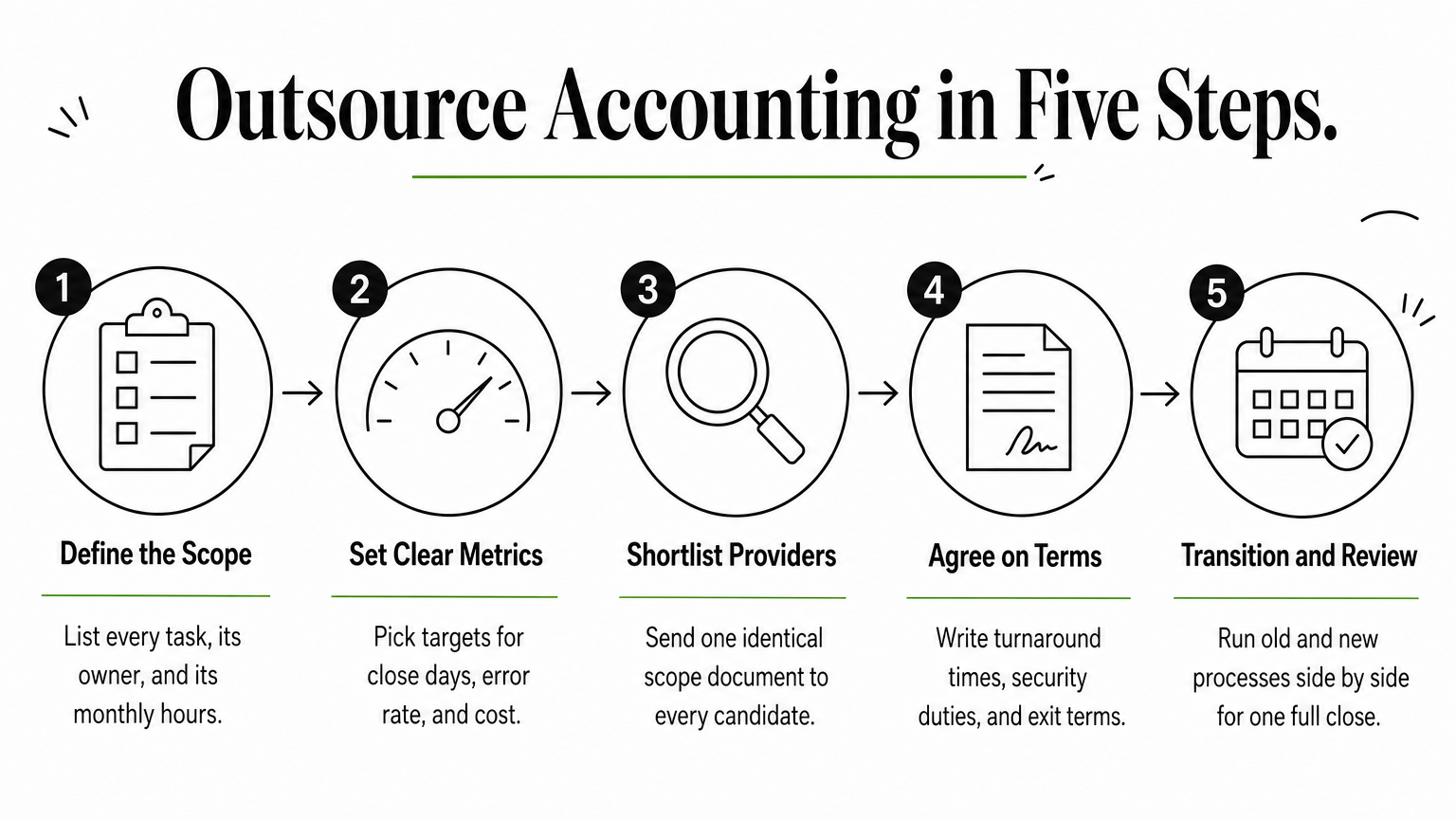
The six steps
- Define the scope. List every accounting task, who does it today, how many hours it takes, and how many transactions it covers. Mark each task as outsource, keep, or fix first.
- Set goals and metrics. Pick measurable targets such as days to close, invoice processing time, error rate, and cost per invoice.
- Shortlist and request proposals. Send the same scope document to every candidate so you can compare answers line by line.
- Agree on the contract and service levels. Put turnaround times, accuracy targets, security duties, and exit terms in writing.
- Transition the work. Run the old and new process side by side for at least one full close. Compare outputs before you cut over.
- Review on a schedule. Check the metrics monthly at first, then quarterly. Renew, amend, or end the contract based on results.
The transition is where trust is built. Share access in stages, keep a single named contact on each side, and keep a written log of open questions so nothing gets lost in handoff.
Contract and pricing models
Providers price accounting BPO in a few common ways. The right model depends on how predictable your volume is and how much you want to control.
| Model | How you pay | Best when |
|---|---|---|
| Fixed monthly fee | A set amount for a defined scope | Volume is steady and scope is clear |
| Time and materials | Hourly or daily rates for work done | Scope is uncertain or changing |
| Per-transaction | A rate per invoice, bill, or payslip | Volume swings and you want costs to follow it |
| Outcome-based | Payment tied to results such as close time | You can measure results precisely |
Whichever you choose, attach service-level agreements (SLAs). An SLA turns "we will do a good job" into numbers you can check.
If a service level cannot be measured, it cannot be enforced, so write every promise as a number.
Which accounting functions you can outsource
You can outsource almost any repeatable, rules-based accounting task, and you should keep anything that requires final authority or judgment. Finance and accounting business process outsourcing usually falls into transactional work, reporting work, and compliance support.

Common functions and what the provider does
The table lists the functions most often handed to a provider, and what the work actually involves.
| Function | What the provider typically does |
|---|---|
| Bookkeeping | Codes transactions, maintains the general ledger, prepares monthly books |
| Accounts payable | Captures invoices, matches them to orders, schedules payments for your approval |
| Accounts receivable | Issues invoices, applies payments, sends collection reminders |
| Payroll | Calculates pay, deductions, and prepares payroll reports |
| Bank reconciliations | Matches bank and card activity to the ledger and flags differences |
| Month-end close and reporting | Posts accruals, prepares financial statements and management reports |
| Tax and audit support | Gathers schedules and documents for your tax preparer or auditor |
| Expense management | Reviews employee expense reports against your policy |
Start with the transactional functions, since they are the most standardized and easiest to measure. Accounts payable and bank reconciliations are the usual starting point, and reporting follows once the underlying data is clean.
What to keep in-house
Keep final approval authority over payments, bank signatory rights, and sign-off on financial statements. Your own team should also hold accounting policy decisions, the relationship with your auditor and bank, and all budgeting and forecasting that drives strategy.
A provider can prepare the numbers, but someone inside the company should be able to read them and challenge them. Even a small business benefits from a monthly review where an owner or finance lead reviews the reports and asks why a number moved.
Outsource the processing, keep the judgment, and never outsource the final signature.
How to evaluate accounting BPO providers
Evaluate a provider on five things: how well it fits your processes, how it protects your data, who actually does the work, what systems it uses, and what the contract allows. Price comes last, because the cheapest quote usually hides gaps in one of the first four.
A checklist for comparing providers
Ask every candidate the same questions, and expect specific answers rather than brochures.
- Process fit. Have they run accounting for companies of your size and in your industry? Can they work in your accounting software instead of forcing a migration?
- Security and controls. Do they hold independent assurance reports such as SOC 1 or SOC 2, or a certification like ISO/IEC 27001? How do they restrict access, and who can export data?
- People. Who is the named team? How much experience do they have, and what happens when someone leaves?
- Systems and reporting. What dashboards, ticketing, and audit trails will you see? Can you view the work in progress?
- Contract terms. What are the SLAs, notice periods, data return rules, and liability limits? How hard is it to exit?
A red flag is any provider that avoids naming who will touch your books or cannot explain its error-correction process. Ask for references from clients with a similar scope, and call them.
Onshore, nearshore, or offshore
Location affects cost, communication, and risk, so decide it early.
| Location | Advantage | Trade-off |
|---|---|---|
| Onshore (same country) | Easy communication, same rules and time zone | Highest cost |
| Nearshore (nearby country) | Overlapping hours with lower cost | Savings are moderate |
| Offshore (distant country) | Largest labor savings, extended coverage | Time-zone gap, more attention to communication and data handling |
A BPO firm or a dedicated offshore employee
A BPO firm runs the process with its own staff, tools, and methods. A dedicated employee model works differently. You get a full-time person who works only for you, in your systems, under your direction. Both are valid, and the difference is who manages the work.
GlobalEmployees follows the second model. We recruit and vet the person, then handle HR, payroll, infrastructure, and compliance. Roles begin at $1,090 per month, you can see sample resumes before you commit, and there are no long-term contracts. Security measures include NDAs, VPNs, limited access, and secured laptops. You can hire operations and admin staff in India, and you supervise the work directly. That suits owners who want control and daily visibility. It suits you less if you want a provider to take full responsibility for the process.
Choose a BPO firm if you want to hand over a process, and choose a dedicated employee if you want to keep running it yourself.
Risks of outsourcing accounting and how to reduce them
The main risks of accounting business process outsourcing are data exposure, loss of control, compliance gaps, hidden costs, and communication breakdowns. Each one is manageable if you plan for it before the contract starts.
The main risks and the fix for each
| Risk | What it looks like | How to reduce it |
|---|---|---|
| Data security | Sensitive bank and payroll data is shared widely | Limit access by role, require multi-factor login, use NDAs |
| Over-reliance | Only the provider knows how the process runs | Keep written procedures and a named internal owner |
| Compliance | Local tax or privacy rules are missed, for example GDPR for European data | Confirm who is responsible in the contract and review it annually |
| Hidden costs | Fees for extra transactions, rework, or software | Ask for a full fee schedule and cap out-of-scope work |
| Communication | Slow replies or unclear questions delay the close | Set response times, one contact, and a weekly check-in |
Controls to put in place on day one
Set segregation of duties from the start. The person who enters a vendor should not be the person who approves a payment, and the provider should never hold sole control of your bank account. Give the provider the least access it needs, and remove access immediately when someone leaves the engagement.
Keep a copy of your books and documentation under your own control, so you can switch providers without losing history. Add an exit clause that spells out how data is returned and how long the handover takes.
Control access, keep your own copy of the books, and you can leave any provider without losing your history.
Making the right call on outsourced accounting
Accounting business process outsourcing works best when you outsource repeatable processing, keep approval and judgment, and measure the provider with numbers. Define the scope, compare providers on security and people before price, run a parallel close, and review results on a schedule. Decide whether you want a firm to own the process or a dedicated person you direct yourself.
If the dedicated employee route fits, GlobalEmployees can help you build it without the HR, payroll, or equipment burden. Contact us for a quote and tell us the accounting and back-office roles you need to fill.